The data confirms how difficult the environment has become. According to 6sense's 2025 B2B Buyer Experience Report, the average B2B buying cycle runs 10.1 months — and by the time a buyer first contacts a seller, they're already 61% through their decision process.
A structured, repeatable B2B sales process changes that dynamic. It gives every rep a clear roadmap, gives managers real pipeline visibility, and gives buyers a consistent experience that builds trust.
This guide covers the seven core stages of a B2B sales process, specific actions for each stage, and proven tips to close deals faster.
Key Takeaways
- A B2B sales process is a repeatable framework — not a script — that moves prospects from first contact to closed deal
- The 7 stages are: prospecting, discovery, qualification, solution presentation/demo, objection handling, closing, and post-sale follow-up
- Multiple stakeholders, longer cycles, and higher deal values mean B2B sales demand far more structure than B2C
- Tracking stage conversion rates, deal velocity, and cycle length reveals exactly where deals stall
- Multi-threading early, personalizing outreach, and acting on buyer engagement signals shorten cycles fastest
What Is the B2B Sales Process?
A B2B sales process is a structured, repeatable set of steps that guides a sales team from identifying a potential customer to closing a deal — and retaining them long term. The key word is repeatable. It's not a rigid script that every rep recites verbatim. It's a replicable framework that ensures consistent execution regardless of who's running the deal.
The goal is predictable, scalable revenue. A documented process gives reps clarity at each stage, gives managers a reliable basis for forecasting, and gives leadership visibility into exactly where deals break down.
B2B sales differ from B2C in three key ways:
- Purchasing decisions involve 6–10 stakeholders across different functions
- Evaluation cycles stretch across months, moving through procurement, legal, and security reviews
- Six- or seven-figure contract values increase scrutiny at every step
These characteristics make a structured process non-negotiable. Without one, reps default to improvisation — and inconsistent results follow.
Why a Structured B2B Sales Process Matters
Sales organizations with a formal, documented process consistently outperform those without one. Research cited by Wipfli finds that companies with a formal sales process see 18% higher revenue growth and 13% shorter sales cycles compared to those without one.
What Structure Actually Enables
A documented process does more than keep reps organized. It creates leverage across the entire organization:
- Consistent performance — outcomes become less dependent on individual rep talent
- Faster ramp time — new hires follow a proven playbook instead of learning by trial and error
- Pipeline visibility — managers can see where deals are and diagnose problems at specific stages
- Bottleneck identification — if deals consistently stall at Stage 4, that's a fixable process problem, not random bad luck
The Buyer Has Already Changed
B2B buyers are far ahead of sellers by the time they make first contact — and that gap keeps widening. 6sense's 2025 research found that buyers first engage sellers at 61% of the purchase journey — and the winning vendor is already on the shortlist 95% of the time before that first conversation happens.
A well-designed process accounts for this reality. It aligns your sales motion to where buyers actually are in their decision — so your team enters conversations ready to move deals forward, not catch up.
The 7 Key Stages of the B2B Sales Process
These stages are sequential, but effective teams treat them as flexible. Every deal has its own dynamics; the process is a guide, not a conveyor belt.
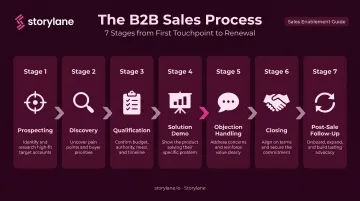
Stage 1: Prospecting and Lead Generation
Prospecting is about finding the right targets, not the most targets. The foundation is a well-defined Ideal Customer Profile (ICP) — a clear description of the companies most likely to buy, based on industry, company size, budget range, and timing.
Before any outreach, verify that the prospect matches the ICP across all dimensions. Generic, volume-based prospecting wastes rep time and tanks conversion rates further down the funnel. Gartner found that 73% of B2B buyers actively avoid suppliers who send irrelevant outreach — precision matters more than volume.
Channels worth prioritizing:
- Inbound leads warmed by marketing content
- LinkedIn outreach tied to specific triggers (funding, hiring, product launches)
- Referrals from existing customers
- Cold email to ICP-matched accounts with genuine personalization
Stage 2: Discovery and Research
Discovery is the homework stage — and skipping it is one of the most common mistakes reps make.
Before any call, reps should research the prospect's company news, recent announcements, industry pressures, and LinkedIn activity. This turns generic outreach into relevant conversation.
On the discovery call itself, the goal is to listen:
- Ask open-ended questions to uncover root causes, not just symptoms
- Identify all stakeholders involved — not just the one on the call
- Understand the decision-making process: who approves, who blocks, who influences
- Map the buying committee as early as possible
The intelligence gathered here shapes everything downstream — qualification, demo focus, objection prep, and proposal scope.
Stage 3: Lead Qualification
Qualification determines whether a prospect is worth pursuing now, not just eventually.
Two frameworks are worth knowing:
| Framework | Best For | Core Elements |
|---|---|---|
| BANT | SMB/mid-market | Budget, Authority, Need, Timeline |
| MEDDIC | Enterprise | Metrics, Economic Buyer, Decision Criteria, Decision Process, Identify Pain, Champion |
Use BANT for faster early screening. MEDDIC suits complex enterprise deals where multiple decision criteria and stakeholders are involved.
The harder discipline is disqualification. Reps who chase every lead end up with bloated pipelines full of deals that won't close. Chasing the wrong accounts delays pipeline velocity and inflates cycle length. Being comfortable saying "this isn't the right fit right now" is a professional skill, not a failure.
Stage 4: Solution Presentation and Product Demo
By this stage, reps should know enough about the prospect's pain points to build the entire presentation around their specific challenges. A generic feature walkthrough adds no value — buyers have already researched the product independently before speaking to sales.
The demo needs to add new insight, not recap what they already know.
Interactive, self-guided demos have become a critical part of this stage. Platforms like Storylane let prospects explore the product interactively before a sales call, so they arrive already familiar with core functionality. Instead of spending the first 20 minutes on basic orientation, the conversation can jump directly to specific use cases, objections, and next steps.
Storylane supports multiple formats, each serving a different buyer need:
- Guided tours for structured, narrated walkthroughs
- Sandbox self-navigation for hands-on technical evaluation
- HTML full-product replicas for the most realistic experience
- Multi-chapter demos with role-specific paths — a VP of Sales and a technical evaluator can explore the same product through entirely different, relevant journeys
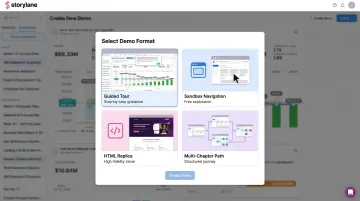
For inbound traffic that arrives outside business hours, Storylane's RepX AI handles demos, qualifies leads, addresses objections, and routes all data to the CRM autonomously, 24/7. No inbound interest goes unattended.
Stage 5: Objection Handling
Objections are not rejections. They're requests for more clarity or reassurance.
The three most common B2B objection categories:
- Pricing concerns — "It's too expensive" or "We don't have budget right now"
- Implementation complexity — "This will take too long to set up" or "We don't have the resources"
- Stakeholder buy-in — "I need to get others involved" or "Legal will need to review this"
Prepare responses for each category before the call — not during it.
The top-performer technique: Instead of defending the product, respond with a clarifying question. "If budget weren't a factor, would this solve your problem?" This isolates whether the objection is the real barrier or a proxy for something else entirely. Gong's research shows that top reps respond to objections with questions 54.3% of the time versus 31% for average reps.
Stage 6: Closing the Deal
By closing, value has been demonstrated and objections addressed. The risk here is assuming the deal is done when it isn't.
Proactively address:
- All remaining stakeholders who need to sign off
- Outstanding contractual or legal concerns
- Timeline for the final decision — get a specific date, not "soon"
Once those gaps are resolved, three closing tactics consistently move deals forward:
- Build a mutual action plan: a shared document listing agreed milestones, owners, and the target close date
- Create urgency through real constraints — implementation timelines, end-of-quarter pricing, or resource availability, not manufactured pressure
- Hold the line on price by anchoring negotiations to value first; unnecessary discounting trains buyers to always ask for more
Stage 7: Post-Sale Follow-Up and Retention
The signed contract is the beginning of the relationship, not the end of the sales process.
Prompt, structured onboarding ensures customers realize value quickly — which directly reduces churn risk. Customer success or the AE should check in at defined intervals: 30, 60, and 90 days post-close to assess satisfaction, resolve friction points, and identify expansion or referral opportunities.
HBR research shows acquiring a new customer can cost 5 to 25 times more than retaining an existing one. The math strongly favors investing in retention.
Storylane customers like Whispli extend their demo library into post-sale workflows, using the same demos for customer onboarding, feature education, and CS team enablement. The asset that closed the deal can onboard the customer faster too, shortening time-to-value.
Proven Tips to Close B2B Deals Faster
Multi-Thread Early, Not at the End
Waiting until late in the sales cycle to engage all stakeholders is one of the most common deal killers. If your champion goes on leave or changes roles, the deal evaporates.
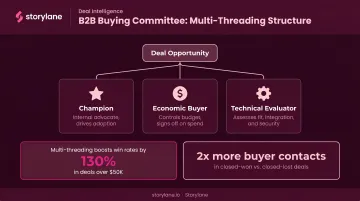
Map the buying committee in Stage 2 and nurture multiple contacts simultaneously — champion, economic buyer, technical evaluator. Gong's data shows multi-threading boosts win rates by 130% in deals over $50K, and closed-won deals have roughly 2x as many buyer contacts as lost deals.
Personalize Using Real Data
Generic pitches don't move B2B buyers. Reference specific company challenges, recent announcements, or industry context in every touchpoint.
Use CRM data, LinkedIn signals, and demo engagement data to make interactions feel relevant. Storylane's smart variable tokens allow reps to dynamically insert company names, logos, revenue figures, and role-specific messaging into demos — delivering a personalized experience at scale without rebuilding each demo from scratch.
Follow Up When Buyers Are Actively Engaged
Top sales teams don't follow up on arbitrary schedules. They follow up when buyers are in the product.
Storylane surfaces real-time Slack and email alerts the moment a prospect engages with a demo. Each alert includes which features they explored, time spent, completion percentage, and whether they clicked a call-to-action. The recommended workflow: demo sent → high-intent engagement detected → rep follows up within two hours with full context.
Build a Mutual Action Plan
A mutual action plan (MAP) is a shared document — given to the buyer — that lists agreed milestones, owners, and a target close date. It creates accountability on both sides and signals that the seller is organized and trustworthy.
A basic MAP should include:
- Key milestones and decision checkpoints
- Specific criteria the buyer will use to make their decision
- Named stakeholders and their roles
- Target close date
Track Deal Velocity, Not Just Activity
Measuring calls made and emails sent reveals nothing about deal health. Track metrics that show where the process is working and where it's breaking down:
| Metric | What It Measures |
|---|---|
| Win rate | Percentage of qualified opportunities closed |
| Stage conversion rate | How many deals advance from each stage |
| Average sales cycle length | Time from first contact to close |
| Pipeline velocity | (Opportunities × avg deal value × win rate) ÷ cycle length |
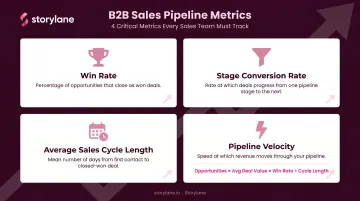
Pipeline velocity tells you how quickly deals generate revenue. A rising number confirms your process changes are working; a flat or declining number tells you where to dig deeper.
Common B2B Sales Process Mistakes to Avoid
Three patterns consistently derail B2B deals — and each one is avoidable.
- Rushing to demo before completing discovery. Presenting before understanding the buyer's pain points produces generic demos that miss the mark. Discovery is a prerequisite, not a formality.
- Treating all leads equally. Chasing unqualified prospects through the full cycle drains rep time, inflates pipeline projections, and pulls focus from high-fit accounts. Regular pipeline reviews should cut deals that don't belong.
- Treating the signed contract as the finish line. Poor onboarding and lack of post-sale follow-through destroys retention and kills expansion revenue. Renewals, upsells, and referrals are won or lost after the deal closes — not before.
Frequently Asked Questions
What are the 7 steps of the B2B sales process?
The 7 stages are: prospecting, discovery, qualification, solution presentation/demo, objection handling, closing, and post-sale follow-up. Each stage builds on the previous one, and the process is designed to be repeatable across reps and deal types.
What is the 95/5 rule for B2B?
The 95/5 rule, developed by the Ehrenberg-Bass Institute, states that roughly 95% of your target market is not actively buying at any given time. Only 5% are in-market right now — so a strong B2B sales process must include long-term nurturing strategies to stay visible when the other 95% finally are.
What is the difference between a B2B sales process and a sales methodology?
A sales process defines the stages and steps a team follows — the what. A sales methodology like MEDDIC, BANT, or Challenger Sale defines the approach used within those stages — the how. The two work together: the process gives your team a consistent structure, while the methodology shapes how reps engage and persuade within each stage.
How long is a typical B2B sales cycle?
B2B sales cycles typically range from 3 to 9 months depending on deal size, complexity, and number of stakeholders. Enterprise deals can run 12 months or longer. That timeline makes consistent pipeline management and regular follow-up non-negotiable — gaps in either let deals go cold.
How can I shorten my B2B sales cycle?
Four levers move the needle most:
- Qualify leads rigorously early to avoid wasting cycles on poor-fit accounts
- Engage all decision-makers from the start rather than working up the chain sequentially
- Use interactive demos to accelerate product understanding before live calls
- Create mutual action plans that hold both sides accountable to a shared close date
What metrics should I track to measure B2B sales process effectiveness?
Four metrics matter most:
- Win rate — percentage of qualified opportunities closed
- Sales cycle length — average time from first contact to close
- Stage conversion rate — how many deals advance from each stage
- Pipeline velocity — how quickly deals move through the pipeline generating revenue