Introduction
Most B2B sales teams spend significant budget generating leads—yet according to MarketingSherpa's B2B Benchmark Report, 73% of those leads are never sales-ready when they first enter the pipeline. They don't convert because of poor follow-up, wrong-fit targeting, or a funnel that simply wasn't built to move people forward.
The problem isn't volume. It's leakage. Revenue drains at every stage—from a top-of-funnel form that's too long, to a middle-of-funnel prospect who went quiet after one generic follow-up email, to a bottom-of-funnel deal that stalled because nobody responded fast enough.
This guide covers each stage of the funnel—where deals leak, why they stall, and the specific fixes that move prospects from first touch to closed won.
Key Takeaways
- 73% of B2B leads aren't sales-ready at first contact—funnel leaks are the norm, not the exception
- Map stage-by-stage conversion rates first, then fix your highest drop-off point
- Let buyers self-educate before your sales call—67% of B2B buyers prefer a rep-free experience at some stage
- Behavior-triggered follow-up consistently outperforms generic drip—personalization is the difference between a reply and silence
- Speed-to-lead is a BOFU multiplier: responding within 5 minutes yields 8x higher conversion rates than waiting 6+ minutes
What Is Sales Funnel Optimization?
Sales funnel optimization is the ongoing process of analyzing every stage of the buyer journey—from first touch to closed deal—and making deliberate improvements to increase the percentage of prospects who advance to the next stage.
Sales Funnel vs. Marketing Funnel
These terms get used interchangeably, but they're distinct:
- Marketing funnel: Generates awareness, captures interest, converts strangers into leads
- Sales funnel: Picks up at the qualified lead stage and guides prospects toward a purchase decision
Both need optimization. But they require different tactics and different success metrics. A marketing team celebrating MQL volume while the sales team watches those leads go cold is a misalignment problem worth fixing.
Why B2B Funnels Are Harder to Optimize
B2B funnels involve longer cycles, multiple decision-makers, and buyers who do most of their research independently. Gartner research found that 67% of B2B buyers prefer a rep-free buying experience at some point in the process.
The goal isn't to eliminate sales reps. It's to build a funnel that meets buyers where they are—before they ever pick up the phone. McKinsey's 2024 B2B Pulse, covering nearly 4,000 decision-makers, found buyer preferences split fairly evenly across three modes:
- Digital self-serve: Research and purchase without rep involvement
- Remote engagement: Video calls, email, and async communication
- In-person interaction: Traditional field sales and on-site meetings
Omnichannel coverage still matters.
Finding Your Funnel's Weak Points Before Optimizing
Optimization without diagnosis is guesswork. Before changing anything, map what you actually have.
Build Your Leak Map
List every stage in your funnel—MQL → SQL → Demo → Proposal → Close—and calculate the conversion rate between each consecutive stage using your CRM data. That's your leak map, showing exactly where the biggest drop-offs occur and where to direct resources.
Key diagnostic tools:
- CRM pipeline reports to surface stalled deals and average time at each stage
- GA4 funnel exploration to track web-based conversion steps
- Heatmaps and session recordings (Hotjar, Microsoft Clarity) to pinpoint where users abandon forms or landing pages
Understand the "Why" Behind Drop-Offs
Quantitative data tells you where people leave. Qualitative research tells you why:
- Exit surveys for leads who didn't convert
- Win/loss interviews with recently closed and lost deals
- Sales call recording analysis to surface recurring objections
Fix High-Volume Leaks First
The sequencing matters. Improving an early-stage conversion creates a compounding effect on all downstream stages.
For example: if 1,000 leads enter your funnel and you convert 2% to closed deals, you close 20. Push your MQL-to-SQL conversion from 20% to 25% (without touching anything else), and you're closing 25 deals from the same lead volume.
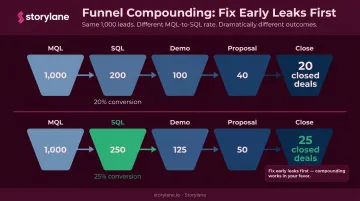
Fix the leak with the highest drop-off volume first — that's where compounding works in your favor.
Top-of-Funnel Optimization Strategies
Sharpen Your ICP and Align Content to Buyer Intent
A vague ideal customer profile (ICP) fills your funnel with wrong-fit leads that consume sales capacity without converting. Tighten your ICP using:
- Firmographic data: company size, industry, tech stack, growth stage
- Behavioral signals: which customers expanded, renewed, and referred others
- Win/loss patterns: which deal characteristics predict a closed-won outcome
Once your ICP is defined, map your top-of-funnel content to buyer intent. Educational content that answers questions buyers have before they know they need a solution attracts higher-quality traffic. Think comparison guides, SEO-driven blog posts, and category-level explainers that pull in prospects actively researching their options.
Optimize Lead Capture Forms and CTAs
Every additional form field reduces submission likelihood. MarketingSherpa's case study on Bacula Systems found that reducing fields on a software trial form improved conversion by 43%.
Practical rules:
- Limit forms to the minimum viable fields (name, email, company)
- Use multi-step forms to reduce perceived effort
- A/B test CTA copy—"See the Product in Action" consistently outperforms "Learn More"
- Test button placement, color, and size; small changes compound over time
Implement Lead Scoring to Prioritize High-Intent Prospects
Lead scoring assigns points to leads based on firmographic fit and behavioral engagement signals: pages visited, content downloaded, time on site. Leads above a score threshold route to sales as MQLs.
The impact is measurable. A MarketingSherpa case study on lead scoring programs found:
- 52% reduction in leads sent to sales (higher quality, lower noise)
- 79% increase in converted leads
- 21% growth in closed-won revenue from re-engaged leads
Reps spend their time on prospects already showing purchase signals — not cold contacts who need months more nurturing.
Middle-of-Funnel Optimization Strategies
Let Buyers Experience Your Product Before the Sales Call
At the MOFU stage, prospects are evaluating options. They want to see how your product handles their specific use case—not sit through a scripted demo on your schedule. Gating all product access behind a booked sales call creates friction that drives prospects to competitors who offer more immediate access.
Interactive product demos solve this. Prospects explore at their own pace, focusing on the features most relevant to them. By the time they engage with a rep, they arrive pre-qualified and already building internal buy-in.
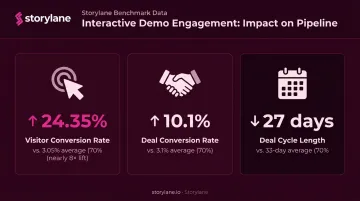
Storylane's internal data, based on analysis of over 110,000 web sessions and 150 deals, shows the impact clearly:
- Visitors who engaged with an interactive demo converted at 24.35%—nearly 8x the average website conversion rate of 3.05%
- Prospects who engaged with demos achieved a deal conversion rate of 10.1%, compared to 3.1% average
- Deals that otherwise averaged 33 days to close were completed in 27 days when interactive demo touchpoints were involved
One customer example: CampMinder used Storylane demos as pre-call material to skip discovery entirely, cutting deal cycles from 6 weeks to as short as 2 weeks.
Storylane's Account Reveal feature identifies anonymous demo visitors using company-level firmographic data, then triggers Slack alerts to sales reps when high-value accounts engage. Reps know exactly who's interested before making a single call.
Personalize Outreach Based on Buyer Engagement Signals
Prospects actively comparing vendors will ignore follow-up that doesn't reference their specific situation. At the MOFU stage, personalization isn't a nice-to-have — it's the baseline.
Personalization at this stage means referencing:
- The specific content or features the prospect explored
- Their industry and the pain points specific to it
- Where they are in their evaluation process
To do this at scale, use behavioral data from your CRM, marketing automation platform, and demo analytics. Segment leads by role, use case, or engagement level, then build follow-up sequences tailored to each segment. Storylane's integrations with Salesforce, HubSpot, Marketo, and Pardot push demo engagement data into your existing workflows, so reps see exactly what a prospect explored before making contact.
Build Trust with Strategic Social Proof
At the MOFU stage, buyers need proof your solution works for companies like theirs. Generic testimonials won't cut it. G2's research finds that 90% of buyers are more likely to make a purchase decision after reading a product review—but the more industry-specific that proof is, the more persuasive it becomes.
Place social proof at the specific moments of doubt:
- Demo follow-up emails: Include a relevant case study from a similar company
- Pricing pages: Use customer logos with quantified results, not just quotes
- Comparison content: Address objections prospects raise when evaluating alternatives
PDQ, a Storylane customer, demonstrated a 92% conversion lift on their product tour over eight months. Dreamdata found that 40.9% of all closed-won new business was influenced by use case pages and interactive demos. Numbers like these, placed where prospects are actively weighing their options, change decisions.
Automate Lead Nurturing to Stay Top of Mind
Not every MOFU lead is ready to buy today. Without a nurturing system, those leads go cold—even though they've already shown genuine interest.
Instead of time-based drip sequences, use behavior-triggered nurturing:
- Prospect watched a demo → send a relevant customer case study
- Prospect visited the pricing page → send an ROI-focused email
- Prospect revisited the same feature section twice → alert the sales rep immediately
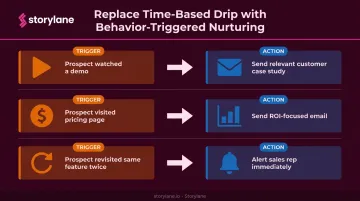
Webhook integrations and native CRM connections make this automatic: specific demo engagement events trigger the right follow-up without manual rep intervention.
Bottom-of-Funnel Strategies and Retargeting
Reduce Friction in the Final Conversion Step
Audit the path between proposal and close for unnecessary complexity. Common friction points:
- Contracts with excessive review cycles or unclear terms
- Pricing pages that raise questions instead of answering them
- Next steps that require the prospect to wait for a rep response to basic questions
Streamline the process. Anticipate objections on the pricing page itself. Offer clear, specific next steps after the proposal—don't leave prospects guessing.
Speed-to-Lead Determines Whether BOFU Leads Convert
Response time at the bottom of the funnel is a conversion multiplier. HBR's study of 2,241 U.S. companies found companies responding within one hour were nearly 7x more likely to qualify a lead than those waiting longer.
More recent XANT research puts the gap in starker terms: conversion rates are 8x higher when responding within 5 minutes versus 6+ minutes. Yet 77% of leads received no response at all.
Use automated first-responses that deliver real value while the rep prepares proper follow-up:
- A personalized interactive demo matched to their use case
- A relevant case study from a similar company or vertical
- A targeted resource tied to what they engaged with
This keeps high-intent prospects moving instead of cooling off.
Retarget Leads Who Went Dark After Showing High Intent
BOFU prospects who went quiet aren't necessarily lost—they're stalled. A structured re-engagement approach combines:
- Email sequences referencing the specific features or content they previously engaged with
- LinkedIn retargeting ads scoped to the prospect's company and role
- Direct rep outreach with a new angle—a fresh case study, a product update, or a limited-time offer
Storylane's Deal Intelligence feature surfaces intent signals from stalled deals, including which demos a prospect revisited and which features generated the most engagement. Those signals give reps a concrete reason to reach out rather than a cold "just checking in" message.
Metrics to Track Sales Funnel Performance
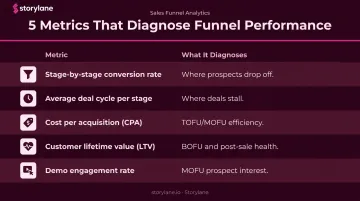
Three metrics do the heavy lifting when diagnosing funnel performance:
Stage-by-stage conversion rate is your primary health indicator. Track the percentage of prospects advancing from each stage, set industry benchmarks, and treat any stage with below-expected conversion as the first optimization target.
Deal velocity (average sales cycle length) tells you where deals stall. A longer-than-expected cycle at a specific stage points to the friction — prospects stuck at demo often lack self-service access, while delays at proposal usually signal internal approval bottlenecks.
When CPA rises while LTV stays flat, you have either a TOFU targeting problem or a MOFU conversion problem. The ratio of LTV to CPA tells you which layer to fix first.
| Metric | What It Diagnoses |
|---|---|
| Stage-by-stage conversion rate | Where prospects drop off |
| Average deal cycle per stage | Where deals stall |
| Cost per acquisition (CPA) | TOFU/MOFU efficiency |
| Customer lifetime value (LTV) | BOFU and post-sale health |
| Demo engagement rate | MOFU prospect interest |
Frequently Asked Questions
What is the 10-3-1 sales rule?
The 10-3-1 rule is a prospecting framework: for every 10 outreach attempts, roughly 3 prospects engage and 1 converts to a customer. Shrink the top of your funnel, and the math at every downstream stage gets worse. Volume at entry isn't optional.
What is the most common reason leads drop off in the sales funnel?
Drop-off usually traces back to one of three problems:
- Poor lead fit — the wrong audience entering the funnel
- Friction at key conversion points — complex forms, slow follow-up, or unclear CTAs
- Content gaps — no relevant material to support the consideration stage
Each requires a different fix. Don't assume one change will solve all three.
What is the difference between a sales funnel and a marketing funnel?
A marketing funnel focuses on generating awareness and converting strangers into leads. A sales funnel focuses on converting qualified leads into customers. The two overlap but require distinct tactics, handoff criteria, and success metrics.
How do you know if your sales funnel needs optimization?
Key warning signs: a high percentage of leads going cold without engaging, deals stalling at the same stage consistently, average sales cycle longer than industry benchmarks, or rising CPA without a corresponding increase in LTV.
What is the fastest way to improve sales funnel conversion rates?
Identify the stage with the highest drop-off rate using CRM and analytics data, then make targeted improvements at that specific stage. Even a modest improvement at an early stage compounds through all downstream conversions—start there before touching anything else.
How long does it take to see results from sales funnel optimization?
Quick-win changes—CTA optimization, form simplification, faster follow-up—can show measurable results within weeks. Structural changes like new lead scoring models, interactive demo implementation, or revised nurture sequences typically take 1–2 quarters to show up in pipeline and close rates.