Introduction
B2B buying has changed fundamentally. According to a 2026 Gartner survey of 646 buyers, 67% of B2B buyers now prefer a rep-free experience — and when they do speak to a rep, that conversation gets only 5–6% of their total buying journey time. Prospects arrive informed, opinionated, and in a hurry.
That makes every live sales conversation higher-stakes than ever. One poorly framed question can confirm a prospect's suspicion that you're just another vendor. The right question can reposition you as someone worth trusting.
Asking questions that unlock genuine insight is what separates top-performing reps — and open-ended questions are where that skill starts. What follows is a practical question bank organized by sales stage, with guidance on using it naturally in real conversations.
Key Takeaways
- 67% of B2B buyers prefer rep-free experiences, making every live conversation count
- Open-ended questions reveal pain, priorities, and objections that closed questions miss
- Match questions to sales stage — discovery, qualification, and closing each require different approaches
- Aim for 11–14 focused questions per call; more than 15 feels like an interrogation
- Pre-call intelligence (like demo engagement data) sharpens your questions before the conversation starts
What Are Open-Ended Sales Questions (and Why They Matter More in 2026)
Open-ended questions can't be answered with "yes," "no," or a single fact. They invite the prospect to elaborate, share context, and reveal priorities in their own words. They typically start with What, How, Why, Tell me about, or Walk me through.
That distinction carries more weight now than it ever has.
The Buying Environment Has Shifted
6sense's 2024 B2B Buyer Experience Report, surveying 2,509 recent buyers, found that 81% had already picked a preferred vendor before their first sales conversation — and 85% had already established their purchase requirements. Prospects aren't blank slates. They arrive with pre-formed views, half-researched assumptions, and criteria they've built without your input.
Leading with feature pitches in this environment means competing on the prospect's pre-set terms. Asking the right questions lets reps surface gaps in the prospect's self-research, uncover unstated needs, and reframe the decision without triggering defensiveness.
Buying Committees Add Complexity
Gartner's 2025 research found buying groups range from 5 to 16 people across up to 4 functions, and 74% show unhealthy conflict during the decision process. Groups that do reach consensus are 2.5x more likely to report a high-quality deal.
Open-ended questions help reps map that committee, surface competing priorities, and find the language that builds consensus across stakeholders — not just one advocate.
Core Benefits
- Reveal genuine pain points and downstream business impact
- Build trust by making prospects feel heard, not interrogated
- Surface hidden stakeholders and decision-making dynamics
- Expose objections early, before they derail the close
- Give reps the context needed to tailor solutions rather than guess
Open-Ended vs. Closed-Ended Questions: Knowing When to Use Each
Closed-ended questions aren't the enemy. "Are you the decision-maker?" and "Is Q3 still your target launch?" confirm facts, establish timelines, and advance the deal. The problem is over-reliance — when reps default to closed questions throughout a discovery call, the conversation turns into an interrogation that produces surface-level data.
| Closed-Ended | Open-Ended | |
|---|---|---|
| Starts with | Is/Are, Do/Did, Can/Could, Will/Would | What, How, Why, Tell me about, Walk me through, Describe |
| Produces | Yes/no, single-fact answers | Elaboration, context, priorities |
| Best used when | Confirming details, scheduling next steps, advancing to close | Exploring challenges, building rapport, qualifying deeply |
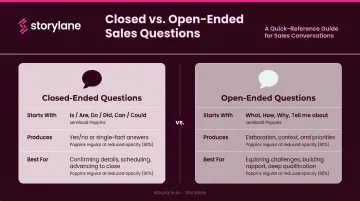
The practical rule: use open-ended questions to explore and understand; use closed-ended questions to confirm and advance. Strong discovery calls move fluidly between both — and that balance matters more than the count.
Gong's research recommends 11–14 targeted discovery questions per call. Asking 15 or more creates an interrogation effect.
30 Open-Ended Sales Questions by Stage
The most effective questions are matched to the right moment. Use these as a flexible toolkit, not a rigid script.
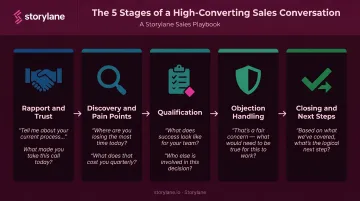
Rapport and Trust-Building Questions
The goal is to create psychological safety, not gather data. Prospects share more when they feel heard rather than evaluated. Lead with genuine curiosity before any qualifying begins.
- "What's been keeping your team busy this quarter?"
- "What got you interested in exploring this area now?"
- "How has your role evolved over the past year?"
- "What does a typical week look like for you right now?"
- "What prompted you to take this meeting today?"
- "What's your team most focused on heading into the next half?"
Discovery and Pain Point Questions
Discovery questions should reveal urgency and business impact — not just surface preferences. The best ones probe both the problem and the cost of leaving it unsolved.
- "What's not working in your current approach?"
- "Where is your team losing the most time right now?"
- "What would happen if this problem stayed unresolved for another quarter?"
- "What have you already tried to address this, and how did it go?"
- "How is this affecting other teams or departments?"
- "What does this challenge cost you in real terms — time, revenue, headcount?"
- "What does your ideal outcome look like six months from now?"
- "What's the gap between where you are today and where you want to be?"
When a prospect has already engaged with an interactive demo before the call (for example, through a Storylane demo sent in advance), reps can skip broad exploratory questions and ask far more targeted ones. Storylane's Demo Signals feature classifies prospects as low, medium, or high intent based on which features they explored, how long they spent, and whether they returned.
A rep who knows a prospect spent significant time on a specific workflow can open discovery by asking "I noticed you explored the reporting section — what were you hoping to see there?" That's a different conversation entirely from starting cold.
Qualification Questions
Qualification shouldn't feel like a gatekeeping checklist. These questions uncover decision-making authority, budget, and evaluation criteria while feeling like natural extensions of the discovery conversation.
- "Who else is involved in evaluating this decision?"
- "What criteria will matter most when comparing options?"
- "How have you handled decisions like this in the past?"
- "What does your evaluation process typically look like?"
- "What's driving the timeline on this?"
- "What would make you confident this is the right investment?"
Objection-Handling Questions
When an objection surfaces, the instinct to counter it immediately is usually wrong. Open-ended objection questions slow the moment down, reduce defensiveness, and reveal what the prospect actually needs to feel confident.
- "Can you tell me more about what's driving that concern?"
- "How are you weighing the cost of staying with your current approach against making a change?"
- "What would need to be true for that concern to go away?"
- "What's your experience been with solutions like this in the past?"
- "If we were able to address that, what would the decision look like?"
Closing and Next-Steps Questions
Strong closing questions create a collaborative path forward — they give the buyer ownership over next steps without letting the deal stall.
- "What would need to happen for this to feel like the right decision for your team?"
- "What does your internal process look like for moving something like this forward?"
- "Who else needs to be part of this conversation before a decision gets made?"
- "What's your biggest remaining question about whether this is the right fit?"
- "What would make this an easy yes for you internally?"
4 Practical Tips for Asking Better Open-Ended Questions
Start Broad, Then Narrow
Open with a high-level question — "What are your top priorities this quarter?" — and let the prospect's answer guide where you go next. Each response narrows the focus naturally. This approach makes the conversation feel exploratory rather than interrogative, and often surfaces priorities the rep wouldn't have thought to ask about directly.
Listen More Than You Talk
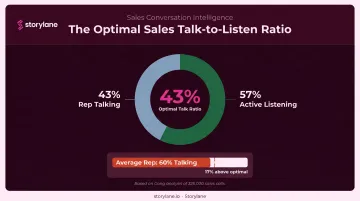
Gong's analysis of 326,000 sales calls found that the highest-yielding talk-to-listen ratio is 43% talking and 57% listening. The average rep is still talking around 60% of the time — well above what drives closed-won outcomes. Silence after a question is valuable. Resist filling it.
Use Follow-Up Questions to Go Deeper
A surface answer like "We're trying to improve efficiency" is an invitation to dig, not a cue to pitch. Strong follow-up probes include:
- "What does efficiency mean to you in this context?"
- "Where is your team losing the most time right now?"
- "How are you currently measuring that?"
- "What's the impact when that doesn't happen?"
The second and third question in a thread often reveal more than the first.
Prepare Questions Based on Pre-Call Intelligence
Gartner found that 73% of B2B buyers actively avoid suppliers who send irrelevant outreach. Generic, unprepared questions signal exactly that kind of irrelevance.
Avoiding that irrelevance means doing the homework. Reps who review demo engagement data, prior email interactions, or CRM activity before a call ask sharper questions and signal genuine preparation.
Tools like Storylane show which features a prospect spent time on, where they dropped off, and whether they came back for a second look — all before the rep says hello. That context gives discovery calls a clear starting point: what the prospect already cares about.
Mistakes That Kill Open-Ended Sales Conversations
Even well-crafted open-ended questions backfire when delivered the wrong way. These are the patterns that most often shut conversations down.
Rapid-Fire Questioning
Listing questions without letting the prospect fully respond turns discovery into an interrogation. The fix: pace your questions, acknowledge what was said, and let each answer guide where you go next. Your next question should build on what they just told you — not pull from a pre-set script.
Answering Your Own Questions
Some reps fill silence by volunteering options: "Is it a budget issue? Or maybe timing?" This plants assumptions and shuts down real insight. Ask the question, then stay quiet. What the prospect says next — unprompted — is almost always more useful than anything you'd have offered them.
Overusing "Why" Questions
"Why" is powerful in moderation, but overused it sounds accusatory. Compare:
- ❌ "Why did you stop using your previous solution?"
- ✅ "What led to your decision to explore alternatives?"
Same intent, different reception. When "why" puts a prospect on the defensive, reframe it as "what led to," "what prompted," or "help me understand."
Frequently Asked Questions
What are 5 open-ended questions for sales?
Five foundational examples: "What prompted you to start exploring solutions now?" / "What's not working in your current process?" / "Who else is involved in this decision?" / "What does success look like for your team?" / "What needs to happen next to keep this moving forward?"
What is the difference between open-ended and closed-ended sales questions?
Closed-ended questions produce yes/no or single-fact answers — useful for confirming details and advancing to next steps. Open-ended questions invite elaboration, revealing the context, motivations, and concerns that actually drive buying decisions.
When should you use open-ended questions in the sales process?
Open-ended questions are most valuable during rapport-building, discovery, qualification, and objection-handling. Closed-ended questions are better suited for confirming facts, locking in timelines, or advancing toward a close.
How many open-ended questions should you ask on a discovery call?
Quality over quantity. Gong's research recommends 11–14 focused questions with thoughtful follow-ups. More than 15 can make the call feel like an interrogation, no matter how relevant each question is.
Why do open-ended questions lead to higher win rates?
They uncover real pain, surface decision criteria, and expose objections before they derail the deal. RAIN Group's 2026 benchmark found Top Performers win 62% of deals and Elite Performers nearly 75%, versus 40% for average reps — a gap that comes down to discovery quality, which open-ended questions directly drive.