Introduction
Most B2B sales teams default to volume: more emails, more calls, more leads. It works fine for transactional deals. But when you're selling complex software to a Fortune 500 enterprise with 11 or more decision-makers involved, spray-and-pray prospecting wastes time and kills credibility.
Account-based selling (ABS) takes the opposite approach. Instead of reaching as many prospects as possible, ABS teams identify a small number of high-value accounts and treat each one as its own individual market — with research, messaging, and outreach tailored to that company's specific goals, stakeholders, and buying context.
This guide covers what ABS is, how it differs from traditional selling, how to build a strategy from ICP to cadence, and which metrics signal it's actually working.
Key Takeaways
- ABS treats each target account as its own market, requiring deep research and cross-functional teamwork
- 76% of marketers using ABM reported higher ROI compared to other approaches
- Multi-threading — engaging multiple stakeholders — boosts win rates by 130% in deals over $50K
- Personalized demos, buyer hubs, and engagement signals are how modern ABS teams move accounts through the funnel
- Success is measured at the account level, not by lead volume
What Is Account-Based Selling?
Account-based selling is a B2B sales methodology where sales, marketing, and customer success teams collaborate to pursue a select group of high-value accounts with tailored, multi-touch outreach — rather than chasing individual leads at volume.
The core principle is the "market of one." Every target account gets outreach, content, and messaging custom-built around that specific company's business context, industry pressures, and key stakeholders. Nothing generic gets sent.
Who's Involved
ABS is not a solo activity. It requires:
- SDRs: account research and initial outreach
- Account Executives: strategy ownership and relationship-building
- Marketing: account-specific campaigns and content
- Customer Success: post-sale expansion and retention
- Sales leadership: cross-team alignment and prioritization
ABS vs. ABM: The One-Line Distinction
Account-based marketing (ABM) is marketing-led — it creates awareness and warms up target accounts through personalized campaigns. ABS is sales-led — it converts that interest into closed revenue. Both work best when run together.
Why Buying Complexity Makes ABS Necessary
B2B buying committees have grown substantially. Challenger's 2024 research shows the average buying group now involves roughly 11 people, with complex deals reaching up to 20 stakeholders. Reaching only one contact and hoping they champion the deal internally isn't a strategy — it's a bet. ABS gives teams the structure to engage every key stakeholder, not just the one who answered the phone.
Account-Based Selling vs. Traditional Sales
Traditional high-volume sales prioritizes quantity — touch as many prospects as possible and let conversion rates do the math. ABS flips that logic: invest heavily in a small number of high-fit accounts where the ROI on that investment makes sense.
When ABS Is the Right Fit
ABS delivers its best results when:
- Deal sizes are above $50K (multi-threading becomes a measurable win-rate driver at this deal size)
- Sales cycles run three months or longer
- Multiple stakeholders are involved in the buying decision
- The product requires significant evaluation, customization, or procurement approval
When ABS Is the Wrong Fit
ABS is generally too resource-intensive for:
- High-volume SMB selling with short, transactional sales cycles
- Products with minimal differentiation where broad-based marketing dominates
- Teams that lack the headcount for cross-functional account coordination
The ICP Difference
Traditional sales often starts with broad segment targeting. ABS requires a precisely defined Ideal Customer Profile (ICP) before a single email goes out. That ICP is built from:
- Firmographic data — company size, industry, revenue range
- Technographics — the tools and platforms prospects already use
- CRM closed-won patterns — characteristics shared by your best past customers
- Behavioral triggers — signals like job changes, funding rounds, or product category searches
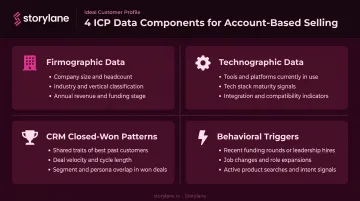
The ICP isn't a nice-to-have; it determines which accounts make the target list at all.
How to Build and Execute an ABS Strategy
Step 1: Define Your Ideal Customer Profile
A strong ICP pulls from six data sources:
- Closed-won CRM data — patterns in your best existing customers
- Firmographics — industry, company size, revenue range
- Technographics — what tools they currently use
- Behavioral triggers — recent funding, hiring surges, product launches
- Cross-functional input — sales, marketing, finance, and CS perspectives
- Predictive analytics — for more mature teams with enough data to model fit scores
Forrester recommends pairing ICP development with win-loss analysis to ensure you're targeting accounts that actually buy, not just accounts that look similar to buyers.
Step 2: Identify and Tier Your Target Account List
Once the ICP is set, build a tiered list:
- Tier 1 (20–50 accounts): One-to-one, fully customized outreach with dedicated team involvement per account
- Tier 2 (~200 accounts): Industry or persona-level personalization with lighter-touch multi-channel campaigns
SDRs and AEs should co-own account selection. If a rep doesn't believe in an account, their outreach will show it.
Step 3: Build Buyer Personas Within Each Account
Map every relevant stakeholder before outreach begins:
- Decision-makers — who has budget authority
- End users — who will use the product daily
- Blockers — who can delay or kill the deal
- Champions — who will advocate internally
For each persona, document their specific challenges, communication preferences, and role in the buying process. With buying committees averaging 11 people, multi-threading isn't optional — it's the strategy.
Step 4: Align Your Cross-Functional Team
ABS only works when every role operates from a shared playbook. Misaligned messaging between sales and marketing is one of the most common reasons account-based programs underperform. Three practices keep teams coordinated:
- Regular syncs — weekly or bi-weekly standups between sales, marketing, and CS to review account activity
- Shared content libraries — a single repository where reps pull the latest approved messaging and collateral
- CRM communication logs — every touchpoint recorded so no two people contact the same stakeholder with conflicting messages
Step 5: Develop Account-Specific Content
Tier content by effort level:
| Effort Level | Examples |
|---|---|
| Low | Personalized emails, LinkedIn engagement, tailored infographics |
| Medium | Custom ROI reports, targeted webinars, business case documents |
| High | On-site workshops, tailored product trials, executive briefings |
Every piece of content should speak to that specific account's pain points — not a generic segment.
Step 6: Build a Consistent Contact Cadence
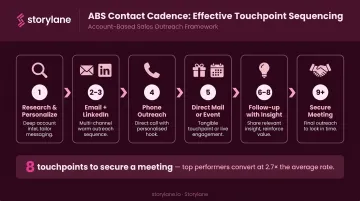
Effective ABS cadences share three characteristics:
- Coordinate across email, phone, LinkedIn, direct mail, and events — not just one or two channels
- Send role-appropriate messaging to different personas at the same time, not sequentially
- Lead every touchpoint with a relevant insight or resource, not a generic follow-up
RAIN Group's research shows it takes an average of 8 touchpoints to secure an initial meeting. Top-performing prospectors achieve 2.7x more conversions than average. Persistence matters, but only when every touchpoint earns its place.
Personalizing Outreach at Scale: Channels and Tactics
The central tension in ABS personalization: true one-to-one customization is resource-intensive. Building a bespoke demo for every account in a 200-account Tier 2 list isn't practical. The solution is personalization at scale — using technology to adapt messaging dynamically without multiplying effort.
86% of B2B marketers now agree that personalized content is key to success, with 38% of buyers citing personalization as a primary factor in trusting business emails. The bar is high, and buyers notice when outreach feels generic.
Email and LinkedIn Outreach
Best practices for ABS email sequences:
- Reference the account's specific business context, recent news, or industry challenge in the opening line
- Tailor the value proposition to the recipient's role — a CTO and a VP of Operations care about different outcomes
- Use automation carefully so sequences feel human rather than templated
- For Tier 1 accounts, direct mail remains a high-impact differentiator that breaks through inbox noise
Personalized Product Demos as an ABS Tool
Personalized interactive demos have become one of the most effective pre-meeting ABS tactics. Teams can share account-specific demos before the first conversation, so prospects arrive already informed and focused on features relevant to their use case.
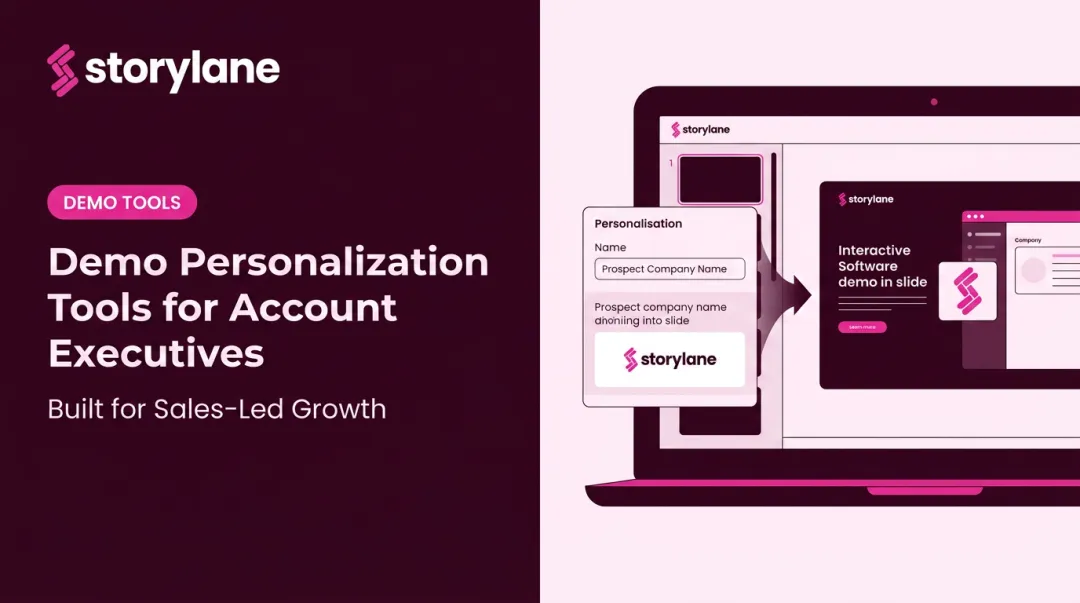
Storylane enables this workflow through dynamic variable tokens that automatically swap in company names, logos, and account-specific data into a single base demo. One master demo adapts to dozens of target accounts without version management overhead.
SentinelOne, for example, uses Storylane's token functionality to populate prospect names and company logos directly into the demo interface, turning a standard product tour into something that feels built specifically for that account.
Storylane's Account Reveal feature adds another layer: it de-anonymizes demo visitors, surfacing firmographic data on which companies are engaging before a rep makes direct contact.
Sales teams receive real-time Slack alerts when high-intent accounts engage — with full context on which features they explored and how long they spent, so follow-up lands at exactly the right moment.
Account-Specific Content Hubs
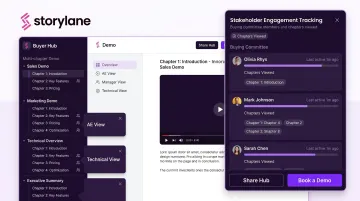
Buyer hubs give each target account a centralized destination where multiple demos and resources are organized in one place. Instead of sending disconnected demo links to different stakeholders, the hub lets every buying committee member self-navigate content relevant to their role.
Storylane's Buyer Hub supports multi-chapter demos, role-specific pathways, AI-narrated walkthroughs, and private access controls — all with stakeholder tracking so AEs can see which committee members engaged with which content. Dreamdata tracked Storylane's influence on 40.9% of their closed-won deals, including their largest deal to date, using this approach.
Omnichannel Consistency
Consistent messaging across all ABS channels — email, phone, social, events, web, direct mail — is critical. When marketing and sales run different messages, accounts notice the inconsistency and trust erodes. Three practices keep teams aligned:
- Shared content libraries so every rep pulls from the same approved assets
- Regular team syncs to reconcile messaging as campaigns evolve
- CRM-logged communications that give the full team visibility into every touchpoint
KPIs and Metrics to Measure ABS Success
In ABS, success is measured at the account level. The metrics that matter:
| KPI | What It Measures |
|---|---|
| Account Engagement Rate | How often target accounts interact with content and outreach across channels |
| Account Conversion Rate | Percentage of target accounts that become paying customers |
| Deal Velocity | Average time for an account to move through the pipeline |
| Average Contract Value (ACV) | Revenue per account, tracked against pre-ABS baseline |
| Customer Lifetime Value (CLV) | Long-term revenue from accounts acquired through ABS |
Measuring Engagement Depth
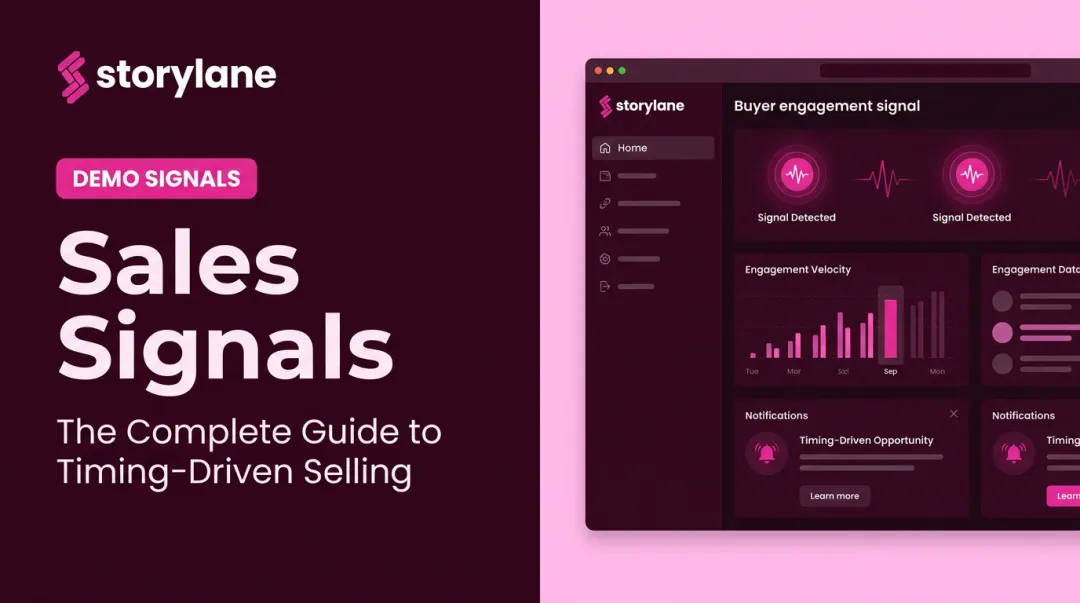
Tracking which stakeholders have been contacted, what content they consumed, and which channels generated meaningful interactions helps teams identify where accounts are stalling. Storylane's Demo Signals platform classifies prospects as low, medium, or high intent based on time spent, completion rates, features explored, and return visits — giving ABS teams a clear prioritization signal.
Measuring ABS ROI
Because ABS involves longer sales cycles and heavier upfront investment, traditional lead-volume metrics misrepresent its impact. Teams should:
- Benchmark the LTV-to-CAC ratio before and after ABS implementation (a 3:1 ratio is a healthy SaaS benchmark)
- Track pipeline influence, not just pipeline sourced — account engagement from marketing, SDRs, and CS all contribute to closed revenue
- Monitor deal size uplift — Forrester's 2024 data shows ABM accounts generate larger average deal sizes, with roughly one-third of organizations reporting 11%–20% uplift and just under one-third reporting 21%–50%
Frequently Asked Questions
What is account-based selling?
Account-based selling (ABS) is a B2B sales model where sales, marketing, and customer success teams treat each high-value target account as its own market. Rather than high-volume prospecting, teams concentrate resources on personalized, multi-touch engagement with a focused set of accounts.
What is the goal of account-based selling?
The primary goal is sustainable revenue growth through long-term relationships with high-value accounts. ABS prioritizes customer lifetime value through personalized engagement, expansion, and cross-sell opportunities rather than one-time closes.
What is an example of account-based selling?
A B2B SaaS company identifies a Fortune 500 enterprise as a Tier 1 target. They assign a dedicated AE, SDR, and marketer to the account, build a custom ROI report, send role-specific outreach to the CTO and VP of Operations separately, and share a personalized demo with the account's own branding — all before the first call.
How is account-based selling different from account-based marketing?
ABM is marketing-led and focused on warming up target accounts through personalized campaigns and content. ABS is sales-led and focused on converting that interest into closed revenue. Both approaches are most effective when run in close alignment with shared account lists and consistent messaging.
Who should use account-based selling?
ABS fits B2B companies with complex products, deal sizes typically above $50K, sales cycles of three or more months, and multiple stakeholders in each buying decision. It's generally too resource-intensive for high-volume SMB selling with short, transactional cycles.
What are the key metrics for measuring ABS success?
ABS success is measured at the account level, not by raw lead volume. Core KPIs include:
- Account engagement rate
- Account conversion rate
- Deal velocity
- Average contract value
- Customer lifetime value