Introduction
Most B2B SaaS teams have a pipeline. Fewer have a clear picture of why deals stall, why MQL volume looks healthy while close rates stay flat, or which stage is actually bleeding revenue.
That's where the sales conversion funnel comes in. It's the structured path a prospect travels from first becoming aware of your product to signing a contract — and more practically, it's the diagnostic model that tells you exactly where buyer momentum breaks down.
This guide is for B2B SaaS sales and marketing teams who hear "funnel" constantly but struggle to use it operationally. We'll cover what the sales conversion funnel is, how each of its five stages works, what drives or stalls progression, and the misconceptions that consistently erode funnel performance.
Key Takeaways
- A sales conversion funnel maps the buyer's journey from awareness to closed deal, revealing exactly where prospects drop off.
- The five stages — Awareness, Interest, Consideration, Evaluation, and Decision — each require a different response from your team.
- In B2B SaaS, those stages translate directly to lead statuses: raw lead, MQL, SQL, Opportunity, and Closed-Won.
- The funnel diagnoses where buyers stall; the pipeline forecasts revenue. Conflating the two leads to the wrong fixes.
- Optimizing the funnel means targeting the stage with the highest drop-off first, not improving everything at once.
What Is a Sales Conversion Funnel?
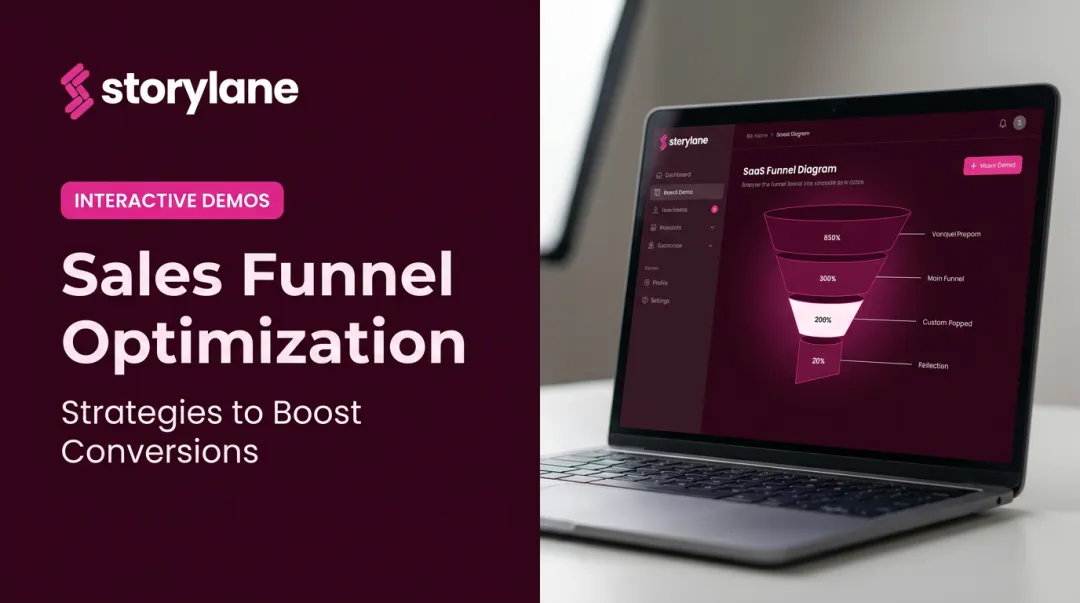
A sales conversion funnel is a visual framework that tracks how prospects move through distinct stages — from initial brand contact to completed sale. It narrows at each step because most leads drop off — and that drop-off pattern is precisely what makes the funnel useful. Its primary value is surfacing where prospects disengage so teams can intervene with stage-appropriate content, outreach, or process changes that move more leads to the bottom.
How It Differs from Related Concepts
Two terms get conflated with the sales conversion funnel constantly, and the confusion causes real operational problems:
- Marketing funnel: Broader in scope. It extends pre-sale (brand awareness, demand creation) and post-sale (retention, advocacy), and is typically owned by marketing. It describes the entire customer lifecycle.
- Sales pipeline: Tracks active deals by stage and dollar value. It answers "what is the current state of revenue?" The funnel answers "why are prospects not progressing?" One is a forecasting tool; the other is diagnostic.
Using pipeline health as a proxy for funnel health is a common mistake. A pipeline full of stalled opportunities confirms something is wrong — the funnel identifies exactly where the breakdown is happening and why.
Why the Sales Conversion Funnel Matters in B2B Sales
B2B sales is structurally different from consumer or transactional selling in ways that make stage-by-stage visibility essential — and difficult to improvise.
Long Cycles, Multiple Stakeholders, High Stakes
The Ebsta/Pavilion 2024 B2B Sales Benchmark Report — based on 4.2 million opportunities across 530 companies — found that sales cycles grew 38% longer than 2021. Deal sizes compound this complexity: SaaS Capital's 2025 survey of 1,000+ private B2B SaaS companies found a median ACV of $26,265, rising to over $56,000 for companies in the $10M–$20M ARR range.
Forrester's 2026 buying-network research puts the coordination challenge in sharp relief: 73% of B2B purchases involve three or more departments, with an average buying network of 13 internal people plus 9 external influencers. Every one of those stakeholders is a potential point of disengagement.

What Happens Without a Defined Funnel
Without a shared funnel model, teams typically:
- Treat all leads identically regardless of readiness
- Send bottom-of-funnel offers (pricing, demos) to top-of-funnel prospects
- Cannot diagnose why high inbound volume produces low close rates
- Misattribute revenue problems to the wrong team or stage
Cross-Team Alignment
When sales and marketing agree on what defines a lead, an MQL, and an SQL, handoffs improve and fewer prospects fall through the cracks. HubSpot's 2026 marketing research surfaces a revealing tension: over 27% of marketers cite sales-marketing alignment as a top challenge — yet only 8% name improving it as a top goal. That disconnect means misrouted leads, inconsistent messaging, and deals that stall for reasons neither team can clearly see.
The 5 Stages of the Sales Conversion Funnel
The funnel narrows at each stage because not every prospect is qualified or ready to buy. The goal isn't to push everyone to the bottom — move the right prospects forward while filtering out poor fits early.
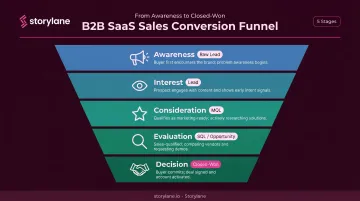
Stage 1: Awareness
The prospect first encounters your brand through search, paid ads, social media, content, or a referral. They're problem-aware but not yet solution-aware.
At this stage, the sales/marketing objective is narrow: earn enough interest to get a click, a form fill, or a content download. Nothing more. Attempting sales engagement here almost always backfires.
Stage 2: Interest
The prospect is now a lead. They're reading blog posts, watching videos, subscribing to a newsletter, or attending a webinar. Marketing's role is lead nurturing and scoring.
Direct sales outreach at this stage is one of the most common causes of funnel abandonment. The prospect hasn't signaled buying intent — they've signaled curiosity. Treat those two differently.
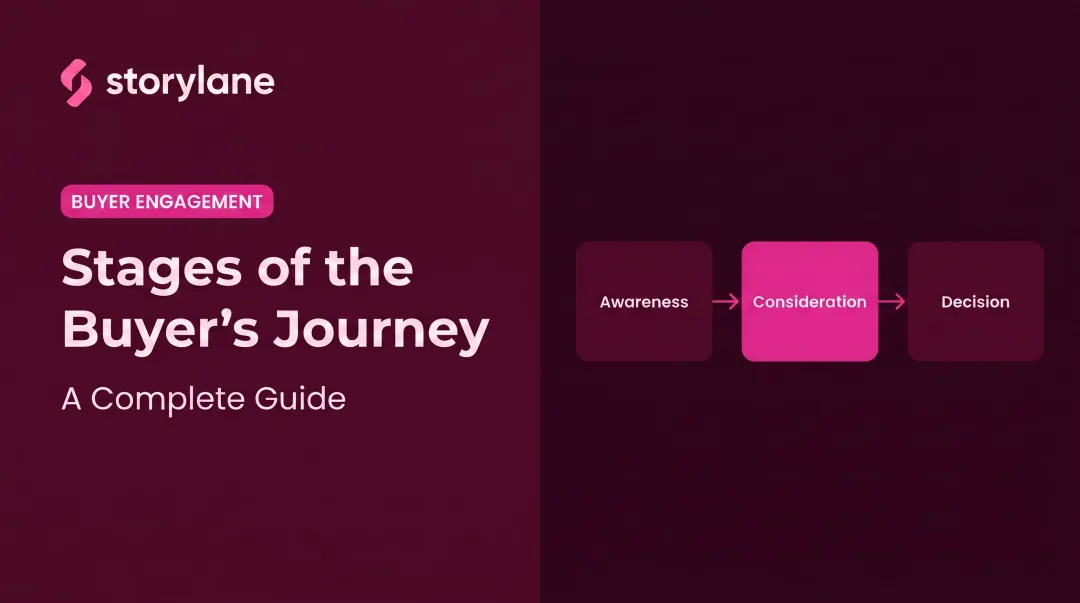
Stage 3: Consideration (MQL)
Repeated engagement signals suggest buying intent: downloading a pricing guide, visiting the product page multiple times, attending a demo webinar. The prospect becomes a marketing qualified lead (MQL).
This is also where most B2B funnels leak. The MQL-to-SQL transition requires explicit, documented agreement on qualification criteria between marketing and sales. Without it, sales rejects leads marketing considers warm, handoffs stall, and solid opportunities disappear in the gap.
At this stage, Storylane's embedded lead capture forms and Demo Signals feature help marketing teams qualify and score MQLs based on actual demo engagement — time spent, completion rates, feature exploration — rather than page view counts alone.
Stage 4: Evaluation (SQL and Demo)
Sales has accepted the lead. Discovery is complete. The prospect is now actively comparing your product against alternatives.
This is where product demonstration becomes decisive. Prospects need to see the product working in the context of their specific problem — not a generic walkthrough.
According to Gartner, 61% of B2B buyers prefer a rep-free buying experience, and Demand Gen Report's 2024 research found buyers are nearly 70% through the purchasing process before engaging with a seller. Prospects are doing significant evaluation independently — before, between, and after sales calls.
Storylane's interactive demo platform addresses this directly. Prospects explore personalized, self-guided demos on their own schedule before a call. Behavioral data — features explored, time spent, drop-off points — flows back to the rep via Salesforce and HubSpot integrations.
Reps enter live calls already knowing what the prospect found compelling and what they skipped. That intelligence sharpens discovery and shortens evaluation time.
Stage 5: Decision (Close)
The prospect is comparing final options, negotiating terms, or routing the decision through additional stakeholders. Sales friction is the primary threat here.
Stalls at this stage are almost never caused by lack of product awareness. The real culprits:
- Internal champion can't build consensus
- Pricing misalignment surfaces late
- Competitive alternatives haven't been clearly differentiated
- The buying process itself is unnecessarily complex
The sales team's job at this stage is friction removal: handling objections, providing business case support, and ensuring the buying process is smooth for every stakeholder involved.
Key Factors That Drive (or Stall) Funnel Progression
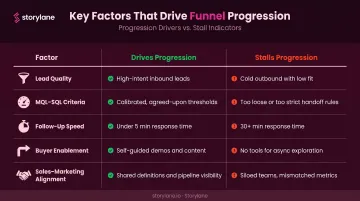
Understanding the funnel stages is necessary but not sufficient. What actually determines whether prospects advance — or abandon — comes down to a handful of operational factors.
Lead quality and source: Leads from high-intent channels (demo requests, branded search) convert at higher rates than cold outbound. Knowing which sources produce qualified leads determines where acquisition spend belongs.
MQL-to-SQL qualification criteria: Definitions that are too loose waste sales capacity on poor-fit prospects. Too strict, and good opportunities stall. First Page Sage's 2025 B2B SaaS benchmark data shows MQL-to-SQL conversion rates ranging from 26% to 51% depending on channel — with SEO leads converting at the top end and PPC leads at the bottom. That spread reflects just how much qualification criteria and lead source interact.
Speed of follow-up: The 2007 Lead Response Management Study (MIT/InsideSales, 15,000+ leads) found that responding within 5 minutes versus 30 minutes increased qualification odds by 21x. A 2021 InsideSales study of 55M+ sales interactions found conversion rates were 8x greater in the first five minutes. Funnel velocity matters as much as funnel volume.
Buyer enablement at evaluation: When prospects can self-advance through evaluation using interactive demos, comparison guides, and ROI tools, they arrive at sales conversations more informed and with clearer intent. Tools that surface engagement signals — feature interest, time-on-step, CTA clicks — give reps measurable buying signals tied to pipeline. Storylane's Buyer Hub and Deal Intelligence are built specifically for this motion.
Sales and marketing alignment: When both teams operate from the same funnel definitions, share data, and collaborate on stage-specific content, conversion rates improve across every transition. Misalignment remains one of the most consistently cited barriers to funnel performance in B2B organizations — and rarely addressed.
Common Misconceptions About the Sales Conversion Funnel
"The Funnel Is Linear"
Modern B2B buyers don't move predictably from stage to stage. They re-enter at different points, loop back to research after a demo, and engage multiple stakeholders simultaneously.
McKinsey's 2024 B2B research found buyers use an average of 10 interaction channels — up from 5 in 2016 — with 42% using more than 11 touchpoints. Treating the funnel as a rigid sequence means teams miss re-engagement windows and misattribute inaction from stakeholders who simply haven't entered the process yet.
"A Leaky Funnel Is a Marketing Problem"
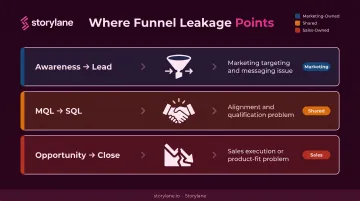
Drop-off at different stages points to different problems:
| Stage | Drop-off indicates |
|---|---|
| Awareness → Lead | Marketing problem (targeting, messaging, channel mix) |
| MQL → SQL | Alignment or qualification problem |
| Opportunity → Close | Sales execution or product-fit problem |
Each requires a different fix. Treating all funnel leakage as a marketing issue — or all of it as a sales issue — guarantees the wrong intervention.
"More Leads at the Top Means Better Funnel Performance"
That last misconception connects directly to how teams diagnose poor close rates. Volume at the top only helps if leads are qualified. Flooding the funnel with unqualified traffic increases cost-per-acquisition, burns sales capacity, and masks the real problem. A team that responds to a low close rate by generating more leads isn't fixing the funnel — they're hiding it.
Conclusion
The sales conversion funnel gives sales and marketing a shared diagnostic language — a way to identify exactly where buyer momentum breaks down, which team owns that stage, and what type of intervention is needed.
It's not a one-time mapping exercise. Teams that review stage-by-stage conversion rates on a regular cadence and target the weakest transition consistently outperform those that optimize without a clear picture of where deals are stalling. That means knowing your MQL-to-SQL rate, your opportunity-to-close rate, and what's actually causing the gap between them.
The funnel won't close deals for you. But when a quarter goes sideways, it tells you whether the problem is lead volume, qualification, or late-stage drop-off — and that distinction determines everything about how you respond.
Frequently Asked Questions
What is a sales conversion funnel?
A sales conversion funnel is a framework that maps the stages a prospect moves through from first becoming aware of a product to completing a purchase. It narrows at each step because not all prospects advance — and that narrowing reveals exactly where engagement breaks down.
What are the 5 stages of a sales funnel?
The five stages are Awareness, Interest, Consideration, Evaluation, and Decision. In B2B SaaS, these typically correspond to lead statuses: raw lead, MQL, SQL, opportunity, and closed-won.
What is the difference between a sales funnel and a marketing funnel?
A marketing funnel covers the full customer lifecycle, including post-purchase retention and advocacy. A sales funnel focuses specifically on the journey from lead to closed deal. The two overlap but serve different diagnostic purposes.
How do you calculate a sales funnel conversion rate?
Divide the number of prospects who reached the later stage by the number who entered the earlier stage, then multiply by 100. For example, 50 SQLs from 200 MQLs equals a 25% MQL-to-SQL conversion rate.
What is a good B2B sales funnel conversion rate?
Benchmarks vary significantly by channel, deal size, and go-to-market motion. First Page Sage's 2025 B2B SaaS data shows MQL-to-SQL rates ranging from 26% to 51% and opportunity-to-close rates from 32% to 40%.
What causes leads to drop off in the middle of the sales funnel?
Mid-funnel drop-off most commonly stems from a few recurring problems: poor MQL/SQL alignment, slow follow-up response times, missing consideration-stage content, or hard-sell outreach before the prospect has shown clear buying intent. Sales rejecting leads marketing considers warm is the single most common culprit.