The problem is growing harder to ignore. According to the Highspot/Sales Enablement PRO 2023 State of Sales Enablement Report, 90% of organizations now have a dedicated enablement function — up from 75% just a year earlier. On the operations side, Salesforce's State of Sales, Fifth Edition found 82% of sales professionals say sales ops plays a critical role in business growth — with that figure climbing to 89% among high performers.
Both functions matter. Neither replaces the other. This article breaks down exactly what each one does, where they differ, and how they work together.
TL;DR
- Sales enablement is people-focused: it equips reps with the training, content, and tools to engage buyers and close deals
- Sales operations handles process: it builds the systems, workflows, and data infrastructure that keep the sales engine running
- The two functions use different metrics, operate at different stages of the sales cycle, and pull entirely different levers
- Neither function substitutes for the other — sustainable revenue growth at scale requires both
- The right question is how to get both functions working together, not which one to prioritize
Sales Enablement vs. Sales Operations: Quick Comparison
| Dimension | Sales Enablement | Sales Operations |
|---|---|---|
| Primary Focus | People development; rep effectiveness | Process efficiency; organizational infrastructure |
| Core Responsibilities | Onboarding, training, content, coaching, messaging alignment | CRM management, forecasting, territory/quota, tech stack |
| Key Metrics | Time-to-productivity, quota attainment, win rates, content usage | Pipeline velocity, forecast accuracy, sales cycle length, CAC |
| Data Usage | Rep-level performance data to improve skills and content | CRM pipeline data to drive structural and process decisions |
| Stage of Sales Cycle Impact | Early and mid-stage (buyer engagement and prep) | Full cycle, from lead assignment through post-sale handoff |
| Typical Reporting Line | VP of Sales or CRO | VP of Sales, CRO, or RevOps leader |
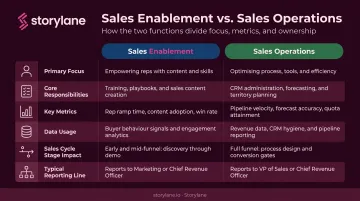
Both teams report to sales or revenue leadership and share the goal of boosting rep productivity. Enablement focuses on developing people; operations focuses on building the systems those people work within. Drop one and you either have reps who can hold a great conversation but lose deals to process gaps — or an airtight operational machine with no one skilled enough to close.
What Is Sales Enablement?
Sales enablement is the practice of equipping reps with the knowledge, content, coaching, and tools they need to engage buyers effectively at every stage of the sales cycle. When the function expands beyond the sales team to include customer success and other revenue-generating roles, it's often called revenue enablement.
Gartner defines it as "the process of providing the sales organization with the information, content, and tools that help sellers sell more effectively."
CSO Insights takes a broader organizational view: "a strategic, collaborative discipline designed to increase predictable sales results by providing consistent, scalable enablement services that allow customer-facing professionals and managers to add value in every customer interaction."
Together, these definitions point to the same core idea: enablement exists to make every customer-facing interaction more effective and consistent.
Core Responsibilities
A sales enablement team typically owns:
- Structured onboarding curricula covering product knowledge, sales methodology, and competitive positioning
- Coaching frameworks and call review programs that build skills over time
- Sales content — playbooks, battlecards, objection-handling guides, and case studies
- Marketing-sales alignment to ensure consistent messaging across both teams
- Program impact measurement that connects training and content to actual performance shifts
How Enablement Shows Up in Buyer Conversations
Enablement's clearest impact is what happens when a rep gets on a call. A well-enabled rep arrives prepared, delivers consistent messaging, and tailors the conversation to a specific prospect's context.
Interactive product demos are a strong example of an enablement asset that directly shapes the buyer experience. Reps using a platform like Storylane can walk prospects through a personalized, hands-on product experience — reducing friction and building buyer confidence before deals reach negotiation. Gartner's research confirms this: interactive demos rank as the most useful website resource among SaaS buyers from startup through mid-market, and can compress sales cycle times when deployed effectively.
Key Metrics
Enablement teams track performance at the individual rep level:
- Time-to-productivity for new hires (industry average: 9.2 months, per CSO Insights; winning organizations compress this to 4–5 months)
- Quota attainment percentage
- Win/loss rates
- Content usage by reps
- Sales confidence scores and skill assessment improvements
Key Stakeholders
Enablement works daily with sales reps, frontline managers (for coaching alignment), marketing (for content and messaging), and product (for launch readiness training).
What Is Sales Operations?
Sales operations is responsible for the processes, systems, data, and infrastructure that allow a sales organization to run efficiently and scale. If enablement is the coach preparing players for the game, ops is the stadium manager making sure the field is lined, the schedule is set, and everyone knows where to show up.
Salesforce describes sales ops as using "systems, technology, and data around hiring, coverage, and incentives to help sales teams reach targets" — and reports that top-performing sales ops teams can increase sales productivity by 20–30%.
Core Responsibilities
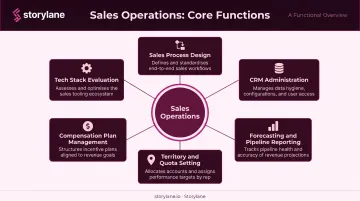
A sales operations team typically owns:
- Sales process design and optimization — defining stages, exit criteria, and workflows that reps follow
- CRM administration — data hygiene, configuration, user access, and reporting
- Forecasting and pipeline reporting — building accurate revenue projections from pipeline data
- Territory and quota setting — structuring who covers what and what reps are measured against
- Compensation plan management — designing incentive structures that align rep behavior with business goals
- Tech stack evaluation and implementation — assessing, purchasing, and integrating sales tools
How Ops Uses Data
Sales ops works at the organizational level, not the rep level. The team analyzes CRM pipeline data, stage-by-stage conversion rates, average deal size trends, and forecast accuracy — not to coach individual reps, but to make structural decisions. If conversion rates are dropping at a specific stage, ops investigates whether it's a process issue, a territory problem, or a capacity constraint.
Individual rep skill gaps get handed off to enablement.
Key Metrics
Sales ops tracks organizational performance:
- Close rate and average sales cycle length
- Pipeline coverage and velocity
- Forecast accuracy
- Customer acquisition cost (CAC)
- Quota attainment at the team level
The Relationship with RevOps
Those metrics don't live in a vacuum — they feed into a larger organizational structure. Gartner projects that by 2026, 75% of the highest-growth companies will have adopted a Revenue Operations (RevOps) model, up from less than 30% today. RevOps expands the operational scope to align sales, marketing, and customer success under a single data and process framework.
For most companies, sales ops is either a direct subset of that RevOps structure or the team that eventually evolves into one.
Key Differences Between Sales Enablement and Sales Operations
People vs. Process
The most fundamental distinction comes down to focus: enablement develops the people doing the selling, while operations builds the systems they sell within.
In practice:
- Enablement creates a negotiation workshop to help reps handle pricing pushback
- Ops shortens the contract approval workflow so deals don't stall waiting for legal sign-off
Both solve sales problems, just from opposite directions.
Onboarding Roles
Both teams are involved in onboarding, but they own different pieces:
| Aspect | Sales Enablement | Sales Operations |
|---|---|---|
| What they build | Training curriculum: product knowledge, methodology, competitive positioning | System setup: CRM access, territory assignment, quota, tool configuration |
| What happens without them | New hires don't know what to do | New hires have nowhere to start |
Without ops, a new rep has no territory and no CRM login. Without enablement, they have access to everything but no idea how to use it.
Technology Ownership
This handoff point is one of the most common sources of friction between the two teams:
- Sales ops evaluates, purchases, integrates, and administers the sales tech stack
- Sales enablement trains reps on how to use those tools and runs adoption programs
When this boundary isn't explicit, tools get purchased but go underutilized, or reps get trained on tools that aren't properly configured. According to Salesforce, only 37% of sales professionals strongly agree their organization fully takes advantage of its CRM. That gap closes when ops implementation and enablement adoption work in sync.
Time Horizon of Impact
- Enablement changes tend to show results within a quarter: a new objection-handling module lifts win rates, faster onboarding reduces time-to-quota
- Ops changes compound over time: better pipeline processes, smarter territory models, and a well-configured CRM build the foundation for scale. The payoff accumulates gradually, not overnight.
How Sales Enablement and Sales Operations Work Together
The Data-to-Training Feedback Loop
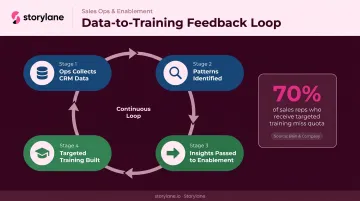
Sales ops has something enablement needs: real performance data. When ops identifies patterns in CRM data — deals consistently stalling at the demo stage, win rates dropping at proposals — it can hand those insights to enablement, who builds targeted training or new content to address the gap directly.
This keeps enablement programs grounded in actual performance data rather than assumptions. Bain & Company found that 70% of companies struggle to integrate their sales plays into CRM and revenue technologies — which is exactly the cost of these two teams operating in silos rather than sharing a feedback loop.
Collaborative Change Management
When ops rolls out a new tool or process change, adoption depends on enablement stepping in to explain the "why," train reps on the new workflow, and reduce resistance. Without that partnership, new systems stall. The Salesforce stat on CRM utilization (only 37% strongly agreeing their org takes full advantage) illustrates the cost of skipping the enablement side of a technology rollout.
Building a Shared Data Layer
Joint buy-in for new tools or headcount is stronger when both teams present a unified case to leadership. Each brings a distinct angle:
- Ops contributes data-backed ROI projections and process rationale
- Enablement brings frontline rep perspective and adoption readiness
Platforms like Storylane's Deal Intelligence and demo engagement analytics give both teams access to the same underlying data. Enablement uses demo interaction signals to improve content and coaching; ops uses pipeline influence metrics to attribute revenue to specific enablement assets. When both teams are working from the same numbers, decisions stop happening in parallel and start happening together.
Frequently Asked Questions
What falls under sales enablement?
Sales enablement covers onboarding and training programs, sales content creation and management (playbooks, battlecards, demo assets), coaching frameworks, and marketing-sales alignment. All of it points toward the same goal: giving individual reps the skills, content, and confidence to win buyer conversations.
What is the main difference between sales enablement and sales operations?
Enablement is people-focused: it builds rep skills, content, and confidence. Operations is process-focused: it builds the systems, data infrastructure, and workflows that make selling efficient at scale. Both improve rep productivity — just through different mechanisms.
Which team should own the CRM?
Sales operations typically owns CRM administration — data hygiene, configuration, reporting, and user access. Sales enablement trains reps on how to use it correctly. In many organizations this becomes a shared responsibility by default, which requires explicit alignment to avoid gaps in both configuration and adoption.
How do you measure the success of sales enablement vs. sales operations?
Enablement success is measured through rep-level metrics: time-to-productivity, quota attainment, win rates, and content usage. Sales ops success is measured through organizational metrics: pipeline velocity, forecast accuracy, average sales cycle length, and cost of sale.
Can one person manage both sales enablement and sales operations?
Yes, in early-stage or smaller companies one person often covers both. As the team grows, the functions diverge: ops demands a data and systems orientation while enablement requires coaching and content skills. Each role also expands significantly in scope, making the combined load unsustainable at scale.
What is the difference between sales operations and RevOps?
Sales operations focuses on the sales team's processes and systems. Revenue operations (RevOps) aligns sales, marketing, and customer success under one operational framework. RevOps is the broader function — sales ops may report into it or evolve into it as the company scales.