Introduction
Most B2B marketing teams invest heavily in lead generation — and then watch those leads go cold. The problem isn't the quantity of leads; it's what happens after they enter the pipeline.
According to Adobe/Marketo, half of the leads in any given system are not yet ready to buy. Those leads need time, relevant content, and consistent follow-through before they'll seriously consider a purchase — not a sales call the moment they download your ebook.
Lead nurturing fills that gap. It moves prospects from early-stage curiosity to sales-ready intent by matching content and outreach to where a buyer actually is in their decision process. Skip it, and you're essentially routing warm leads to competitors who bothered to stay in touch.
This guide covers what lead nurturing actually is, why it matters, six strategies that work in practice, how to map nurturing to the buyer's journey, and best practices to build a program that keeps improving as you learn what moves your buyers.
Key Takeaways
- Half of leads aren't ready to buy at first contact — nurturing bridges the gap between interest and purchase
- Nurtured leads generate 50% more sales-ready opportunities at 33% lower cost than non-nurtured leads
- Effective nurturing spans email, content, lead scoring, interactive demos, and social — not just one channel
- Match content to funnel stage — education early, credibility in the middle, proof and low friction at the close
- Interactive demos are the strongest BOFU assets — prospects self-qualify by experiencing the product directly
What Is Lead Nurturing?
Lead nurturing is the ongoing process of building meaningful relationships with prospects at every stage of the buyer journey — by delivering timely, relevant content and interactions — with the goal of guiding them toward a purchase when they're ready.
The key phrase is "when they're ready." Nurturing isn't about accelerating someone past their decision threshold; it's about being present and useful until they reach it naturally.
Lead Nurturing vs. Lead Generation
These two are often conflated, but they serve distinct purposes:
- Lead generation attracts new contacts and fills the top of the funnel
- Lead nurturing engages and educates the leads already in your pipeline, moving them through it
What Lead Nurturing Looks Like in Practice
Common nurturing tactics include:
- Automated email drip campaigns triggered by prospect behavior
- Content offers (whitepapers, guides, case studies) mapped to funnel stage
- Lead scoring to prioritize sales-ready prospects
- Retargeting ads that re-engage website visitors
- Personalized interactive demos delivered pre-sales-call
- Webinars and live events that build credibility at scale
Why Lead Nurturing Matters: Key Benefits
The numbers make a clear case for lead nurturing — and an equally clear case against skipping it.
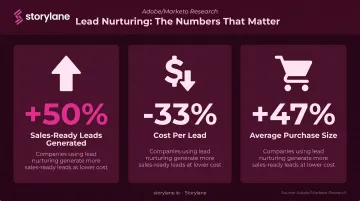
Adobe/Marketo reports that companies excelling at lead nurturing generate 50% more sales-ready leads at a 33% lower cost per lead. The same research, citing The Annuitas Group, found that nurtured leads make 47% larger purchases than non-nurtured leads. Across volume, cost, and deal size, the compounding effect is hard to ignore.
The Revenue Case
| Metric | Impact of Nurturing |
|---|---|
| Sales-ready leads generated | +50% |
| Cost per lead | -33% |
| Average purchase size | +47% |
The Relationship Dimension
The conversion numbers only tell half the story. Lead nurturing also builds trust — and trust changes how prospects behave long before they talk to sales.
Prospects who receive consistent, relevant content associate your brand with expertise — not just a vendor pushing for a close. That positioning translates into:
- Shorter sales cycles when prospects arrive to calls already informed
- Higher close rates because objections were addressed before the first meeting
- Better retention because customers chose you deliberately, not by default
6 Lead Nurturing Strategies That Actually Work
Targeted Email Drip Campaigns
Email remains one of the highest-ROI channels in marketing. Litmus reports an average return of $36 for every $1 spent on email — a ratio that holds specifically in software and technology.
The ROI comes from relevance. A blast email to your entire list is not nurturing. A triggered sequence sent when a prospect downloads a specific guide, visits your pricing page, or attends a webinar — that's nurturing.
What makes drip campaigns effective:
- Behavioral triggers: Send emails based on what a prospect did, not just who they are
- Segmentation by persona or funnel stage: A VP of Engineering and a Head of Marketing need different messages
- Short subject lines and clear CTAs: Reduce cognitive load; one ask per email
- Consistent but non-intrusive cadence: 3–5 touches over 2–3 weeks is a reasonable starting point for most sequences
- Mobile-friendly design: A significant share of B2B email is opened on mobile
Content Marketing Mapped to Funnel Stages
Content is the fuel behind every nurturing channel. The mistake most teams make is creating content without considering where a prospect is in their journey.
CMI's 2025 B2B Content Marketing research found that content marketing helped 62% of B2B marketers nurture leads — and the most effective formats were videos (58%), case studies (53%), and whitepapers/ebooks (45%).
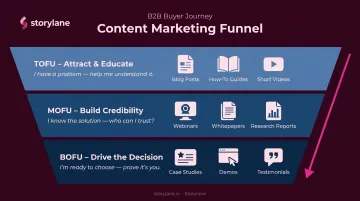
A practical stage-by-stage content map:
| Funnel Stage | Prospect Mindset | Best Content Types |
|---|---|---|
| TOFU | Discovering the problem | Blog posts, how-to guides, short videos |
| MOFU | Evaluating solutions | Webinars, whitepapers, research reports |
| BOFU | Making a decision | Case studies, demos, testimonials, trials |
Repurpose aggressively. A long-form research report can fuel a five-part email sequence, six social posts, a webinar topic, and three blog posts. Volume without repurposing burns out content teams; repurposing compounds the investment.
Lead Scoring to Prioritize Your Best Prospects
Lead scoring assigns numerical values to prospects based on two categories:
- Profile attributes: Job title, company size, industry, and how closely they match your ideal customer profile
- Behavioral signals: Email opens, page visits, whitepaper downloads, demo requests, and webinar attendance
The output is a ranked list that tells sales and marketing teams where to focus energy. A prospect who's downloaded two whitepapers, visited your pricing page three times, and opened every email in your sequence is very different from one who clicked a single LinkedIn ad two months ago — even if both are in your CRM.
Without scoring, both get treated the same. With scoring, the first gets a sales call; the second gets more nurture content.
Interactive Product Demos as a BOFU Nurturing Asset
B2B buyers increasingly want to evaluate products before engaging with sales. Gartner research shows that 75% of B2B buyers prefer a rep-free sales experience, and TrustRadius found that 71% of buyers who used demos cited them as the most influential resource in their purchasing decision.
Interactive demos — self-guided, shareable product walkthroughs — directly answer that preference.
Platforms like Storylane let teams build demos that prospects can explore on their own schedule, without scheduling a call. The practical benefits for a BOFU nurture workflow are significant:
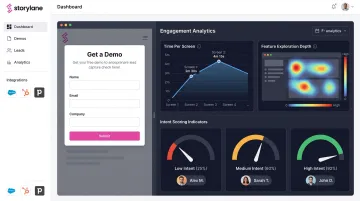
- Embedded lead capture forms collect prospect data at peak engagement and feed directly into Salesforce and HubSpot
- Time-per-screen, feature exploration depth, and drop-off data give sales reps specific context before any follow-up call
- Engagement signals are automatically scored as Low, Medium, or High intent — triggering real-time Slack alerts when a prospect crosses the High threshold
- Dynamic variable tokens (company name, logo, relevant metrics) personalize each demo without building individual versions per account
Demos can be embedded in nurture email sequences, shared as private tracked links, or organized into a centralized Buyer Hub where prospects self-discover content by use case or role — providing 24/7 product exposure without requiring a live sales rep.
That kind of always-on exposure adds up. ContactMonkey, an internal communications platform, built a gated interactive demo as a core BOFU nurture asset. The results: a 28% demo-to-opportunity conversion rate (roughly 2x other inbound channels), $1.3M in attributed pipeline, and a 5x increase in lead volume.
Multichannel Nurturing: Social, Retargeting, and Beyond
Prospects don't live in a single channel, so nurturing that relies on email alone will miss large windows of potential engagement.
For B2B specifically, LinkedIn is the most effective thought-leadership channel — cited by 76% of B2B marketers in CMI's 2026 B2B Content research. Consistent content sharing and community interaction on LinkedIn maintain brand presence without requiring high-pressure sales outreach.
Retargeting ads serve a complementary role: re-engaging website visitors who left without converting and keeping your brand visible as they continue their research elsewhere.
Additional channels worth incorporating depending on your audience:
- Webinars — high-credibility MOFU assets that create natural sales handoff opportunities
- SMS/messaging — effective for time-sensitive follow-ups with high-intent prospects
- Chatbots — useful for qualifying inbound visitors and routing them to the right content or team
Pick the channels where your buyers actually spend time, show up consistently there, and let the other channels go. Spread too thin, the message dilutes; concentrated where it counts, it compounds.
Matching Lead Nurturing to the Buyer's Journey
Content and channel selection must change as a prospect moves through the funnel. Sending the wrong content at the wrong time — a product comparison to someone who just discovered the problem, or an awareness blog post to someone ready to buy — wastes both the content and the relationship.
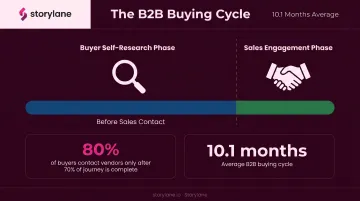
6sense's 2025 Buyer Experience Report found that the average B2B buying cycle runs 10.1 months — down from 11.3 months in 2024 — and that 80% of buyers initiate first contact only after they're already 70% through the journey. That means most of the decision happens before your sales team enters the picture. Your nurture program has to carry most of the persuasion work.
Top of Funnel (TOFU): Attract and Educate
TOFU prospects are discovering their problem. They may not know your brand, or they may need to understand why the problem matters before evaluating any solution.
Goal: Attract attention, provide genuinely useful information, earn a second interaction.
Best content types: Short blog posts, how-to guides, checklists, explainer videos, social media content.
CTA: Low-commitment asks — subscribe to a newsletter, download a checklist, follow for more content.
Middle of Funnel (MOFU): Build Trust and Credibility
MOFU prospects are actively comparing options. They know the problem exists and are now evaluating which vendor understands it best.
Goal: Become the most credible and knowledgeable option in their consideration set.
Best content types: Webinars, in-depth whitepapers, research reports, free tools, email nurture sequences.
This is also where lead scoring becomes critical. Whitepaper downloads and webinar attendance are strong intent signals. Prospects hitting these triggers should be scored up and flagged for potential sales outreach.
Bottom of Funnel (BOFU): Reduce Friction and Drive the Decision
BOFU prospects are close to buying but may have lingering objections or need reassurance that they're making the right choice.
Goal: Make the decision easy by proving value and removing risk.
Best content types: Case studies, customer testimonials, product comparison pages, free trials, interactive demos.
CTA: High-intent asks — book a personalized demo, start a free trial, talk to a specialist.
Personalized, hands-on content is especially powerful here. TrustRadius data shows 38% of buyers are less likely to purchase if forced to contact sales just to access a demo or trial — meaning friction at this stage doesn't just slow deals, it kills them. Give BOFU prospects a way to experience the product on their own terms, and that friction disappears before it ever becomes an objection.
Lead Nurturing Best Practices and Tips
Start small, then scale. Build one focused nurture sequence for a single segment or funnel stage — a 3-email welcome series for new leads is a practical starting point. Measure performance, refine, and expand. Trying to build a full multi-stage, multichannel program overnight leads to poorly calibrated messaging that drives unsubscribes.
Build buyer personas before building content. Every nurture asset should be written with a specific person in mind — their role, pain points, decision criteria, and preferred channels. Without personas, email sequences feel generic, and generic content gets ignored.
A/B test continuously. Subject lines, send timing, CTAs, content formats, and messaging angles all affect performance. Small optimizations — a better subject line, a clearer CTA — compound into significantly higher conversion rates over months. Test one variable at a time, track results, and apply what you learn.
Align sales and marketing on what "qualified" actually means. When both teams agree on the behaviors and attributes that indicate sales readiness, handoffs improve and fewer leads fall through the cracks. Without that alignment:
- Sales ignores marketing-sourced leads
- Marketing keeps routing unqualified contacts to the sales queue
- Follow-up timing drifts, costing pipeline
Measure the right KPIs. Establish a baseline before you start, then track:
- Email open and click-through rates
- Lead-to-opportunity conversion rate
- Average sales cycle length
- Revenue influenced by nurtured leads
Review metrics monthly, not quarterly — the data moves fast enough to warrant frequent iteration. A program where nurtured leads convert at 2-3x the rate of non-nurtured ones is a program worth scaling.
Frequently Asked Questions
What does lead nurturing mean?
Lead nurturing is the process of building relationships with prospects over time by delivering relevant, personalized content and touchpoints, with the goal of guiding them toward a purchase when they're ready rather than pushing for an immediate conversion.
How does lead nurturing begin?
Nurturing begins the moment a prospect enters your database — typically after completing a form, downloading content, or signing up for a newsletter. The first step is usually a welcome email or short sequence that introduces the brand and sets expectations for ongoing communication.
What is an example of lead nurturing?
A prospect downloads an ebook on a topic related to your product. Over the next two weeks, they receive a series of automated emails: a related blog post, then a case study, then an invitation to explore an interactive product demo. Each touchpoint moves them closer to a purchase decision.
What is the difference between lead nurturing and lead generation?
Lead generation attracts and captures new prospects; it fills the funnel. Lead nurturing engages and educates those prospects over time to convert them into customers; it moves them through the funnel. Both are necessary; neither replaces the other.
What are the best channels for lead nurturing?
The most effective channels include email, content marketing, LinkedIn, retargeting ads, and webinars. The right mix depends on where your audience spends time and how they prefer to consume information.
How do you measure the success of a lead nurturing campaign?
Track email open and click-through rates, lead-to-opportunity conversion rate, average sales cycle length, and revenue influenced by nurtured leads. The clearest signal of program effectiveness is comparing conversion rates between nurtured and non-nurtured leads over the same period.