
Introduction
Most B2B buyers arrive at their first sales conversation having already done extensive research. Yet many reps still open with feature walkthroughs and generic discovery scripts — pitching before they've listened.
The cost is measurable. Gartner's 2025 survey of 632 B2B buyers found 73% of B2B buyers actively avoid suppliers that send irrelevant outreach, and 61% prefer a rep-free buying experience entirely. Meanwhile, Forrester's 2024 research found that 86% of B2B purchases stall during the buying process — a sign that most sales motions fail to build enough trust and alignment to carry deals through.
Consultative selling addresses this gap. This article covers what it actually means, how it differs from traditional selling, the core techniques top reps use, and the concrete benefits that make it the dominant approach in complex B2B sales.
Key Takeaways
- Consultative selling centers on understanding buyer needs before recommending any solution
- It builds trust through active listening, deep research, and personalized recommendations
- It works best in complex, multi-stakeholder B2B deals with long sales cycles
- Top performers demonstrate understanding of buyer needs 2.5x more often than second-place finishers
- Pre-call buyer signals like demo engagement and stakeholder tracking give consultative reps a head start most competitors can't match
What Is Consultative Selling?
Consultative selling is a buyer-first sales approach where the rep prioritizes understanding a prospect's unique challenges, goals, and constraints before recommending any solution. The seller acts as a trusted advisor rather than a product promoter.
Mack Hanan popularized this philosophy in his 1970 book Consultative Selling: The Hanan Formula for High-Margin Sales at High Levels. Hanan framed consultative selling not merely as a questioning technique, but as a "delivery system for value": a model that improves seller margins by improving customer outcomes.
The approach emerged as a direct response to transactional selling's limitations in complex B2B environments, where a product pitch rarely addresses the full scope of buyer context.
From Diagnosis to Demonstrated Understanding
Early consultative selling frameworks emphasized diagnosing buyer problems through structured questioning. That model has evolved. According to RAIN Group research on 731 major B2B purchases, sales winners demonstrated that they understood buyer needs 2.5 times more often than second-place finishers. Crucially, "deepened my understanding of my needs" ranked 40th out of 42 differentiating factors — meaning buyers reward sellers who already grasp their context, not those still fishing for it.
The Shift Toward Insight Selling
That finding points to a broader shift. When buyers already arrive with defined solutions in mind, diagnosing their needs from scratch is the wrong play. This is the logic behind insight selling, a model where reps proactively surface perspectives buyers hadn't considered, challenge entrenched assumptions, and help prospects see beyond their current frame of reference.
A rep who validates existing assumptions adds little value. One who reframes the problem productively earns a different kind of trust.
Consultative Selling vs. Traditional Selling
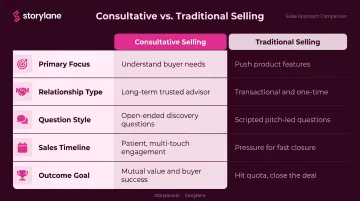
The clearest way to see the difference is side by side.
| Dimension | Consultative Selling | Traditional/Transactional Selling |
|---|---|---|
| Primary focus | Buyer's needs and business outcomes | Product features and immediate purchase |
| Relationship type | Long-term trusted advisor | One-time transaction |
| Question style | Open-ended, probing, aspiration-focused | Closed or feature-qualifying |
| Sales timeline | Extended, multi-touch | Short, often single-call |
| Outcome goal | Mutual value creation | Closed deal |
How It Differs from Solution Selling
Consultative selling is often confused with solution selling, but they're distinct. Solution selling matches a defined product to a defined problem. Consultative selling goes further: it helps buyers reframe what the problem actually is. Harvard Business Review's analysis of CEB research notes that when buyers already arrive with defined needs, pure solution discovery adds little. Consultative sellers who bring new perspective create value that solution sellers can't.
When to Use It
Consultative selling is most effective when:
- Deals involve multiple decision-makers and departments
- The buying cycle extends weeks or months
- The stakes are high and risk perception is strong
- A wrong decision carries significant downstream consequences
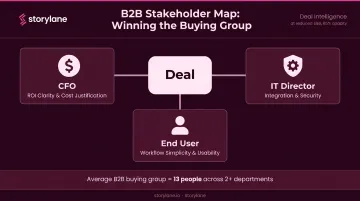
Forrester's 2024 data makes this concrete: the average B2B buying group now includes 13 people across two or more departments. A transactional approach breaks down when consensus must be built across finance, IT, legal, and operations simultaneously.
Core Techniques of Consultative Selling
Active Listening
Active listening means full engagement: tracking verbal cadence, word choice, emotional tone, and what's conspicuously not said. It's not waiting for your turn to speak.
Gong's analysis of 326,000 sales calls found that closed-won deals averaged 57% rep talk time, while lost deals averaged 62%. The gap is small but consistent. Reps who listen more win more. Reading nonverbal cues on video calls (hesitation, energy shifts, changed posture) adds another layer of signal that most reps miss.
Asking High-Impact Questions
The goal isn't more questions — it's better ones. Gong's 2025 data shows that reps in won deals ask 15 to 16 questions per call, while reps in lost deals ask closer to 20. More questions don't signal more curiosity; they often signal poor preparation.
Weak question: "Are you happy with your current process?"
High-impact alternative: "What would have to be true about a new solution for your team to actually adopt it?"
The second version opens space for aspirations, constraints, and internal dynamics that yes/no questions never reach.
Pre-Call Research and Preparation
Walking into a discovery call cold costs credibility immediately. Researching a prospect's industry, competitive position, recent news, and likely pain points before any conversation lets reps demonstrate understanding from the first exchange.
Storylane's Account Reveal surfaces company-level intelligence (industry, employee count, engagement history) when prospects interact with a demo beforehand. Teams like Altrata's receive Slack alerts the moment a prospect engages, with firmographic data and behavioral signals attached, so the first real conversation starts informed.
Personalization at Scale
Consultative sellers tailor every recommendation, proposal, and follow-up to what the specific buyer has shared. The challenge is doing that across a full pipeline without rebuilding everything from scratch.
Storylane addresses this through dynamic smart variables that insert prospect-specific data (company name, industry, role) directly into demo content, so a single template delivers a customized experience to every recipient. When prospects explore those demos before discovery calls, reps can see exactly which features they engaged with, where they dropped off, and which sections held attention longest — all synced to Salesforce or HubSpot before the call begins.
Engaging Multiple Decision-Makers
In complex B2B deals, the person who signs is rarely the only person who matters. Each member of the buying committee needs something different:
- CFO: ROI clarity and cost justification
- IT Director: Integration detail and security requirements
- End user: Workflow simplicity and day-to-day usability
Consultative sellers map the buying committee early, build messaging tailored to each role, and develop internal champions who can advance the deal when the rep isn't in the room. Storylane's Buyer Hubs support this by centralizing multiple demos in a single link with role-based chapter branching, so each stakeholder finds what's relevant while the rep tracks who's engaging and when.
The Consultative Selling Process: Step by Step
1. Prospect and Prepare
Define your ideal buyer profile, then conduct deep pre-call research across:
- Company context and recent news
- Industry pressures and competitive dynamics
- Decision-maker roles and reporting structure
- Likely pain points based on company stage and size
The goal isn't to script the conversation. It's to enter it with enough context that your early questions demonstrate understanding rather than ignorance.
2. Establish Rapport and Qualify
Build trust through genuine curiosity about the buyer's situation. Then qualify early: confirm you're speaking with someone who has authority, that budget exists, and that a real problem is present worth solving. Spending two hours on a deal with no budget and no urgency is a choice, not an unavoidable outcome.
3. Discover Needs Through Dialogue
Use open-ended, probing, and aspiration-focused questions to guide discovery. Listen actively. Take detailed notes. Push past surface-level answers — "our process is slow" is an observation, not a root cause. The rep who gets to the real business impact earns a different level of trust than the one who stops at symptoms.
4. Propose a Tailored Solution
Build your proposal using the specific language, priorities, and concerns the buyer has expressed. Mirror their words back in writing. When a prospect reads a proposal that reflects what they actually said — not a generic template — it confirms they were heard. That confirmation alone reduces friction before a contract is ever reviewed.
5. Handle Objections and Close Collaboratively
Objections are information, not obstacles. Treat each one as a question to answer, not a wall to overcome:
- Price objection → unclear value; revisit ROI and business impact
- Timing objection → misalignment on urgency; reanchor to the cost of inaction
Co-create the path to a decision by involving stakeholders, addressing concerns as they arise, and guiding the buying committee through their internal approval process rather than pushing for a signature.
Key Benefits of Consultative Selling
Stronger, Longer-Lasting Customer Relationships
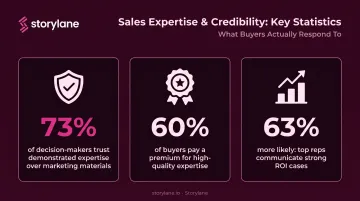
Consultative sellers earn trust by focusing on buyer success, not transaction completion. That trust converts into something transactional sellers rarely achieve: repeat business, referrals, and long-term retention. The 2024 Edelman-LinkedIn B2B Thought Leadership Impact Report, based on 3,484 global executives, found that 73% of decision-makers say demonstrated expertise is a more trustworthy basis for assessing an organization than marketing materials. Reps who consistently bring informed, relevant perspective build that kind of credibility naturally over time.
The same report found 60% of buyers are willing to pay a premium to work with organizations that demonstrate high-quality expertise — a direct argument for investing in consultative depth over transactional speed.
Higher Close Rates on Complex Deals
Deep discovery and personalized proposals reduce late-stage friction by addressing objections before they become blockers. RAIN Group's research on top-performing reps found they are 63% more likely to communicate strong ROI cases — a skill that's only possible when the rep has done the discovery work to understand what ROI actually means to that specific buyer.
When value is established early and reinforced throughout the sales process, pricing conversations become significantly less contentious. Buyers who feel understood don't need to negotiate the value down.
Buyer Intent Intelligence Before the Pitch
Reps who invest in understanding buyers early enter later conversations armed with context that competitors can't match. Interactive demo platforms like Storylane give consultative sellers a practical advantage here.
Before a discovery call, reps can review exactly which features a prospect explored, where they spent the most time, and where they disengaged — all tracked and pushed to CRM automatically.
Companies like Ignition report that prospects arriving at discovery calls after engaging with a Storylane demo are meaningfully better prepared, leading to more focused conversations and less time spent on basic product education. ContactMonkey achieved a 28% demo-to-opportunity conversion rate — roughly twice the rate of other inbound sources — attributed to the same pre-qualification effect.
When prospects arrive already familiar with the product, reps spend less time educating and more time closing.
Frequently Asked Questions
What best describes consultative selling?
Consultative selling is a buyer-first approach where the rep acts as a trusted advisor, prioritizing a deep understanding of the prospect's needs, challenges, and goals before recommending any solution. The emphasis is on diagnosing business problems and co-creating solutions, not pitching products.
What is an example of consultative selling?
A software sales rep spends the first call asking about a prospect's current workflow bottlenecks and team structure. Rather than following up with a standard demo, the rep returns with a tailored walkthrough addressing the specific pain points raised — showing the buyer exactly how the product fits their environment rather than a generic use case.
What are the 4 C's in sales?
The best-known 4 C's framework comes from Robert Lauterborn's 1990 marketing model: Customer needs, Cost, Convenience, and Communication. In sales contexts, some practitioners adapt these into Connect, Collaborate, Communicate, and Close , though no single standard version exists across the industry.
How is consultative selling different from traditional selling?
Traditional selling leads with the product and pushes features toward a close; consultative selling leads with questions and structures recommendations around the buyer's specific situation. The distinction matters most in complex B2B deals, where multiple stakeholders and high perceived risk make feature-led pitching structurally ineffective.
What skills are most important for consultative selling?
Active listening, open-ended questioning, pre-call research, empathy, and real-time adaptability based on what the buyer reveals are the highest-leverage skills. Following a rigid script is the fastest way to undermine the trust consultative selling is designed to build.