The difference between teams that consistently hit pipeline targets and those that don't rarely comes down to budget or headcount. It comes down to strategy. Specifically, knowing which channels attract buyers who are actually ready to buy, and building systems that prioritize those buyers over everyone else.
This guide covers both pillars of modern B2B lead generation: proven inbound and outbound strategies that consistently drive qualified pipeline, plus modern tactics — intent data, AI-powered scoring, and interactive demos — that are reshaping how fast teams can identify and convert in-market buyers.
Key Takeaways
- B2B lead generation means identifying prospective buyers, capturing their interest, and moving them toward a sales conversation
- Inbound strategies attract high-intent buyers over time; outbound (cold email, ABM, LinkedIn) reaches target accounts proactively
- Interactive demos, intent data, and AI scoring help teams identify in-market buyers earlier and qualify them faster
- Quality beats volume — the best programs focus on ICP-aligned channels, not maximum lead count
- Sales and marketing alignment on MQL/SQL definitions determines whether leads actually convert
What Is B2B Lead Generation and Why It Matters
B2B lead generation is the process of identifying companies or individuals within companies who could benefit from your product, capturing their contact information, and engaging them until they're ready for a sales conversation.
It's fundamentally different from B2C lead generation. B2B deals involve longer sales cycles — averaging 10.1 months in 2025 according to a 6sense study of nearly 4,000 B2B buyers — multiple decision-makers (often 10 or more), and purchasing decisions heavily influenced by ROI, risk, and organizational fit rather than personal preference.
Without a deliberate lead generation engine, sales teams turn reactive. Pipelines thin, revenue becomes unpredictable, and growth stalls. 74% of B2B marketers say content marketing helped generate demand and leads in the past 12 months — which means lead gen isn't a supporting function anymore. It's the engine.
Understanding why lead gen matters is step one. The next is knowing what you're actually generating — and how to tell when a lead is ready to move.
MQLs vs. SQLs: Why the Distinction Matters
Two lead types drive how modern B2B teams operate:
- MQL (Marketing Qualified Lead): Shows interest through content downloads, webinar attendance, or page visits — but isn't yet ready for a sales conversation
- SQL (Sales Qualified Lead): Actively engaging, has demonstrated buying intent, and is ready to speak with a rep
The MQL-to-SQL gap is where most pipeline leakage happens. When sales and marketing don't agree on what qualifies as each, leads get passed too early (wasting rep time) or held too long (losing warm buyers to competitors). Getting aligned on both definitions — and the handoff criteria — is the starting point for any lead gen program that actually works.
Top Inbound B2B Lead Generation Strategies
Inbound lead generation attracts buyers who are already searching for solutions. Done well, it delivers higher-intent leads and lower cost-per-lead over time compared to purely outbound approaches.
Content Marketing and SEO
Publishing educational content — blog posts, guides, case studies, whitepapers — positions your brand as the trusted authority before buyers ever speak to a salesperson. SEO ensures that content surfaces when your ICP is actively searching.
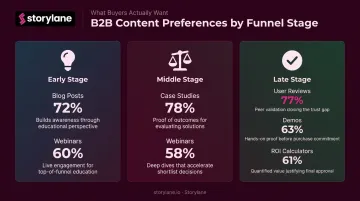
The key is mapping content to buyer journey stage. According to Demand Gen Report's 2024 Content Preferences Survey, buyer preferences vary significantly by stage:
- Early stage: Blog posts (72%) and webinars (60%)
- Middle stage: Case studies (78%) and webinars (58%)
- Late stage: Demos (63%), user reviews (77%), and ROI calculators (61%)
To convert content traffic into leads:
- Gate high-value assets (research reports, templates, playbooks) to capture contact information
- Embed CTAs on high-traffic pages that match the content's buyer stage
- Repurpose top-performing content across email and LinkedIn to extend reach
NetLine's analysis of 8 million first-party registrations found B2B content demand increased 27% year over year. Buyers are consuming content at every stage — the question is whether yours surfaces at the right moment. That same intent carries over to where buyers spend their professional time: LinkedIn.
Social Selling and LinkedIn
Social selling uses platforms — primarily LinkedIn — to build visibility and create warm outreach opportunities before any direct ask. LinkedIn reports 89% of B2B marketers use the platform to generate leads, and social selling leaders create 45% more sales opportunities than peers with lower Social Selling Index scores.
Actions that build pipeline on LinkedIn:
- Share thought leadership content regularly (your own POV, not just reposts)
- Engage with prospects' posts before sending connection requests
- Use LinkedIn Sales Navigator to surface in-market accounts based on engagement signals
- Respond to comments on your posts — each one is a potential warm conversation
Webinars and Virtual Events
Webinars are one of the highest-intent lead formats in B2B. Registration requires a prospect to identify themselves and commit time — that combination signals genuine interest that a content download alone doesn't.
ON24's 2025 benchmark data shows strong engagement numbers: average attendance of 216 per webinar, a 57% registration-to-attendance rate, and average engagement of 51 minutes. Meeting bookings during webinars increased 3x in 2024.
Structure webinars for lead gen by:
- Choosing a topic tied to a real, specific pain point — not a product feature
- Including live Q&A to increase engagement and surface buying signals
- Following up with attendees within 24 hours — they're often mid-funnel and ripe for a direct sales conversation
- Making recordings available on-demand, since on-demand viewing accounts for 50% of all webinar attendees
Referral Programs
Event-based touchpoints drive strong engagement, but some of the warmest leads never come from a campaign at all. Referral leads arrive with built-in trust — a peer already vouched for you. Influitive research found B2B companies with formalized referral programs generate 2x more high-quality referrals and are 3x more likely to reach revenue targets when marketing owns the program.
Yet only one in three B2B organizations has a formalized referral program — which means most companies are leaving their highest-converting lead source on the table.
To operationalize referrals effectively:
- Make the ask personal and specific — a targeted message to a satisfied customer outperforms a generic email blast
- Offer a meaningful incentive: credits, cash, or exclusive access
- Give customers a simple template so they don't have to write the introduction themselves
Top Outbound B2B Lead Generation Strategies
Outbound is the proactive complement to inbound — essential for reaching high-value accounts that may never find you organically, and for accelerating pipeline when you need results quickly.
Cold Email and Personalized Outreach
Cold email works when it's precise. The core mistake most teams make is prioritizing volume over relevance — sending thousands of generic messages that hurt deliverability and brand reputation simultaneously.
What precision looks like in practice:
- Segment lists tightly by industry, company size, and role before writing a single word
- Personalize beyond first-name tokens — reference a specific company challenge, recent news, or industry dynamic
- Use a clear, low-friction CTA ("worth a 15-minute call?" performs better than "schedule a demo")
- Run multi-touch sequences across email and phone, with behavioral triggers that adjust follow-up timing based on actions like pricing page visits or content downloads
A/B test subject lines and CTAs continuously. Small improvements in open and reply rates compound significantly across a large sequence.
Account-Based Marketing (ABM)
ABM flips the traditional demand gen model. Instead of casting a wide net, sales and marketing align around a defined list of target accounts and deliver personalized messaging to each account's buying committee. This makes it especially effective for enterprise deals with multiple stakeholders, where treating each account as its own market is the whole point.
Demandbase reports top B2B marketers achieved 81% higher ROI with ABM, with Forrester data showing the most common outcome is 21-50% higher ROI.
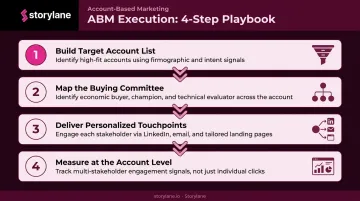
Core ABM execution steps:
- Build your target account list using firmographic filters (size, industry, tech stack) and intent data
- Map the buying committee — identify the economic buyer, champion, and technical evaluators
- Deliver personalized touchpoints across LinkedIn ads, email, and dedicated landing pages
- Measure at the account level, not just the contact level — engagement from multiple stakeholders signals a live deal
For ABM specifically, interactive demos can accelerate this motion significantly. Storylane lets teams build one guided demo and create personalized versions for 20-50 target accounts — swapping logos, company names, and brand colors — with tracking at the account level to see exactly who's engaging.
LinkedIn Prospecting and Sales Outreach
LinkedIn prospecting bridges inbound and outbound when done strategically. Reps identify decision-makers at target accounts, warm up the relationship by engaging with their content, then initiate a direct conversation with a relevant, personalized message.
Timing matters. Reaching out after a prospect has engaged with your company's content or a rep's post is a warm moment, far more likely to get a response than cold outreach to the same person with no prior history.
LinkedIn Sales Navigator supports this with intent-based filtering:
- Pinpoint the right contact within a target account
- Surface hiring signals and company growth triggers
- Prioritize outreach based on recent engagement activity
Modern B2B Lead Gen Tactics: AI, Intent Data, and Interactive Demos
Buyer behavior has shifted in ways that most lead gen programs haven't fully adapted to. The 6sense 2025 study found that sellers now make first contact at roughly 61% of the way through the buying journey — meaning buyers have already done significant research, formed preferences, and often built a shortlist before any human interaction. The pre-contact favorite vendor wins approximately 80% of the time.
Teams that can identify who is in-market before that shortlist forms — and engage them with the right experience — have a structural advantage.
Intent Data and AI-Powered Lead Scoring
Intent platforms identify companies actively researching your category by monitoring content consumption signals, search behavior, and review site activity. When a company in your ICP starts reading competitor comparisons and visiting G2 review pages for your category, that's a buying signal you can act on before they ever reach out.
AI-powered lead scoring takes this further, prioritizing leads most likely to convert based on behavioral signals (pages visited, content consumed, demo engagement) and firmographic data (company size, industry, funding stage). Together, these tools focus outreach on accounts already in motion — rather than equal-effort prospecting across a cold list.
Bombora was named a Leader in the Forrester Wave for B2B Intent Data Providers in Q1 2025, a signal of how mature this category has become.
Interactive Product Demos
Traditional lead generation has a timing problem: prospects want to understand your product's value before committing to a sales call, but most B2B software requires a sales call before they can see the product. Interactive demos close that gap.
Rather than waiting for a prospect to book a call, interactive demos let buyers self-explore features at their own pace — embedded on landing pages, sent in email sequences, or gated behind a lead capture form. Late-stage buyers prioritize demos (63%) in their evaluation process, yet most teams don't surface a product experience until deep in the sales cycle.
The data on interactive demo performance is compelling. Storylane's internal analysis found that website visitors who engage with interactive demos convert at 24.35% vs. 3.05% for the overall average — nearly 8x higher. ContactMonkey generated $1.3M in attributed pipeline from a single interactive demo, with demo-sourced leads converting to opportunities at 28%, roughly double other inbound sources.
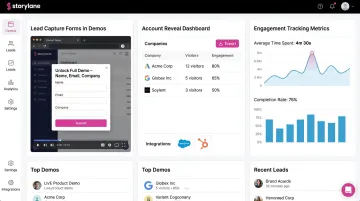
Storylane's platform lets teams:
- Capture leads directly inside demos with custom forms that sync to Salesforce, HubSpot, Marketo, and other CRMs
- Use Account Reveal to de-anonymize demo visitors and surface company-level buying signals, even from ungated demos
- Track engagement depth — time spent, completion rate, features explored, and return visits — to score intent and trigger real-time Slack alerts when high-value accounts engage
- Personalize at scale for ABM campaigns using dynamic tokens for company name, logo, and brand colors
When a prospect engages deeply with a demo, they arrive at a sales conversation already informed — compressing the sales cycle. Dreamdata found that 40.9% of all closed-won new business was influenced by their interactive demos and use case pages.
Navattic's 2024 analysis found interactive demos increased in adoption by nearly 90% since 2022, with the top-performing demos achieving click-through rates between 8-32%.
Marketing Automation and Lead Nurturing
Marketing automation bridges initial interest and sales readiness. Automated email sequences, behavioral triggers, and CRM-synced workflows ensure no lead goes cold between touchpoints.
Effective nurturing delivers value matched to where the buyer actually is — not a one-size drip sequence:
- Educational content that addresses pain points without pitching (awareness)
- Case studies, competitor comparisons, and ROI frameworks (consideration)
- Demos, customer references, and risk-reduction content like security reviews or implementation guides (decision)
- Re-engagement sequences for leads that went quiet after early interactions
The stage mismatch — sending decision-stage content to early-stage leads — is one of the most common nurturing mistakes. Behavioral triggers that respond to actual prospect actions (not just time-based drips) are what separate effective nurture programs from the ones that get unsubscribed.
How to Build and Prioritize Your B2B Lead Generation Strategy
No single strategy works for every business. The right mix depends on your ICP, average deal size, sales cycle length, and available resources.
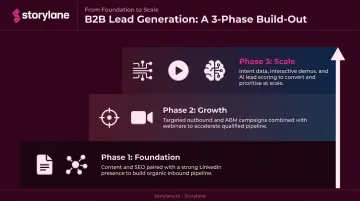
A Practical Prioritization Framework
Start here (Phase 1):
- Content + SEO: Builds durable, compounding inbound traffic
- LinkedIn presence: Establishes credibility for both inbound and outbound
Layer in (Phase 2):
- Targeted outbound: ABM or cold email to a tightly defined account list
- Webinars: If your buyers are mid-funnel and education-hungry
Add as you scale (Phase 3):
- Intent data: To focus outbound on in-market accounts
- Interactive demos: To qualify leads faster and reduce sales cycle length
- AI lead scoring: To prioritize the highest-probability pipeline
The Most Common Mistake
Spreading effort across too many channels instead of going deep on 2-3 that align with where your buyers actually spend time. A mediocre presence on six channels will always underperform a strong, consistent presence on three.
Define success metrics before launching any channel:
| Metric | What It Tells You |
|---|---|
| Cost per lead (CPL) | Channel efficiency |
| Lead-to-MQL rate | Lead quality |
| MQL-to-SQL rate | Sales/marketing alignment |
| Pipeline influenced | Revenue impact |
| ROI by channel | Where to invest more |
Track by source so you can cut what isn't working and invest more in what works.
Strong channel execution only takes you so far — if sales and marketing aren't pulling in the same direction, leads stall before they reach pipeline. Make sure both teams are aligned on:
- ICP definition — who you're actually targeting
- Lead qualification criteria — what makes an MQL vs. SQL
- Handoff timing — when marketing passes to sales, and how
- Shared pipeline goals — not separate "leads generated" vs. "deals closed" scorecards
When these four elements are locked in, the tactics above compound. When they're not, even your best-performing channels produce noise instead of revenue.
Conclusion
Effective B2B lead generation comes down to one principle: doing the right things for your specific buyers, not doing everything.
The teams hitting pipeline targets consistently are the ones who combine inbound and outbound channels deliberately, layer in modern tactics at the right stage, and keep their focus on in-market buyers rather than maximizing raw lead volume.
If interactive demos aren't yet part of your lead gen mix, they're worth a hard look — especially if you need to qualify prospects faster, cut sales cycle friction, or surface buying intent from anonymous website traffic.
Storylane offers a free plan to start building demos, with Account Reveal and CRM integration available as you scale. Teams that use it consistently report one thing: prospects who engage with a demo before a sales call show up to conversations already sold on the category — and far easier to close.
Audit your current channel mix, identify the 1-2 gaps with the highest potential impact, and build there first.
Frequently Asked Questions
What are the lead generation strategies for B2B?
The main categories are inbound (content marketing, SEO, social selling, webinars, referrals) and outbound (cold email, ABM, LinkedIn prospecting). The most effective programs combine both and layer in modern tactics like intent data and interactive demos to identify and engage in-market buyers earlier.
What is the 95-5 rule for B2B?
The 95-5 rule (from Professor John Dawes at the Ehrenberg-Bass Institute) states that only 5% of B2B buyers are actively in-market at any given time. Brand building matters as much as demand capture — when prospects finally enter that 5%, you want to be the first vendor they think of.
What are the 4 C's of B2B marketing?
The 4 C's framework covers Customer (understanding buyer needs deeply), Cost (total cost of ownership, not just price), Convenience (how easily buyers can evaluate and adopt your solution), and Communication (two-way dialogue rather than one-way promotion).
What is the difference between inbound and outbound B2B lead generation?
Inbound attracts buyers who come to you through content, SEO, and social media — typically higher intent, but slower to build. Outbound involves proactively reaching target accounts via email, calls, and ABM — faster to pipeline, but requires precision to avoid wasted effort on low-quality outreach.
How do you qualify B2B leads?
Common methods include lead scoring (behavior and firmographics), the BANT framework (Budget, Authority, Need, Timeline), and ICP matching. MQLs have cleared a marketing engagement threshold; SQLs have shown buying intent and are ready for a sales conversation.
What metrics should I track for B2B lead generation?
Track cost per lead (CPL), lead-to-MQL conversion rate, MQL-to-SQL rate, pipeline influenced, and ROI by channel. Measuring these by source shows exactly which strategies to scale and which to cut.