A well-built sales pipeline fixes this. It gives your team a stage-by-stage system that shows exactly where every deal stands, what action is required, and which opportunities deserve attention right now.
This guide covers what a sales pipeline is, the core stages it should include, how to build one step by step, the metrics that reveal whether it's healthy, the tools that make it work, and the mistakes that quietly kill revenue.
Key Takeaways
- A sales pipeline is a visual, stage-by-stage system for tracking every active deal from first contact to closed-won.
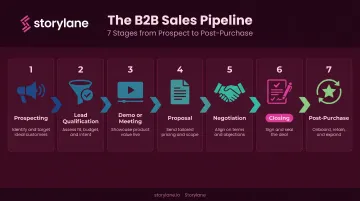
- Most B2B pipelines run 6–7 stages: prospecting, qualification, demo/meeting, proposal, negotiation, closing, and post-purchase.
- Building a pipeline requires a defined ICP, clear stage-entry criteria, consistent lead generation, and consistent review cadences.
- Metrics like pipeline velocity, stage conversion rates, and deal age expose bottlenecks before they hurt revenue.
- Pairing a CRM with interactive demo software and analytics directly accelerates deal progression.
What Is a Sales Pipeline and Why Does It Matter?
A sales pipeline is a visual representation of where every active deal sits in your sales process — from first contact to closed-won. It's a structured, stage-by-stage workflow that tells reps what action to take next and gives managers a real-time snapshot of deal health and expected revenue.
Unlike a contact list or a spreadsheet of leads, a pipeline maps each deal to a defined stage with clear next steps attached.
Pipeline vs. Sales Funnel
These two terms get used interchangeably, but they serve different purposes:
- Sales pipeline — the seller's view. Shows what actions reps must take to move each deal forward through defined stages.
- Sales funnel — the buyer's view. Shows how leads narrow from broad awareness down to purchase, used to measure conversion rates at each level.
The pipeline drives daily rep activity; the funnel tells you where conversions are breaking down. You need both to manage execution and diagnose performance.
Why Pipeline Health Drives Business Outcomes
According to HBR research, companies with a formal sales process generate 18% more revenue growth than those without one. The same research found that managers who spend at least three hours per month on each rep's pipeline see 11% greater revenue growth.
Beyond revenue, a healthy pipeline:
- Enables accurate forecasting by showing deal value and expected close dates
- Surfaces bottlenecks before they compound into missed quarters
- Helps prioritize high-value deals over low-probability ones
- Gives managers visibility into where individual reps need coaching
Key Stages of a Sales Pipeline
The exact number of stages varies by industry and deal complexity, but most B2B pipelines follow six or seven core stages. The important thing: each stage should map to a specific buyer action or milestone, not just a calendar interval. Stages tied to buyer milestones give reps clear signals on where to push — and when to hold.
Prospecting
Prospecting is where reps identify potential buyers through outbound channels (cold email, LinkedIn, cold calling) and inbound sources (content downloads, demo requests, referrals). Quality beats volume here. Filling the pipeline with prospects who don't match your Ideal Customer Profile creates noise that distorts forecasts and wastes rep time.
Lead Qualification
Qualification separates real opportunities from time-wasters. The BANT framework (Budget, Authority, Need, Timeline) — popularized by IBM — remains a practical starting point for structured screening. Many teams layer in lead scoring within their CRM to automate initial qualification so reps spend time only on prospects who meet minimum thresholds.
Unqualified leads left in the pipeline inflate pipeline value and make forecasting unreliable — not just a time problem, but a revenue visibility problem.
Demo or Meeting
This is the stage where reps demonstrate value tied directly to the prospect's pain points. Modern B2B buyers increasingly expect to experience a product before a formal call — Gartner has reported that 75% of B2B buyers prefer a rep-free sales experience at some point in their journey.
Sending an interactive demo before the meeting addresses this directly. When prospects arrive already familiar with the product, discovery becomes faster and conversations go deeper.
Storylane lets teams share personalized, self-guided demos ahead of live calls. Prospects explore on their own terms; reps enter the meeting with engagement data showing exactly what the prospect found interesting.
Proposal and Negotiation
The proposal formally outlines the solution, pricing, and value proposition tailored to the prospect's specific situation. Negotiation is where both sides align on scope and terms. A generic proposal is one of the most common reasons deals stall here. Proposals that mirror the prospect's language, priorities, and use cases tend to move faster through this stage.
Dynamic token personalization — available in tools like Storylane — lets reps customize demos at the proposal stage without building separate versions for each account.
Closing and Post-Purchase
The closing stage finalizes the contract. But the pipeline doesn't end at closed-won — especially for SaaS and subscription businesses. Post-purchase (onboarding, follow-up, expansion) is increasingly treated as its own pipeline stage.
Effective post-purchase management delivers compounding returns:
- Reduces churn through structured onboarding and follow-up
- Drives referrals from satisfied customers who become advocates
- Opens upsell and expansion conversations tied directly to revenue growth
How to Build a Successful Sales Pipeline Step by Step
Step 1: Define Your ICP and Revenue Targets
Before touching pipeline structure, get clear on who belongs in it. Your Ideal Customer Profile — company size, industry, job title, pain points, budget range — determines which prospects qualify and which don't.
Revenue targets work backwards: how many deals, at what average deal size, with what win rate do you need to hit your number? This math drives your pipeline coverage target.
Step 2: Map Stages to Entry and Exit Criteria
Each pipeline stage needs more than a name. Define what gates movement in and out:
- Entry criteria — what must be true for a deal to enter this stage (e.g., "prospect has confirmed need and budget")
- Exit criteria — what must happen to advance to the next stage (e.g., "proposal accepted, verbal commitment received")
This removes ambiguity, makes pipeline reviews consistent, and gives managers a concrete basis for coaching reps.
Step 3: Build a Consistent Lead Generation Engine
Pipeline generation is an ongoing discipline. Inbound (SEO, content, product-led demos, paid ads) and outbound (cold outreach, LinkedIn, referrals) are complementary — most teams need both.
Coverage targets vary by motion:
- Standard B2B: 3–4x pipeline coverage (total pipeline value vs. revenue target)
- Enterprise / long-cycle: closer to 5x to account for slower movement and higher deal fallout
- High-velocity SMB: 2–3x is often sufficient when win rates are higher
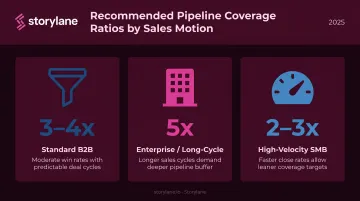
The right ratio depends on your win rate, average deal size, and pipeline hygiene.
Step 4: Invest in Engagement and Nurturing
Demand Gen Report research found that 51% of B2B buyers say content is too generic or irrelevant, while 89% consume independently discovered assets before engaging a rep. Teams that equip prospects with personalized content during the nurturing phase see faster deal progression.
Interactive demos are particularly effective here. Storylane customers report outcomes including a 3x improvement in sales velocity and a 25% increase in pipeline from sharing demos earlier in the process. As one sales manager put it: "Prospects see the product. We skip over the discovery, and jump straight into a high-intent demo."
Buyer hubs — organized collections of demos, case studies, and other content behind a single shareable link — are well-suited to mid-to-late pipeline stages where multiple stakeholders need to evaluate the product and build internal consensus.
Step 5: Document the Pipeline in a CRM and Align Your Team
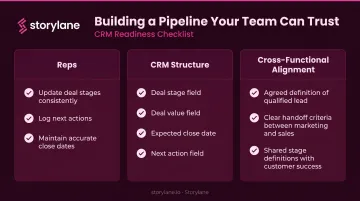
A pipeline is only as reliable as the data in it. That means:
- Reps update deal stages, close dates, and next actions consistently
- CRM fields are structured to support useful pipeline reports (deal stage, deal value, expected close date, next action)
- Marketing, sales, and customer success are aligned on stage definitions and handoff criteria
Cross-functional alignment is often overlooked. When marketing doesn't know what "qualified lead" means to sales, the pipeline fills with mismatches that waste everyone's time. Get these definitions agreed on before you scale — the further along a misaligned prospect gets, the more expensive the correction.
How to Measure and Optimize Pipeline Performance
A pipeline that looks full on paper but is loaded with stale deals gives a false sense of security. Ebsta's B2B Sales Benchmarks found that 44% of deals slipped and 31% of opportunities were already past their close date — clear evidence that raw pipeline volume doesn't equal pipeline health.
Core Metrics to Track
| Metric | What It Tells You |
|---|---|
| Number of qualified leads | Whether you have enough real opportunities |
| Stage-by-stage conversion rates | Where deals stall or drop out |
| Average deal size | Whether deal quality is improving or declining |
| Average sales cycle length | How long deals take to close |
| Pipeline velocity | How fast revenue flows through the pipeline |
| Pipeline coverage ratio | Whether you have enough pipeline to hit targets |
Pipeline Velocity
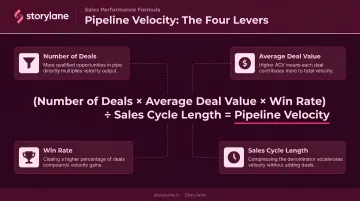
Pipeline velocity is one of the most useful and underused metrics in sales. The formula:
(Number of Deals × Average Deal Value × Win Rate) ÷ Sales Cycle Length = Pipeline Velocity
This single number shows how fast money flows through your pipeline. Improving any of the four inputs — more qualified deals, larger deal sizes, better win rates, or shorter cycles — accelerates revenue. It also reveals which levers to pull: if win rate is the drag, the problem is likely qualification or proposal quality; if cycle length is the issue, look at nurturing and follow-up cadence.
Pipeline Reviews
Two distinct review cadences matter:
- Weekly deal reviews with individual reps to address stuck deals, update stages, and plan next actions
- Monthly or quarterly pipeline audits to remove dead deals, identify stage-level bottlenecks, and adjust lead generation based on coverage gaps
Buyer engagement analytics add a layer that CRM data alone misses. Knowing which demo features a prospect spent time on, or where they dropped off, gives reps conversation starters rooted in actual behavior, not guesswork.
Take that same analytical lens to pipeline segmentation — break data down by rep, product line, region, or lead source. If one channel closes twice as fast, shift budget and effort accordingly.
Tools to Build and Manage Your Sales Pipeline
CRM Software
The CRM is the backbone of any pipeline. It centralizes deal data, automates stage transitions, enables forecasting, and gives the entire revenue team a shared view. Common options include Salesforce (ranked #1 CRM provider for the 12th consecutive year by IDC), HubSpot, and Pipedrive. AI-powered CRMs increasingly automate lead scoring, next-best-action recommendations, and data entry — HubSpot's 2025 State of Sales found 84% of sales professionals say AI saves them time on exactly these tasks.
Interactive Demo and Sales Enablement Tools
Platforms like Storylane help reps engage prospects more effectively during the demo and nurturing stages. Sales teams can create personalized, self-guided demos that prospects explore asynchronously — then use engagement analytics (where prospects spent time, which features they explored, where they dropped off) to prioritize outreach and personalize follow-up conversations.
Storylane also adds pipeline intelligence that most demo tools skip:
- Account Reveal de-anonymizes anonymous demo visitors, surfacing company and contact data that flows directly into Salesforce, HubSpot, or Pipedrive
- Real-time Slack alerts notify reps the moment a target account engages, so follow-up happens while the prospect is still evaluating
- Engagement analytics show exactly which features held attention and where prospects dropped off — giving reps a concrete starting point for the next conversation
Prospecting, Analytics, and Communication Tools
- LinkedIn Sales Navigator, Apollo, and ZoomInfo fill the top of the pipeline with qualified accounts
- Gong and Clari surface deal-level risks, forecast accuracy, and conversation patterns
- Multi-channel sequencing tools coordinate email, calls, and social touchpoints across the buyer journey
The critical factor across all of these is connectivity. Data should flow between tools and back into the CRM — a fragmented stack means a fragmented pipeline view, and that's where deals quietly stall.
Common Sales Pipeline Mistakes to Avoid
Overstuffing with Unqualified Leads
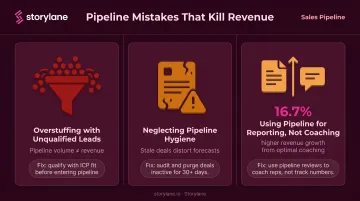
More deals in the pipeline don't mean more revenue — they can actually harm forecasting and burn rep time. Ebsta found that pipeline generation increased 23% while win rates simultaneously fell, showing that volume alone doesn't solve revenue problems.
A well-defined qualification process prevents bad leads from entering; regular deal reviews remove them when they slip through.
Neglecting Pipeline Hygiene
Stale deals, outdated contact info, and opportunities stuck in the same stage for weeks will distort your forecast and erode team confidence. Set "deal rot" rules — automated flags for deals that haven't moved in a defined number of days — so reps and managers catch deteriorating opportunities before they skew reporting.
Using the Pipeline for Reporting Instead of Coaching
The numbers on a pipeline report matter less than the conversations they enable. The best use of pipeline data is identifying where specific reps struggle — deals that convert well through the demo but stall at proposal, for instance — and coaching to that gap.
Sales Management Association research found that optimal coaching correlates with 16.7% higher annual revenue growth, with pipeline management consistently ranking among the top coaching topics driving that outcome.
Frequently Asked Questions
What is a sales pipeline?
A sales pipeline is a visual, stage-by-stage system that tracks every active deal from initial contact to close. It helps sales teams prioritize actions, forecast revenue, and identify where opportunities are stalling, giving reps and managers a shared view of what needs to happen next.
What are the stages of a sales pipeline?
Most B2B pipelines include prospecting, lead qualification, demo or meeting, proposal, negotiation, closing, and post-purchase. The exact stages vary by company, industry, and product complexity — what matters is that each stage maps to a specific buyer milestone, not just a time interval.
What is the difference between a sales pipeline and a sales funnel?
A sales pipeline is the seller's view — it shows active deals and the actions reps must take to advance them. A sales funnel is the buyer's journey from awareness to purchase, used to measure how leads convert at each stage. Both are useful, but they serve different purposes.
What metrics should you track in a sales pipeline?
Track these six: number of qualified leads, stage-by-stage conversion rates, average deal size, sales cycle length, pipeline velocity, and pipeline coverage ratio. Together, they show not just how much is in your pipeline, but how fast and reliably it converts.
How often should you review your sales pipeline?
Run weekly deal-level reviews with reps to address stuck deals and keep stages current. Monthly or quarterly audits go further: remove dead deals, surface stage bottlenecks, and adjust top-of-funnel activity based on coverage gaps.
How do you keep your sales pipeline from stagnating?
Three habits keep pipelines healthy: continuously add qualified leads at the top, maintain follow-up cadences so no deal goes quiet, and cut deals that exceed your average sales cycle with no meaningful engagement. Most CRMs can automate deal rot flags to enforce this without manual tracking.