A well-built sales playbook closes that gap. It captures what your best reps instinctively do — the questions they ask, the objections they handle, the assets they share — and puts that knowledge in every rep's hands. Done right, it's not an onboarding PDF that collects dust. It's a strategic asset that shapes how your entire team sells.
This guide covers what a sales playbook actually is, the components it needs, a six-step process to build one, how to drive real adoption, and how to keep it from going stale.
Key Takeaways
- A sales playbook codifies your process, messaging, tools, and plays in one living reference — not a one-time onboarding doc
- Strong playbooks cover buyer personas, stage-by-stage criteria, objection handling, demo assets, battle cards, and measurable KPIs
- Build it with input from top performers, sales leaders, marketing, and customer success — never in isolation
- Driving adoption means securing leadership buy-in, reinforcing through managers, and embedding the playbook directly in your CRM
- Keep it current with a named owner, quarterly reviews, and a structured rep feedback loop
What Is a Sales Playbook (and Why Does It Matter)?
A sales playbook is a centralized guide that documents your company's sales methodology, process stages, messaging, tools, and best practices. Its purpose: give every rep a repeatable roadmap for how to sell your product, regardless of tenure.
How It Differs From Related Terms
These three concepts are often conflated, and that confusion creates gaps:
- Sales playbook — the overarching system: methodology, process, messaging, assets, and performance benchmarks
- Sales process — the stage-by-stage framework the playbook is built around (one chapter of the playbook, not the whole thing)
- Sales play — a specific, situational set of tactics for a defined scenario (re-engaging stalled deals, handling a price objection, competing against a named rival)
Treating these as interchangeable means teams end up with a process document that has no messaging, or a set of plays with no underlying methodology. Understanding the difference is the first step toward building something that actually gets used.
The Business Case
The ROI on documented sales processes is well established. CSO Insights' 2019 Sales Enablement Study found that organizations with sales enablement reported an average 49% win rate — 6.5 percentage points higher than organizations without it. That gap compounds across a full sales team over a full year.
A playbook is how you turn that advantage rather than leaving it in a few top performers' heads.
Essential Components of an Effective Sales Playbook
Company Foundation and ICP
Every playbook should open with context — not a corporate mission statement, but the information a rep needs to sell confidently:
- Company positioning and what market problem you solve
- Ideal customer profiles (ICPs) with firmographic criteria (size, industry, tech stack, growth stage)
- Buyer personas for each key role, including their pain points, buying authority, and the objections they typically raise
This grounding ensures every rep knows who they're selling to and why the product matters to that specific person.
Sales Process and Methodology
The playbook must define each stage of your sales cycle — from prospecting through close — with:
- Entry criteria: the specific conditions that qualify a deal to move into this stage
- Exit criteria: what must be demonstrably true before the deal advances
- Chosen methodology (SPIN, Challenger, Consultative, etc.) and how it applies to your specific buyer type
Vague stage definitions are where deals stall and forecast accuracy breaks down — defined criteria solve both problems at once.
Product Information, Demo Assets, and Sales Collateral
Reps need feature-benefit language, not technical specs. Organize collateral by persona and sales stage so reps can retrieve the right asset in seconds.
One asset category worth prioritizing: interactive product demos. Forrester research found that 65% of content marketing assets go unused because they're irrelevant to the specific buyer or context. Interactive demos address this directly by letting prospects explore the product on their own terms, in their own role context.
Teams using Storylane embed personalized, clickable demos in prospecting sequences, meeting confirmations, and follow-up emails — giving prospects a hands-on product experience before the sales call happens. Prospects who engage with interactive demos have achieved deal conversion rates 3.2x higher than non-demo-engaged prospects, based on Storylane's internal platform data.
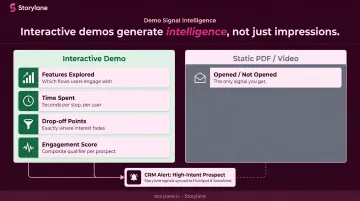
Unlike a static PDF or recorded video, an interactive demo generates behavioral signals: which features a prospect explored, how long they spent, where they dropped off — intelligence that makes the first conversation sharper.
Objection Handling and Competitive Battle Cards
Document the top 5–7 objections reps actually encounter — price, integration concerns, timing, competitive alternatives — with proven responses sourced from your top performers.
For your top 3–5 competitors, build battle cards covering:
- Their strengths (don't dismiss these — reps who know them can pre-empt them)
- Their weaknesses and gaps
- Your differentiators and how to make them land
- Specific language for competitive displacement conversations
Scripts, Templates, and Plays
The tactical layer of the playbook should include:
- Cold call scripts and voicemail frameworks
- Discovery question sets organized by persona
- Email templates for outreach, follow-up, and re-engagement
- Presentation outlines for different deal stages
- Situation-specific plays — step-by-step guidance for high-frequency scenarios like re-engaging stalled deals, handling multi-stakeholder evaluations, or competing against a specific named rival
Each play should specify: the target scenario, the recommended actions in sequence, and the assets to use at each step.
KPIs and Performance Benchmarks
The playbook should define what success looks like — by role and by stage:
- Conversion rate from stage to stage
- Average deal size and time to close by segment
- Activity benchmarks (calls per day, demos per week, follow-up cadence)
- Links to the dashboards where performance is tracked
When benchmarks live in the playbook alongside the process itself, managers can coach to numbers rather than instincts — and reps know exactly what "on track" looks like before their first pipeline review.
How to Build Your Sales Playbook: A Step-by-Step Process
Step 1 — Assemble the Right Team
The playbook owner (typically a sales enablement manager or senior sales leader) should pull contributors from:
- Sales leadership — process authority and strategic priorities
- Top-performing reps — field reality and what actually moves deals
- Marketing — messaging consistency and content inventory
- Customer success — post-sale patterns that reveal objections and use cases the sales team may not surface
Each group brings a lens the others lack. A playbook built without rep input will read like it was written by someone who hasn't taken a discovery call in years.
Step 2 — Audit Existing Processes and Interview Top Performers
Before writing anything new, do the research:
- Conduct structured interviews with your best reps — ask what they do at each stage, not what the process says they should do
- Analyze win/loss data and CRM records for patterns in deal velocity and stage conversion
- Review call recordings to identify the questions that move deals forward and the moments where they stall
- Audit existing content — what gets shared, what gets ignored, what's missing entirely
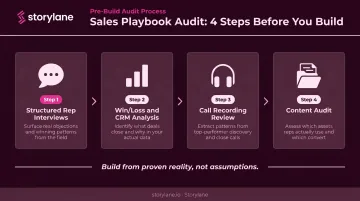
Build the playbook from proven reality, not assumptions.
Step 3 — Define Stages, Methodology, and Plays
Map each stage of your sales cycle with clear entry and exit criteria. Align it to your chosen methodology. Then develop specific plays for the situations reps face most:
- Competitive displacement scenarios
- Multi-stakeholder evaluations where the champion isn't the decision-maker
- Price objections at late stage
- Re-engaging deals that have gone quiet
Each play should specify the scenario, the recommended action sequence, and the assets to deploy.
Step 4 — Build Out Content and Templates
Create or consolidate the scripts, email templates, battle cards, case studies, and collateral assets that support each stage. A focused set of high-performing assets beats an overwhelming content library every time.
Organize everything by sales stage and buyer persona for fast retrieval. If a rep can't find the right asset in under 30 seconds, they'll use whatever's closest — which may be the wrong thing.
Step 5 — Pilot Test Before Full Rollout
With your content built, run the playbook with a small, diverse group of reps before full rollout. Track three things during the pilot:
- Where reps get confused or abandon the guidance
- Whether following it actually improves their outcomes
- What they skip entirely — and why
Structured feedback at this stage prevents a broken playbook from creating bad habits at scale.
Step 6 — Plan the Rollout as a Change Initiative
Treating the playbook launch as a document release is the most common reason playbooks fail. Instead:
- Build a communication plan with leadership announcement
- Schedule formal training sessions, not just a shared drive notification
- Set clear expectations for usage
- Tie adoption tracking to performance reviews
How you launch determines whether reps treat it as real infrastructure — or skip it entirely.
Implementing and Driving Adoption
Get Leadership Aligned Before Launch
Rep adoption tracks directly to whether managers use the playbook in their coaching. If a manager never references it in a 1:1, reps conclude it doesn't matter.
Before rollout, train managers to coach against specific playbook sections. Pipeline reviews should reinforce the playbook: "Walk me through your discovery using the framework" — not bypass it.
Sales Management Association research found that high-performing managers get 30% more sellers to quota, and 75% of sales managers say they provide too little coaching. The playbook gives managers a concrete coaching structure, not just a content library.
Integrate the Playbook Into Daily Workflows
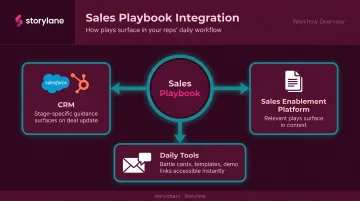
The playbook shouldn't live in a PDF. It should surface where reps already work:
- Embed stage-specific guidance in Salesforce or HubSpot so it appears when a rep updates a deal
- Surface relevant plays in your sales enablement platform
- Make key assets (battle cards, email templates, demo links) accessible in the tools reps use every day
For teams using Storylane, demo engagement data flows directly into CRM workflows: real-time Slack alerts when a prospect engages, intent scoring, and deal attribution. The playbook's demo assets don't just sit in a library — they generate follow-up signals reps can act on immediately.
Recognize Early Adopters to Build Momentum
Share "playbook win stories" — specific deals closed using a particular play — in team meetings or Slack channels. Peer-to-peer proof of value is more persuasive than top-down mandates.
Concrete examples land better than abstract encouragement. Spotlight wins like:
- A rep who used the competitive battle card to displace a rival
- A rep who sent an interactive demo in a re-engagement sequence and got a response after 30 days of silence
Stories like these spread adoption faster than any training mandate.
Track Adoption Metrics Separately From Outcomes
Win rates and revenue are lag indicators. By the time they move, the playbook has either worked or failed for months.
Track leading adoption metrics first:
- How often the playbook is accessed
- Which sections are referenced most
- Whether reps are using the correct collateral at each stage
- Demo engagement rates for assets in the playbook
These early signals let you course-correct before a bad quarter makes the problem obvious.
Common Sales Playbook Mistakes to Avoid
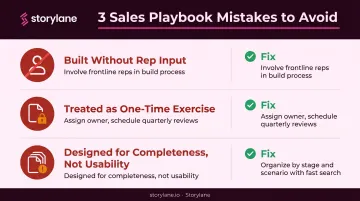
Most playbook failures trace back to three recurring mistakes:
Built without rep input. Playbooks created by leadership alone miss real-world selling dynamics. Reps quietly ignore anything that feels impractical. Involving frontline reps in the build process produces a more accurate document and drives higher adoption.
Treated as a one-time exercise. Markets shift. Competitors evolve. 51% of B2B software buyers now start their research with AI chatbots, up from 29% just 11 months earlier. A static playbook becomes a liability — reps lose trust in a resource pointing them toward outdated tactics.
Designed for completeness, not usability. An 80-page document that requires scrolling to find an objection response is useless under call pressure. Structure matters as much as content: a clear table of contents, organized by stage and scenario, with fast search is what gets used.
How to Keep Your Sales Playbook Relevant Over Time
Assign a Named Owner and Schedule Quarterly Reviews
The playbook needs a single person accountable for keeping it current — typically in sales enablement or sales operations. Quarterly reviews should evaluate:
- Whether content reflects current product capabilities and pricing
- Whether market conditions or buyer behavior have shifted
- Whether the plays are still producing results or need updating
A review cadence without a named owner is a meeting that doesn't happen.
Build an Internal Feedback Loop
Create a persistent channel for rep input. The goal is to turn the playbook from a top-down mandate into a collaborative resource that reps feel ownership over. Common formats include:
- A dedicated Slack channel for real-time field observations
- A commenting layer built directly into the playbook document
- A recurring quarterly survey for structured feedback
When a rep surfaces a new objection they're hearing in the field, that belongs in the playbook within days, not quarters. When a play stops working against a competitor who's updated their pitch, the rep who noticed that should have somewhere to flag it.
The reps closest to buyers are your best signal for what needs to change — build the process to capture that signal consistently.
Frequently Asked Questions
What is in a sales playbook?
A sales playbook typically includes a company overview, ideal customer profiles, buyer personas, sales process stages with entry/exit criteria, messaging scripts, objection handling, competitive battle cards, sales collateral organized by stage, and performance KPIs. The exact contents vary based on your sales motion and team size.
What is an example of a sales playbook?
A B2B SaaS company's playbook might include three buyer personas with distinct pain points, a six-stage sales process with discovery questions and exit criteria for each stage, email templates organized by scenario, interactive demo assets organized by persona, and battle cards for the top five competitors.
What are the 5 C's of sales?
One widely referenced version covers Customer-Centricity, Communication, Closing, Consistency, and Continuous Learning. A well-built playbook supports all five by documenting customer context, messaging frameworks, closing criteria, consistent process steps, and structured learning resources for reps.
How long should a sales playbook be?
Salesforce recommends 50–80 pages for a comprehensive playbook, but length matters less than navigability. A rep should be able to find the right guidance in seconds, not scroll through pages of background context.
How often should a sales playbook be updated?
At minimum, quarterly — with real-time updates triggered by product launches, significant competitive moves, or notable shifts in buyer behavior. Having a named owner drives the cadence; without accountability, reviews get skipped.
What is the difference between a sales playbook and a sales process?
A sales process defines the stages and milestones from prospecting to close. A sales playbook is the broader guide that wraps around the process, adding methodology, messaging, tools, templates, situational plays, and performance benchmarks.