Introduction
Most B2B sales teams can sketch a funnel on a whiteboard. The harder problem is making it work — leads enter at the top, stall somewhere in the middle, and deals die without anyone knowing exactly why.
The symptoms are familiar:
- Reps pitching before prospects are ready
- Unqualified leads clogging the pipeline
- Follow-ups landing too early or too late
- No clear way to trace where revenue is leaking
According to Adobe Marketo, half of all leads in a typical system aren't ready to buy. Most teams treat them identically anyway.
This guide breaks down each sales funnel stage with precision: what happens at each point, what buyers are thinking, and what your team should actually be doing. If you're in B2B sales or marketing and need a framework you can actually apply — stage by stage — this is it.
Key Takeaways
- A sales funnel maps the full buyer's journey from awareness through purchase, not just your rep's activity log
- Each stage requires different content, outreach timing, and qualification criteria
- Speed to lead at the Interest stage directly determines conversion rates
- The Evaluation stage decides B2B deals; interactive demos compress that cycle significantly
- Funnel performance lives in stage-to-stage conversion rates, not raw activity volume
What Is a Sales Funnel?
A sales funnel is the structured journey a prospect takes from first becoming aware of your product to making a purchase decision, and in modern B2B selling, that journey continues beyond the sale into retention and expansion.
The "funnel" shape is intentional. A large pool of potential buyers enters at the top; only the most qualified and engaged reach the bottom. This narrowing is by design — not every prospect belongs in every stage, and the funnel exists precisely to separate genuinely interested buyers from those who were never a fit.
How It Differs From Related Concepts
Two terms are regularly confused with the sales funnel:
- Marketing funnel: Focuses on awareness and lead generation before sales engagement. It feeds into the sales funnel but operates upstream of it
- Sales pipeline: Tracks the seller's internal deal management — stages, deal values, and rep activities — rather than the buyer's mindset and journey
The distinction matters. A sales funnel is buyer-centric — it describes what prospects are thinking and experiencing at each stage. A pipeline is seller-centric, tracking what your team is actively doing to move deals forward. Both are necessary, but they're not interchangeable.
Why Sales Funnels Matter for B2B Teams
Without a defined funnel, the same problems surface repeatedly: reps pitch before prospects are ready, unqualified leads consume sales capacity, and follow-ups arrive at the wrong moment. There's no shared language between sales and marketing, and no systematic way to diagnose where deals stall.
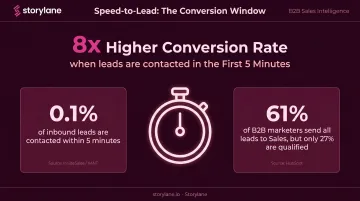
The qualification failure rate is significant. HubSpot reports that 61% of B2B marketers send all leads directly to Sales — but only 27% of those leads are actually qualified. That's three-quarters of the leads entering the funnel consuming sales time without realistic conversion potential.
A well-defined funnel addresses this in concrete ways:
- Creates a shared language between sales and marketing so both teams agree on what "qualified" means
- Enables stage-specific content and outreach rather than generic blasts
- Allows teams to measure conversion rates at each transition point and find the specific stage where deals are dying
- Prevents premature pitching by defining clear entry criteria for each stage
Used well, the funnel becomes the operating system for revenue — giving every stage a measurable definition, a clear owner, and a specific next action.
The Sales Funnel Stages Explained
This guide uses a six-stage model: Awareness, Interest, Consideration, Intent and Evaluation, Purchase, and Retention. These map to the standard ToFu (top of funnel), MoFu (mid-funnel), and BoFu (bottom of funnel) breakdown.
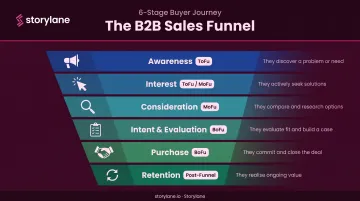
The exact number of stages varies by company and product complexity. What matters is that every stage has a clear entry trigger, a defined buyer mindset, and a corresponding team action.
Stage 1: Awareness (ToFu)
The prospect becomes aware of a problem and discovers that your company exists. This may arrive through SEO content, paid ads, cold outreach, social media, events, or referrals. The buyer isn't evaluating yet — they're learning.
Your team's job: Generate reach among the right ICP. A tightly defined target audience at the top of the funnel prevents wasted effort at every stage below it. The quality filter starts here.
Stage 2: Interest (ToFu/MoFu)
The prospect actively engages — subscribing to content, filling out a form, responding to outreach, attending a webinar. Intent signals are present, but they haven't committed to evaluating a solution.
What sales should do: Respond fast and qualify early. According to InsideSales/XANT's 2021 Lead Response Study, conversion rates are 8x greater when you respond within the first five minutes of a lead submitting. Only 0.1% of inbound leads are actually engaged that quickly, creating a real competitive gap for teams that move fast.
Tools like Storylane's Account Reveal help here by de-anonymizing demo visitors with firmographic data before a form is even submitted, so sales teams can prioritize outreach based on company fit, not just who raised their hand.
Stage 3: Consideration (MoFu)
The prospect is actively comparing solutions — yours and competitors'. They're asking detailed questions about features, pricing, workflow fit, and integration requirements.
Your team's job: Deliver differentiated content. Case studies, comparison guides, and ROI calculators are the right tools at this stage — not product pitches. This is also where marketing and sales alignment becomes critical: buyers need consistent, relevant information regardless of which team they're talking to.
Storylane's Buyer Hub supports this stage by giving prospects a centralized, self-serve gallery of demos organized by use case and persona. Prospects can navigate freely, explore the content most relevant to their role, and share it with other stakeholders on their buying committee — all without requiring a sales rep to coordinate each interaction.
Stage 4: Intent and Evaluation (BoFu)
The prospect has shown clear buying intent and is now evaluating your solution hands-on. Demos, free trials, and proof-of-concept conversations happen here. The buyer is verifying that your product solves their specific problem before committing.
Your team's job: Deliver a compelling, personalized product experience. This is the stage where the quality of the evaluation experience directly determines whether you win or lose.
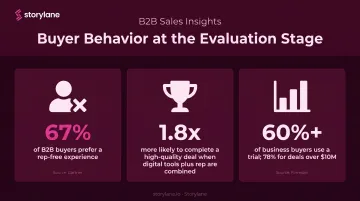
Gartner research shows that 67% of B2B buyers prefer a rep-free experience — but buyers who engage with supplier-provided digital tools alongside a sales rep are 1.8x more likely to complete a high-quality deal. Self-guided exploration and sales support aren't mutually exclusive. The best outcomes come from both.
This is where interactive demos create a measurable advantage. Storylane customer ContactMonkey attributed $1.3M in pipeline to a single gated interactive demo. They achieved a 28% demo-to-opportunity conversion rate — roughly twice the rate of other inbound sources — and a 3x improvement in sales velocity.
Campminder's sales team found that sharing a guided demo before the discovery call let them skip basic discovery entirely and open every conversation already at high intent.
These results reflect a broader buyer behavior shift. Forrester reports that more than 60% of business buyers use a trial, and 78% of buyers making purchases of $10M or more engage in a trial first. Compressing this stage through self-guided demos, so prospects arrive at sales calls already primed, is one of the highest-leverage moves a B2B team can make.
Stage 5: Purchase and Action (BoFu)
The prospect has decided. Now they're navigating procurement, legal review, pricing negotiation, and contract finalization. This stage is not complete until ink is on paper.
The play here: Reduce friction. The most common mistake at this stage is assuming the deal is done and deprioritizing it. Late-stage stalls happen when paperwork drags, responses slow, or next steps go undefined. Maintain momentum with clear action items at every touchpoint.
For teams selling in field environments — on-site meetings, conferences, procurement reviews — Storylane's offline demo capability allows reps to run fully interactive demos without WiFi. Customers including Clari, GlobalSign, and SentinelOne have deployed offline demos specifically for these late-stage, high-stakes scenarios where connectivity limitations shouldn't derail deal momentum.
Stage 6: Retention and Loyalty (Post-Funnel)
The customer has purchased, but high-performing B2B teams don't treat the funnel as finished. Retention feeds back into Stage 1 through referrals and word-of-mouth. Upsell and cross-sell opportunities extend customer lifetime value.
Focus on: Onboarding effectively, checking in proactively, gathering feedback, and identifying expansion. Satisfied customers are the most cost-effective top-of-funnel input available and the easiest source of qualified new pipeline.
Key Factors That Shape Sales Funnel Performance
ICP and List Quality
Funnel performance problems frequently trace back to admitting the wrong prospects at the top. When the ICP definition is loose, unqualified leads progress through multiple stages before dropping, wasting sales capacity and distorting pipeline metrics in the process.
The qualification gap is real: only 9.1% of salespeople describe marketing leads as very high quality, and 41.7% say higher-quality leads are their top need (HubSpot, 2022). Palo Alto Networks found that high MQL volume wasn't translating into wins. After shifting focus from individual MQLs to buying groups, they boosted win rates by 17%.
Stage-to-Stage Conversion Criteria
Without clear behavioral criteria for advancing prospects, reps push deals forward based on gut feel. Define what "good" progression actually looks like — for example, moving from Interest to Consideration should require specific engagement signals (multiple content interactions, a responded outreach, demo activity), not just an opened email.
Content and Outreach Alignment
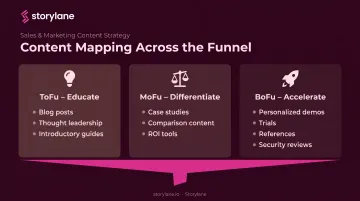
The type of content and communication must match the buyer's mindset at each stage:
- ToFu: Educate and create awareness — blog posts, thought leadership, introductory guides
- MoFu: Differentiate and build trust — case studies, comparison content, ROI tools
- BoFu: Reduce risk and accelerate decisions — personalized demos, trials, references, security reviews
Sending bottom-funnel content to a top-funnel prospect is as damaging as sending top-funnel content to a buyer who's ready to decide.
Speed and Responsiveness
The longer a prospect sits in any stage without meaningful engagement, the more likely they are to disengage or choose a competitor. Response timing has an outsized impact:
- Only 0.1% of inbound leads are contacted within five minutes of inquiry
- Conversion rates are 8x higher in that first five-minute window (InsideSales/XANT)
Most teams leave this advantage untouched entirely.
Analytics and Funnel Visibility
Without visibility into stage conversion rates, average time in stage, and drop-off points, pipeline reviews rely on opinion rather than data. Tracking these metrics requires CRM and engagement analytics infrastructure — and without it, the same bottlenecks repeat quarter after quarter.
Common Sales Funnel Mistakes and How to Avoid Them
Overfilling the Top
Volume at the top feels like success. It's often the opposite. A funnel packed with poorly qualified leads wastes sales capacity and produces misleading metrics. Quality at awareness determines efficiency everywhere downstream.
Skipping Qualification
Letting leads who don't match ICP criteria slide past the Interest or Consideration stage without proper qualification causes late-stage drop-off. The cost isn't just the lost deal — it's every hour of sales time invested in a prospect who was never going to close.
Confusing Activity with Progress
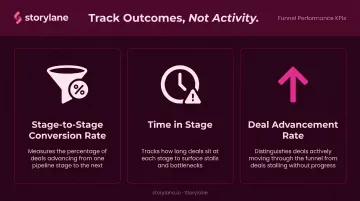
Calls made and emails sent are not the same as deals moving forward. Teams mistake busy pipelines for healthy ones. To catch this early, track stage-based outcome metrics instead of activity counts:
- Conversion rate between each funnel stage
- Time in stage to spot where deals stall
- Deal advancement rate to separate motion from momentum
Conclusion
A sales funnel is not a passive diagram pinned to a conference room wall. When built around actual buyer behavior and enforced with clear stage criteria, it becomes the most reliable system for predictable revenue.
Teams that understand what buyers need at each stage — and deliver the right content, conversation, and experience at the right moment — consistently outperform those relying on instinct and activity volume. The funnel won't close deals on its own. What it does is make every breakdown visible — so you know whether leads are stalling at awareness, dropping off during evaluation, or losing momentum at the close, and you can address each one directly.
The teams that treat this as a living system — reviewing stage conversion rates, adjusting messaging based on where buyers disengage, and using tools like Storylane to track how prospects interact with demos before the first call — are the ones who compound improvements over time rather than chasing one-off wins.
Frequently Asked Questions
What are the stages of the sales funnel?
The core stages are Awareness, Interest, Consideration, Intent, Evaluation, and Purchase — with Retention often added as a post-funnel stage for high-performing B2B teams. The exact number varies by business model and product complexity; what matters is that each stage has clear entry criteria and defined team actions.
What is the difference between a sales funnel and a sales pipeline?
A sales funnel is buyer-centric: it charts the prospect's journey, mindset, and decision-making process. A sales pipeline is seller-centric — it tracks deal stages, values, and rep activities from an internal management perspective. Use both together; one tells you where buyers are, the other tells you where deals stand.
How is a B2B sales funnel different from a B2C sales funnel?
B2B cycles are longer, involve multiple stakeholders (Gartner finds buying groups typically range from 5 to 16 people), and require demos, trials, and formal procurement steps. B2C decisions are faster and individual — a single buyer, a shorter consideration window, and far less process overhead.
What causes prospects to drop out of a sales funnel?
The most common causes: poor ICP fit surfaced too late, slow follow-up, content misaligned with the buyer's current stage, and weak value communication during evaluation. Most drop-off happens before the Consideration stage — catching ICP mismatches at Interest saves everyone's time.
How do you measure the effectiveness of a sales funnel?
Track stage-to-stage conversion rates, average time spent in each stage, overall funnel velocity, and deal win/loss rates. CRM analytics are the infrastructure that makes this possible — without them, you're estimating rather than measuring.
What is the most important stage of the sales funnel?
In B2B, Evaluation and Consideration are where deals are most commonly won or lost. Buyers form their final judgment on fit and value here, and the quality of the demo or product experience directly determines the outcome. Get these two stages right, and the close becomes significantly easier.