Research spanning 2.5 million sales calls found that 40–60% of deals are lost to "no decision" — not to a competitor, but to inertia. That's a closing problem.
The good news: closing is a learnable skill. It's not about pressure tactics or manipulation. Modern closing is a well-timed ask that makes it easy for a ready buyer to say yes.
This guide covers 10 proven techniques — with scripts and clear guidance on when to use each one.
Key Takeaways
- Closing is a series of small commitments throughout the cycle, not a single high-stakes moment at the end
- Each technique has a specific "when to use" condition — matching method to buyer mindset is the real skill
- Prospect engagement signals — demo views, feature time, internal sharing — tell you when a buyer is ready
- The most common mistake isn't using the wrong technique — it's defaulting to the same one every time
- Sending an interactive demo before the closing call reduces friction and primes buyers to commit
What Sales Closing Is and Why Technique Matters
Sales closing is the stage where a buyer formally agrees to move forward. By the time you reach it, every prior conversation, objection handled, and piece of value demonstrated has already shaped the outcome.
Technique matters because without a defined approach, reps close at the wrong time. Too early creates pressure. Too late loses momentum. Clari's 2024 State of Revenue Leak report found that 60% of RevOps leaders reported slipped deals — not deals lost to competitors, but deals that simply never crossed the finish line.
The Shift from "Always Be Closing" to "Always Be Helping"
Gartner's 2025 research found that 61% of B2B buyers prefer a rep-free buying experience. Buyers want to move at their own pace, do their own research, and feel in control.
That doesn't mean reps are irrelevant. It means the close has to feel like a natural next step, not a push. The most effective closers are consultative — they ask the right questions, surface real concerns, and let the value speak for itself.
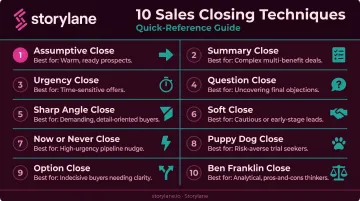
The Top 10 Proven Sales Closing Techniques
These techniques work across industries and deal sizes. The difference between them isn't quality — it's context. Match the method to the moment.
1. The Assumptive Close
Best for: Warm buyers showing strong intent signals
Proceed as if the decision is already made. Use forward-looking language rather than conditional framing.
- ❌ "If you decide to move forward..."
- ✅ "When we kick off onboarding, we'll assign you a dedicated implementation manager..."
Sample script:
"Based on everything we've discussed, let's get your kickoff scheduled for the first week of next month. Does Tuesday or Thursday work better for your team?"
Watch out for: Using this before value is established. If the buyer doesn't feel confident yet, assumptive language reads as arrogance, not confidence. Reserve this for buyers who are asking about timelines, pricing details, or next steps unprompted.
2. The Summary Close
Best for: Complex B2B deals with long sales cycles or multiple stakeholders
Before asking for the sale, recap everything the buyer has already agreed to — their pain points, the outcomes they want, the solutions you've matched to each one. You're reminding them of all the small "yeses" that led here.
Sample script:
"So just to recap what we've covered: you need a solution that integrates with Salesforce, handles your current volume of 500 demos a month, and can be deployed within Q3. We've confirmed we can do all three. Based on that, does it make sense to move forward?"
The key: Use the buyer's own words back to them. This only lands when the rep has kept careful notes throughout the sales cycle.
3. The Question Close
Best for: Prospects who are interested but haven't articulated what's holding them back
Instead of making a statement, ask a question that confirms alignment and surfaces hidden hesitation.
Sample script:
"Does what we've built together solve the problem you described in our first call?"
If the answer is yes, you follow with: "Then what would need to be true for you to feel confident moving forward today?"
This approach puts the buyer in the driver's seat — they're not being pushed toward a decision, they're arriving at it themselves.
4. The Puppy Dog Close
Best for: Risk-averse buyers and SaaS prospects who need hands-on experience before committing
The concept: let the prospect experience the product before committing. Hands-on use eliminates abstract doubt in a way that no demo or deck can.
For SaaS products, this typically means offering a time-limited trial or a personalized interactive demo before the closing call. Tools like Storylane let reps send personalized self-guided demos — complete with the prospect's company name, logo, and relevant data — so the experience feels built specifically for them rather than pulled from a generic library.
Sample script:
"Before we finalize anything, I'd like to send you a personalized walkthrough so you can explore the platform on your own terms. It'll take about 10 minutes, and I'll follow up Thursday to answer anything that came up. Sound fair?"
Forrester's 2026 research found that 78% of buyers making purchases of $10M or more use trials as part of their evaluation. Hands-on experience isn't a nice-to-have at higher ACVs; it's expected.
5. The Empathy Close
Best for: Prospects expressing genuine anxiety about the investment
Validate the hesitation directly before bridging to how others in the same position moved forward.
Sample script:
"It makes complete sense that you want to be 100% certain before committing — this is a significant decision. We've had other customers in your exact situation who felt the same way. What helped them move forward was [specific outcome]. Does that resonate with where you are?"
This isn't about overcoming an objection — it's about acknowledging that the concern is real, then showing a path through it. The moment it reads like a brush-off, you've lost the trust it was meant to build.
6. The Scarcity Close
Best for: Situations with a real, verifiable deadline or limited availability
Introduce legitimate urgency by tying a time-sensitive offer to a specific constraint — an end-of-quarter pricing window, a limited number of implementation slots, an expiring procurement approval.
Sample script:
"Our implementation team has one onboarding slot available in July. After that, the next availability is September. If getting live before Q3 matters for your timeline, now is the window to lock that in."
Critical distinction:
| Ethical Scarcity | Manufactured Urgency |
|---|---|
| End-of-quarter pricing that's real | "This offer expires Friday" (it doesn't) |
| Limited implementation bandwidth | "We only have 2 slots left" (always) |
| Expiring procurement approval | Arbitrary deadlines invented to pressure |
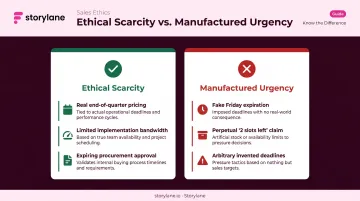
Today's buyers are sharp. Fake urgency is easy to detect and destroys trust permanently.
7. The Sharp Angle Close
Best for: Procurement-trained buyers who habitually ask for concessions
When a prospect requests a discount, additional feature, or contract adjustment, agree — conditionally.
Sample script:
"If I can get that discount approved by my VP, are you in a position to sign today?"
This turns their ask into a closing trigger. Instead of giving the concession and then waiting, you get the commitment first. It works particularly well with buyers who are conditioned to negotiate — they expect to give something to get something.
8. The Now-or-Never Close
Best for: End-of-quarter situations where management has authorized a genuine special package
This is a high-risk, high-reward play. Present a one-time offer tied to a hard deadline — but only when the offer is real.
Sample script:
"Our team has been authorized to offer a 15% reduction on the annual contract for deals signed before June 30th. After that, the standard pricing applies. I wanted to make sure you had the option before the window closes."
Use this sparingly. It should be a last resort when you have a warm buyer who needs a final nudge. Reach for it too often and it stops working. Used as a bluff, it permanently damages the relationship and your credibility.
9. The Scale Close
Best for: Getting mixed signals and needing clear visibility into where the buyer actually stands
Ask the prospect to rate their readiness on a scale of 1 to 10. Anything below 10 opens a direct, non-confrontational conversation about what's in the way.
Sample script:
"On a scale of 1 to 10, how close are you to feeling ready to move forward — with 10 being 'let's sign today'?"
If they say 7: "What would get you to a 9 or 10?"
This is as much a diagnostic tool as a closing move. It surfaces objections that the prospect hasn't yet put into words, and it does so without pressure.
10. The Option Close
Best for: Buyers who are aligned on value but still deciding between configurations
Instead of a yes/no ask, present two choices that both lead to a sale.
Sample script:
"Based on your team size and volume, both the Growth and Premium plans would work for you. Would you prefer to start with Growth and scale up, or go straight to Premium to unlock the analytics features from day one?"
The buyer's mindset shifts from "whether to buy" to "which version fits us better." This works when you genuinely have two paths suited to the buyer's situation. A manufactured second option that doesn't actually fit their needs will backfire the moment they press for details.
How to Choose the Right Closing Technique
Three factors should drive your technique selection:
1. Buying signals
- Strong signals (asking about timelines, pricing, implementation) → Assumptive Close, Option Close
- Weak or mixed signals → Question Close, Scale Close, Empathy Close
2. Stakeholder complexity The average B2B buying decision now involves 13 internal stakeholders and 9 external influencers, according to Forrester. When multiple people are evaluating, Summary and Question closes work better than pressure-based approaches — you need consensus, not a single "yes."
3. Deal stage and trust already built Early in a relationship, empathy and discovery-based closes protect rapport. Later, when value is established and trust is solid, directness is appropriate.
Using Engagement Data to Time the Close
Knowing when a buyer is warm — rather than guessing — is what separates consistent closers from inconsistent ones. Storylane's analytics surface behavioral signals that make that timing concrete:
- Demo completion rates and time spent per session
- CTA clicks and individual visitor activity
- Re-engagement with specific product overviews
When a prospect completes 80%+ of a demo and clicks a CTA, a Slack alert fires in real time. The rep gets a precise window to reach out while the product is still top of mind.
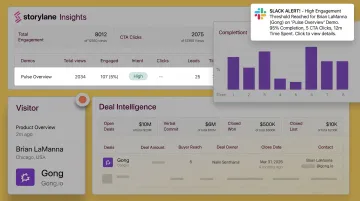
Once you know a prospect is engaged, the next step is matching that signal to the right technique.
A Simple Decision Framework
| Buyer Signal | Technique to Use |
|---|---|
| Asking about timelines and pricing | Assumptive or Summary |
| Expressing anxiety or uncertainty | Empathy or Scale |
| Requesting a concession | Sharp Angle |
| Stalling without a clear reason | Scarcity or Now-or-Never |
| Comparing configurations | Option Close |
Common Closing Mistakes to Avoid
Mistake 1: Closing before value is established
Going for the ask before the buyer has internalized the ROI turns your close into pressure. Closing should happen throughout the sales cycle as a series of small commitments — agreement on the problem, the solution, the fit — not as one sudden push at the end. If the close feels abrupt to the buyer, you skipped steps.
Mistake 2: Never asking for the sale
Gong's analysis of 8,382 deals found a significant gap between deals with clear next-step discussions and those without. After demonstrating value and handling objections, directly asking "Are you ready to move forward?" is not pushy — it's professional. Buyers don't close themselves.
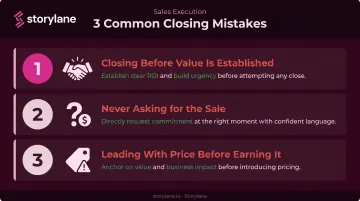
Mistake 3: Leading with price before earning it
Recurring budget objections are almost always a signal that the rep hasn't yet connected the solution to a tangible business outcome. The ROI story is what transforms price from a cost into an investment — establish that before any pricing conversation begins.
Conclusion
Effective closing is a skill built on preparation, empathy, and knowing which technique fits the moment. No single method works in every situation — the best reps keep a full toolkit, read the buyer accurately, and adapt in real time.
Buyers who arrive at the closing call already familiar with your product are easier to close. Storylane's interactive demos let you send a personalized, self-guided product experience before that final conversation — so prospects show up informed, not uncertain.
If you want to shorten the path to yes, explore how Storylane's interactive demos work — or start building for free.
Frequently Asked Questions
What are the top 5 closing techniques?
The five most versatile are the Assumptive Close, Summary Close, Question Close, Puppy Dog Close, and Empathy Close. Each suits a different buyer mindset — the best choice depends on how much trust you've built and how clearly the buyer has articulated their readiness.
What is the difference between a hard close and a soft close?
Hard closes (Now-or-Never, Sharp Angle) push for an immediate decision using urgency and directness. Soft closes (Summary, Question, Empathy) guide buyers toward a natural conclusion through value reinforcement and trust. Most modern B2B buyers respond better to soft approaches; hard closes work best in specific late-stage situations.
When is the right time to close a sale?
Close when the buyer has acknowledged the problem, agreed on your solution's value, and has no unresolved objections. Reliable buying signals include questions about implementation timelines, contract terms, or pricing specifics.
How do you close a sale without being pushy?
Lead with the buyer's goals, not your quota. Use question-based or empathy closes to surface concerns before making the ask. Frame the close as helping them take the logical next step — not forcing a decision they aren't ready for.
What should you do if a prospect keeps delaying?
Use the Scale Close to identify what's actually blocking them. If urgency is warranted, follow with a Scarcity Close. If timing is genuinely wrong, say so directly — walking away early preserves the relationship for later.
How can sending an interactive demo help close deals faster?
Letting prospects explore your product independently before a closing call reduces uncertainty and surfaces objections early. By the time the conversation happens, the buyer already understands the value, making the ask far easier and more productive.