Introduction
Most B2B marketing and sales teams don't have a targeting problem — they have a relevance problem. According to Demand Gen Report's 2024 Content Preferences Benchmark Survey, 51% of B2B buyers said marketing content was too generic and irrelevant to their needs — up from 38% in 2023. That's not a content volume issue. It's a buyer understanding issue.
Buyer personas are the fix. When built from real data rather than gut instinct, they give marketing, sales, and product teams a shared picture of who they're actually selling to, what those buyers care about, and what finally gets them to act.
This guide walks through the full picture: what buyer personas are, how to build them from real research, how to activate them across sales and marketing, and the mistakes that make most persona efforts fall flat.
Key Takeaways
- A buyer persona is a research-based profile of your ideal customer — not just demographics, but motivations, goals, and decision behavior
- B2B deals typically involve 5–16 stakeholders, each requiring different messaging
- Real buyer interviews are the most valuable (and most skipped) step in persona development
- Personas only work when activated across sales, marketing, and product — not filed away as a PDF
- Generic personas are useless; specificity is what makes them actionable
What Is a Buyer Persona and Why Does It Matter
A buyer persona is a research-based, fictional representation of your ideal customer. It goes further than a basic customer profile or ICP, capturing:
- What motivates them and what frustrates them
- How they evaluate options and make purchase decisions
- What they need to hear — or see — before they'll commit
For B2B teams specifically, personas do something structural: they align marketing, sales, and product around a shared understanding of the buyer. Without that alignment, marketing sends content that sales can't use, sales has conversations that undermine what marketing promised, and product ships features that miss what buyers actually want.
Cintell's 2016 B2B benchmark study found that 71% of companies exceeding their revenue and lead goals had documented buyer personas, compared to just 26% of companies missing their goals. The same study found that high-performing companies were 7.4x more likely to have updated their personas within the prior six months.
Positive vs. Negative Personas
Most teams only build positive personas — profiles of buyers who are likely to convert and succeed. But negative personas are equally worth defining.
A negative persona describes someone who looks like a fit but rarely converts or churns quickly: a student researching for a class project, a competitor doing competitive intelligence, or a company too small to get real value from your product.
Defining both types helps sales teams stop chasing poor-fit leads and gives marketing clearer guardrails for who they're trying to attract.
Types of Buyer Personas
B2B buying decisions are committee decisions. Gartner research shows buying groups range from 5 to 16 people across up to four functions, and Forrester reports a typical decision involves 13 internal stakeholders and 9 external influencers. That's not one persona to map — it's several, each with different priorities and different reasons to care about your solution.
B2B Role-Based Persona Types
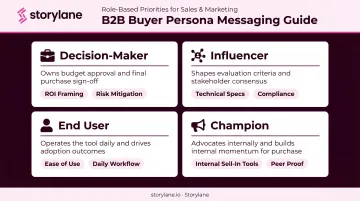
Forrester identifies four core roles that appear across most complex B2B purchases:
- Decision-Maker: the executive or budget holder with final approval authority
- Influencer: internal stakeholders (IT, legal, finance) or external advisors who shape the recommendation
- End User: the person who will operate the product daily and feels the friction most directly
- Champion: an internal advocate with credibility who builds the case for change within the organization
Each role needs different messaging. A Decision-Maker wants ROI framing and risk mitigation. An End User wants to know if the product will actually make their day easier. A Champion needs tools to sell the solution internally. Sending the same message to all four is one of the most common mistakes in B2B outreach.
Decision-Making Style Types
Role isn't the only variable. Buyers also differ in how they make decisions. The Eisenberg brothers' Persuasion Architecture framework identifies four decision-making styles:
- Competitive: fast, logic-driven; wants proof and efficiency
- Spontaneous: fast, emotion-driven; responds to urgency and social proof
- Methodical: slow, logic-driven; wants detailed specs and thorough comparisons
- Humanistic: slow, relationship-driven; needs trust and alignment on values
Knowing a buyer's decision style shapes everything from email tone to content format. A Methodical buyer wants a detailed comparison doc. A Competitive buyer wants the three-line executive summary.
In most B2B deals, you'll encounter multiple personas simultaneously — which is exactly why messaging discipline across the sales cycle matters.
What to Include in an Effective Buyer Persona
Surface-level personas — job title, industry, rough age range — don't drive better decisions. What makes a persona actually useful is the depth of information beneath the surface.
Demographic and Firmographic Data
Start with the basics: job title, seniority, industry, company size, geography, and budget authority. For B2B personas, firmographic details carry equal weight to individual demographics. Company size, growth stage, tech stack, and current vendor relationships help filter high-quality leads from noise — and determine whether a prospect is actually in a position to buy.
Psychographic and Behavioral Data
This layer is what separates an actionable persona from a generic one. Capture:
- Professional values and risk tolerance
- Preferred communication style (email vs. phone vs. async)
- How they consume information — peer recommendations, analyst reports, G2 reviews, demos, webinars
This insight tells you where to reach them and how to frame your message — not just who they are demographically.
Goals and Success Metrics
What is this person measured on? What does a win look like in their role? When your messaging maps to their KPIs rather than your product's feature list, sales conversations become discussions about outcomes they already care about.
Pain Points and Perceived Barriers
The Buyer Persona Institute's "5 Rings of Buying Insight" framework identifies Perceived Barriers as the fears, concerns, and objections that cause buyers to stick with the status quo or choose a competitor. These aren't end-of-cycle objections. They're the anxieties your messaging needs to address from the first touchpoint.
Buying Journey and Decision Criteria
Understanding how this persona moves through a purchase decision shapes your entire content strategy. Key things to map:
- How they research solutions (search, peer networks, analyst reports, review sites)
- Who else is involved in the decision and what each stakeholder cares about
- What evaluation questions they ask — and what finally triggers a commitment
- Which funnel stage calls for education versus a direct push toward action
How to Create a Buyer Persona: A Step-by-Step Process
Step 1: Mine Existing Data First
Before any interviews, pull from your CRM, sales call notes, support tickets, and web analytics. Look for patterns in who's actually buying, why they convert, and where they come from. This data-anchored starting point prevents persona-building from becoming a guesswork exercise and helps you identify which buyer types to prioritize in interviews.
Step 2: Conduct Real Buyer Interviews
Customer interviews are the most valuable step in this process — and the most frequently skipped. The Buyer Persona Institute recommends a minimum of 10 interviews before compiling findings. Cintell's research found that 82.4% of companies exceeding their revenue goals used qualitative interviews, while 70% of companies missing their goals did not conduct them at all.
Interview guidelines that actually work:
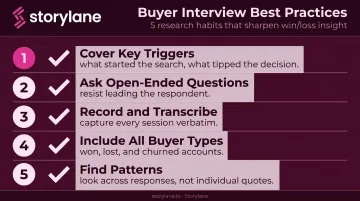
- Cover: what triggered their search, how they evaluated options, what nearly stopped them, and what tipped the final decision
- Ask open-ended questions and resist the urge to lead
- Record and transcribe every session
- Include won customers, lost prospects, and churned accounts — each group reveals something different
- Look for patterns across responses, not individual quotes
Step 3: Supplement With Secondary Research
Secondary research fills the gaps when you don't have enough customers to interview yet — especially useful when entering a new market segment. Strong sources include:
- Job listings for target titles (reveals daily responsibilities and priorities)
- LinkedIn profiles of buyers in your ICP
- Industry analyst reports covering your space
- Competitor reviews on G2 or Capterra (buyers tell you exactly what they want)
Step 4: Build the Persona Document
Group common findings into a structured, visually scannable document. Include a fictional name and photo (it helps teams internalize the persona as a real person rather than a data point). Organize by:
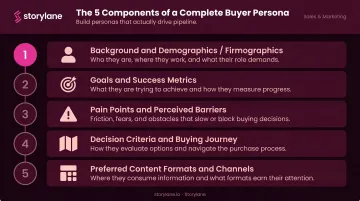
- Background and demographics/firmographics
- Goals and success metrics
- Pain points and perceived barriers
- Decision criteria and buying journey
- Preferred content formats and channels
Step 5: Socialize and Schedule Updates
A persona that lives in one marketer's Google Drive helps no one. Share it with sales, marketing, and product teams. Build it into onboarding and sales enablement materials.
Set a calendar reminder to review and update at least annually. Revisit sooner if you notice new customer segments emerging, significant market shifts, or changes in win/loss patterns.
How to Activate Buyer Personas Across Sales and Marketing
Building a persona is the easy part. Activation is where most teams stall.
Content and Messaging Alignment
Map each persona's pain points and decision criteria to specific content assets: blog posts, case studies, email sequences, landing pages. Every piece should lead with buyer benefit, not product features. Messaging should also shift based on where a buyer is in their journey — early-stage buyers favor blogs (72%) and webinars (60%), while late-stage buyers rely heavily on demos (77%) and user reviews (63%), per Demand Gen Report's 2024 content data.
Sales Outreach Personalization
Persona insights make cold outreach less cold. Use them to tailor discovery call agendas, follow-up sequences, and the framing of your value proposition by role:
- A Champion needs peer-level social proof and internal sell-in tools (one-pagers, ROI calculators their exec will trust)
- A Decision-Maker needs executive-level case studies and clear ROI framing
- An End User needs to see that the product will actually work in their context
According to RAIN Group's Sales Prospecting Research, top-performing sellers achieve 2.7x more conversions and 1.8x more quality outcomes — including meetings and demos — by delivering customized, value-focused first interactions.
Persona-Specific Interactive Demo Experiences
One of the highest-impact activation points is the product demo. Generic demos that show every feature to every prospect waste both parties' time.
Storylane's dynamic variable token system lets sales teams build one base demo and personalize it at the point of delivery: swap in the prospect's name, company name, logo, revenue figures, and custom metrics using tokens like {{first_name}} and {{company_name}}. No rebuilding required — one base demo adapts to dozens of scenarios.
For persona-specific flows, Storylane offers several approaches:
- Multi-Chapter Demos let teams build different paths within a single asset — a Decision-Maker selects an ROI-focused flow, an End User navigates a feature-depth walkthrough
- Buyer Hubs organize separate demos for self-directed discovery
- AI editor recontextualizes an entire demo for a new persona in seconds, without maintaining multiple versions
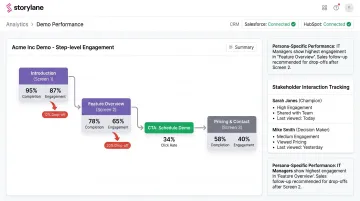
Storylane's analytics layer closes the loop: step-level engagement data shows which features each stakeholder explored, where they dropped off, and which CTAs they clicked — all of which flows directly into Salesforce, HubSpot, or Marketo for lead scoring and follow-up personalization.
Cross-Functional Activation
Personas shouldn't live only in marketing. When treated as a shared organizational asset, they sharpen the entire revenue motion:
- Product prioritizes feature development by the persona most likely to drive retention
- Customer Success tailors onboarding flows by role
- RevOps builds lead scoring models that weight persona fit alongside behavioral signals
Common Buyer Persona Mistakes to Avoid
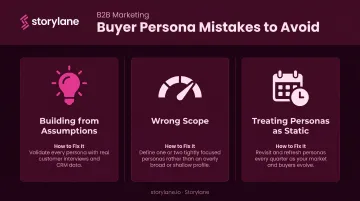
Most persona projects fail the same three ways. Knowing what to watch for helps you avoid building something that looks thorough but drives the wrong decisions.
1. Building from assumptions, not data
The most common failure is creating personas in a conference room based on gut instinct. Even 10 real buyer interviews will produce more actionable insight than hours of internal brainstorming, because customers will always surface things you didn't expect — objections, job pressures, and decision triggers that never show up on a whiteboard.
2. Making personas too broad or too narrow
"Any VP at a mid-market company" is too vague to act on. "VP of Marketing at a Series B SaaS company in Boston with exactly 12 SDRs" is too specific to scale. The right scope is specific enough to drive distinct messaging decisions, but broad enough that your team can identify multiple matching prospects each month.
3. Treating personas as static documents
Buyer behavior shifts. Markets evolve. Your ICP changes as your product matures. Personas built once and shelved become misaligned with reality — and misaligned sales and marketing efforts drain budget without obvious warning signs. Schedule the review cadence before you think you need it.
Frequently Asked Questions
What is a buyer persona?
A buyer persona is a research-based, fictional representation of your ideal customer that captures their role, motivations, challenges, and how they make decisions. Teams use personas to guide marketing, sales, and product choices toward messaging that actually connects.
What should be included in a buyer persona?
A complete persona typically covers:
- Demographic and firmographic data (role, company size, industry)
- Psychographic traits: values, risk tolerance, communication preferences
- Professional goals, KPIs, and pain points
- Decision criteria and preferred content formats
What are the 4 types of buyer personas?
In B2B, the four role-based types are Decision-Maker, Influencer, End User, and Champion. There are also four decision-making styles: Competitive, Spontaneous, Methodical, and Humanistic — and most deals involve several role types at once, each needing different messaging.
What is an example of a buyer persona?
"Demand Gen Director Dana" — a 38-year-old demand generation leader at a 300-person SaaS company, measured on pipeline contribution, frustrated by disconnected tools and generic vendor outreach, who evaluates solutions through peer reviews, analyst reports, and vendor demos before recommending a shortlist to her VP.
How many buyer personas should a company have?
Most companies start with 3–5 personas and expand as the business grows. Creating too many introduces complexity and dilutes focus. A practical rule: one persona per distinct buying decision or product line. Start with the personas representing your highest-value customer segments.
What is the difference between a buyer persona and an ICP?
An ICP (Ideal Customer Profile) describes the type of company that's the best fit for your solution — based on firmographic data like industry, company size, and revenue. A buyer persona describes the individual human within that company, including their psychology, role, goals, and decision-making behavior. Most go-to-market strategies require both: ICP to target the right accounts, personas to reach the right people inside them.