This article clarifies all three concepts — MVP, product demo, and MVP demo — explains what separates them, and helps you decide which one fits where you are right now.
Key Takeaways
- An MVP is a real, functional product with only the core features needed to validate market demand through actual usage.
- A product demo is a persuasion tool: a video, slide deck, or interactive walkthrough that shows value without delivering it.
- An MVP demo is either a demo of a minimal product, or (more commonly) a demo used as the MVP to test demand before building anything.
- Choosing between them comes down to your goal: are you trying to validate demand or close a deal?
What Is an MVP?
The Agile Alliance attributes this definition to Eric Ries: an MVP is "that version of a new product which allows a team to collect the maximum amount of validated learning about customers with the least effort." That framing matters because it shifts the question from "what's the smallest feature set?" to "what's the smallest experiment that produces real evidence?"
An MVP is a working product. Not a mockup. Not a wireframe. Real users interact with it, and their behavior generates data you can act on.
The Wedding Cake Analogy
If your vision is a five-layer wedding cake, your MVP is one complete, edible layer — not a photograph of a cake, not a sketch, and not a crumble of ingredients. It needs to be consumable.
That distinction trips up many founders. Prototypes and wireframes test design assumptions internally. An MVP tests whether real people will use and pay for something.
How Long Does an MVP Take?
Y Combinator's guidance is direct: build a lean MVP in weeks, not months. Michael Seibel recommends time-boxing scope ruthlessly — if a feature can't fit in a short sprint, cut it. Speed to evidence is the goal, not completeness.
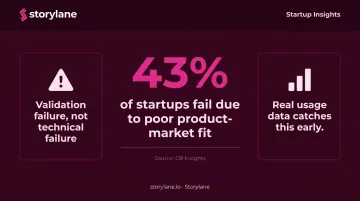
CB Insights found that 43% of failed startups cited poor product-market fit as the primary cause of failure. That's a validation failure, not a technical one. Real usage data — collected early — is what tells you whether to stay the course, cut features, or pivot entirely.
What Is a Product Demo?
A product demo is external-facing collateral designed to show value, not deliver it. It can be a video, a slide deck, a clickable prototype, or an interactive walkthrough. Unlike an MVP, it's not a product users depend on — it's a persuasion tool.
Demos appear in two distinct contexts:
- Early-stage: The product doesn't fully exist yet. The demo simulates the experience to generate interest from investors or early adopters.
- Mature-stage: The product is live, and the demo serves as a guided tour or self-serve walkthrough for prospects already evaluating it.
The Shift Toward Interactive Demos
Static videos and slide decks have largely given way to interactive product demos — experiences where prospects click through real or simulated product flows on their own schedule. Two data points show how far this has gone: TrustRadius found that 77% of B2B buyers start their evaluation process with independent research, and 43% specifically wanted self-guided product demos available before talking to sales.
Gartner went further, reporting that 61% of B2B buyers now prefer a rep-free buying experience overall. A demo that requires a sales call to access is already friction.
That buying shift is exactly what interactive demo platforms are built for. Tools like Storylane let teams build screenshot-based or full HTML demo captures without engineering involvement — no dev tickets, no staging environments.
Prospects click through actual product flows, explore use cases at their own pace, and arrive at a sales call already informed. Storylane's internal data found that prospects who engaged with an interactive demo converted to deals at 3.2x the average rate, and deals closed nearly a week faster.
Speed and visual impact matter more than technical depth — demos are built to persuade, not persist.
What Is an MVP Demo?
"MVP demo" gets used in two ways, and the distinction determines how much you build before you validate.
Definition 1: A demo of an MVP — created to show off a just-launched minimal product and drive early adoption.
Definition 2: A demo used as the MVP — a video, landing page, or clickable prototype deployed instead of a real product to validate demand before writing significant code.
The second definition is far more common in startup culture, and it has strong historical backing.
The Dropbox Example
Eric Ries described Dropbox's early video as the minimum viable product itself. The video demonstrated automatic file sync for a product that barely existed yet, and moved the beta waitlist from 5,000 to 75,000 people overnight. No production code required. The video was the experiment.
Buffer did something similar with a two-page landing page: the first page explained the product and asked visitors to click pricing tiers; the second said it wasn't ready yet and asked for an email. Clicks on pricing were the demand signal.
When Does an MVP Demo Make Sense?
Use an MVP demo when:
- The technical cost of building even a minimal product outweighs the current evidence for demand
- Your product concept is complex enough that prospects need to see it before they'll believe it's possible
- You're testing messaging or positioning before committing to a feature set
- You need investor interest before you have anything to show
MVP Demo vs. Prototype
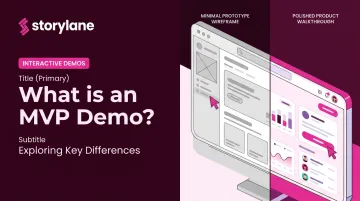
These are not the same thing. A prototype is typically internal — used to test technical feasibility or UX flows within the team. An MVP demo is externally facing, polished enough to make a commercial case, and designed to attract buyers or investors. The prototype answers "can we build it?" The MVP demo answers "will anyone buy it?"
Where It Sits in the Timeline
The MVP demo comes before the MVP. It tests the hypothesis ("Do people want this?") so the team can build the actual MVP with more confidence and a clearer scope.
The sequence typically looks like: MVP demo → prototype → MVP → full product. Not every team needs every stage — those with deep market knowledge may skip straight to MVP.
But skipping the MVP demo without any demand evidence is where most product-market fit failures originate. CB Insights research consistently places "no market need" as the top reason startups fail.
MVP vs. Demo vs. MVP Demo: Key Differences
| MVP | Product Demo | MVP Demo | |
|---|---|---|---|
| Purpose | Validate real usage and retention | Persuade or educate prospects | Validate demand before building |
| Audience | Real users | Prospects, investors, buyers | Early adopters, investors |
| Is It Functional? | Yes — fully working | No — simulated or guided | No — represents future product |
| Typical Format | Working software | Video, interactive walkthrough, slides | Video, landing page, clickable demo |
| Time to Build | Weeks (YC guidance) | Hours to days | Hours to days |
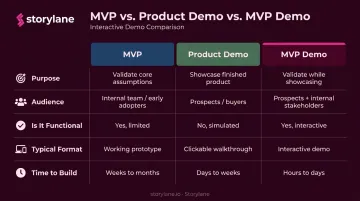
The most critical distinction comes down to delivery: an MVP delivers value even at minimal scope. A demo, including an MVP demo, represents value — but it cannot substitute for a working product when users need to actually rely on it. The right format depends on what you're trying to learn.
Confusing an MVP demo with a real MVP pushes teams in one of two costly directions: over-investing in a polished demo when the real question is whether users will retain and return, or shipping a non-functional demo when users expect a working product.
When to Use a Demo, an MVP, or an MVP Demo
The decision comes down to one question: what is the primary risk you need to reduce right now?
Build an MVP Demo If:
- You have an idea but no product
- The technical build cost is too high to justify without demand proof
- You need investor interest before you can fund development
- You want to test messaging or positioning before locking in a feature set
- Your concept is hard to explain without showing it
Create a Product Demo If:
- You have a working product and are in an active sales cycle
- Prospects are evaluating you but need self-serve access before a call
- You want buyers to self-qualify before discovery
- Your sales team is spending too much time on unqualified demos
Build an MVP If:
- You have demand evidence and need to start learning from real usage
- You've identified a specific customer archetype and job to be done
- You need to prove retention and operational feasibility, not just interest
The Modern SaaS Pattern
In practice, the MVP and the product demo often coexist. Teams launch an MVP and immediately build an interactive demo alongside it to reduce sales friction. Prospects can explore the product before a live call, arriving more informed and more ready to buy.
Storylane supports this motion directly. Screenshot demos go live in under 10 minutes, and HTML demos reproduce your actual product without requiring prospects to sign up. For teams running an MVP demo campaign, the Account Reveal feature identifies the companies engaging with ungated demos — so you know who is interested before a single sales call is booked.
Frequently Asked Questions
What is an MVP demo?
An MVP demo is either a demo of a minimal product (used to drive early adoption after launch) or a demo used as the MVP — a video, landing page, or interactive walkthrough deployed to validate demand before any real product is built. The second meaning is more common in startup contexts.
What is the difference between a solution demo and an MVP?
A solution demo is a sales tool showing how a product solves a specific prospect's problem — it's a persuasion artifact. An MVP is an actual functional product built to generate real usage data. The demo influences a decision; the MVP generates evidence.
What is MVP testing?
MVP testing is the process of releasing a minimal product to real users and measuring how they interact with it. Key metrics include activation rate, retention, feature usage, and willingness to pay — each one testing whether the core value hypothesis holds.
Do you need a demo before building an MVP?
Not always. If you already have strong demand evidence, go straight to the MVP. But if demand is unproven, an MVP demo — a video, landing page, or interactive walkthrough — can validate interest cheaply before committing to development.
Can an interactive demo replace an MVP?
An interactive demo can validate interest and generate signups (Dropbox's video moved a waitlist from 5,000 to 75,000 overnight). But it cannot replace an MVP for learning how users actually interact with a working product over time — that requires real usage data.