This article covers how to define and calculate sales conversion rate correctly, what benchmarks to compare against, the factors that move it up or down, and five strategies that actually work. It's written for sales managers, revenue ops, and GTM leaders at B2B companies who want to convert more of the pipeline they already have.
Key Takeaways
- Sales conversion rate is a family of stage-level metrics — not one single number
- The core formula: (Conversions ÷ Total Leads) × 100 — applied consistently at every stage
- Software industry average sits at 7.6%, but stage-level benchmarks are more useful for diagnosis
- Lead quality and ICP fit are the biggest drivers of conversion rate
- Prospects who engage with interactive demos before sales calls convert at 3.2x higher rates than those who don't
What Is a Sales Conversion Rate?
Sales conversion rate is the percentage of prospects who complete a desired action at a given stage of the sales process. That action could be a lead becoming an opportunity, a demo leading to a proposal, or a proposal closing into a deal. It's a family of metrics that spans the entire funnel — not one number.
Three Signals Conversion Rate Sends at Once
Most teams glance at conversion rate as a periodic sanity check. It does more than that:
- Are reps converting the leads they already have? (sales efficiency)
- Are MQLs actually sales-ready when marketing hands them off? (alignment)
- Can you trust your revenue projections? Without stage-level rates, forecasting is guesswork.
- Which part of the funnel is bleeding — and why?
Stage-Level vs. End-to-End
The distinction between overall conversion rate (lead-to-customer) and stage-level conversion rates matters a lot in practice. An overall rate of 4% tells you something is wrong. Stage-level rates tell you where.
If your SQL-to-Opportunity rate is healthy but your Demo-to-Proposal rate is low, that's a mid-funnel problem — likely in how demos are run, not in how leads are sourced. Stage-level tracking shows you exactly where deals are stalling. An overall rate just tells you they are.
How to Calculate Your Sales Conversion Rate
The formula is straightforward:
Sales Conversion Rate (%) = (Number of Conversions ÷ Total Leads or Prospects) × 100
A concrete example: a sales team receives 200 SQLs in a quarter and closes 14 deals. Lead-to-close conversion rate = 7%.
Applying It Across the Funnel
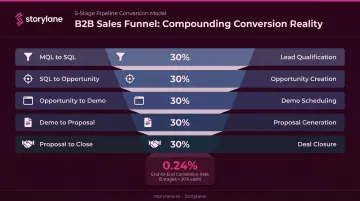
The same formula applies at every stage. A typical B2B pipeline looks like this:
| Stage | Formula |
|---|---|
| MQL → SQL | SQLs created ÷ MQLs generated |
| SQL → Opportunity | Opportunities created ÷ SQLs |
| Opportunity → Demo | Demos completed ÷ Opportunities |
| Demo → Proposal | Proposals sent ÷ Demos completed |
| Proposal → Close | Deals closed ÷ Proposals sent |
Multiply these stage rates together and you get your full-funnel conversion rate. If each stage runs at 30%, your end-to-end rate is roughly 0.3⁵ (about 0.24%). Stage rates compound fast, which means even small improvements at each step have an outsized effect on overall close rates.
Common Calculation Errors
Two mistakes consistently distort these numbers:
- Mixing unqualified leads with SQLs — inflates the denominator and makes conversion look worse than it is
- Inconsistent lead definitions between teams — if marketing counts a lead differently than sales does, the math is meaningless
Clean CRM data and agreed-upon stage definitions are the foundation for numbers you can actually act on.
Reporting Cadence
- Weekly: Stage-level rates (catch sudden drops fast)
- Monthly/Quarterly: Full-funnel rates (identify structural trends)
Sales managers and revenue ops typically own this metric jointly.
Sales Conversion Rate Benchmarks: What Does "Good" Look Like?
There's no universal benchmark. "Good" depends on your industry, deal complexity, and business model. The goal is comparison against relevant peers, not chasing an arbitrary average.
Overall B2B Software Benchmarks
According to Ruler Analytics' 2026 conversion benchmark study based on 5+ million data points:
- Software industry overall: 7.6%
- All-industry average: 5.13%
For context, HubSpot puts B2B lead-to-customer targets at 2–5% generally. Enterprise software sits lower at 1–3% — deal complexity and stakeholder count compress end-to-end conversion at every stage.
Stage-Level Benchmarks
These ranges reflect typical B2B performance. Your numbers will vary by segment and deal size:
| Stage | Typical Range |
|---|---|
| Qualified Lead → Opportunity | 15–25% |
| Demo → Proposal | 20–30% |
| Proposal → Close | 25–40% |
| New-logo win rate | ~19% |
Enterprise deals tend to sit at the lower end of each range. Expansion deals convert significantly better — win rates around 45% for existing accounts, per the 2025 Ebsta x Pavilion GTM Benchmarks report.
How to Use Benchmarks Practically
Don't chase the average. Use benchmarks as a diagnostic. If your Demo-to-Proposal rate is 12% against a benchmark of 20–30%, that stage is your first fix — not your top-of-funnel volume.
Stage conversion and deal velocity are connected. The same Ebsta report shows win rates drop from 18% for deals that slip one week to just 3% for deals that slip over six months — so where you're losing matters as much as how fast.
Key Factors That Affect Your Sales Conversion Rate
Lead Quality and ICP Fit
The single biggest driver of conversion rate is whether leads actually match your ideal customer profile. High volume with poor ICP alignment doesn't just tank conversion — it floods the pipeline with low-probability deals that consume rep capacity.
HubSpot's 2026 marketing data shows 40% of marketers cite lead quality as their most important success metric, while Forrester notes that fewer than 1% of leads convert to closed deals — pointing to how much wasted volume enters most funnels.
Sales Process Friction
Complicated, slow, or disjointed steps bleed conversion at every stage. Buyers who have to chase sellers disengage quickly. Common friction points include:
Complicated, slow, or disjointed steps bleed conversion at every stage. Buyers who have to chase sellers disengage quickly. Common friction points include:
- Delayed follow-ups after a demo
- Unclear next steps or handoffs
- Cumbersome procurement processes
Given that the average B2B buying group now includes 11 active members (Gartner, 2024), coordinating a disorganized process across that many stakeholders is hard enough without adding unnecessary friction.
Demo Quality
Generic demos are a major conversion killer at the mid-funnel. When a demo doesn't map to the buyer's specific role or use case, it fails to move the deal forward regardless of how strong the product is.
The experience a prospect has before they speak to a rep matters here. A prospect who arrives at a sales call already familiar with the product asks better questions and moves faster.
Lead Source
Not all leads convert equally. Ruler Analytics' 2026 software industry data shows significant channel variation:
| Channel | Software Conversion Rate |
|---|---|
| Paid search | 8.2% |
| Organic search | 7.9% |
| Direct | 6.4% |
| 4.0% | |
| Social organic | 2.74% |
| Social paid | 1.7% |
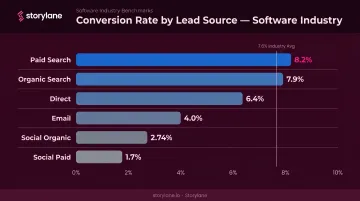
Teams that track conversion by source can reallocate effort toward higher-converting channels instead of spreading resources evenly.
Proven Strategies to Improve Your Sales Conversion Rate
Sharpen Lead Qualification with a Scoring Framework
Lead scoring ranks prospects by assigning values based on firmographic fit (company size, industry, role) and behavioral signals (content engagement, demo requests, email opens). The practical effect: reps spend time on deals most likely to close.
Tightening MQL-to-SQL handoff criteria reduces the volume of low-probability leads entering the pipeline, which improves conversion rate without changing a single downstream process. Salesforce cites examples where predictive lead scoring increased sales by 27% and customized manual scoring improved revenue by more than 18%.
Personalize Outreach at Every Stage
Generic mass outreach consistently underperforms targeted messaging. Personalization means referencing the prospect's specific pain points, industry context, and previous interactions — swapping a first-name token for something that actually shows you did the work.
McKinsey research shows personalization typically drives a 10–15% revenue lift, and faster-growing companies generate 40% more revenue from personalization than slower-growing peers. Structured follow-up sequences that reference prior engagement (what they viewed, what questions they asked) prevent deals from going dark after an initial touch.
Storylane supports this with smart variable tokens that customize demo content per prospect — names, company context, use case framing — so personalization scales without a rep manually editing each asset.
Warm Up Buyers Before the Sales Call with Interactive Demos
Letting prospects experience the product before the first full sales conversation is one of the most effective mid-funnel conversion levers available.
Gartner reports that 75% of B2B buyers prefer a rep-free sales experience, and buyers are 1.8x more likely to complete a high-quality deal when they use supplier-provided digital tools alongside a sales rep. Self-service exploration combined with human follow-up outperforms either approach alone.
Storylane's internal data shows prospects who engaged with an interactive demo converted at a 10.1% deal conversion rate, compared to 3.1% for those who didn't. That's a 3.2x improvement in deal conversion.
This works because pre-demo exposure changes the conversation. Prospects who've already explored the product:
- Arrive at discovery calls familiar with key features
- Ask sharper, more specific questions
- Skip the basic "what does this do?" walkthrough entirely
Sales reps get Slack alerts when a prospect engages with a demo, including which features they explored and their intent level, so follow-up is timely and contextually relevant.
Use Funnel Analytics to Find and Fix Drop-Offs
Regularly audit each stage conversion rate to identify the single biggest drop-off point. That stage is your next priority — not whichever section of the funnel happens to look interesting.
A disciplined approach:
- Pull stage conversion rates for the last 30–60 days
- Identify the stage with the steepest gap versus benchmark
- Hypothesize a root cause (messaging, ICP mismatch, process friction)
- A/B test one change at that stage — email subject line, call script, demo format
- Measure for 2–4 weeks before drawing conclusions
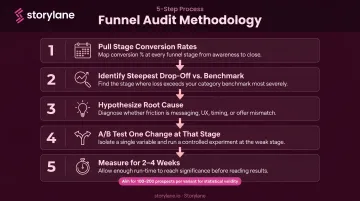
Outreach's guidance recommends testing 100–200 prospects per template to get statistically meaningful results. Treat conversion problems as diagnostic, not punitive.
Align Sales and Marketing Around Shared Definitions
Many conversion rate problems aren't sales problems — they're definition problems. If marketing counts a lead as "qualified" by one standard and sales works them by another, the handoff is broken before a rep makes the first call.
HubSpot reports that more than 27% of marketers cite sales-marketing alignment as a top challenge, and companies with an active service-level agreement are 31% more likely to hire additional sales staff to meet demand — a signal that alignment creates capacity, not just coordination.
Three structural fixes close the gap:
- Shared lead lifecycle: Agree on stage entry criteria so "qualified" means the same thing to both teams
- Joint review cadence: Meet monthly to examine conversion rates by stage together, not in silos
- Single CRM source of truth: Both teams define and track handoffs in the same system
Frequently Asked Questions
What is a good sales conversion rate?
There's no single benchmark. Software and B2B SaaS companies typically see overall lead-to-close rates in the 2–8% range, with enterprise deals sitting lower (1–3%) and SMB deals higher. Comparing your stage-level rates against industry benchmarks is more useful than chasing a single end-to-end number.
How do you calculate sales conversion rate?
Divide the number of successful conversions by the total number of leads or prospects, then multiply by 100. Apply this formula at each funnel stage — MQL-to-SQL, SQL-to-Opportunity, Demo-to-Proposal, and so on — rather than just end-to-end.
What is a KPI for conversion rate?
Sales conversion rate itself is a KPI, tracked alongside lead-to-opportunity rate, demo-to-close rate, and win rate. Each stage-level KPI pinpoints a specific drop-off point, so your team knows whether the problem is lead quality, demo effectiveness, or closing execution.
What factors most commonly cause a low sales conversion rate?
The most frequent causes: poor lead quality or ICP mismatch, friction in the sales process (slow follow-up, unclear next steps), generic non-personalized outreach, and demos that don't connect to the buyer's specific use case.
What is the difference between lead conversion rate and sales conversion rate?
Lead conversion rate measures how many raw leads become qualified or engaged prospects. Sales conversion rate measures how many of those qualified prospects become paying customers.