

For teams selling complex SaaS products, the problem compounds. Prospects arrive at sales calls expecting technically informed, consultative conversations. When sellers can't meet that bar — because they haven't researched the account, don't understand the buyer's environment, or deliver a generic demo — deals stall or die quietly, well before any negotiation ever begins.
That's the gap presales exists to close.
This article covers what presales is, how it differs from sales, what activities it involves, who does the work, and why a structured presales function makes a measurable difference for B2B revenue teams.
Key Takeaways
- Presales encompasses all technical and research activities before a deal closes: discovery, qualification, solution demos, and proposals.
- Presales focuses on solution fit (technical alignment); sales focuses on customer fit (relationship and closing).
- Core presales activities include lead qualification, discovery calls, tailored demos, proof-of-concept builds, and RFP responses.
- A structured presales function improves win rates, shortens sales cycles, and sharpens the buyer's experience.
- Tools like Storylane let presales teams deliver personalized, scalable demos without a live engineer at every interaction.
What Is Presales?
Presales is the set of activities that occur before a deal closes — from a prospect's first contact through qualification, solution design, and proposal. It hands off to sales for final negotiation and contract, though in complex enterprise deals, presales professionals often stay involved through implementation.
A few important distinctions:
- Presales vs. marketing: Marketing builds awareness at scale. Presales is prospect-specific — direct engagement aimed at qualifying and solving for a particular customer's problem. Both precede a close, but they serve different purposes.
- Presales vs. sales: Sales owns the relationship and the close. Presales owns the technical evaluation and solution fit.
The function matters most in B2B contexts where products are complex, configurable, or deeply integrated with a buyer's existing infrastructure. The more technical the product, the harder it is for sales alone to address questions about integration, configuration, and expected ROI — which is exactly where presales earns its keep.
Where Presales Sits in the Sales Cycle
Presales enters the moment a lead hits the pipeline and runs through:
- Initial discovery and research
- Lead qualification
- Product demonstration
- Proposal and proof-of-concept
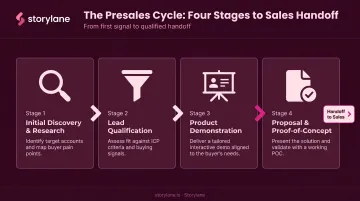
After proof-of-concept, the baton passes to sales — though in enterprise deals with complex procurement or lengthy security reviews, presales may stay in the room longer than that.
Common Presales Job Titles
The function goes by many names depending on the organization:
- Sales Engineer / Solutions Engineer
- Presales Consultant
- Solutions Architect
- Technical Account Manager
The title varies; the job doesn't. Each role sits at the intersection of product expertise and buyer communication — turning technical depth into a reason to buy.
Presales vs. Sales: Key Differences Explained
The clearest framing is this: presales asks "Does our product technically solve this customer's problem?" Sales asks "Is this the right buyer, and can we close them?" Both questions matter. They require different skills, different mindsets, and different metrics.
Presales: Technical and Analytical Focus
Presales professionals live in product depth. They analyze prospect requirements, map capabilities to pain points, build proof-of-concept materials, and handle technically demanding deliverables: RFP responses, security questionnaires, architecture consultations. Their credibility comes from accuracy and specificity, not persuasion.
The U.S. Bureau of Labor Statistics defines sales engineers as professionals who "sell complex scientific and technological products or services to businesses" — and explicitly notes that while other salespeople may focus on marketing and commercial selling, sales engineers concentrate on technical aspects. The numbers reflect how valued this role is: 56,800 sales engineer jobs in 2024, a median annual wage of $121,520, and 5% projected employment growth through 2034.
Sales: Relationship and Closing Focus
Sales reps build trust, manage the buying relationship, navigate objections, negotiate terms, and close. Their KPIs center on revenue: quota attainment, pipeline velocity, deal size, and close rate. They benefit from technical knowledge, but they rely on presales to provide that depth — freeing them to focus on the human side of the transaction.
Side-by-Side Comparison
| Dimension | Presales | Sales |
|---|---|---|
| Primary goal | Solution fit — technical evaluation | Customer fit — relationship and close |
| Core skills | Product depth, analytical thinking, problem-solving | Communication, persuasion, negotiation |
| Key activities | Discovery, demos, POC, RFP responses | Prospecting, objection handling, contract |
| Success metrics | Technical win rate, POC conversion, demo engagement | Quota attainment, pipeline velocity, close rate |
| Funnel position | Entry to technical evaluation complete | Technical evaluation through contract signed |
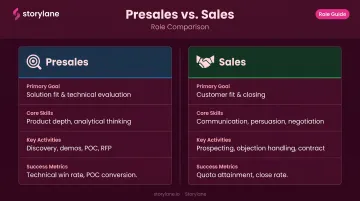
When Each Team Engages
A typical handoff sequence: presales enters at discovery and owns the technical evaluation through the proposal stage. Once the buyer is technically convinced, sales takes the lead on negotiating terms and closing. In complex enterprise deals — cybersecurity platforms, pharma software, infrastructure tooling — presales may stay engaged through implementation.
Without defined rules of engagement, roles overlap, prospects receive conflicting messages, and no one owns the outcome.
Common Presales Activities and Responsibilities
Discovery and Research
Before any demo or proposal happens, presales professionals do the groundwork: market research, prospect analysis, and competitive intelligence. Specifically, they map out:
- Who the buyer is and what problems they face
- How those problems are currently being addressed
- What technical constraints exist in their environment
This research shapes buyer personas that inform every subsequent touchpoint — from the demo to the proposal to the live conversation.
Lead Qualification
Not every inbound or outbound lead deserves full presales attention. The presales team evaluates fit based on:
- Company size and industry
- Tech stack compatibility
- Budget signals
- Nature and urgency of the pain point
Discovery calls are the primary mechanism for qualification. A well-run discovery call surfaces whether a prospect is a genuine fit — or whether pursuing them would waste sales resources on a low-probability deal.
Product Demonstrations
Demos are the most visible presales responsibility. The goal isn't a generic walkthrough. Presales tailors each demo to the prospect's specific use case, showing exactly how the product solves their particular problem.
Modern presales teams use interactive demo platforms to scale this work. Storylane, for example, allows solutions engineers to build guided tours, multi-chapter branching demos, and self-serve experiences that prospects can explore independently before a live call. Personalization tokens dynamically swap in the prospect's company name, logo, and relevant data — so a single demo template can be customized for dozens of accounts without manual rebuilding.
SentinelOne uses Storylane's Buyer Hub at major industry events like RSA Conference to deliver persona-specific demo experiences to security teams, IT managers, and executives simultaneously — without requiring a presales engineer to be present for every interaction.
Navattic's 2026 State of the Interactive Product Demo report found that 18% of B2B SaaS websites now feature an interactive demo CTA, up from 12% in 2024 — confirming that async, self-serve demo delivery is now standard practice.
Proposal and RFP Work
Presales brings the technical depth required to produce credible proposals. They document the customer's requirements, outline the proposed solution, incorporate proof-of-concept details, and build ROI models to demonstrate value.
A sales rep without deep product knowledge would struggle to produce this work convincingly. Worse, a poorly constructed RFP response can eliminate a vendor from consideration before a conversation even happens.
Why Presales Matters: Key Benefits for B2B Teams
Better-Armed Sales Reps
When presales does its job well, sales reps enter conversations knowing the buyer's pain points, understanding how the product fits, and ready to handle technical objections on the spot. Salesforce's 2026 research found that sales reps already spend 60% of their time on non-selling tasks. Without presales support, that number climbs — reps either burn hours on research and proposal work, or worse, make technically inaccurate claims that derail deals before they reach negotiation.
Presales absorbs the technical burden so sales can focus on what it does best.
A Better Buyer Experience
Buyers of complex products want to feel understood. When a presales team demonstrates genuine knowledge of the customer's environment and tailors the solution presentation accordingly, it creates a consultative experience that builds confidence in the vendor.
This connects directly to the buyer-seller misalignment problem. Gartner's 2025 research found 73% of B2B buyers avoid suppliers that send irrelevant outreach, and 69% encounter inconsistencies between vendor content and what sellers actually say.
A well-run presales function closes that gap — ensuring every touchpoint reflects real understanding of the customer's situation.
Scalable Technical Engagement
Presales teams face a practical constraint: there are only so many hours in the day, and enterprise deals require significant technical attention. Interactive demo tools help solve this.
Storylane's analytics and Demo Signals features give presales teams visibility into how prospects engaged with a demo before a live call:
- Which features they explored and for how long
- Where they dropped off in the demo flow
- Their overall intent score (Low, Medium, or High)
Real-time Slack alerts notify teams the moment a high-value account engages. That intelligence lets presales walk into every conversation already informed — and focus their time on the accounts most likely to convert.
Presales Best Practices
Define rules of engagement clearly. Specify exactly when presales gets involved in a deal, which tasks they own versus share with sales, and how handoffs are structured. Without this clarity, prospects get conflicting messages and accountability gaps form. Map these rules by deal stage or deal complexity.
Build a Continuous Discovery Culture
Effective presales teams don't just execute a checklist — they actively refine their market knowledge through deliberate feedback loops. That means staying close to both wins and losses:
- Review lost deal data in the CRM to identify where value failed to land
- Run post-sale retrospectives with account executives
- Read industry reports and track competitive shifts
- Share intelligence with product and marketing teams
Storylane's demo analytics support this directly. Drop-off data and feature engagement patterns show presales exactly where their demo narrative loses buyers, enabling ongoing refinement without guesswork.
Measure presales performance with specific KPIs. Without measurement, presales impact remains invisible and difficult to resource. PreSales Collective identifies several technical sales metrics that matter:
- Activity Volume — tracks presales workload across the pipeline
- Attachment Rate — measures what percentage of deals include presales involvement (global median is approximately 4:1 AE-to-SC ratio)
- Revenue Impact — ties presales activity to closed ARR
- SC Capacity — monitors whether the team is overloaded relative to pipeline volume
- Engagement Duration — tracks presales time per opportunity against expected SLAs
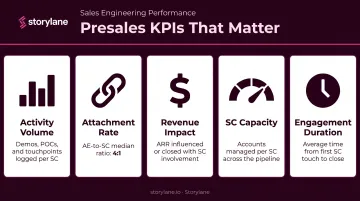
Storylane's analytics make this more granular: completion rates, time-per-step, and feature engagement are captured at the account level. That data can be exported to CSV or pushed directly to Salesforce and HubSpot for inclusion in broader presales performance dashboards.
Frequently Asked Questions
What is a pre-sales role?
A pre-sales role covers the technical and research-focused responsibilities that occur before a deal closes — including lead qualification, discovery, product demonstrations, and proposal and RFP preparation. Common titles include Sales Engineer, Solutions Engineer, and Presales Consultant, all focused on proving product fit to a prospect's specific requirements.
What is the difference between sales and presales?
Presales focuses on solution fit — understanding what the customer needs technically and demonstrating how the product addresses it. Sales focuses on relationship-building, trust, and closing. The two functions are complementary and hand off to each other at defined points in the buying process.
What does a presales engineer do?
A presales engineer handles the technical side of the sales process: building tailored demos, creating proof-of-concept environments, responding to RFPs, and fielding questions from a prospect's IT and engineering team. They're typically the primary contact for technical decision-makers during an evaluation.
What are the key activities in a presales process?
The main activities are: market research and competitive analysis, lead qualification via discovery calls, tailored product demonstrations, proof-of-concept builds, and proposal or RFP preparation — occurring sequentially across the early-to-mid stages of the sales cycle.
Why is presales important in B2B sales?
Presales ensures sales teams pursue qualified, well-researched opportunities, reduces the risk of technical misrepresentation, and creates a consultative buyer experience that accelerates deal cycles. It's especially critical for complex products where buyers need to confirm fit before committing.
What skills are needed for a presales role?
Key skills include deep product and technical knowledge, strong analytical ability, and clear communication. The most important skill is translating complex technical concepts into business value for non-technical stakeholders and decision-makers.