
.svg)

That gap between "user signed up" and "user got value" is where retention is actually won or lost. Closing it is the entire point of onboarding.
This article covers the foundational tactics that drive activation, how personalization shortens time-to-value, and the metrics that tell you whether your onboarding is actually working — not just completing.
Key Takeaways
- Onboarding is the journey from sign-up to first meaningful outcome, not a product tour
- Sign-up friction, unclear expectations, and missing contextual guidance are the three biggest onboarding killers
- A brief welcome survey dramatically shortens time-to-value by routing users into relevant flows
- Measure activation rate, time-to-value, and Day 7/Day 30 retention cohorts — not tour completion
- Great onboarding starts before sign-up, not after it
Why SaaS Onboarding Is the Make-or-Break Moment
Onboarding is the first real experience a paying user has with your product after exiting the sales funnel. A weak onboarding experience doesn't just cause early churn — it inflates customer acquisition costs because you're perpetually replacing lost users rather than building on them.
Wyzowl research puts the business case plainly: 63% of customers say onboarding and post-sale support influences their purchase decisions, and 86% are more likely to stay loyal when a company invests in onboarding content. Onboarding isn't a post-sale courtesy — it's a revenue lever.
Three Business Outcomes a Strong Onboarding Process Delivers
- Accelerates product adoption so users hit their "aha moment" before motivation fades
- Reduces support ticket volume as educated users self-serve confidently
- Cuts churn by helping users find early value, then expand usage over time
User Onboarding vs. Customer Onboarding
These two terms get conflated, but the mechanics differ significantly:
| User Onboarding | Customer Onboarding | |
|---|---|---|
| Driver | Product-led, in-app | Relationship-led, CSM-assisted |
| Focus | Individual activation | Enterprise implementation |
| Scale | High-volume, self-serve | Low-volume, high-touch |
| Goal | Value realization | Value realization |
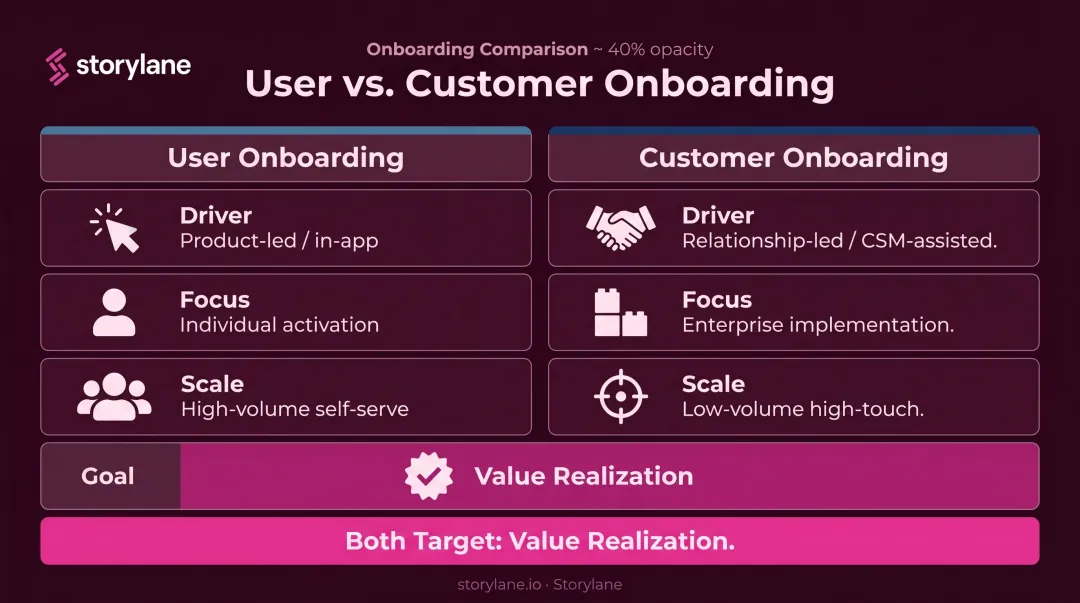
Both motions target the same outcome: getting users to value realization as fast as possible. That distinction shapes every tactical decision you'll make.
SaaS Onboarding Best Practices That Drive Activation
These six tactics address the most common activation failure points across high-performing SaaS products.
Cut Sign-Up Friction to the Minimum
Every additional field, verification step, or forced decision in your sign-up flow increases the probability of abandonment before a user has seen any product value. The principle: ask only for what is absolutely necessary to create the initial session, then collect additional data progressively inside the product.
The payoff is measurable. CXL documents how Chargebee doubled signups after delaying password creation and email verification until the user's second visit. That same experiment later raised trial-to-paid conversion from 8% to 15% by adding purpose-driven qualifying questions at the right moment.
SSO (Google, Microsoft) is the single highest-impact friction reducer. Email verification, while sometimes necessary for compliance, is one of the most common silent conversion killers — users abandon before the email arrives.
One caveat: reducing fields isn't automatically better. The goal is eliminating unnecessary friction, not pursuing shorter forms for their own sake.
Welcome New Users with Intent, Not Just Politeness
A generic welcome screen ("Thanks for signing up!") wastes one of the highest-leverage moments in the entire onboarding flow. An intentional welcome does real work: setting expectations, building a human connection, and capturing the user's primary goal.
The welcome moment should speak to the user's desired outcome, not your product's feature list. What did they come here to accomplish? Acknowledge that explicitly. A short founder video or personal note — as companies like Userlist use — can build early trust and reduce the psychological distance between a new user and your product.
Show Value Early with Interactive Walkthroughs
Passive product tours fail for a simple reason: clicking "Next" through a series of screens doesn't build product intuition. An interactive walkthrough only advances when the user completes the action — teaching through doing rather than watching.
The activation difference is real. Attention Insight raised heatmap creation activation from 47% to 69% — a 47% relative increase — after switching to interactive, driven-action walkthroughs.
That same principle extends before sign-up. Interactive product demos let prospects experience the product hands-on before they enter the onboarding funnel. Storylane enables companies to deploy self-guided interactive demos directly on their websites and in outreach emails. Prospects arrive at sign-up already oriented to core value — no orientation required.
Customers like Whispli apply the same format post-signup: building dedicated onboarding demos that help new users get up to speed without scheduling a live CSM session.
Format guidance:
- Guided step-by-step walkthroughs — best for complex, sequential workflows
- Hotspots — best for contextual feature discovery at the user's own pace
- Tooltips/annotations — best for UI clarification on specific elements
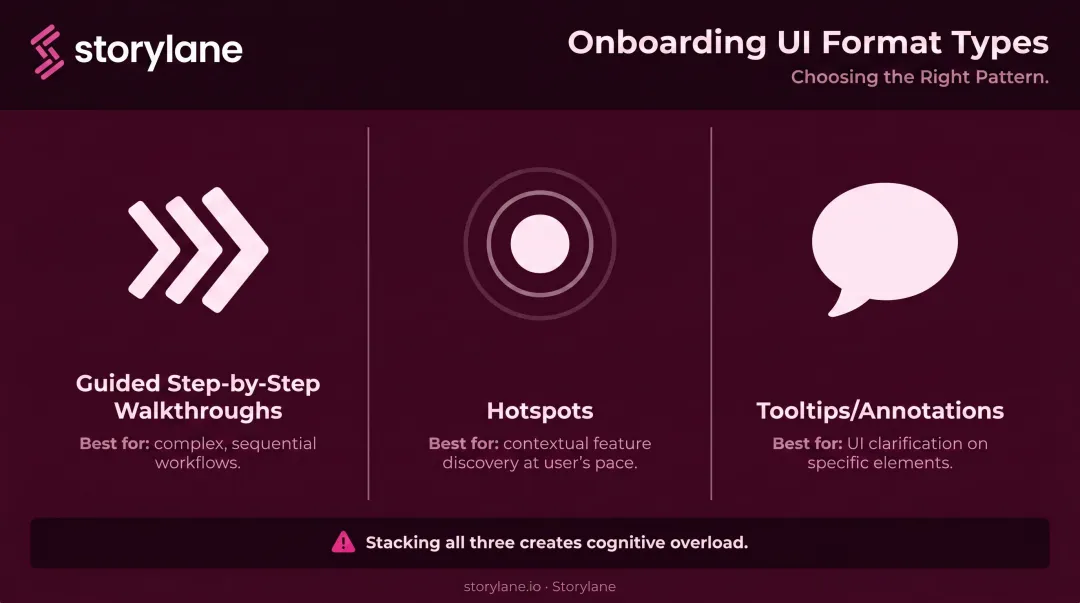
Use each format at the right moment. Stacking all three simultaneously creates cognitive overload, not guidance.
Build Onboarding Checklists Tied to Activation Milestones
Checklists work because of two well-documented psychological mechanisms. The Zeigarnik Effect — established by Bluma Zeigarnik's foundational research — shows that incomplete tasks stay cognitively salient, creating a natural pull toward completion. The endowed progress effect (Nunes and Dreze, Journal of Consumer Research, 2006) shows that artificial advancement toward a goal increases persistence — which is why pre-checking the first item makes users feel already invested.
Practical guidelines:
- Keep checklists to 3–5 items maximum
- Each item should map to a meaningful activation milestone, not a feature exploration
- Include a visible progress bar and a pre-completed first task
- Add a celebration message at completion — it signals arrival at the first milestone
If your core onboarding checklist completion rate is below 30%, that's a signal of friction or misalignment between checklist items and what users actually care about.
Trigger Guidance Contextually, Not on a Fixed Schedule
Scheduled onboarding fires in sequence regardless of what the user is actually doing. Contextual onboarding surfaces at the moment a user needs it — and not before.
A concrete example: a social scheduling tool that surfaces content templates when a user's post queue is empty. Not five minutes into their first session before they've tried anything — when they actually need it.
The infrastructure that makes this possible: behavioral triggers based on custom events, inactivity signals, and incomplete step detection. Without this data layer, contextual onboarding isn't achievable.
Make Self-Serve Help Easy to Find When Users Get Stuck
Light-touch onboarding only works if users have a clear path to help when they hit walls. An embedded resource center — searchable, in-app, accessible without leaving the product — is the right answer for most SaaS products at scale.
Whispli's implementation is a useful model: their customer success team built a library of feature-based interactive demos (covering things like adding team members or accessing analytics) that customers can access independently. When a user has a question, they get a targeted demo rather than a scheduled CSM call. The result is self-serve support that scales without proportionally scaling headcount.
Personalizing Onboarding for Different User Segments
A sales rep and an engineer signing up for the same product have different goals, different technical comfort levels, and different definitions of "value." Showing both users the same onboarding flow means irrelevant steps for at least one of them — and irrelevant steps are drop-off risks.
The Welcome Microsurvey
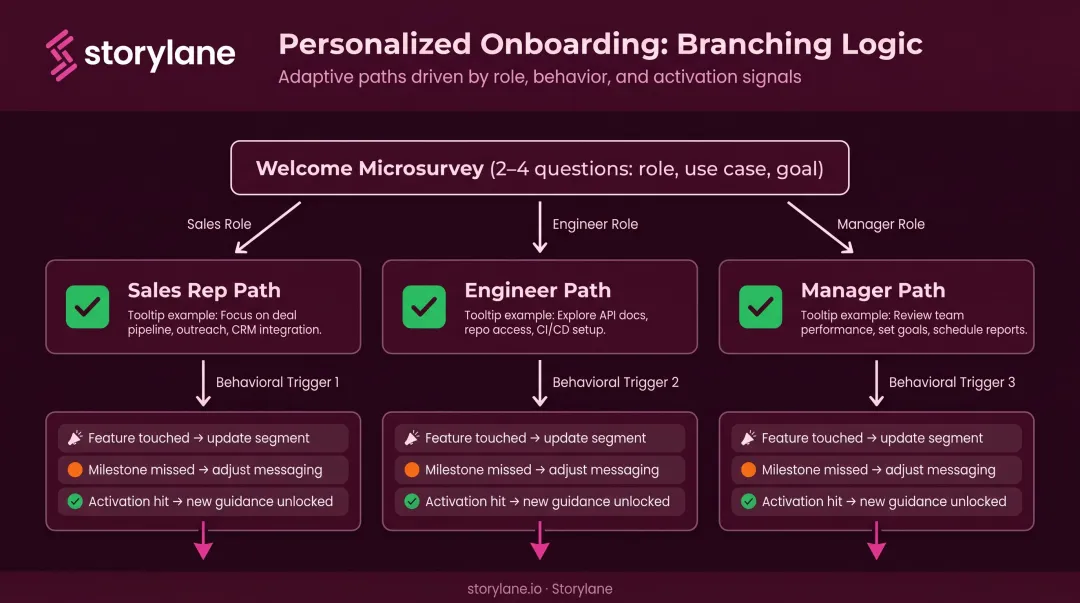
The mechanics are simple: 2–4 targeted questions asked immediately after sign-up, covering role, primary use case, or main goal. Responses route users into distinct onboarding paths.
Questions should be actionable for personalization. Avoid questions that only benefit the company (like company revenue). HubSpot asks about user role and goals to shape the onboarding path that follows, using those responses as a core branching mechanism in their flow.
Make's onboarding teardown reported a 4–6% activation lift from shifting to role-tailored onboarding experiences — a meaningful gain at scale even if it sounds modest.
Beyond the First Session
Personalization shouldn't stop after the welcome survey. As users take actions inside the product, behavioral data should update their segment and trigger new contextual guidance based on where they are in adoption, not just what they stated at sign-up.
Storylane's branching demo capabilities illustrate this well. Customers like SpyCloud and Clari use multi-chapter demo structures where different buyer roles follow distinct paths through the same product experience.
That segmentation logic — role- or use-case-based path selection — is directly transferable to in-app onboarding design. A few ways to apply it:
- Trigger different checklists based on the features a user has (or hasn't) touched
- Surface role-specific tooltips based on job title captured at sign-up
- Adjust in-app messaging cadence as users hit or miss activation milestones
Metrics That Tell You Whether Your Onboarding Is Working
Activation Rate
Activation rate is the foundational onboarding metric: the percentage of new users who reach the specific in-product action that signals genuine value realization.
Define the activation event narrowly. "Published their first flow" is an activation event. "Logged in three times" is not.
Benchmarks to know:
- Average SaaS activation rate: 36% (OpenView), 30.22% (Appcues)
- Companies below 20% activation face serious retention headwinds
- Enterprise companies (1,000+ employees) average 53%; sub-50-employee companies average ~19%
Identify your activation event by analyzing which early behaviors correlate with long-term retention. That correlation is your activation signal.
Time-to-Value
Time-to-value (TTV) measures how long it takes a new user to reach the activation event after sign-up. Track it as a median, not a mean — long-tail outliers distort the mean significantly.
Industry TTV benchmarks:
- Freemium products: 2.28 days average
- Free trial products: 33.42 days average
- B2B products: 2–3 weeks is reasonable; aim for activation within 1–3 days where possible
A high TTV usually points to one of three problems: too many steps in the flow, the wrong activation milestone defined, or excessive friction at a specific step.
Day 7 and Three-Month Retention Cohorts
Retention cohorts validate whether onboarding built real product intuition or just clicked through a tour. A cohort that activates fast but churns by Day 7 suggests users completed steps without actually learning the product.
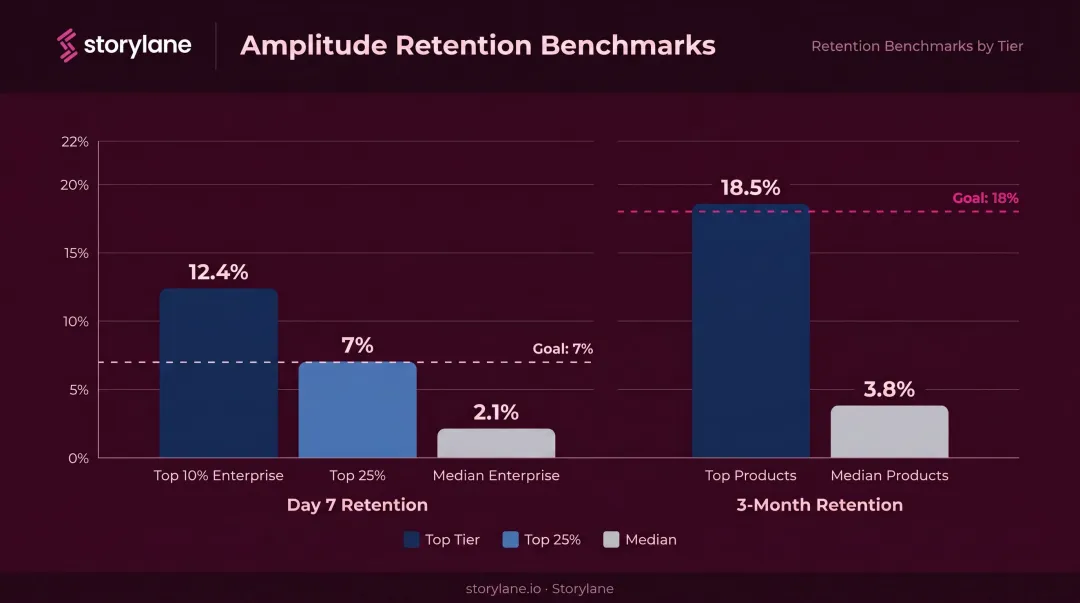
Amplitude's benchmarks show how wide the gap is:
- 7% Day 7 retention places a product in the top 25% for activation performance
- Top 10% enterprise products reach 12.4% Day 7 retention; median enterprise products reach just 2.1%
- At three months, top products retain 18.5% of users; median products retain 3.8%
Diagnosing Low Feature Usage
When a feature has low adoption, use this three-layer triage before rebuilding your onboarding:
- Funnel analysis — where exactly is drop-off happening?
- Session replay — why is it happening at that specific step?
- In-app microsurvey — what does the user think is happening?
All three layers together tell you whether you have an onboarding problem or a product problem. Each one alone leaves you guessing.
Common SaaS Onboarding Mistakes to Avoid
Over-Engineering the Guided Experience
Adding more flows, more tooltips, and more pop-ups in response to low activation is the most common trap. It can lift short-term completion metrics while quietly damaging long-term retention. Users guided through every step without making their own decisions never build the product intuition needed to stay.
The fix is usually timing and relevance — not volume.
Misusing Empty States
Empty states are among the highest-leverage moments in early product experience — and most products squander them. Two failure modes:
- Dummy data that confuses users about what's real vs. placeholder
- Blank states with no direction, leaving users with no obvious next action
NN/g's research on empty state design shows that a good empty state communicates system status, increases learnability, and provides a direct pathway for the key task. For SaaS specifically, that means a clear instruction, a visible CTA, and ideally a sample or template that shows what the product looks like when it's working.
Treating Onboarding as a One-Time Build
Products change. User segments drift. Onboarding copy goes stale. The operational habits that keep onboarding effective:
- A/B test onboarding changes before committing to them
- Collect user feedback at the end of the flow
- Review drop-off data regularly, not just at launch
Onboarding that isn't actively maintained drifts out of sync with the product and the users it's meant to serve. Teams that skip the maintenance end up rebuilding the whole thing when activation numbers finally crater.
Frequently Asked Questions
What is the difference between user onboarding and customer onboarding in SaaS?
User onboarding is product-led and in-app, built around self-serve flows, tooltips, and walkthroughs for individual activation. Customer onboarding is relationship-led, typically involving a CSM for enterprise implementation and setup. Both target value realization, but the mechanics and scale differ significantly.
How long should SaaS onboarding take?
Frame the question around time-to-value, not a calendar target. Simple tools can activate users in minutes; complex B2B platforms may take two to three weeks. The goal is reaching the user's first meaningful outcome as fast as possible.
What metrics should I track to measure SaaS onboarding success?
Track activation rate, time-to-value, onboarding checklist completion rate, and Day 7/three-month retention cohorts. Activation rate is the most critical starting point: it tells you whether users are reaching genuine value, not just completing steps.
How can I reduce early user churn during onboarding?
Reduce sign-up friction so users reach the product faster, personalize the flow so users only see steps relevant to their goals, and make sure every user hits a tangible win within their first session. Early churn almost always traces back to one of these gaps.
What are the most common SaaS onboarding mistakes to avoid?
Over-engineering with too many guided steps creates dependency instead of product intuition. Leaving empty states blank gives users no clear first action. Treating onboarding as a one-time build rather than an ongoing optimization process is the third common failure.
How do interactive product demos fit into a SaaS onboarding strategy?
Interactive demos can serve as a pre-onboarding layer — letting prospects experience the product hands-on before they sign up. This means users arrive already familiar with core workflows, which reduces time-to-activation and lowers the burden on in-app onboarding flows. Platforms like Storylane enable this with self-guided demos embedded on websites or shared via email before any formal sign-up occurs.