That gap between form submission and first contact is where marketing spend goes to die. A lead who was actively researching your product at 2pm on Tuesday is a very different conversation at 10am on Wednesday.
Lead response time is one of the highest-leverage variables in your sales funnel, yet most teams treat it as a rep discipline issue when it's almost always a systems problem. This article explains why response speed drives pipeline outcomes and what to actually fix.
Key Takeaways
- Lead response time measures the gap between a lead's inquiry and your first contact attempt
- Waiting just 30 minutes drops qualification odds by 21x compared to responding in 5 minutes
- The average company takes 42 hours to respond — most buyers have moved on by then
- Slow response traces back to broken routing and missing tooling — not rep effort
- Fixing it means measuring response gaps, prioritizing by intent signals, and automating handoffs
What Is Lead Response Time?
Lead response time (LRT) is the measured duration between the moment a lead takes an action — form fill, demo request, content download — and the moment a sales rep makes first contact. At the team level, it's tracked as an average across all inbound leads.
The formula is straightforward:
Lead Response Time = Time of First Contact Attempt − Time of Lead's Initial Inquiry
Average LRT is calculated by summing all individual response times and dividing by the number of leads in a given period.
That said, LRT is a means to an end — not a metric to chase in isolation. The real goal is reaching a lead while their intent is still high. Urgency should be calibrated to lead type: a demo request warrants a response in minutes, while a whitepaper download can wait hours. Treating both with the same SLA either wastes rep time or lets high-intent leads go cold.
Why Lead Response Time Matters
The case for speed isn't abstract best-practice territory. It sits directly in conversion rates, pipeline economics, and competitive dynamics.
First-Mover Conversion Advantage
When a prospect submits a demo request, they're in active research mode. They haven't chosen a vendor or taken meetings yet. The first sales rep to reach them captures a disproportionate share of their attention and shapes how every subsequent vendor gets evaluated.
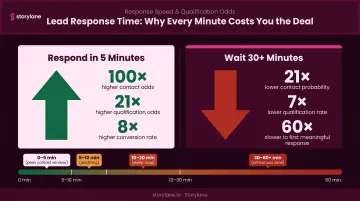
Research from InsideSales.com and MIT's James Oldroyd, spanning 15,000+ web-generated leads over three years, found that calling within 5 minutes versus waiting 30 minutes produced a 100x drop in contact odds and a 21x drop in qualification odds. A 2021 follow-up study across 5.7 million marketing leads confirmed 8x higher conversion rates within the first 5 minutes compared to 6+ minutes.
KPIs directly affected:
- Lead-to-opportunity conversion rate
- Qualified lead rate
- Pipeline created per inbound lead
The first-mover advantage matters most in high-competition categories where multiple vendors are being evaluated simultaneously. The first conversation anchors the buyer's reference point — everything evaluated afterward gets measured against it.
Competitive Differentiation Through Speed
Most companies are genuinely bad at lead response. That gap is the opportunity.
A 2024 audit by RevenueHero submitted demo requests to 1,000 B2B SaaS companies and found 63.5% failed to respond at all. Among those who did respond, the average response time was 1 day, 5 hours, and 17 minutes. A separate Workato study of 114 B2B companies found that 0% called within 5 minutes and only 31% called at all.
Speed becomes a differentiator when the product category is crowded. Responding in minutes signals operational maturity and genuine buyer respect. Slower competitors simply cannot replicate that at the moment it counts.
Where this advantage is sharpest:
- Win rate against direct competitors
- First-response-to-meeting conversion rate
- Competitive displacement rate
This advantage is most impactful when buyers are evaluating three or more vendors simultaneously or when the lead source is high-intent, such as a pricing page visit or direct demo request.
Protection of Marketing Investment
Every inbound lead carries a cost. Paid media, content production, SEO, and event spend all produced that form submission. Failing to follow up quickly turns that investment into waste.
The no-response numbers are damaging on their own: InsideSales/XANT data from 2021 shows 77% of leads were never responded to at all. HubSpot research cites an average B2B cost per lead of $84 across all channels. At that rate, a team generating 500 inbound leads per month and failing to contact 77% of them is writing off roughly $32,000 in demand generation spend monthly, before accounting for the revenue those leads might have generated.
Pipeline metrics directly at stake:
- Marketing-sourced pipeline
- Cost per opportunity
- Lead-to-MQL-to-SQL funnel efficiency
Improving lead response time recovers revenue from budget already spent — no additional acquisition cost required.
What Happens When Lead Response Time Is Ignored
Slow response doesn't just reduce one metric — it creates a compounding set of downstream problems.
The mechanics are straightforward: a lead who submitted a form at 9am and hears nothing until the next morning has spent 24 hours in a different mental state. They've researched alternatives, possibly scheduled calls with competitors, and their urgency has dissipated. The sales rep who finally calls inherits a harder conversation with a less engaged prospect.
According to HBR's research on online sales leads, firms responding within one hour were more than 60x more likely to qualify a lead than firms waiting 24+ hours. Of the 2,241 companies audited, 24% took more than 24 hours to respond and 23% never responded at all.
The damage extends beyond the initial conversion. Slow response sends a signal — and buyers notice. Downstream consequences include:
- Lost deal momentum: Prospects who wait shift from evaluating your solution to comparing alternatives
- Eroded trust: A 48-hour delay raises questions about post-sale responsiveness, not just pre-sale speed
- Harder conversations: Reps inherit colder, more skeptical prospects rather than engaged, ready-to-buy leads
How to Measure Lead Response Time Accurately
Most teams track one number — average response time — and stop there. That single metric hides more than it reveals.
Track three numbers instead:
| Metric | What It Tells You |
|---|---|
| Mean response time | Overall baseline — useful for trend tracking |
| Median response time | What a typical lead actually experiences |
| P90 response time | Worst-case scenario — reveals where SLAs actually break |
The mean can look acceptable while the P90 exposes systematic failures for specific lead segments or time windows.
The Critical Diagnostic Split
Measure lead processing time (enrichment, matching, routing) separately from rep response time. These require completely different fixes. Most tracking tools only show the total, which obscures where the problem lives. If processing time is the bottleneck, coaching reps harder accomplishes nothing.
Once you know where the delay originates, you can set realistic targets for each stage.
Response Time Benchmarks by Lead Type
| Lead Type | Target Response Time |
|---|---|
| Demo request / pricing inquiry | Under 5 minutes |
| Contact sales form | Under 15 minutes |
| Content download / whitepaper | Same business day |
| Webinar registrant | Within 24 hours |
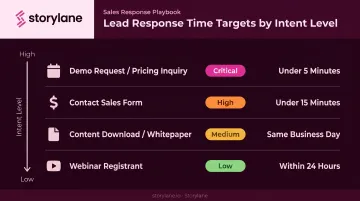
These targets reflect published B2B benchmarks and the intent hierarchy behind each lead type. Treating every inbound the same — same urgency, same queue — means high-intent leads wait while low-intent ones get instant calls.
How to Improve Lead Response Time
Improving LRT means fixing the system upstream — routing logic, tooling, and process design. These strategies address the most common failure points.
Automate Lead Routing and Notifications in Real Time
Manual triage is where minutes become hours. Any step that requires a human to check a queue, assign a lead, or notify a rep introduces latency that compounds fast.
Automated routing that runs natively inside the CRM handles account matching, record enrichment, and rep notification without human handoffs. Reps receive structured lead data immediately and can act rather than piecing together context manually.
After-hours inbound is a systematic blind spot worth addressing separately. Routing fallback logic (round-robin queues, hold-until-available rules) ensures leads submitted at 11pm don't sit cold until the next morning.
Prioritize by Intent, Not Just Territory or Queue Order
Not all leads warrant the same urgency. A pricing page inquiry signals active buying intent. A content download signals early research. Treating both with the same routing logic wastes fast-response capacity on low-intent leads and delays action on high-intent ones.
Set tighter SLAs for high-intent lead types and route them to a dedicated fast-response path. Storylane's Demo Signals feature, for example, tracks behavioral engagement across interactive demos and classifies prospects as low, medium, or high intent based on what they explored, so sales teams have a clear prioritization signal before any rep picks up the phone.
Use Self-Service Interactive Demos as a Zero-Latency First Response
One practical problem with the 5-minute rule: human reps aren't available 24/7. A lead who submits a demo request at 7pm can't wait until morning without losing momentum.
Self-service interactive demos address this directly by engaging the prospect immediately — before any rep is available. Rather than leaving the lead on a thank-you page with nothing to do, an interactive demo lets them explore the product on their own terms at the moment of peak interest.
Storylane's RepX takes this further by functioning as an AI sales rep that operates continuously. It speaks with inbound buyers, qualifies intent, handles product objections, and runs interactive demos autonomously — routing all interaction data to the CRM without human involvement.
For after-hours leads, RepX eliminates the gap between form submission and first meaningful engagement. Reps inherit warm, pre-qualified prospects rather than cold form fills.
Set SLAs by Lead Type and Review Them Regularly
Without defined targets, there's no objective standard to measure against. SLAs serve two purposes: they give reps a clear expectation and they function as diagnostics when breaches occur.
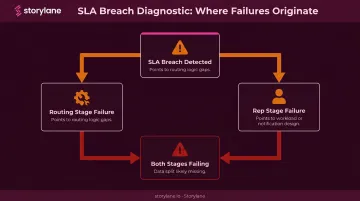
Where failures cluster tells you what's broken:
- Routing stage failures point to routing logic gaps
- Rep stage failures point to workload distribution or notification design
- Both stages failing together usually means the data isn't being split correctly to begin with
Review SLAs quarterly. Lead mix, team size, and product changes all shift what targets are realistic and where failures are likely to emerge.
Build a Consistent Multi-Touch Follow-Up Cadence
Fast first contact matters, but it rarely converts on its own. Most prospects need multiple touchpoints before they respond.
A structured cadence with a defined number of attempts, consistent spacing, and multiple channels ensures leads receive follow-up without depending on individual rep memory or judgment. Without it, a qualified lead who didn't answer the first call simply disappears after one attempt.
The cadence also protects against reps marking leads as dead prematurely. Many sales teams abandon leads after two or three attempts when research suggests meaningful contact rates improve with five to eight touches across multiple channels.
Conclusion
Lead response time is not a rep discipline problem. It's a systems problem that lives in routing logic, tooling decisions, and process design. Coaching reps to move faster without fixing the underlying infrastructure produces no lasting change.
The path forward comes down to three things:
- Measure at the right granularity — track mean, median, P90, and the processing/rep time split separately
- Automate every manual step — eliminate latency that lives in handoff gaps, not rep behavior
- Calibrate urgency to intent — concentrate fast-response capacity where conversion probability is highest
Teams that respond consistently in minutes protect their marketing investment, arrive first in competitive evaluations, and convert a far greater share of the demand they've already paid to generate. Fix the system, and the pipeline results follow.
Frequently Asked Questions
What is lead response time?
Lead response time is the duration between a lead's initial inquiry (form fill, demo request, or other action) and the first follow-up from a sales rep. It's typically tracked as an average across all inbound leads in a given period, though mean, median, and P90 together give a more complete picture.
How quickly should you respond to a lead?
Five minutes is the widely cited benchmark for highest conversion probability. Response urgency should scale with intent level — a demo request warrants near-immediate action, while a content download can reasonably wait until the same business day.
What is the average lead response time for B2B companies?
Harvard Business Review found the average response time across B2B companies was 42 hours — well past the 5-minute window where conversion probability peaks. Most of the qualification advantage is gone long before most teams pick up the phone.
How do you calculate lead response time?
Subtract the time of the lead's initial action from the time of the first contact attempt. For team-level tracking, sum all individual response times across a period and divide by the number of leads to get the average LRT.
Does lead response time differ by channel or lead source?
Yes — and channel is a reliable proxy for intent. High-intent channels like live chat, pricing pages, and direct demo requests need the fastest response. Leads from content downloads or email newsletters allow more time because those prospects are typically earlier in their buying process.
What happens if you take too long to respond to a lead?
Delayed responses allow leads to lose buying intent, engage with competitors, and form a negative impression of your organization's responsiveness. HBR research found that waiting more than 24 hours makes a company 60x less likely to qualify a lead than responding within the first hour.