Add subscription economics into that mix, and the stakes compound. A lost deal or churned customer doesn't just affect this quarter — it erodes MRR and distorts growth forecasts for months.
A structured, repeatable sales process is how SaaS teams escape that cycle. Without it, deals stall, forecasts become guesswork, and reps reinvent the wheel with every prospect.
This guide is for SaaS founders, sales managers, AEs, and SDRs who want to understand how the process actually works operationally — from the first prospecting touch through onboarding and renewal. We'll cover the seven core stages, the three primary sales models, and the metrics that actually reflect revenue health.
Key Takeaways
- The SaaS sales process is subscription-aware and cyclical, spanning prospecting, retention, and expansion
- Modern buyers self-educate early; your process must meet them at every stage, not just the bottom
- Demo quality is a major conversion lever — personalized, pain-point-led demos consistently outperform generic walkthroughs
- The right sales model (self-service, transactional, or enterprise) shapes team structure and cycle length
- MRR, churn, CAC, and CLTV:CAC are the metrics that reflect true sales health
What Is the SaaS Sales Process?
The SaaS sales process is a structured sequence of stages that moves a potential buyer from first awareness to closed deal, then through onboarding, retention, and expansion. Subscription pricing, software complexity, and the recurring nature of the customer relationship all shape how this process unfolds.
Unlike a traditional product sale, the deal close isn't the finish line. The goal is a revenue relationship that renews, expands, and generates referrals. That means retention is as commercially important as acquisition.
Three things separate SaaS sales from traditional selling:
- Cycles are longer and involve multiple decision-makers
- The product must be demonstrated and understood before buyers commit
- Post-sale engagement drives active revenue — through renewals, expansions, and referrals
Why the SaaS Sales Process Matters
Subscription revenue compounds in both directions. Strong retention and expansion accelerate growth — but when the process breaks down, churn erodes MRR faster than new deals can replace it.
KeyBanc's 2025 private SaaS company survey found that gross retention declined to 86% in 2023 before recovering toward the 90% threshold — a gap that represents substantial ARR at scale.
Bessemer benchmarks put the bar in clear terms: net revenue retention of 100% is good, 110% is better, and 120%+ is best for Series B/C enterprise SaaS.
What Buyers Expect Now
Research from HubSpot citing G2 buyer data reveals how far buyer behavior has shifted:
- 83% of B2B buyers prefer the discovery stage to be self-service
- 79% only engage a salesperson at the final stage of their journey
- Buyers are 1.8x more likely to close a high-quality deal when supplier-provided digital tools support the process alongside a rep (Gartner)
A process built only for the bottom of the funnel misses the majority of buyer activity.
What Happens Without a Defined Process
- Deals stall at every stage because next steps aren't documented
- Unqualified deals inflate pipeline numbers and waste rep time
- Forecasts rely on intuition rather than stage-entry data
- Onboarding suffers when the sales-to-success handoff carries no context
The Stages of the SaaS Sales Process
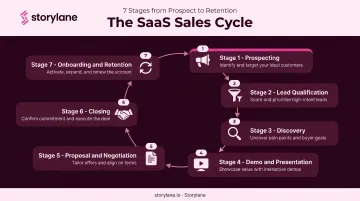
High-performing SaaS teams run through the same core sequence regardless of deal size or industry. The process is cyclical — retention feeds expansion, and expansion generates referrals that restart the cycle at the top.
Stage 1: Prospecting and Lead Generation
Effective prospecting starts with a clearly defined Ideal Customer Profile (ICP). Without one, reps waste cycles chasing leads that will never convert.
Pipeline typically comes from two directions:
- Inbound: Content, SEO, website demos, and free trials that attract buyers already looking for a solution
- Outbound: SDR-led cold outreach, LinkedIn sequences, and targeted campaigns to ICP-matched accounts
Sales teams use interactive demos at this stage to generate and qualify pipeline. Storylane customers embed lead capture forms directly inside demos, capturing prospect information at peak engagement rather than through a separate form. ContactMonkey, for example, saw their form conversion rate climb from 11% to 15% with this approach — and attributed $1.3M in pipeline directly to their demo program.
Storylane's Account Reveal feature also surfaces which companies are engaging with demos before they fill out a form, giving SDRs real-time Slack alerts and warm conversation starters for outbound follow-up.
Stage 2: Lead Qualification
Qualification filters out poor-fit prospects before reps invest significant time. The most widely used framework is BANT: Budget, Authority, Need, and Timeline.
Skipping this stage doesn't accelerate the pipeline — it clogs it. Unqualified deals move through stages slowly, inflate forecasts, and ultimately ghost at proposal or contract. Stage-entry criteria in the CRM (mandatory fields that must be completed before a deal advances) are the simplest fix.
Stage 3: Discovery
Discovery is where reps move from "does this lead fit us?" to "do we understand their specific problem deeply enough to solve it?"
Strong discovery questions do three things:
- Uncover the pain and quantify its business impact
- Identify all stakeholders involved in the buying decision
- Surface the language the buyer uses to describe their problem
Every subsequent stage — demo, proposal, negotiation — is sharper when discovery is done well. Reps who skip directly to a demo almost always underperform against those who invest in discovery first.
Stage 4: Demo and Presentation
The demo is the decisive stage in SaaS sales. Buyers expect to evaluate real product value early, not sit through a slide deck about benefits they've already researched.
High-converting demos are built around what was uncovered in discovery. They mirror the prospect's language, focus on their specific use case, and skip features that aren't relevant to their pain. Generic feature tours underperform because they don't connect functionality to what the buyer actually cares about.
Storylane equips sales teams with several tools that make personalized demos practical at scale:
- Dynamic variable tokens that automatically populate prospect-specific data (name, company, metrics) without rebuilding the demo each time
- Multi-chapter demos that let a CFO explore an ROI-focused path while a technical evaluator follows an integration-focused path — all within the same demo asset
- Guided flows and sandbox environments that adapt the demo format to the buyer's stage and preference
- AI features including video avatars, voiceovers in 25+ languages, and an AI content assistant that reduce production time without requiring design resources
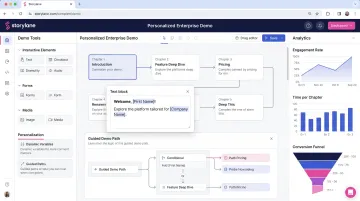
The self-guided format solves a common pre-call problem: prospects who disengage between submitting a demo request and attending a scheduled meeting. When a prospect has already navigated the product independently, the live call starts at a consultative level. PDQ noted that prospects arrived at calls "already primed" after engaging with Storylane's interactive demos.
Demo analytics sharpen this further. Storylane tracks which features a prospect explored, where they spent the most time, and where they dropped off — pushing that data directly to Salesforce or HubSpot. The AE walks into the call already knowing what the prospect cares about.
Stage 5: Proposal and Negotiation
By the time the proposal arrives, value should already be established. The proposal confirms what the buyer already believes — it doesn't try to persuade them from scratch.
A strong SaaS proposal covers:
- Scope and specific use case addressed
- Pricing tiers and contract terms
- Implementation timeline and onboarding expectations
- Mutual success criteria
Negotiation is smoother when discovery and qualification were done correctly. Most objections at this stage trace back to gaps earlier in the process — unclear fit, unstated stakeholder concerns, or value that was assumed rather than demonstrated.
Storylane's Buyer Hub supports the proposal stage by giving the entire buying committee a single organized destination — role-specific demos, pricing information, competitive comparisons, and getting-started resources — rather than a string of separate email threads. Sprout Social and Clari both use this approach to reduce friction during multi-stakeholder evaluation.
Stage 6: Closing
Closing in SaaS means removing the remaining friction that prevents a decision — not applying pressure.
Key actions at this stage:
- Confirm stakeholder alignment across the buying group
- Address last-minute objections with specific evidence, not reassurance
- Document mutual success criteria before the contract is signed
- Lock in onboarding expectations and first-30-days milestones
Stage 7: Onboarding and Retention
The signed contract starts the revenue relationship. A customer who churns after six months doesn't generate meaningful LTV regardless of how well the deal closed.
The sales-to-success handoff should include documented goals, defined KPIs, and notes from every discovery and demo conversation. Customer success teams that receive a clean handoff can run effective onboarding — those that receive nothing spend their first month reconstructing context.
Interactive demos extend naturally into onboarding. Premier Food Safety used Storylane to build role-specific onboarding demos for different user types, reducing reliance on support tickets and making self-serve activation faster. Sales reps who stay engaged through early onboarding also identify upsell and expansion opportunities before the customer is fully owned by CS.
SaaS Sales Models: Choosing the Right Fit
Three models dominate SaaS go-to-market strategy. The right choice depends on product complexity, average contract value, and how many stakeholders are involved in a buying decision.
| Model | ACV Range | Team Structure | Cycle Length |
|---|---|---|---|
| Self-Service | $100–$5K | No sales team required; PLG-driven | Days |
| Transactional | $5K–$50K | SDRs + AEs, scalable motions | Weeks |
| Enterprise | $50K+ | AEs, SEs, CS, procurement | Months |
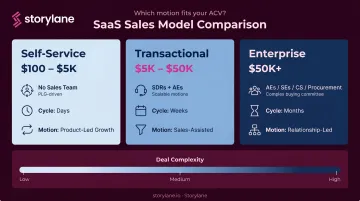
Bain research from 2023 found that product-led growth companies grew revenue nearly twice as fast as those with limited PLG focus — but also that 61% of PLG firms launch enterprise sales teams by the time they reach $50M in annual revenue. Self-service and enterprise aren't competing models; they're sequential stages in most SaaS growth paths.
Bain points to two concrete examples of how companies trigger that shift from self-serve to human-led sales:
- Twilio brings in a rep once an account hits $100K ACV
- Dropbox uses 3% employee adoption as its signal to engage sales
Most SaaS companies eventually run all three in parallel: self-service for SMB, transactional for mid-market, and enterprise for large accounts — each with its own demo, discovery, and onboarding process. Knowing which model fits your current stage shapes every other decision in your sales process.
Key SaaS Sales Metrics to Track
Close rate tells you whether deals are converting. These four metrics tell you whether the business is healthy.
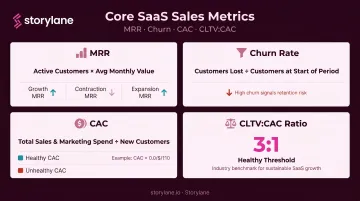
Monthly Recurring Revenue (MRR) tells you where revenue is actually coming from. Calculate it as active customers × average monthly subscription value. Track growth, contraction, and expansion separately — blended totals hide whether gains come from new logos, retained accounts, or upsells.
Churn Rate is where unit economics fall apart if ignored. Calculate monthly churn as customers lost ÷ customers at start of period. Sales behaviors — overpromising, poor qualification, weak handoffs — directly cause churn. A rep who closes the wrong customer is generating negative LTV.
Customer Acquisition Cost (CAC) is total sales and marketing spend ÷ new customers acquired. Never evaluate it in isolation. A $10,000 CAC is healthy if the customer generates $80,000 in lifetime value. The same CAC is catastrophic if they churn in 90 days.
CLTV:CAC Ratio
CLTV is the total revenue a customer generates over their relationship with the company. The CLTV:CAC ratio turns that number into a profitability signal.
ForEntrepreneurs/Matrix Partners established the widely-used benchmark: a healthy SaaS business should target a CLTV:CAC ratio greater than 3:1, meaning every dollar spent acquiring a customer should return at least three dollars over the relationship. A ratio below 3:1 signals either an acquisition cost problem or a retention problem — and you need to know which one before you can fix it.
Sales Cycle Length rounds out the picture. Track average cycle length by deal size and customer segment. The Bridge Group's 2024 SaaS AE benchmark, drawn from 172 B2B SaaS companies, found a median sales cycle of 5.0 months across all deal sizes — though this varies significantly by ACV tier. Longer-than-average cycles in a specific segment usually point to a specific bottleneck: qualification gaps, stalled demos, or slow legal reviews.
Common SaaS Sales Mistakes to Avoid
Most SaaS sales failures aren't random — they cluster around three predictable points: the pipeline entry, the demo, and the handoff.
Skipping or Rushing Qualification
Unqualified deals don't disappear — they move slowly through the pipeline and crash at proposal. Define stage-entry criteria in your CRM and enforce them. A shorter pipeline of well-qualified deals closes faster than a bloated one that drains rep time.
Treating the Demo as a Feature Tour
Generic demos fail because they don't connect product functionality to the buyer's specific pain. Whispli's sales team built separate demo chapters for different buyer personas — a whistleblower-facing flow and a case manager-facing flow — because one walkthrough couldn't serve both.
Reps who skip discovery and jump to a standard product tour consistently underperform against those who tailor the demo to what they learned.
Neglecting the Post-Sale Relationship
A closed deal with a poor onboarding experience churns before generating meaningful LTV. Sales teams that treat contract signature as the finish line set up their CS team to fail — and forfeit the expansion and referral revenue that drives SaaS LTV.
Frequently Asked Questions
What are the stages of the SaaS sales process?
The seven core stages are: prospecting, lead qualification, discovery, demo and presentation, proposal and negotiation, closing, and onboarding and retention. The process is cyclical — satisfied customers generate expansion revenue and referrals that feed back into new pipeline.
What is the 3-3-3 rule in SaaS sales?
There's no single canonical definition — multiple competing versions exist across SDR training resources. Common interpretations include three touches across three channels over three days, or three personalization facts gathered in three minutes before outreach.
What is the 3-3-2-2-2 rule in SaaS?
The 3-3-2-2-2 rule (also called T2D3) is a SaaS revenue growth framework, not a sales cadence. Battery Ventures' Neeraj Agrawal describes it as: triple annual revenue for two consecutive years, then double it for three years.
How is SaaS sales different from traditional sales?
SaaS sales involves subscription-based recurring revenue rather than one-time transactions, which means post-sale retention is a financial imperative. Cycles are longer, buying committees are larger, and the sales team has ongoing responsibility for expansion and renewal — not just closing.
How long is a typical SaaS sales cycle?
Cycle length depends on deal size. The Bridge Group's 2024 benchmark across 172 B2B SaaS companies found a median sales cycle of 5.0 months. Enterprise deals with higher ACV run considerably longer; simpler, low-ACV products close in weeks. Tracking cycle length by segment is more useful than tracking an overall average.
What metrics should I track to measure SaaS sales success?
Focus on four: MRR (revenue health), churn rate (retention health), CAC (cost efficiency), and CLTV:CAC ratio (profitability and sustainability). A CLTV:CAC ratio above 3:1 is the standard benchmark for a healthy SaaS business.