This article breaks down all six types of product demos, where each one belongs in the buying journey, and how to stop defaulting to one format for every situation.
Key Takeaways
- The 6 types are: Vision, Micro, Standard/Discovery, Technical, Closing, and FAQ — each serves a distinct stage and goal.
- Using the wrong demo type at the wrong stage wastes SE time and stalls deals.
- Micro and FAQ demos are the strongest candidates for automation and self-serve delivery.
- Match the demo to the buyer's stage, their role, and what they still need to be convinced of.
What Is a Product Demo?
A product demo is a structured presentation or interactive experience that shows a product's features, benefits, and value in action — going beyond written descriptions to give prospects firsthand understanding of what the product does.
In B2B SaaS, that definition covers a lot of ground. A "demo" might be:
- A 5-minute value pitch on a first outbound call
- A 60-minute customized technical deep-dive
- A self-guided interactive tour embedded on a website
- A short recorded clip answering one specific question
Each format serves a different buyer stage and goal. Knowing which type to use — and when — is what separates demos that move deals forward from those that stall them. Here's how the six main types break down.
Why Product Demos Matter in B2B SaaS Sales
Demos aren't just a nice-to-have in the sales process. According to TrustRadius's 2024 B2B Buying Disconnect Report, 71% of buyers who used demos said they were the most influential resource in their purchase decision. For enterprise deals, demo usage climbed to 67% of buyers.
The problem isn't that teams do demos — it's that most teams do the same demo regardless of context.
Here's what that looks like in practice:
- SEs get pulled onto early unqualified calls, burning prep time on opportunities that aren't ready
- Buyers receive generic walkthroughs that don't address their actual concerns
- Sales cycles stretch because the wrong demo creates more questions than it answers
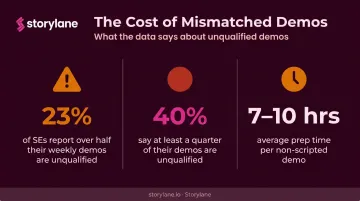
According to PreSales Collective, 23% of SEs reported that more than half of their weekly demos were to unqualified prospects, and 40% said at least a quarter were unqualified. Non-scripted demos average 7–10 hours of prep time each — hours spent on deals that were never going to close.
Understanding all six demo types gives sales and presales teams a direct way to fix that — by matching the right demo to the right moment.
The 6 Types of Product Demos
Not all demos are created equal. Each of the six types exists to serve a specific moment in the buyer's decision-making process. The goal is matching the right format to the right stage.
1. Vision Demo
Length: 5–7 minutes | Delivered by: Sales rep | Stage: Top of funnel
A Vision Demo is a short, high-level presentation focused entirely on the problem, the solution, and the business benefit. It's light on product detail and heavy on value narrative (typically built by marketing, not a solutions engineer).
This format is best for:
- Outbound prospecting and first touches
- Event conversations and introductory calls
- Business buyers and economic stakeholders (not technical users)
The key limitation: because it barely shows the product, a Vision Demo can't move a qualified buyer forward on its own. It earns the next conversation and nothing beyond that.
2. Micro Demo
Length: 5–7 minutes | Delivered by: SE or self-serve | Stage: Top of funnel
A Micro Demo shows specific, targeted product functionality without going into full depth. It's generic in terms of customization but demonstrates the product directly, answering one core question: does what this product does match the problem the prospect has?
This is where self-serve delivery creates real leverage. Platforms like Storylane let teams embed interactive micro demos directly on their website — giving prospects a hands-on product experience before a single discovery call happens. Storylane's Account Reveal feature takes this further, identifying which companies are engaging with those demos anonymously, so sales reps get Slack alerts with company-level intent data before making first contact.
TCP Software saw the efficiency impact directly: their team of 11 SCs/SEs achieved 5x ROI within 12 months by using Storylane demos during qualification calls, closing smaller SME deals without any SE involvement and freeing up technical resources for strategic opportunities.
The trade-off: Micro Demos are brief and generic by design. They're not equipped to handle detailed technical questions — using one in place of a deeper walkthrough leaves qualified buyers feeling under-served.
3. Standard (Discovery) Demo
Length: 12–25 minutes | Delivered by: SE | Stage: Post-initial qualification
The Standard Demo goes deeper than a Micro Demo, addressing a prospect's stated needs — though content is still largely generic rather than account-specific. It's triggered when a prospect asks to "learn more" and has confirmed a relevant business problem.
Think of this demo type as a diagnostic tool. The goal is as much to qualify the opportunity further as it is to showcase the product. Teams that schedule Standard Demos without prior discovery end up burning SE time on buyers who aren't far enough along to evaluate meaningfully.
The main risk: Technically sophisticated buyers can leave a Standard Demo underwhelmed. If discovery reveals a complex, detailed use case, skip straight to a Technical Demo instead.
4. Technical Demo
Length: 45–60+ minutes | Delivered by: Experienced SE | Stage: Mid-to-late evaluation
The Technical Demo is the most resource-intensive format — a deep-dive into specific product capabilities tailored to the prospect's environment, use case, and technical requirements. This is where SEs add their most distinctive value, and where proper discovery beforehand is non-negotiable.
This demo type is built for:
- Qualified mid-to-late stage opportunities with articulated requirements
- Audiences that include technical stakeholders and buying committee members
- Situations where the prospect needs to see their specific problem solved, not a general walkthrough
The resource cost is the defining constraint. Scripted technical demos can require 40+ hours of prep time according to PreSales Collective data. Deploying this format before proper qualification is one of the most common sources of SE burnout.
Storylane's HTML sandbox demos and demo token personalization address this directly — teams build customized technical environments where on-screen data, company names, and configurations reflect the prospect's actual context, without the risks of a live product environment.
5. Closing Demo
Length: 1–5 minutes | Delivered by: SE or rep | Stage: Late-stage, pre-signature
A Closing Demo is a very short, targeted product interaction that responds to a final question or concern from a buyer who has already decided directionally to purchase. These conversations resolve final concerns, not open new ones.
Common triggers:
- "Does this integrate with our existing CRM?"
- "How does your platform handle data migration?"
- "Can you show me how the permission controls work?"
These questions often come from procurement, legal, or IT security stakeholders who weren't involved in earlier demo stages. The distinguishing feature of this format is precision — it answers one specific question with one focused product interaction. Going beyond that scope risks reopening objections that have already been resolved.
Storylane's Buyer Hubs support this use case directly: teams can build personalized hub links that bundle a single targeted demo alongside pricing, security documentation, and other relevant assets, giving late-stage stakeholders exactly what they need without scheduling another call.
6. FAQ Demo
Length: 1–5 minutes | Delivered by: Pre-recorded or self-serve | Stage: Any stage (reactive)
An FAQ Demo answers a specific, recurring question or objection — typically triggered by a rep saying "let me send you something that shows exactly how that works." The same questions come up across deals: integration capabilities, data handling, specific workflows, pricing breakdowns.
Because they're highly repeatable, FAQ Demos are the strongest candidates for automation. Building them as short interactive demos or pre-recorded clips delivers three immediate wins:
- Buyers get answers faster, without waiting to schedule a call
- SEs aren't pulled into reactive 10-minute explanations across every deal
- The answer stays consistent regardless of who's handling the conversation
Storylane's Demo Hubs let teams organize multiple FAQ demos into a self-serve library — segmented by persona, use case, or question type — so prospects can find relevant answers independently. Limiting hubs to under 9 demos and organizing content into clear sections keeps the experience navigable rather than overwhelming.
When FAQ Demos aren't systematized, SE time drains reactively and inconsistently. Some buyers get fast, thorough answers while others wait days — and that gap creates late-stage friction that stalls otherwise winnable deals.
How to Choose the Right Type of Product Demo
The right demo type follows the buyer's stage — not team habit or availability.
Start with three questions before scheduling any demo:
- Where is this buyer in their journey? Have they confirmed a problem? Are they actively evaluating? Are they in final approval?
- What do they need to believe or understand to move forward? Awareness? Fit? Capability? Risk removal?
- Who is in the room? Business stakeholder, technical evaluator, procurement, or a mixed committee?
The Practical Mapping
| Buyer Stage | Demo Type | Delivery |
|---|---|---|
| Awareness / First contact | Vision Demo | Live (rep) |
| Top of funnel / Pre-call | Micro Demo | Self-serve or live |
| Post-qualification | Standard Demo | Live (SE) |
| Mid-to-late evaluation | Technical Demo | Live (experienced SE) |
| Pre-signature | Closing Demo | Live or async |
| Any stage (specific question) | FAQ Demo | Async / pre-recorded |
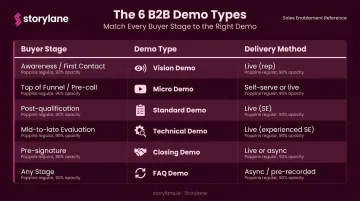
That mapping shifts depending on product complexity and sales motion. A simple SaaS tool with a short cycle may rarely need a full Technical Demo. A complex enterprise platform will use all six types across different committee touchpoints.
The more useful question: which demo types require live SE involvement, and which can scale through self-serve?
- Automate these: Micro and FAQ demos — low friction, high reach, no SE needed
- Keep these live: Technical and Closing demos — preparation and judgment matter too much to hand off
Common Mistakes to Avoid
Deploying the wrong demo at the wrong stage
The four most common and costly errors:
- Running Technical Demos before qualification is complete: 40+ hours of SE prep on an unready opportunity destroys budget and morale
- Treating every FAQ as a live call: reactive, inconsistent, and slow — build reusable assets instead
- Using Vision Demos to close: they build awareness, not conviction; no buyer signs after a 5-minute value pitch alone
- Defaulting to the same 30-minute generic demo every time: 94% of buyers say demos tailored to their specific use case are important; generic demos signal you didn't listen
Under-investing in scalable demo types
Most teams pour energy into the Technical Demo while giving almost no attention to Micro and FAQ formats. The result: buyers arrive at discovery calls with no product context, qualification drags, and SEs spend time on education that should have happened asynchronously.
ContactMonkey fixed this by shifting early-stage education to Storylane interactive demos. The outcome:
- Demo-sourced leads converted to opportunities at a 28% rate — roughly double other inbound sources
- Generated $1.3M in influenced pipeline
- Buyers arrived pre-qualified before ever reaching an SE
Systematize the top-of-funnel formats first. That's where the pipeline leverage is.
Frequently Asked Questions
What are common types of demos?
The six types are Vision, Micro, Standard/Discovery, Technical, Closing, and FAQ. Each corresponds to a different stage of the B2B buyer's journey and serves a distinct purpose.
What is an example of a demo?
A Micro Demo embedded on a SaaS website lets a prospect click through five or six key product interactions before speaking to anyone on the sales team. They arrive at the first discovery call with product context already established, and the rep enters a more qualified conversation.
What is the difference between a product demo and a product tour?
A product tour is one specific delivery method: self-guided and interactive. A product demo is the broader category, encompassing live walkthroughs, recorded videos, interactive tours, and guided presentations across the full buyer journey.
How long should a product demo be?
Length should match buyer stage: Vision and Micro Demos run 5–7 minutes, Standard Demos 12–25 minutes, Technical Demos 45–60+ minutes, and Closing and FAQ Demos 1–5 minutes. Let buyer stage determine length, not internal convention.
When should you use a live demo vs. an interactive self-serve demo?
Live demos work best for qualified mid-to-late funnel opportunities that require customization and real-time dialogue. Self-serve demos are better for top-of-funnel education, scaling outbound outreach, and enabling buying committee members who won't attend live calls.
What is the purpose of a product demo in the sales process?
Demos serve different purposes at different stages: building awareness early, qualifying prospects mid-funnel, and de-risking final decisions at close. Matching demo type to stage is what compresses sales cycles and improves conversion at each handoff.