Introduction
Sales reps spend only 28% of their week actually selling, according to Salesforce's 2022 research — and a significant chunk of the remaining time goes toward prospects who were never serious buyers to begin with. The culprit isn't a thin pipeline — it's poor qualification upstream.
That wasted time compounds fast. Ask the right qualification questions early and you spend cycles on deals that can actually close. Skip them, and you're running full sales motions on prospects who lack the budget, authority, or urgency to move forward.
This article lays out the questions that actually work — organized by the four qualification dimensions that matter most: Budget, Authority, Need, and Timing. You'll also find guidance on how to sequence these questions naturally, when to disqualify versus nurture, and how modern tools help sales teams move qualification earlier — before the first call even happens.
Key Takeaways
- Budget, Authority, Need, and Timing (BANT) form the foundation of most B2B qualification frameworks
- The best qualifying questions are open-ended and reveal both fit and urgency simultaneously
- Need and pain discovery should come before budget questions — leads open up once they feel understood
- A prospect without a defined problem, timeline, or authority is a nurture candidate, not an active deal
- Interactive demos surface engagement signals before a rep picks up the phone
Lead Qualification Criteria and Frameworks
Lead qualification is the process of determining whether a prospect has the problem, resources, authority, and timeline to realistically become a customer. Lead generation finds people. Qualification filters them — those are two separate jobs.
The BANT Foundation
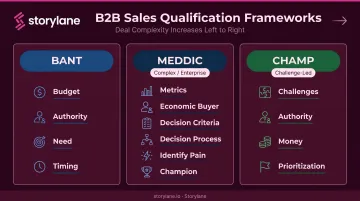
BANT (Budget, Authority, Need, Timing) is the most widely adopted starting point for B2B qualification. Salesforce describes it as a framework for evaluating the four most critical dimensions of a prospect's readiness to buy. For most mid-market sales cycles, it's sufficient.
For complex, enterprise deals, two extensions are worth knowing:
- MEDDIC — Metrics, Economic Buyer, Decision Criteria, Decision Process, Identify Pain, Champion. Created in 1996 at PTC, it adds rigor around economic buyers and internal champions — better suited for six-figure deals with long evaluation cycles.
- CHAMP — Challenges, Authority, Money, Prioritization. Developed as a deliberate alternative to BANT, CHAMP argues that reps should lead with customer challenges rather than budget, which changes the tone of the entire conversation.
What Good Qualifying Questions Must Do
Whatever framework you use, every qualifying question needs to do two things:
- Gather factual data — Does a budget exist? Who owns the decision? What's the timeline?
- Reveal motivation — Is this prospect actively trying to solve something, or just browsing?
Both matter. A prospect with budget but no urgency stalls. A prospect with urgency but no authority can't close. The questions that follow are designed to surface both signals early.
Budget and Resource Questions
"Do you have a budget allocated for this?"
This is the first financial question to ask — it separates explorers from active buyers. The goal isn't an exact number. The goal is confirmation that the organization has formally prioritized solving this problem.
If the answer is no, follow up immediately: "When do you expect to have one?" That answer tells you whether to pursue now or schedule a future touchpoint in 60-90 days.
"What are you currently spending to solve this problem?"
This question benchmarks the prospect's existing spend. If they're already paying for a solution in this category (a competitor, a workaround, or manual labor) they've already validated that this problem is worth paying to fix. That makes your pricing conversation easier.
It's also a competitive intelligence opportunity: what they're paying now is the reference point they'll anchor to when evaluating your price.
"What would the ROI need to look like for this to be worth the investment?"
This reframes the conversation from cost to value before you've said a word about your product. More usefully, it surfaces the prospect's success metrics early.
If their ROI expectations are disconnected from what your solution delivers, that's an early disqualification signal — better to know now than at the proposal stage.
"Are there financial approval processes or stakeholders we should be aware of?"
Budget decisions in B2B rarely involve just one person. This question surfaces whether a CFO, procurement team, or budget committee needs to sign off. Getting this answer early prevents the classic end-of-cycle surprise: a deal stalling because someone with veto authority was never brought into the conversation.
Common stakeholders to ask about include:
- Finance or CFO: Final sign-off on new spend above a threshold
- Procurement: Vendor vetting, security reviews, and contract terms
- IT or Legal: Compliance approvals, especially for SaaS tools with data access
- Executive sponsor: Internal champion needed to drive urgency upward
If additional stakeholders exist, start broadening outreach now, not after the prospect has already championed you internally.
Authority and Decision-Making Questions
"Who is typically involved when your company evaluates and purchases a new solution?"
This open-ended phrasing works better than "Are you the decision-maker?" because it maps the full buying committee without putting anyone on the defensive.
The stakes are real: research from CEB shows that when more than five stakeholders are involved, the likelihood of a purchase decision drops to just 30%. And according to Challenger's more recent research, modern B2B buying groups have grown to nearly a dozen people.
The earlier you map who's involved, the earlier you can build alignment across all of them.
"Who has final approval authority on the budget?"
Even the most enthusiastic champion can't close a deal without financial sign-off. If the person you're speaking with isn't the economic buyer, ask directly: "Would it be possible to get 20 minutes with that person at some point?"
Getting in front of the economic buyer early means you can address budget objections before they derail a late-stage deal.
"What role do you play in this decision?"
This clarifies whether you're talking to a champion, an influencer, or the final decision-maker. If they're an influencer, equip them to sell internally with:
- Business case templates they can present up the chain
- Competitive comparisons that address likely objections
- ROI summaries tied to their specific use case
Your job becomes helping them win the internal conversation.
"Are there other stakeholders who should be involved in our conversations?"
Asking this proactively prevents the dreaded "I need to loop in my boss" delay that surfaces at the end of a long sales cycle. Offer to set up a broader call that includes all relevant parties — most champions will welcome the help navigating their own organization.
Need and Pain Point Questions
"What specific problem are you trying to solve?"
This is the most important question in the entire qualification process. No clearly defined problem means no real reason to buy.
Listen for specificity. "Our SDRs spend three hours a day on manual research" is a qualified answer. "We want to improve sales" is not. Vague answers usually mean the prospect is still in early research mode and needs nurturing, not a full sales pitch.
"Why are you looking for a solution now?"
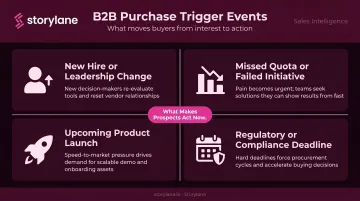
This uncovers the trigger event that made this problem urgent enough to act on today. Common triggers include:
- A new hire or leadership change
- A missed quota or failed initiative
- An upcoming product launch
- A regulatory or compliance deadline
According to Gartner, B2B purchases are almost always driven by organizational changes. Prospects with a clear trigger convert at significantly higher rates than those browsing without one.
"Have you tried to solve this problem before? What happened?"
This surfaces prior solutions, competitor experiences, and hidden objections before they become deal blockers. If they tried a competitor and it failed, that failure tells you exactly what not to promise. It also positions your solution as the fix for what others got wrong, without requiring you to knock the competition directly.
"What happens if this problem goes unsolved?"
This question quantifies the cost of inaction. It's often the most powerful motivator for a prospect to act. If the answer is "not much," the problem isn't urgent.
That's either a disqualification signal or a nurture flag, depending on whether the underlying pain is real but dormant.
"What does success look like to you in 6–12 months?"
This aligns your value proposition to their definition of success before you pitch anything. It also surfaces misaligned expectations early. If their 6-month success metric has nothing to do with what your solution delivers, that gap needs to be addressed before the proposal, since expectation gaps set in before the contract is signed.
Timing, Urgency, and Fit Questions
"What does your ideal timeline for a decision look like?"
A clear timeline — "we need something in place before Q4" — signals a serious buyer. An indefinite answer — "sometime next year, maybe" — signals that this prospect needs nurturing, not a full sales cycle today.
For context on how timeline relates to deal size: B2B SaaS deals under $25,000 ACV typically close in around 90 days; deals above $100,000 often take 3–9 months. If a prospect's stated timeline doesn't align with what's realistic for their deal size, that's worth discussing explicitly.
"Are there any upcoming events, renewals, or deadlines driving this decision?"
Contract renewals are a particularly reliable timing signal. Capterra's 2024 research found that 58% of businesses begin their software renewal process about four months before expiration, and over 60% investigate alternative solutions before renewing. Knowing a prospect's renewal date helps you time outreach strategically rather than showing up cold.
Regulatory deadlines, product launches, and leadership changes create the same kind of urgency — ask about all of them.
"What other solutions are you evaluating, and what criteria matter most?"
This question works on two levels at once:
- Reveals your competition — knowing which vendors are in the mix helps you position against them directly
- Exposes what the prospect actually values — their top criteria tell you more than any discovery question about pain points
If those criteria don't align with your product's strengths, you have a choice: reframe the conversation around a value they haven't considered yet, or acknowledge the mismatch before investing further in the deal.
How to Run a Better Qualification Conversation
Sequence Matters
Lead with need and pain discovery before moving to budget and authority. Prospects share more when they feel heard rather than screened. The SPIN Selling methodology — Situation, Problem, Implication, Need-Payoff — supports this: put problem discovery first, then explore business impact, then discuss commercial fit.
Gong's data supports this sequencing too: win rates are 10% higher when pricing is discussed on the first call, but the optimal window is late in the call (roughly the 38–46 minute mark), after value has been established. Budget is not a topic to avoid — it's a topic to time correctly.
Handling Common Challenges
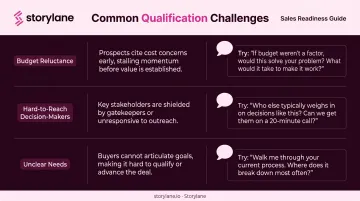
- Budget reluctance: Frame budget questions as helping find the right fit — "I want to make sure I'm recommending the right option for your situation" lands better than a direct ask for a number
- Hard-to-reach decision-makers: Ask for introductions naturally — "Would it make sense to include [name] in a brief call so I can address their questions directly?"
- Unclear needs: Use open-ended follow-ups to help prospects articulate problems they haven't fully defined — "What does that challenge cost you in time or revenue?" often surfaces specificity that "What's your problem?" doesn't
When to Disqualify vs. Nurture
Not every stalled qualification conversation means disqualification. Here's the practical distinction:
Disqualify when:
- No ICP fit (wrong industry, company size, or use case)
- No articulable pain point your product addresses
- No budget and no realistic path to one
- No authority to influence a purchase decision
- Consistently low engagement across multiple touchpoints
Nurture when:
- The problem is real but the timing isn't right
- Budget exists but the cycle is 6+ months out
- A champion exists but needs to build internal buy-in first
Front-Loading Qualification with Interactive Demos
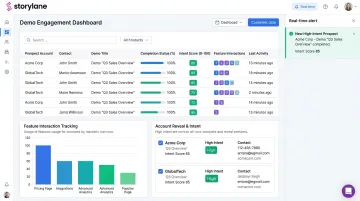
The fastest way to improve qualification efficiency is to start before the first call. Storylane's interactive demo platform lets sales teams send prospects a self-guided product walkthrough before the discovery conversation begins.
When a prospect self-explores a demo, Storylane captures their engagement signals: which features they spent time on, whether they completed the demo, what they clicked, and how intent scores track over time. Account Reveal surfaces the company behind anonymous visitors.
Reps receive Slack alerts the moment engagement crosses a high-intent threshold, with recommended follow-up within two hours. By the time the qualification call starts, reps already know what the prospect cared about, which features resonated, and whether the account shows enough intent to be worth a full sales cycle.
Frequently Asked Questions
What are the criteria for qualified leads?
The four core criteria are Budget (can they pay?), Authority (can they decide?), Need (do they have a problem you solve?), and Timing (are they ready to act?). ICP fit — whether the prospect matches your ideal customer profile — is typically evaluated first before any of these four.
What is an example of a qualifying question?
A strong example: "What problem are you trying to solve, and why are you prioritizing it now?" Good qualifying questions are open-ended, invite context, and reveal both urgency and fit at the same time — rather than prompting a simple yes or no.
What are qualification questions?
Qualification questions are structured questions sales reps ask early in the sales process to determine whether a prospect has the problem, budget, decision-making authority, and timeline needed to become a real customer. They filter pipeline before significant time is invested.
What is the BANT framework for lead qualification?
BANT stands for Budget, Authority, Need, and Timing — a classic B2B qualification framework that helps reps assess a prospect's readiness to buy. It's a reliable starting point for most deals, though complex enterprise sales often extend it with frameworks like MEDDIC.
When should you disqualify a prospect?
Disqualify when a prospect doesn't fit your ICP, lacks budget or purchasing authority, or can't articulate a pain point your product addresses. If the problem is genuine but timing is off, move them to a nurture track rather than closing the file.