A defined sales cycle fixes that. It gives every rep a consistent roadmap, gives managers visibility into where deals stall, and gives revenue leaders the data they need for accurate forecasting.
This article covers exactly what a sales cycle is, breaks down all 7 stages, explains how to measure cycle length, and gives you five concrete ways to improve effectiveness at every step.
Key Takeaways
- A sales cycle is a structured, repeatable roadmap from first contact to closed deal — and beyond
- The 7 stages are: prospecting, initial contact, lead qualification, demo and presentation, objection handling, closing, and post-sale follow-up
- Track cycle length and stage conversion rates to forecast accurately and find bottlenecks
- Shortening a cycle means removing friction for buyers, not rushing them through it
- Interactive demos compress the evaluation phase so prospects arrive at calls already informed
What Is a Sales Cycle?
A sales cycle is the repeatable series of steps a sales team follows to turn a prospect into a paying customer. It's structured and measurable, built to improve over time rather than drift with each individual rep.
Sales Cycle vs. Sales Process
These two terms are often used interchangeably, but they serve different purposes:
- Sales cycle = the "what" — the specific stages a deal moves through (prospecting → closing)
- Sales process = the "how" — the methodology, tactics, and strategies used at each stage
You need both. The cycle defines the path; the process defines how to walk it effectively.
Why a Defined Sales Cycle Matters
Without a defined cycle, deals move inconsistently, forecasting is guesswork, and new reps take far longer to ramp up. With one in place:
- Reps follow a consistent path, reducing deal-to-deal variability
- Managers can see exactly where deals stall and direct coaching accordingly
- Revenue forecasting becomes based on pipeline data, not intuition
- Onboarding accelerates because new hires have a clear framework to follow
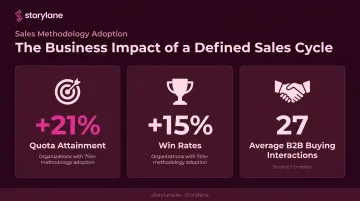
Korn Ferry found that organizations with greater than 75% adoption of their sales methodology achieve +21% quota attainment and +15% win rates compared to low-adoption peers. In other words, the methodology only works when reps know which stage they're in and what's expected at each one.
The 7 Stages of the Sales Cycle
Stage 1: Prospecting
Prospecting means identifying potential buyers who match your ideal customer profile (ICP). Volume without fit wastes time. A hundred poor-fit leads will cost more effort than ten well-qualified ones.
Key prospecting channels include:
- LinkedIn outreach and social selling
- Inbound leads from content, SEO, and paid campaigns
- Referrals from existing customers
- Industry events and conferences
Strong prospecting starts with ICP clarity. Look at your best existing customers — what industries, company sizes, roles, and pain points do they share? That profile is your targeting filter.
Stage 2: Initial Contact
The goal of initial outreach is to earn the right to a deeper conversation, not to pitch.
Personalization is the difference between a reply and an ignore. Woodpecker analyzed over 20 million cold emails and found advanced personalization produced a 17% response rate versus 7% for generic templates (more than double). Referencing a specific pain point, a recent company announcement, or a mutual connection signals that you've done the work.
Persistence also matters. Sequences with 4–7 emails reach 27% reply rates, compared to just 9% for one-to-three email sequences.
Stage 3: Lead Qualification
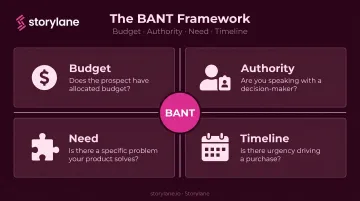
Qualifying early prevents wasted effort on deals that will never close. The BANT framework (Budget, Authority, Need, Timeline) is a practical starting point for any qualification conversation:
- Budget: Does the prospect have budget allocated, or is this exploratory?
- Authority: Are you talking to a decision-maker, or do you need to reach one?
- Need: Is there a genuine, specific problem your product solves?
- Timeline: Is there urgency driving a purchase, or is this a "someday" conversation?
Qualification isn't a one-time checkpoint. New information emerges throughout the cycle : additional stakeholders surface, budgets shift, timelines change. Reassess as you go.
The stakes are high here. Ebsta's analysis of 4.2 million opportunities found deals that skip a qualification stage are 46% less likely to close.
Stage 4: Demo and Presentation
The demo is where you show (not tell) how your solution addresses the specific problems uncovered in discovery. One-size-fits-all demos fail. The most effective ones are:
- Tailored to the prospect's industry, role, and pain points
- Designed to include all key stakeholders who influence the decision
- Built around outcomes, not feature lists
Modern B2B buyers increasingly want to explore a product before a formal sales call. Gartner found that 67% of B2B buyers prefer a rep-free experience at some point in their journey, and buyers using supplier-provided digital tools alongside a sales rep are 1.8x more likely to complete a high-quality deal.
This is where interactive demos change the dynamic. Tools like Storylane let prospects explore product features at their own pace before a live call. Reps receive engagement analytics (which features were explored, where attention dropped off, completion rates) so they can walk into the live call knowing exactly what the prospect cares about.
Buyers arrive already primed. Discovery is shorter. Conversations are sharper.
Stage 5: Objection Handling
When a prospect raises an objection, they're telling you what they still need to feel confident moving forward. Common objection categories include:
- Price: Budget concerns or unclear ROI
- Timing: Competing priorities or "not the right quarter"
- Implementation: Concern about switching costs or complexity
- Authority: "I need to loop in my manager/CFO/IT team"
The right response starts with listening fully, confirming your understanding of the concern, and responding with evidence rather than argument. Gong's analysis of sales interactions found top performers respond to objections by asking questions 54.3% of the time, versus 31% for average performers. They diagnose before they prescribe.
Use ROI data, case studies, and social proof to address the underlying concern rather than trying to talk past it.
Stage 6: Closing
If prospecting, qualification, and demos were done well, closing should feel like a natural next step rather than a high-pressure confrontation. The practical steps at this stage:
- Draft a clear proposal — scope, pricing, timeline, and expected outcomes
- Identify all stakeholders who need to review or sign off
- Proactively manage contract review — flag potential legal or security review timelines early
- Handle final negotiation — anchor on value, not just price
Deals that stall here usually trace back to earlier gaps: incomplete qualification, missing stakeholders, or objections that were sidestepped rather than resolved. When closing drags, revisit those stages before adding more pressure at the end.
Stage 7: Post-Sale Follow-Up
The sale doesn't end at contract signature. The post-sale stage determines whether customers stay, expand, and refer others.
Key activities include:
- Smooth handoff to onboarding or customer success
- Regular check-ins during the first 90 days
- Identifying upsell or expansion opportunities once initial value is delivered
Happy customers are also your most efficient source of future pipeline. Retention economics are stark: Harvard Business Review cites Bain research showing that acquiring a new customer is 5 to 25 times more expensive than retaining one.
Storylane customers use onboarding demos and feature-specific walkthroughs in this stage — giving customers a self-serve way to learn the product without requiring repetitive live sessions from the CS team.
Short vs. Long Sales Cycles
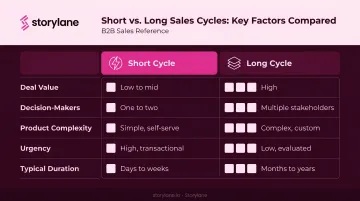
Cycle length is shaped by several factors:
| Factor | Short Cycle | Long Cycle |
|---|---|---|
| Deal value | Low to mid | High |
| Decision-makers | 1–2 | 5+ |
| Product complexity | Transactional | Highly technical |
| Urgency | High | Variable |
| Typical duration | Days to weeks | Months to years |
According to the 2024 KeyBanc/Sapphire Ventures SaaS Survey, the median private SaaS sales cycle sits at 6 months — though it shifts considerably based on deal size and product complexity.
Neither cycle type is inherently better. Short cycles benefit from automation and streamlined processes, while long cycles demand consistent nurturing, multi-threading across stakeholders, and patience. Recognize which type your business runs and design your approach around it.
Stakeholder count is a key driver of that complexity. Gartner's research shows B2B buying groups can range from 5 to 16 people across multiple functions, and 74% of those teams demonstrate unhealthy conflict during the decision process. The more stakeholders involved, the more deliberate your multi-threading strategy needs to be.
How to Measure Your Sales Cycle Length
The Basic Formula
Add up the total days across all closed deals in a given period, then divide by the number of deals closed:
Average cycle length = Total days to close (all deals) ÷ Number of closed deals
One important refinement: calculate this separately for your top performers. Their cycle length is a more useful benchmark for what's achievable.
Break It Down by Stage
Overall cycle length is useful, but stage-level time data is where you find actionable insight. Track "time in stage" for each step and look for where deals consistently slow down:
- Prospecting — Are reps spending too long sourcing before first contact?
- Qualification — Are unqualified deals advancing too far before getting cut?
- Demo — Is this moving fast, or are buyers going cold before the next step?
- Contract review — Is legal or procurement creating a predictable bottleneck?
If deals stall post-qualification, that's a different problem than a slow contract review. Stage-level data tells you where to direct coaching — not just that something is wrong.
Segment by Deal Type
Enterprise deals naturally run longer than SMB deals. Tracking them together inflates your averages and obscures patterns. Separate benchmarks by segment — SMB, mid-market, enterprise — enable more accurate forecasting and fairer rep performance comparisons.
5 Ways to Boost Sales Cycle Effectiveness
1. Qualify Rigorously and Early
The biggest source of wasted time in any sales cycle is spending weeks on deals that were never winnable. Apply a consistent qualification framework — BANT, MEDDIC, or SPICED — from the first meaningful conversation.
Use qualification as a gate before advancing prospects to demo or proposal stages. Ebsta's data shows that completing MEDDPICC by the solution-presented stage increases win probability by 324% — a result worth building your process around.
2. Enable Buyers to Explore Before the Demo
Modern B2B buyers want to do their own research before engaging a rep. Sending prospects an interactive demo before the first formal meeting — such as one built with Storylane — lets them self-educate, arrive pre-qualified, and ask sharper questions.
The practical benefits:
- Buyers arrive at the live call already familiar with core features
- Discovery time is compressed because you're building on prior context
- Demo engagement analytics (feature clicks, time spent, drop-off points) show reps exactly what resonated before the call starts
- Storylane's Account Reveal feature identifies which companies and contacts engaged, triggering real-time Slack alerts so reps follow up at peak interest
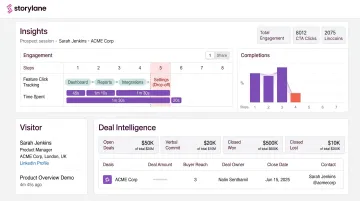
Companies like Campminder report skipping over early-stage discovery entirely because prospects arrive already engaged: "We skip over the discovery and jump straight into a high-intent demo."
3. Automate Repetitive Tasks to Protect Selling Time
Salesforce reports that reps spend 60% of their week on non-selling activities — scheduling, data entry, internal meetings, generating quotes. McKinsey's analysis of nearly 500 B2B companies found that automating these tasks can open up 20% more sales capacity without adding headcount. CRM workflows are where that reclamation starts:
- Lead routing and assignment
- Follow-up reminder sequences
- Email logging and activity tracking
- Quote and proposal generation triggers
4. Align Sales and Marketing Around Shared Lead Definitions
Misalignment on what constitutes a "qualified lead" creates friction at every stage of the cycle. Forrester found that while 82% of C-suite executives believe their teams are aligned, 65% of sales and marketing professionals report meaningful misalignment in practice.
The fix requires shared definitions and shared accountability:
- Agree on MQL and SQL criteria in writing
- Build closed-loop feedback so sales tells marketing which leads converted and why
- Co-create objection-handling resources, case studies, and ROI calculators
- Review lead quality together, not in separate silos
5. Track Stage-Level Conversion Rates and Act on the Data
Monitoring overall close rates isn't enough. Track what percentage of deals advance from each stage to the next and look for where the drop-offs are steepest.
If 70% of deals stall after the demo, that's a specific problem to diagnose — pricing objections, wrong stakeholders in the room, weak follow-up. If deals die in contract review, that's a different problem with a different fix.
Stage-level conversion data turns vague coaching ("close more deals") into targeted interventions tied to the exact moment momentum breaks.
Frequently Asked Questions
What is the sales cycle?
A sales cycle is the structured, repeatable series of stages a sales team follows to move a prospect from initial contact to closed deal. Having a defined cycle creates consistency across reps, speeds up onboarding, and enables accurate revenue forecasting.
What are the stages of the sales cycle?
The 7 stages are: prospecting, initial contact, lead qualification, demo and presentation, objection handling, closing, and post-sale follow-up. The exact stages may vary by company or industry, but this framework applies broadly to B2B sales.
What is the difference between a sales cycle and a sales process?
A sales cycle describes the stages a deal moves through — the "what." A sales process describes the methodology and strategies used to execute those stages — the "how." Both are necessary, but they serve different purposes.
How long does a typical B2B sales cycle last?
B2B sales cycles vary significantly by deal size and complexity. The median for private SaaS companies averages around 6 months, but simpler or lower-value deals can close in weeks, while large enterprise deals can stretch considerably longer.
How can you shorten your sales cycle without rushing buyers?
Focus on four levers:
- Qualify rigorously upfront to invest time only in winnable deals
- Automate administrative tasks through CRM to cut friction
- Give buyers interactive demos to self-educate before live calls
- Address common objections in early-stage content, not late in negotiations