According to the Marketing Science Institute, only 5% of B2B buyers are actively in-market at any given time. Intent signals are how you find that 5% before they find your competitors.
The friction isn't usually in collecting data — most teams already have behavioral signals scattered across their CRM, website analytics, and marketing platforms. The problem is turning that data into consistent, timely action. This guide breaks down how to identify, score, and act on buyer intent signals across both sales and marketing.
Key Takeaways
- Buyer intent signals are behavioral cues — first-party and third-party — that indicate a prospect's readiness to buy
- Signals fall into four main categories: engagement, technographic, company activity, and hiring intent
- First-party signals carry the highest confidence; third-party signals surface prospects before they ever reach your site
- Intent signals only create value when mapped to a specific action: lead scoring, direct outreach, or ABM targeting
- Signal value degrades fast — speed-to-follow-up is a direct competitive advantage
What Are Buyer Intent Signals and Why Do They Matter?
Buyer intent signals are behavioral data points — actions prospects take online — that indicate interest in purchasing a solution. Examples include visiting a pricing page, downloading a competitive comparison guide, requesting a demo, or researching your product category on a review site like G2.
Demand Gen Report research shows that 80% of B2B buyers initiate first vendor contact only after completing 70% of their research — and 81% already have a preferred vendor by then. Without monitoring signals earlier in that cycle, you're entering conversations where someone else has already built the relationship.
Core Business Benefits
These signals directly address four common gaps in B2B pipeline execution:
- Engage buyers already deep in research mode, cutting the time spent on cold education
- Focus resources on accounts showing demonstrated buying behavior, not just firmographic fit
- Personalize outreach based on what a prospect is actively researching — not just their job title
- Catch at-risk customers early by spotting competitive research or dissatisfaction signals before they churn
Types of Buyer Intent Signals
Not all signals carry the same weight. Understanding the categories helps teams build a scoring framework that reflects actual buying behavior.
Engagement Signals
Direct interactions with your own brand properties are the highest-confidence signals — they represent known interest in your specific solution, not just the broader category. These include:
- Repeated website visits or pricing page views
- Content downloads and demo requests
- Email link clicks to product or feature pages
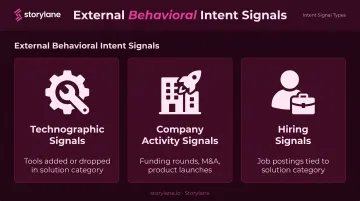
External Behavioral Signals
Three sub-types, each decoded differently depending on your ICP and sales stage:
- Technographic signals: A company adding or dropping tools in your category signals new needs or budget reallocation worth tracking
- Company activity signals: Funding rounds, M&A activity, and new product launches indicate available budget and shifting priorities
- Hiring signals: Job postings for roles tied to your solution category often surface upcoming projects or active tool evaluations
Active vs. Passive Intent
The distinction matters for how you respond:
| Intent Type | What It Looks Like | Response Approach |
|---|---|---|
| Active | Comparing vendors, revisiting pricing pages, requesting demos | Competitive positioning sequence, direct meeting ask |
| Passive | Dissatisfied with current tool, not yet searching alternatives | Educational content, problem-awareness nurture |
Reaching out with a direct pitch when a prospect is still in passive mode typically triggers disengagement — the timing feels off because it is. Map your response to where the buyer actually is, not where you want them to be.
Where Buyer Intent Signals Come From: First-Party vs. Third-Party
First-Party Intent Data
Signals generated through direct interactions with your own properties:
- Website analytics (page views, session depth, form fills)
- CRM activity (demo requests, email engagement, deal stage progression)
- Interactive product touchpoints
This is where demo platforms become a meaningful first-party signal layer. Storylane's Account Reveal feature, for example, de-anonymizes visitors engaging with interactive demos, surfacing company and firmographic data without requiring a form fill.
The analytics layer goes deeper still — tracking step completion rates, time spent per section, drop-off points, and CTA clicks. When a prospect spends 18 minutes exploring your product walkthrough and completes 85% of a demo, that's a first-party signal with real specificity, not just a page view.
Slack alerts notify sales reps in real time when a tracked account re-engages, so follow-up happens while the prospect is still active rather than hours later.
Third-Party Intent Data
Signals aggregated by external providers from across the web:
- Review site activity (G2, Capterra) — product comparisons, alternatives research, pricing views
- Content consumption on B2B publisher networks
- Job board monitoring for hiring signals
- Technographic tracking
Third-party data helps teams spot in-market accounts before those prospects ever visit their website. The trade-off is precision: third-party signals indicate category interest, not necessarily interest in your specific product.
Forrester warns against relying on intent data without first-party validation. The most effective intent programs use both: third-party to find in-market buyers early, first-party to confirm and contextualize that interest.
How to Use Buyer Intent Signals Effectively: A Step-by-Step Approach
Using intent signals well is less about having the most data and more about building a reliable sequence. Skipping steps leads to either inaction (data collected but never used) or poor timing (outreach that misses the moment).
Step 1: Set Up Signal Tracking Across Your Key Sources
Start by auditing what your current stack already captures:
- Website analytics platform (page views, session data)
- CRM (demo requests, email engagement, deal stage activity)
- Marketing automation (email clicks, content downloads)
- Product or demo interactions (completion rates, feature engagement)
Map the gaps, particularly around third-party coverage, and determine which sources reflect how your buyers actually research.
Then define specific trigger conditions:
- Visited pricing page twice within seven days
- Job posting for a role that uses your solution category
- Funding announcement from a target account
Step 2: Score and Prioritize Signals
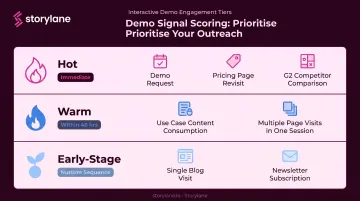
Build a tiered scoring framework weighted by intent strength:
- High intent: Demo request, pricing page revisit, G2 competitor comparison
- Mid intent: Use case content consumption, multiple page visits in one session
- Awareness level: Single blog visit, newsletter subscription
Also consider stakeholder context. Forrester's research notes that the typical B2B buying group has expanded to 13 people — so tracking engagement across multiple contacts from the same account matters. A CFO reviewing ROI content in the same week a VP of Engineering explores your integration docs carries more combined weight than either signal alone.
Group accounts into tiers — hot, warm, early-stage — and use these tiers to determine outreach urgency and channel.
Step 3: Personalize Sales Outreach Based on Signal Context
Most reps acknowledge the signal and stop there. "I saw you visited our website" is not personalization — it's noise. Signal-informed outreach references the actual behavior:
- "Noticed your team spent time on our Salesforce integration walkthrough — happy to show you how we handle the sync in more detail."
- "Saw you were comparing options in the compliance category — we have a use case that might be directly relevant to your setup."
Signal combinations should map to specific plays:
- Prospect views competitive comparison content and visits the pricing page → competitive positioning sequence
- Use case content consumed, demo CTAs ignored → send a targeted case study before any meeting ask
- Multiple stakeholders from the same account engage within a short window → expand outreach to the full buying group
Step 4: Run Signal-Driven Marketing Campaigns
Marketing teams use intent signals to:
- Personalize content delivery — serve compliance-focused content to accounts researching security, not generic product overviews
- Trigger ABM campaigns for accounts showing multi-stakeholder engagement
- Build retargeting audiences from high-intent behavioral segments
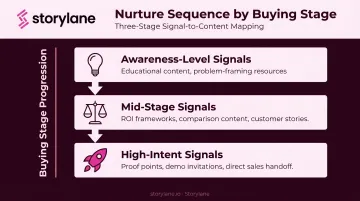
Nurture sequencing should map to buying stage:
- Awareness-level signals → educational content, problem-framing resources
- Mid-stage signals → ROI frameworks, comparison content, customer stories
- High-intent signals → proof points, demo invitations, direct sales handoff
Step 5: Monitor and Iterate
After activation, track what's actually working:
- Response rates by signal type
- Time-to-engagement from signal detection to rep follow-up
- Pipeline influence from intent-sourced outreach
This data reveals which signals reliably convert versus which generate noise. Storylane's demo analytics show exactly where prospects engage or drop off during product walkthroughs — and teams like Respond.io have used this data to iterate on demo content biweekly, doubling their engagement rate over time.
Best Practices for Using Buyer Intent Signals Effectively
Act within the signal window. Intent signal value degrades quickly. HBR research found that firms responding within one hour were nearly 7x more likely to qualify a lead than those waiting longer. Set team SLAs for high-intent signals — 24 to 48 hours is a reasonable benchmark for follow-up on a pricing page visit or demo engagement.
Avoid single-signal decisions. One pricing page visit doesn't confirm buying intent. One funding announcement doesn't mean a prospect needs your solution today. Train teams to look for signal clusters before escalating outreach — that means multiple behavioral indicators from the same account within a short window, such as:
- Repeat pricing page visits combined with a demo request
- Job posting activity alongside content downloads
- Champion engagement paired with a recent funding event
Forrester explicitly recommends triangulating multiple signal types to identify buying-group members and gauge buying-cycle stage.
Align sales and marketing around a shared signal taxonomy. Both teams need shared definitions for signal types, consistent scoring thresholds, and unified playbooks for each tier. Without this, marketing-sourced intent data gets ignored by sales — and campaigns miss active buyers that sales is already pursuing.
Forrester reports that highly aligned B2B companies grow 19% faster and are 15% more profitable than their less-aligned counterparts. Alignment isn't a soft goal — it's a measurable revenue driver.
Frequently Asked Questions
What are buyer intent signals?
Buyer intent signals are behavioral data points that indicate a prospect's interest in purchasing a product or service. They help sales and marketing teams identify who is in-market and when to engage, before a prospect ever fills out a form or contacts a rep.
What are some examples of buying signals?
Concrete examples include repeated visits to a pricing page, downloading a competitive comparison guide, requesting a demo, a company announcing new funding, posting job openings for roles that use your solution category, or reviewing your product on G2.
What are buyer intent keywords?
Buyer intent keywords are search terms prospects use when evaluating a solution, such as "best [category] software," "[competitor] alternative," or "[product] pricing." Tracking these via SEO tools or third-party intent providers helps surface accounts in an active buying cycle before they engage directly.
What is the difference between first-party and third-party intent data?
First-party intent data comes from your own channels — website, CRM, demo engagement — and reflects direct interaction with your brand. Third-party intent data is aggregated from across the web by external providers and helps surface accounts researching your category before they ever visit your site.
How do you prioritize leads using buyer intent signals?
Weight signals by intent strength (demo request > pricing page visit > blog read) and look for signal clusters — multiple high-intent behaviors from the same account. Segment accounts into hot, warm, and early-stage tiers to determine outreach urgency and the right channel for each.
How quickly should you act on a buyer intent signal?
High-intent signals (pricing page visits, demo requests, high-completion demo views) should trigger follow-up within 24 hours. Intent value degrades fast. Set team SLAs for signal response time so no high-intent account goes cold waiting for outreach.