
.svg)

Both tools do the same basic thing: capture your product and turn it into a clickable demo you can share. The real comparison starts after that first capture. How many formats can you ship from one demo? How deep does the analytics go? Which teams across your company can actually use it day to day?
Storylane covers the full GTM stack. Marketing builds interactive product tours for the website. Sales sends personalized Hubs to buying committees. Presales runs sandbox demos on live calls. CS uses video demos for onboarding. All from one platform. Storylane launched in 2021 and is the longest-running platform in this category by a meaningful margin, with 1,400+ G2 reviews and a Fortune 1000 customer base. It holds a 4.8-star rating across 1,400+ G2 reviews, making it the #1 rated demo automation software on the platform.
Guideflow launched in 2023 with a focused pitch: fast capture, marketing-friendly demos, bundled-seat pricing. The product is fast and reviewers love it for ease of use. In November 2025, they shipped Guideflow 2.0, which added sandbox environments, demo centers (their version of demo hubs), live demos with backend connectivity, and mobile demos. Most of what makes Guideflow a full platform rather than a focused tool has shipped in the last 12-18 months. Worth knowing when you're evaluating maturity.
The core divide: Storylane treats demos as a GTM asset that works across channels, teams, and funnel stages. Guideflow treats them as a marketing content format. That distinction shapes everything from output types to analytics depth.
Feature comparison at a glance
The table tells you the "what." The sections below tell you the "so what."
Output formats and category first maturity
Both platforms now produce roughly the same output types:
- Interactive demos, captured from your live product UI, fully editable and clickable (screenshot and HTML)
- Sandbox Demos, where buyers explore a html replica of your product, a pixel perfect simulation
- Hubs that package demos, videos, PDFs, and case studies into a single trackable link for buying committees (Guideflow calls them Demo Centers),
- Video, GIF export, mobile demos. for social ads, email sequences, and landing pages
The useful comparison happens one layer below the feature list: how long has each format been in production, and how much customer iteration has shaped it.

Take Hubs. Storylane's category-first innovation, has been in production for years. Teams use it to build buying-committee deal rooms with demos, PDFs, videos, and embeds. The format has been tested and improved upon the longest, including AI Hub Creation, which generates a personalized hub from a single prompt.
Guideflow's Demo Centers do the same job, and were brought front and center as part of Guideflow 2.0's relaunch in November 2025. The build is solid, and everything around the feature is just earlier-stage: fewer customer playbooks on how to use hubs in real sales motions, fewer integration patterns refined over years, less muscle memory in the customer base.
The same story plays out across sandbox demos, AI demo creation, and CRM-synced analytics. Storylane shipped first on several category-defining moves, and others followed. Both platforms have these features today. The difference shows up at scale: thousands of deployments, integration edge cases handled, workflows that just work without you babysitting them.
Pricing breakdown by team size
Pricing is where Guideflow's cost structure gets tricky at scale. Here is a breakdown of both platforms:
Storylane pricing:
Guideflow pricing
Guideflow's lower tiers are genuinely well-priced. Solo at $35/mo is a solid entry point for individual creators, and Growth at $499/mo bundles 10 seats with HTML capture, which beats Storylane Growth's 5 seats at the same price point. If you're a marketing-only team that needs HTML demos and lead forms, Guideflow wins on cost.
The story changes at the higher tiers:
- Storylane Premium ($1,200/mo) includes 10 seats, Buyer Hub, SSO, deep Salesforce integration, Account Reveal for 10,000 accounts, offline demos, AI Suite Premium with 250 min avatar usage, and a dedicated CSM.
- Guideflow Advanced ($1,499/mo) includes sandbox demos, custom domain, and offline demos. Demo Center is a paid add-on at this tier. SSO isn't available, it requires Enterprise at $2,999+/mo.
So Guideflow wins on entry price for solo users and marketing-only teams under 10 people. Storylane wins as soon as you need demo hubs, SSO, or deep CRM integration in one tier, which is where most teams end up within 12-18 months of adoption.
One thing worth knowing about Guideflow's free plan: it adds a watermark to every demo. A Storylane customer who evaluated both put it this way:
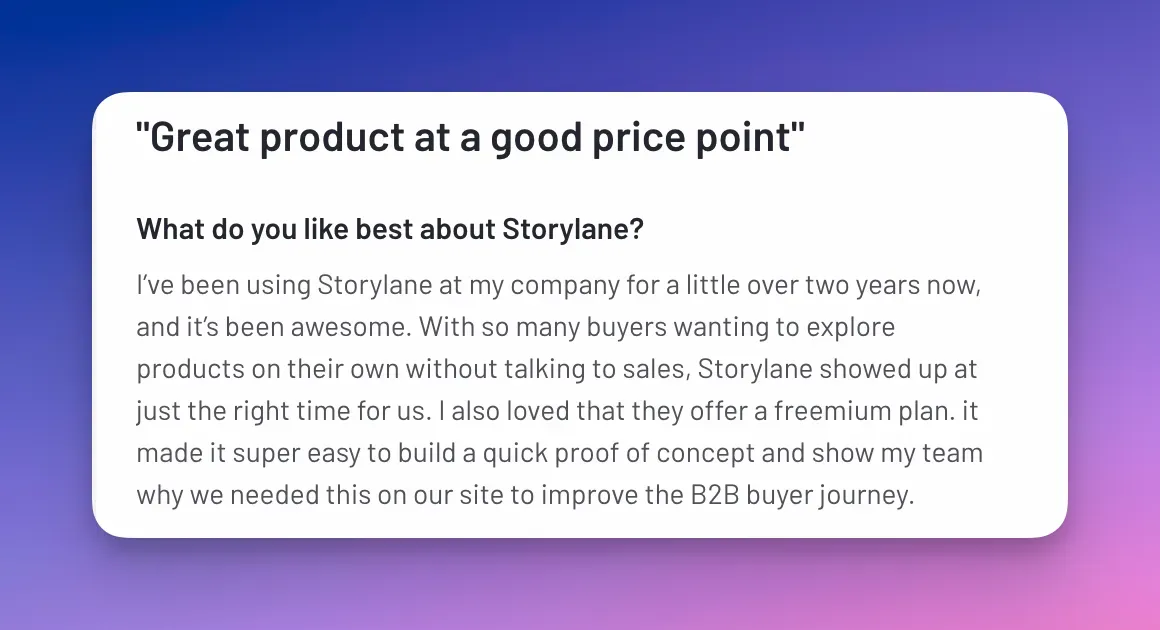
"I did look at a couple of competitors. One was Guideflow. I think their free plan has a watermark, so we kind of put them to the side."
AI features - breadth and maturity

Both tools have built out serious AI features, and most of the headline capabilities show up on both sides:
- AI Demo Creation: Once you capture your product flow, AI automatically generates tooltips, hotspots, and guides for every step. You skip the manual work of writing guide text for each screen.
- AI Video Avatars: Generate video demos with a virtual presenter layered on top. No recording booth, no scheduling a voice actor.
- AI Voiceovers: AI-generated narration in 25+ languages with 50+ voice options.
- Auto-translation: Translate entire demos into multiple languages for global teams without rebuilding.
Where Storylane’s AI maturity really shows:

Storylane's AI suite has been shipping iteratively since 2023, so each of these features has had more cycles of customer feedback shaping how they perform at scale. The capability list looks similar on paper, but the time on the curve shows up in capture quality, speed, and how naturally AI threads through the rest of the workflow.
On top of the shared capabilities, Storylane includes two things Guideflow doesn't:
- AI HTML Editor: Describe the data you want in your demo and AI updates charts, tables, and graphs with industry-relevant numbers for a targeted experience. The personalization happens at the data layer, not just the text layer.
- RepX: A conversational AI agent that qualifies prospects engaging with your demos and routes them to sales. A separate layer on top of demo creation, aimed at the conversion step rather than the build step.

Analytics and deal intelligence (CRM integration depth)
If you only need to know how many people viewed your demo and how many finished it, both platforms will get you there. The real comparison is in depth, and in how the data flows into your pipeline.
Guideflow gives you the basics done well: session-level analytics, completion rates, AI Account Reveal for visitor identification, and CRM variable personalization. You see how a demo is performing overall, and which company an anonymous viewer belongs to. What it stops short of is tying that engagement back to specific stakeholders inside a deal, or syncing the engagement data into your pipeline workflow in a way sales reps can act on without leaving their CRM.
Storylane tracks engagement at a fundamentally different level:
- Per-viewer, per-step tracking: See exactly who viewed each step, how long they spent, and where they dropped off.
- Account Reveal: De-anonymize website visitors by mapping IP addresses to company names, so you know which target accounts are engaging even before they fill out a form.
- Hub engagement for buying committees: When you share a Hub with a multi-stakeholder deal, see which specific people on the buying committee opened it, which assets each person engaged with, and who has gone quiet.
- Bi-directional CRM sync: Demo activity logs directly to contact and deal records in HubSpot and Salesforce. No manual data entry.
- Slack notifications: Get real-time alerts when a prospect views a demo or revisits a Hub.
- Pipeline attribution: Tie demo engagement to influenced revenue so you can measure the ROI of your demo program.
Why this matters to sales teams: knowing that "42 people viewed the demo" is interesting. Knowing that "the CFO at a target account revisited the pricing section three times this week and the deal is in Stage 3" is actionable. That is the difference between activity reporting and deal intelligence.
Example: A sales rep shares a Storylane Hub with a 6-person buying committee. Within 48 hours, the rep sees that the VP of Engineering watched the integrations section twice and the CFO opened the pricing walkthrough. The rep receives a Slack alert, checks the CRM timeline (synced automatically), and tailors the next call to address technical integration concerns and pricing questions specifically.
How you can implement it:
- Create a Hub with assets organized by persona (technical, financial, end-user)
- Share the Hub link with your champion and ask them to distribute it
- Monitor Hub engagement to see which stakeholders are active and which have gone quiet
- Use Slack notifications to trigger timely follow-up based on real engagement signals
Enterprise readiness
Both tools have SOC 2 Type II, GDPR, and CCPA covered. The procurement differences are in the softer signals.
A great sign of trust to look at the Customer base. Storylane's customer roster includes Fortune 1000 companies across multiple industries: Big names like Hubspot, Microsoft, Nutanix, Gong and Bitdefender.
Guideflow's customer base is mid-market and growth-stage heavy, with named customers like Amplitude, DocuSign, Qonto, Gorgias, and PandaDoc. Solid for a tool only two years into market.
- Time in market with enterprise. Storylane has been clearing procurement reviews since 2022, with the security questionnaire patterns and integration playbooks that come with multi-year experience. Guideflow's enterprise push expanded in the last year, with an Enterprise plan that includes workspace governance, role-based access, and SSO.
- SSO accessibility. Storylane includes SSO on Premium plans and above. Guideflow keeps SSO on its Enterprise plan only, which starts at $2,999/month.
- Review volume. Storylane: 1,400+ G2 reviews. Guideflow: ~141. For an infosec team doing due diligence, that 10x gap is a procurement-relevant signal alongside the technical review.
If your bar is SOC 2, SSO, and a polished workspace, both clear it. If your bar is "how many companies our size have already deployed this across multiple teams," Storylane has a wider reference pool to draw from.
The verdict: which tool fits your team?
Pick Guideflow if you're running a marketing or onboarding team that wants fast capture, predictable bundled-seat pricing for the marketing function specifically, and a focused interactive demo tool. The Solo plan is a strong entry for individual creators, and the team ships product fast.
Pick Storylane if demos are a shared GTM asset across marketing, sales, presales, and CS. The maturity gap shows up where it counts: demo hub patterns, bi-directional CRM sync, sales workflow features like branching and dynamic variables, and a customer base that's already deployed at Fortune 1000 scale. If demo engagement is going to feed your sales pipeline and reporting, analytics depth decides the call.
Still on the fence? Storylane has a free plan with no credit card required. Build a demo, see how it fits, decide from there.
Frequently asked questions - Storylane vs Guideflow
Q. Is Storylane or Guideflow better value for a 5-person team?
Depends on what you need. Guideflow Growth ($499/mo) bundles 10 seats and HTML capture, so a 5-person marketing team gets HTML demos with room to grow on a single bill. Storylane Growth ($500-$625/mo) bundles 5 seats and adds AI Suite Plus (125 min of avatar usage), Account Reveal for 2,500 accounts/month, and advanced branching for sales workflows. If you're a marketing-only team that just needs HTML demos and lead capture, Guideflow is cheaper. If you need sales-grade features earlier (A/B testing, deeper account intelligence, mature AI), Storylane includes more at the same price point.
Q. Where does the pricing comparison actually flip?
At the Premium/Advanced tier. Storylane Premium at $1,200/mo includes 10 seats, Buyer Hub, SSO, deep Salesforce integration, Account Reveal for 10,000 accounts, and offline demos. Guideflow Advanced at $1,499/mo includes 10 seats and a sandbox, but Demo Center is listed as a paid add-on, and SSO isn't on this tier at all. SSO on Guideflow requires Enterprise starting at $2,999/mo. For a mid-market team that needs hubs and SSO together, Storylane Premium is $300 to $1,800/mo cheaper for comparable capability.
Q. Can either tool export demos as video?
Yes, both platforms support video and GIF export. Storylane has had video export for longer and includes it from Starter. Guideflow added video and GIF export as part of its expanded feature set, included from Solo.
Q. Which has better analytics?
Both have analytics. Storylane goes deeper on per-viewer, per-step engagement, bi-directional CRM sync into Salesforce and HubSpot, hub engagement tracking by stakeholder, and pipeline attribution that ties demo engagement back to influenced revenue. Guideflow has session-level analytics and AI Account Reveal for visitor identification. For aggregate demo reporting, both work. For sales teams that want to use demo engagement as a signal inside their CRM, Storylane's depth is the differentiator.
Q. Which tool is better for enterprise teams?
Both hold SOC 2 Type II, GDPR, and CCPA certifications, so the baseline compliance bar is met by both. The differentiators are softer signals. Storylane has a larger Fortune 1000 customer base, 10x the G2 review volume, and includes SSO at Premium ($1,200/mo). Guideflow's enterprise footprint is younger and gates SSO behind Enterprise at $2,999+/mo. If your procurement process weighs customer reference density and SSO accessibility, Storylane has the wider track record.
Q. Which one is more mature overall?
Storylane launched in 2021 and was first to ship several category-defining features, including demo hubs. Guideflow launched in 2023 and relaunched its product as an AI demo automation suite in November 2025 (Guideflow 2.0), bringing sandbox, demo centers, live demos, and mobile demos under one positioning. Both are well-built products. The maturity gap shows up in customer base size, integration polish, analytics depth, and enterprise rollout experience.
Q. What about AI features?
Both have substantial AI. They've bet on different parts of the workflow. Storylane's AI speeds up the post-capture stage: once you record your product flow, AI Demo Creation auto-generates the guide text, tooltips, and hotspots for every step. Smart personalization updates content across an entire demo library at once. Guideflow's AI focuses on polish and localization: AI Voiceover, AI Avatars (turn any team member into a speaking presenter), AI Translation, and an AI Assistant chat interface for editing captured demos via prompts. Pick based on where your bottleneck is.