
.svg)

Guideflow alternative - summary
You built your first Guideflow demo on the free plan, shared it with a prospect, and the first thing they noticed was the watermark. You upgraded to Solo at $35/mo to fix that, and Growth at $499/mo gave you HTML capture with 10 seats. The pricing through that point is competitive.
Then your team scaled, and you ran into the harder ceilings: Demo Center sits behind an add-on at the $1,499 Advanced tier, SSO is gated behind Enterprise at $2,999+/mo, native A/B testing isn't available on any tier, and analytics don't quite tie into pipeline the way mature platforms do.
If you're hitting those limits, here are six alternatives worth evaluating.
Why look for a Guideflow alternative
Before diving in, here is how we evaluated: each tool was scored on demo format flexibility (screenshot, HTML, video, sandbox), AI capabilities, analytics depth, pricing transparency, and integration breadth. These are the five factors that matter most when choosing a demo platform.
Five patterns surface across G2 reviews, sales calls, and competitive evaluations:
- The free plan watermark limits professional use. Guideflow's free tier caps you at 5 demos with a branded watermark on every one. For teams testing the tool with prospects or executives, that watermark is a dealbreaker before you even evaluate features. "I did look at a couple of competitors. One was Guideflow. I think their free plan has a watermark, so we kind of put them to the side."
- Pricing scales unevenly above Growth. Solo at $35/mo and Growth at $499/mo for HTML capture work well for marketing teams. The friction starts above Growth. Advanced jumps to $1,499/mo but Demo Center is still an add-on. SSO only unlocks at Enterprise ($2,999+/mo). Teams that need full hub functionality, single sign-on, or A/B testing end up paying enterprise prices for features other platforms include at mid-tier.
- Feature maturity lags behind established platforms. Guideflow ships fast, but the feature set still trails category leaders on analytics, integrations, and advanced demo logic. Teams evaluating multiple tools consistently find the gap. "Guideflow and similar tools come right below us in terms of features; they're still catching up. They don't even compete in terms of the feature sets."
- Analytics depth is uneven across tiers. The free plan limits analytics to 7 days. Solo includes visitor identification and basic CRM integrations, but advanced analytics, deal-level reporting, and the AI Account Reveal experience sit on higher tiers. For teams using interactive demos to influence deals, not just generate clicks, the lower-tier reporting falls short of what's needed to act on engagement signals.
- Demo Center is an add-on, not a core feature. Guideflow's Demo Center, their version of a multi-demo hub, is only available as an add-on on the Advanced plan ($1,499/mo annual). Teams that want to organize demos into buyer-facing collections hit a paywall that most competitors include at lower tiers.
What is Guideflow?
Guideflow is a demo automation platform built around screenshots and HTML-based interactive demos. It positions itself as a fast, affordable way to create product walkthroughs for marketing, sales, and customer success teams.
It offers AI demo content generation, AI translation, and lead capture forms. They have a free plan that scales to $2,999/mo+ for Enterprise with sandbox demos and professional services.
Guideflow works well for solo marketers or small teams that need basic screenshot walkthroughs quickly. The friction starts when teams need HTML capture, deeper analytics, or hub-style demo organization without jumping to enterprise pricing.
The 7 best Guideflow alternatives
1. Storylane
Best for: teams that need screenshots, HTML, video, and sandbox demos on one platform
Storylane is one of the most established platforms in the category, in the market since 2021 with 1,400+ G2 reviews and a Fortune 1000 customer roster (Microsoft, HubSpot, Nutanix, Gong, Bitdefender). It covers screenshot, video, HTML/CSS, and sandbox demos under one product called Demo Suite, plus an AI sales agent called RepX. Storylane Growth and Guideflow Growth land at the same price ($500 vs $499) but include different things, and the gap widens at higher tiers.
Where it wins:
- Native A/B testing for demos. Run controlled experiments between demo variants and measure which version converts better. Guideflow doesn't offer A/B testing on any tier.
- Storylane’s Deal Intelligence. Demo engagement data that flows into deal records, not just dashboards. Bi-directional CRM sync logs Storylane demo activity directly to contact and deal records in Salesforce and HubSpot. Guideflow integrates with both CRMs without tying demo engagement to specific deals at the same depth.
- A mature Hubs experience. Hubs at Premium ($1,200/mo) includes Interest Screens. Guideflow's Demo Center is the newer equivalent and sits as an add-on at the $1,499 Advanced tier.
- Pricing that holds up at higher tiers. Storylane Premium at $1,200/mo includes Hubs, SSO, deep Salesforce integration, Account Reveal for 10,000 accounts, and offline demos. The Guideflow equivalent needs Advanced ($1,499) plus the Demo Center add-on, with SSO gated behind Enterprise at $2,999+/mo.
- RepX for inbound qualification. Beyond demo creation, Storylane includes RepX, an AI agent that qualifies prospects engaging with demos on your website and routes them to sales. Guideflow doesn't offer anything like that.
- AI HTML Editor: Describe the data you want in your demo, and AI updates charts, tables, and graphs with industry-relevant numbers for a targeted experience. The personalization happens at the data layer, not just the text layer.
Honest tradeoff: Storylane does not hold HIPAA certification, and ISO 27001 is not available (only Saleo offers that in this category). Teams needing live product data overlay for sales demos should evaluate Saleo instead for their needs
G2 rating: 4.8/5 across 1,405 reviews (#1 in Demo Automation category with highest 99/100 Satisfaction Score)
Pricing: Free plan with 1 demo and 1 seat (no watermark). Starter at $40/mo annual with unlimited demos and Account Reveal. Growth at $500/mo annual with HTML demos and A/B testing. Premium at $1,200/mo annual with Salesforce App, SSO, Deal Intelligence, and Hubs included. Enterprise is custom.
2. Arcade
Best for: product marketing teams that need quick, shareable product tours
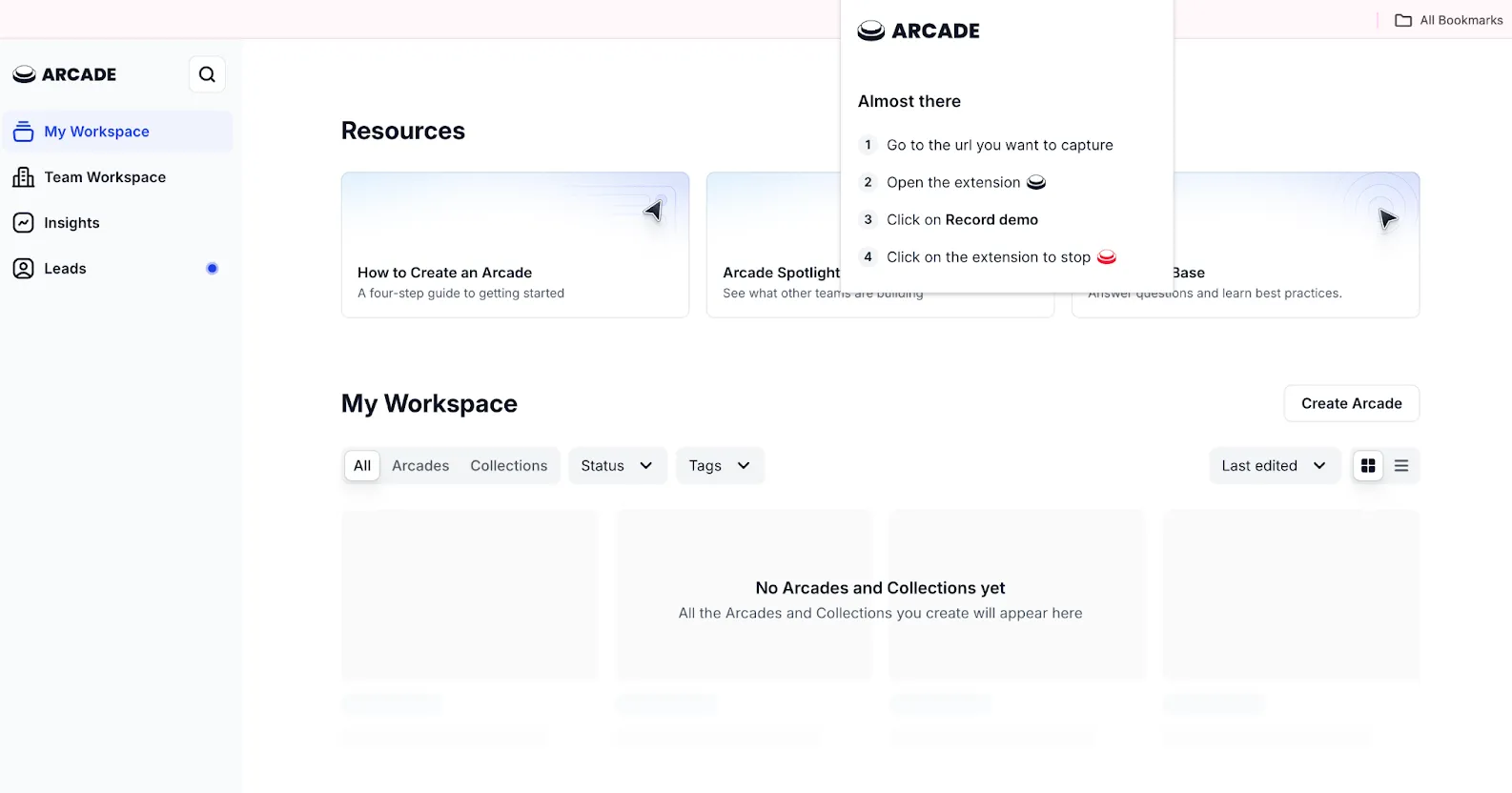
Arcade focuses on turning product screenshots into shareable, animated walkthroughs. It is the closest competitor to Guideflow in approach: both start with screenshot capture and target marketing teams that want demos live on their website or in email campaigns. Arcade's export options (GIF, video, HTML embed) make it particularly useful for teams distributing demos across channels where an interactive format is not supported.
Where it wins:
- GIF and video export. Turn any demo into a GIF or MP4 for use in emails, ads, or social posts where interactive embeds are not an option.
- Narration and AI voiceover. Add AI-generated narration to walkthroughs without recording audio manually.
- Simple creation flow. Screenshot capture plus a drag-and-drop editor keeps the learning curve minimal for non-technical marketers.
Honest tradeoff: Arcade is screenshot-only. There is no HTML/CSS capture, no sandbox demos, and no video demo format. Teams that outgrow screenshot walkthroughs and need interactive HTML product experiences will need to switch platforms. Analytics are lighter than full-funnel tools like Storylane or Navattic.
G2 rating: 4.6/5 across 175 reviews
Pricing: Free plan (basic screenshot/video demos, limited features). Pro at ~$32/mo annual ($38/mo monthly) per person (AI demos, analytics, custom branding). Growth at ~$297/mo annual ($350/mo monthly) for teams (collaboration, advanced analytics).
3. Navattic
Best for: teams that prioritize HTML/CSS demo capture over screenshot walkthroughs

Navattic’s strength is its ABM integration layer: demo intent data, account identification, engagement signals, and LaunchPad (a workspace for managing account-level demo experiences). Buyer circle discovery on the Growth plan reveals which stakeholders from a target account are engaging with demos.
For teams leaving Guideflow because they need to connect demo engagement to ABM campaigns and account-level pipeline tracking, Navattic is the most focused solution.
Where it wins:
- HTML/CSS demo depth. Purpose-built capture engine for complex product UIs. The editor handles dynamic elements, data masking, and multi-page flows without engineering involvement.
- Account identification. Navattic includes visitor identification to connect demo engagement to accounts in your CRM.
- Deep ABM workflow integration with account-level intent signals
- LaunchPad. Navattic's demo center (released September 2025) lets teams organize multiple demos into a single destination page.
Honest tradeoff: Navattic's free Starter plan is limited to 1 demo, and paid plans start at $500/mo (Base) with no mid-tier option. The learning curve is steeper than Guideflow or Arcade. "It boils down to ease of use; Storylane just feels more intuitive and easier to get going. Navattic has a slightly longer learning curve." Teams that only need screenshot demos are overpaying for HTML capability they will not use.
G2 rating: 4.8/5 across 914+ reviews (#2-3 in Demo Automation, 95/100 satisfaction)
Pricing: Free Starter plan (1 demo, 1 seat). Base at $500/mo annual ($600/mo monthly) for 5 seats (unlimited HTML demos, AI voiceovers, A/B testing, 25+ integrations). Growth at $1,000/mo annual ($1,200/mo monthly) for 10 seats (LaunchPad, sandbox demos, SSO).
4. Supademo
Best for: product marketers who want AI-powered demo creation at a lower price point

Supademo competes directly with Guideflow on the screenshot demo side but differentiates with aggressive AI features, broader language support, and a surprisingly deep Growth tier that includes HTML demos and sandbox environments. If Guideflow's AI demo content feels limited, Supademo's AI voiceover (supporting 50+ languages), AI voice cloning, and AI data editing offer a meaningful upgrade at a lower price point.
Where it wins:
- AI voiceover in 50+ languages. Generate narrated walkthroughs without recording audio. Includes AI voice cloning on Growth. Broader language coverage than most competitors in this price range.
- HTML demos and sandbox on Growth ($350/mo). Unlike most screenshot-first tools, Supademo unlocks unlimited HTML demos, text/image/HTML editing, and unlimited sandbox demos on its Growth tier, undercutting Storylane's HTML entry by $150/mo.
- Route Hub for demo collections. Supademo's Route Hub supports demos, videos, PDFs, and links, making it a lightweight alternative to enterprise demo centers. Available from the Growth tier onwards.
Honest tradeoff: The Scale plan ($38/mo) is screenshot-only. HTML and sandbox demos require Growth at $350/mo. No account-level identification. The free plan caps you at 5 demos with basic features. Teams needing deep CRM integrations or account-level analytics will find Supademo lighter than Storylane or Navattic.
G2 rating: 4.7/5 across 619+ reviews (#5 fastest growing software on G2, 77/100 satisfaction)
Pricing: Free Starter (5 demos, 1 creator). Scale at $38/mo annual ($50/mo monthly) per creator (unlimited screenshot demos, analytics, branching, custom branding). Growth at $350/mo annual ($450/mo monthly) for 5 creators (unlimited HTML and sandbox demos, AI voice cloning, Route Hub).
5. Walnut
Best for: sales teams that need per-prospect demo personalization

Walnut takes a different approach from Guideflow entirely. Instead of marketing-led product tours, Walnut is built for sales teams that want to personalize demos for individual prospects before calls or as leave-behinds. The platform captures your product's front-end and lets AEs swap in prospect-specific data (company name, logo, use-case-relevant screens) without engineering support.
Where it wins:
- AI-powered prospect personalization. Swap logos, data, and screens to create tailored demos for each deal. Built for the sales workflow, not the marketing website. All via a simple prompt.
- Sales team adoption. The UX is designed for AEs and SEs who are not demo-building specialists. Template-based creation keeps turnaround fast.
- Enterprise security. Walnut targets enterprise buyers with corresponding compliance and security features.
Honest tradeoff: Walnut starts at $750/mo annual ($9,000/yr) for 3 editor seats, and charges for both editors and presenters separately, a pricing model unique in this category. There is no free plan and no self-serve signup. Teams looking for a marketing-first tool to embed on their website (Guideflow's primary use case) will find Walnut is solving a different problem. The platform is sales-focused, not full-funnel.
G2 rating: 3.8/5 across 200+ reviews (32/100 satisfaction; lowest in category)
Pricing: Ignite plan at $750/mo annual ($9,000/yr) for 3 editor seats. Charges separately for editors and presenters. No free plan.
6. HowdyGo: unlimited users on every plan
Best for: teams that want HTML demos and unlimited users without per-seat charges

HowdyGo is a Chrome extension-based demo tool built by a small, bootstrapped team (Australia + Europe) with a clear value proposition: unlimited users on every plan and HTML capture from day one. For teams where Guideflow's per-seat pricing ($35/seat on Solo, $50/seat on Growth) creates friction, HowdyGo removes the seat math entirely. The single-capture model (one recording exports to interactive demo, video, and GIF simultaneously) is a unique efficiency gain.
Where it wins:
- Unlimited users, every plan. No per-seat charges. Every team member can create and share demos without budget negotiations.
- HTML demos from $159/mo. HTML capture is available on the entry-level Starter plan, making HowdyGo's HTML entry ~3x cheaper than Storylane's Growth ($500/mo) and cheaper than Guideflow's Growth ($499/mo).
- One capture, three outputs. A single recording exports as an interactive demo, video, and GIF simultaneously. Auto-progression and zoom/pan give video exports a polished feel.
Honest tradeoff: There is no free plan (14-day trial only), and Starter at $159/mo is significantly more than Guideflow's Solo at $35/mo. The team is small and bootstrapped, which means a narrower integration library and no confirmed SOC 2 certification. Analytics are locked behind the Pro plan at $399/mo. No AI video avatars, and the AI feature set is lighter than Storylane or Supademo overall. Teams needing enterprise compliance or deep CRM integrations will find the platform too light.
G2 rating: 4.9/5 across 29 reviews (High Performer; small review base but very high satisfaction)
Pricing: No free plan (14-day trial). Starter at $159/mo annual ($199/mo monthly) with unlimited users, unlimited HTML demos, lead capture. Pro at $399/mo annual ($499/mo monthly) with analytics, CRM integrations, offline demos, custom domain. Enterprise is custom.
Guideflow alternatives: full comparison
How to choose the right Guideflow alternative
The right tool depends on three things: what demo formats your team needs today, how your demos connect to pipeline, and where you expect to be in 12 months.
If you need screenshot demos and nothing else, Arcade, Supademo, or HowdyGo will cover the use case at a lower price than Guideflow's paid tiers. HowdyGo is the strongest option if per-seat pricing is the friction; Supademo wins if AI voiceover and translation are priorities.
If you need HTML capture, the real comparison is between Storylane and Navattic. Both offer no-code HTML/CSS demo capture at similar price points. Storylane adds format breadth (screenshot, video, sandbox on the same platform), AI capabilities across every workflow, and deeper analytics with Account Reveal starting at $40/mo. Navattic is the specialist choice if HTML fidelity is the only priority.
If you need sales-specific personalization, Walnut is built for that workflow. It solves a different problem than Guideflow: per-prospect demo customization for sales teams, not marketing website tours.
If you are scaling past a single use case, Storylane is the only platform that covers screenshot, HTML, video, and sandbox demos under one roof, with Hubs for buyer enablement and RepX as a standalone AI sales agent. Teams using interactive demos across marketing, sales, and customer success avoid maintaining separate tools. Prospects who engage with interactive demos convert at 24.35% versus a 3.05% baseline: a 7.9x improvement. Investing in the right platform compounds that advantage.
The bottom line
Guideflow is a capable demo automation tool with a fast creation flow and an aggressive feature roadmap. It works well for marketing teams. But for most teams evaluating Guideflow alternatives, you are looking for a tool that is more tried and tested and offers more matured features. Storylane offers the strongest combination of format breadth, AI features, analytics, and pricing transparency. Start with the free plan (no watermark, no credit card) and build your first demo in under 10 minutes.
Frequently asked questions - Guideflow alternatives
Q. Is Guideflow free?
Guideflow offers a free plan, but it is limited to 5 demos, 1 team member, 7 days of analytics, and includes a Guideflow watermark on every demo. To remove the watermark and unlock unlimited demos, you need the Solo plan at $35/mo (annual billing).
Q. What is the best free alternative to Guideflow?
Storylane's free plan includes 1 demo with no watermark, unlimited views, and basic analytics. Supademo offers 5 free demos, Arcade has a free tier, and Navattic provides 1 free demo. HowdyGo does not have a free plan but offers a 14-day trial with unlimited users. The best choice depends on whether you need AI features (Storylane, Supademo), HTML capture at a lower price (HowdyGo at $159/mo), or export flexibility (Arcade).
Q. Does Guideflow support HTML demos?
Yes, but only from the Growth plan at $499/mo (annual billing). The free and Solo plans are limited to screenshot and mobile demos. Teams that need HTML-based interactive product replicas should compare Guideflow's Growth plan against Storylane Growth ($500/mo) and Navattic's paid plans, which include HTML capture as a core feature.
Q. How does Guideflow pricing compare to Storylane?
At the entry level, they are close: Guideflow Solo is $35/mo, and Storylane Starter is $40/mo (both annual). The difference is what you get: Storylane Starter includes Account Reveal, unlimited demos, and no watermark. For HTML demos, Guideflow Growth ($499/mo) and Storylane Growth ($500/mo) are nearly identical in price, but Storylane Growth includes A/B testing, personalization tokens, and a Hubs add-on option.
Q. Can I migrate my demos from Guideflow?
Most interactive demo platforms do not offer direct import from competitors. Migrating from Guideflow typically means recreating demos on the new platform. Screenshot-based demos are fast to rebuild (Storylane's AI Demo Creation can generate a walkthrough from a URL). HTML demos require re-capturing your product's front-end, which takes longer but is a one-time setup. Check whether your new platform offers migration support or onboarding assistance.
Q. What is the best Guideflow alternative for enterprise teams?
Storylane covers the widest enterprise footprint: SOC 2 Type 2, SAML SSO, sandbox demos, Salesforce App, audit logs, and custom data retention on the Enterprise plan. Navattic is a strong alternative for teams that only need HTML demos. Walnut serves enterprise sales teams that need per-prospect personalization.
Q. Does Guideflow offer account identification?
Guideflow lists visitor identification as a feature on the Solo plan and above. However, the depth of identification (IP-based vs. enriched account data) and integration with CRMs is less documented than competitors like Storylane (Account Reveal from Starter, $40/mo) or Navattic.
Ready to see how Storylane compares to Guideflow? Start building your first interactive demo for free. No watermark, no credit card, no time limit.