
.svg)

Last updated: October 2026. Ownership, pricing and product facts were re-checked against each vendor's own site this month.
If you are looking for Qualified alternatives, you are probably in one of three spots: you are not on Salesforce and want an AI SDR that does not assume it, you cannot get a quote-based enterprise contract past your CFO at your current stage, or you want an inbound agent that can show the product, not just route to a calendar. This guide ranks seven Qualified competitors for those situations, with published pricing where it exists and an honest note on where each one falls short, including our own product.
TL;DR
- Salesforce completed its acquisition of Qualified on April 1, 2026. Qualified's AI SDR, Piper, now sits inside a Salesforce-owned company, and Salesforce plans to bring the technology into Agentforce.
- Qualified does not publish prices. Its Premier, Enterprise, and Ultimate plans are all quote-based, and each is built around Salesforce CRM integration.
- Seven Qualified alternatives worth evaluating in 2026: Storylane RepX, Warmly, Breakout, Docket, 1mind, 11x, and Artisan. Each solves a different part of the inbound or outbound qualification problem.
- RepX is Storylane's inbound AI agent: it answers, qualifies, and books meetings with website visitors in real time across text, voice, and video, and it can pull up an interactive product demo in the same conversation. Published pricing starts at $2,000/month with a 30-day free trial.
Qualified alternatives compared: pricing, best fit, and trade-offs
Here is the shortlist at a glance. Prices are what each vendor publishes on its own pricing page as of October 2026; where a vendor does not publish a price, the table says so instead of guessing.
| Tool | Best for | Standout capability | Pricing model (published) | Where it falls short |
|---|---|---|---|---|
| Storylane RepX | Inbound AI qualification with an interactive demo in the same conversation | Trained on your docs, site, decks and demos; shows the real product in chat | From $2,000/mo (Growth, up to 20,000 monthly visitors); Premium from $3,000/mo; 30-day free trial | Inbound only, no outbound prospecting |
| Warmly | Visitor de-anonymization with an AI chat layer | Person-level visitor identification plus Inbound and TAM agents | From $10,000/yr (de-anonymization); Inbound Chat $20,000/yr; AI Inbound Autopilot $30,000/yr | AI chat sits on the higher tiers |
| Breakout | De-anonymization, inbound AI SDR and warm outbound in one tool | Follows up on warm accounts after they leave the site | Signals from $500/mo; Growth (inbound AI SDR) from $2,000/mo | Inbound AI SDR is a Growth-tier feature |
| Docket | Inbound qualification grounded in your sales knowledge | Sales Knowledge Lake, multi-visit memory, Showroom guided tour | Growth $3,000/mo, Scale $4,000/mo (billed annually) | Video avatar and multiple agents start on Scale |
| 1mind | Enterprise teams wanting a video AI "Superhuman," including on live calls | Photorealistic avatar on the website, in product and on sales calls | Pricing not public; quote-based | Enterprise buying process; no published entry price |
| 11x | Outbound prospecting plus an inbound phone agent | Alice (outbound) and Julian (inbound phone agent) | Pricing not public; quote-based | Not a website chat qualification tool |
| Artisan | Outbound AI BDR | Ava, an outbound AI BDR | Credit-based plan tiers; prices not shown publicly | Outbound only; does not convert website traffic |
Why teams are looking for Qualified alternatives in 2026
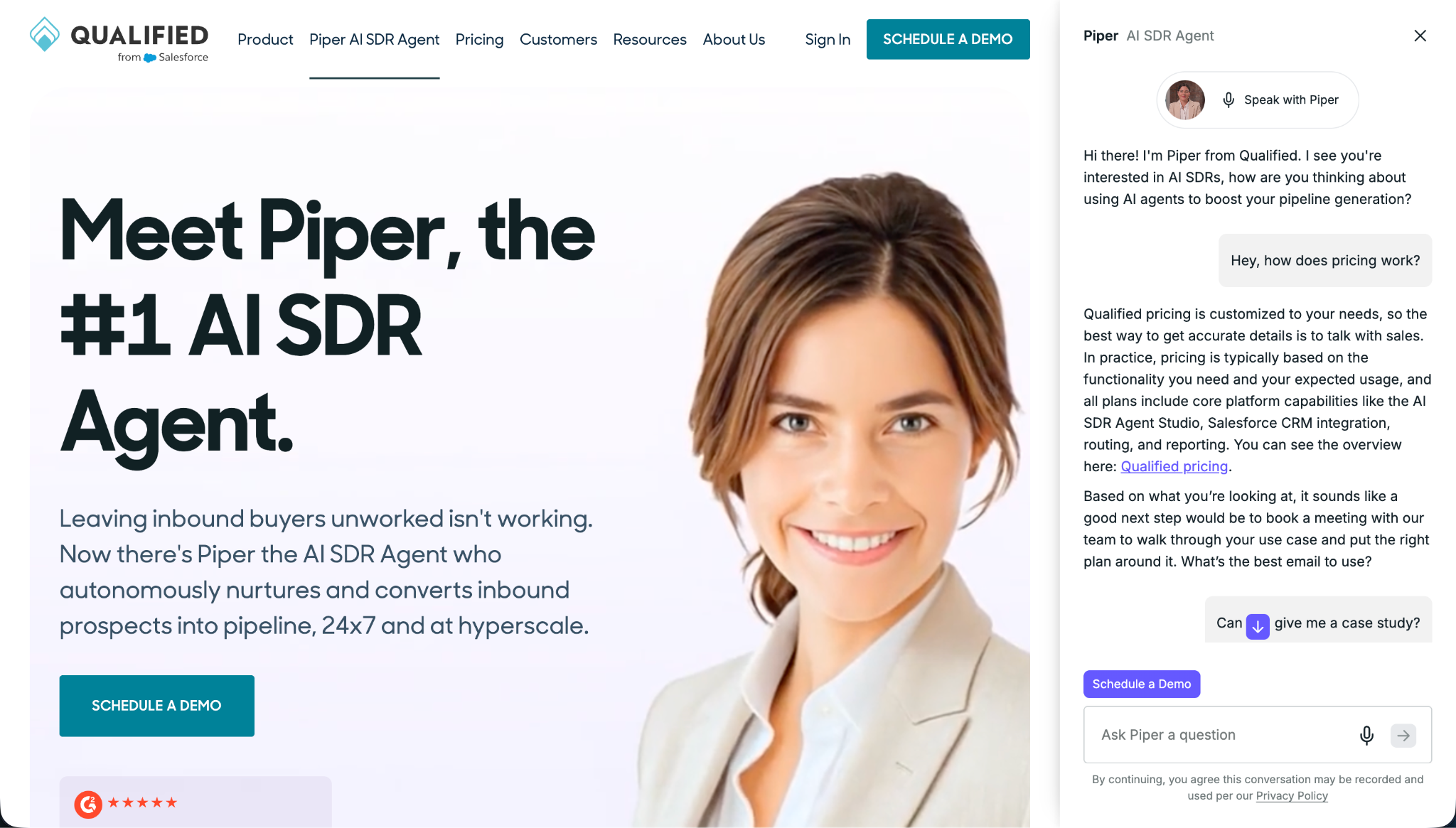
Qualified built a real product and a defensible position. For enterprise revenue teams running the full Salesforce stack, Piper, Qualified's AI SDR agent, was a credible answer to a genuine problem: website visitors arriving with intent and no one available to engage them at that moment. Piper meets buyers on the website over video, voice, or live chat, follows up with inbound leads by email, books meetings, and serves personalized offers, per qualified.com. Qualified says Piper has been hired by over 500 companies.
Then the ownership changed. Salesforce announced a definitive agreement to acquire Qualified in December 2025, and an editor's note on that release confirms the acquisition completed on April 1, 2026. Salesforce said it would integrate Qualified's agentic marketing technology into Agentforce.
For buyers evaluating the market today, that creates a different risk profile than it did a year ago:
- Roadmap: the product direction is now set inside Salesforce, alongside Agentforce. That is good news if you are all-in on Salesforce and a question to ask if you are not.
- CRM center of gravity: every plan on Qualified's pricing page is built around the Salesforce CRM integration. Qualified also lists HubSpot, Marketo, Eloqua, Outreach, and Salesloft among its integrations, so HubSpot-first teams should confirm in a demo exactly what works without Salesforce at the center.
- Cost visibility: there is no published price, so you cannot budget before a sales cycle.
The problem these teams are trying to solve has not changed: inbound interest exists, but there is no scalable layer to catch it, qualify it, and push it toward a conversation before the visitor leaves. Most teams evaluating inbound AI SDR tools as Qualified alternatives fall into one of three groups: teams on HubSpot or another non-Salesforce CRM, earlier-stage companies that need a published price and a fast start, and teams that want a qualification layer that can show the product and qualify in the same interaction.
Qualified pricing: what we could verify
Qualified's pricing page lists three plans, all with a "Contact us" button and no price:
- Premier: multi-modal agent (text, voice, video), agentic website and email conversations, meeting booking, multi-language support; includes 1 SDR agent profile, 250K monthly web sessions, and 2.5K monthly active email contacts.
- Enterprise: everything in Premier plus agent handoff, MCP and API access, and a Salesforce sandbox; 2M monthly web sessions and 10K monthly active email contacts.
- Ultimate: everything in Enterprise plus multiple agent profiles, high-volume contact databases, and a dedicated IP address; 5M monthly web sessions and 24K monthly active email contacts.
So the honest answer to "how much does Qualified cost" is: pricing not public; quote-based. If you see a specific Qualified price quoted online, ask where it came from. By contrast, several alternatives below publish their entry price, which is part of why they show up on so many shortlists.
1. Storylane RepX: the best AI SDR alternative with interactive demos
RepX is Storylane's inbound AI agent for sales: it sits on your website and answers, qualifies, and books meetings with visitors in real time. Buyers can type, talk, or (on Premium) speak face to face with an AI video avatar. Storylane is best known for interactive demo software, and RepX is built to use the demos you already have, alongside engagement signals that turn anonymous browsing into an actionable lead.
What makes RepX different from Piper is what happens when a visitor shows purchase intent. Most inbound AI agents can answer questions and route to a form or a calendar. RepX does that, and it also proactively pulls up the relevant interactive demo and walks the visitor through the real product in the same conversation, then continues qualifying and routes to a booking or a self-serve signup. It is not the only tool that shows product in conversation (1mind and Docket both do versions of this, and Spara lists AI demos on its Growth plan), but it is built by a company whose core product is interactive demos, so your existing demo library becomes the agent's best asset.
RepX is trained on your docs, website, decks, call scripts, and interactive demos. Playbooks let you set a different qualification flow per page, so pricing and paid landing pages each get their own questions and nudges. Qualified leads and conversation summaries flow to HubSpot, Salesforce, and Slack, and you can track engagements, qualified conversations, and booked meetings, then ask "Ask RepX" what visitors are asking about.
Pricing is published. RepX Growth starts at $2,000/month for up to 20,000 monthly visitors, Premium starts at $3,000/month for up to 60,000 monthly visitors and adds the AI video avatar and visitor de-anonymization, and there is a 30-day free trial, per storylane.io/plans. Neither plan requires Salesforce.
Where RepX is not the right fit: teams whose primary pipeline problem is cold outbound rather than inbound conversion. RepX is built for visitors who are already on your website. It does not prospect, build contact lists, or run outbound sequences. If that is your gap, pair RepX with an outbound tool, or look at the demand generation tools that fill the top of the funnel. If your need is closer to a lightweight chat widget than a full AI SDR, our Docket alternatives comparison covers that tier.
2. Warmly: best for website visitor de-anonymization
Warmly's primary function is website visitor de-anonymization: its site says its AI "de-anonymizes website visitors at the person level," and it pairs that with an Inbound Agent for on-site conversations and a TAM Agent that runs coordinated email and ads off-site. That puts it in the same conversation as Qualified and RepX for inbound qualification.
Note that HubSpot acquired Warmly in mid-2026 (reported by MarTech, CMSWire and CX Today, July 2026), so teams on other CRMs should ask about roadmap and integration plans.
The de-anonymization piece is where Warmly is genuinely strong. For B2B teams with meaningful website traffic and a defined ICP, knowing which target account is on your pricing page right now is a valuable signal, and Warmly routes it to the relevant rep or play.
Warmly publishes annual pricing: AI Web-Deanonymization at $10,000/year, Inbound Chat (adds the AI chatbot and live chat) at $20,000/year, and AI Inbound Autopilot at $30,000/year, per warmly.ai/pricing. We did not find a free plan listed. Warmly is a strong fit when the intent signal layer is the missing piece; if you need deeper conversational qualification on top, plan for an inbound agent alongside it. Our full list of Warmly alternatives goes deeper.
3. Breakout: best for teams that need the signal layer to actually act
Breakout occupies the space between an identification layer and a conversational qualifier. Its site says it identifies and qualifies every visitor, engages in real time, and books meetings "before they leave the tab," then watches for buying signals and launches researched warm outreach when an account warms up. It says it connects to 55+ GTM apps.
Breakout publishes starting prices: Signals (de-anonymization, enrichment, buying group identification) starts at $500/month, and Growth, which adds the inbound AI SDR, rep hand-off, routing and scheduling, starts at $2,000/month, per getbreakout.ai/pricing.
Where Breakout is not the right fit: if your conversion flow depends on showing your product inside the qualification conversation, compare its demo story carefully against RepX. And its value scales with ICP concentration in your traffic: if most visitors are not buyers, the identification layer has less to work with.
4. Docket: inbound qualification grounded in your sales knowledge
Docket is built around a governed knowledge layer. Its agent engages inbound visitors through voice or text with an on-page avatar, grounds answers in a Sales Knowledge Lake that ingests product docs, CRM records, and call recordings, remembers visitor context across repeat visits, and syncs the conversation, qualification answers, and next steps into Salesforce or HubSpot when it books a meeting. Docket also offers Showroom, which it describes as a live, guided tour of your product.
Pricing is published: Growth at $3,000/month billed annually for up to 20,000 monthly visitors, and Scale at $4,000/month for up to 100,000 visitors with the video avatar and multiple agents, per docket.io/pricing. Standard onboarding is quoted at 7 to 14 days.
Where Docket is not the right fit: it converts and follows up on demand you already generate; it does not manufacture net-new outbound pipeline from a cold list.
Worth noting: another tool in this chat-qualification tier is Chili Piper Chat, which pairs conversational qualification with meeting routing. The names collide, so to be clear: Qualified's AI agent is called Piper, while Chili Piper is a separate company. If you are weighing the two, see Chili Piper vs Qualified.
5. 1mind: the AI Superhuman platform (Drift's referred successor)
1mind is the most enterprise-oriented alternative on this list. On March 5, 2026, Clari + Salesloft announced the gradual sunset of Drift and an exclusive agreement to refer existing Drift clients to 1mind as the successor, per the Salesloft newsroom. If you were a Drift customer, 1mind is on your list by default; our Drift alternatives guide covers that migration in full, and our Drift vs Qualified comparison puts the two incumbents side by side.
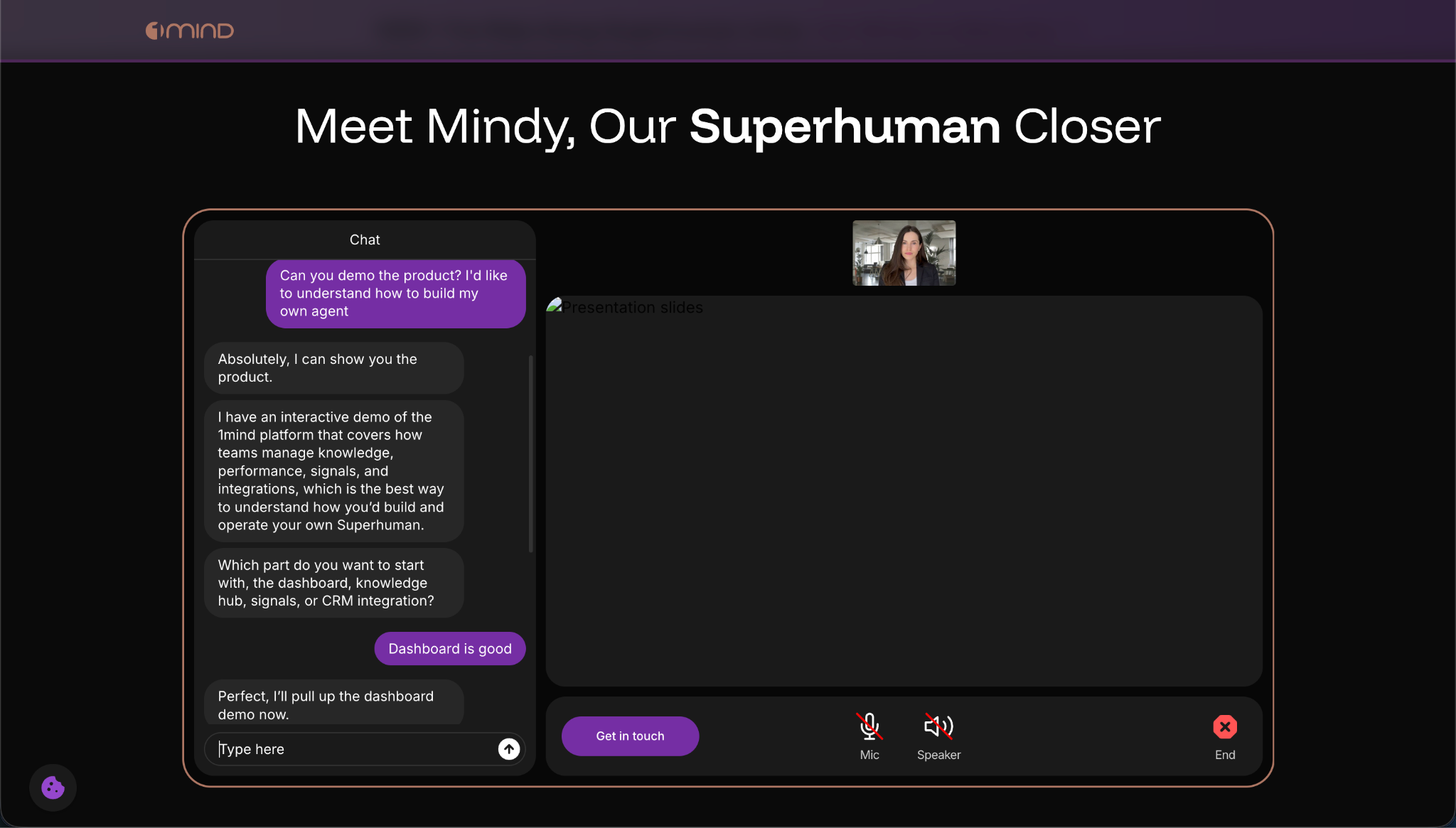
The core concept is a photorealistic AI "Superhuman" built for your product and buyer personas. 1mind says its Superhumans qualify leads, answer product questions, deliver demos, and handle objections on the website, inside the product, and as a participant on live sales calls. That last surface is distinctive: few tools on this list are designed to join a live call alongside your reps.
1mind does not publish pricing, so treat it as quote-based and expect an enterprise buying process. For teams replacing Qualified at the enterprise level, it is a direct comparison point. For teams that chose Qualified simply because it was the Salesforce default, it may be more tool than the situation requires.
6. 11x: outbound AI SDR plus an inbound phone agent
11x sells two AI "digital workers," per 11x.ai: Alice, an outbound worker that runs multi-channel sequences across email, phone, chat, social, SMS and WhatsApp, and Julian, an inbound phone agent for speed-to-lead, qualification, and meeting scheduling. This is mostly a different job from what Qualified does on the website.

The distinction matters. Qualified, RepX, and Warmly are inbound conversion tools that work on demand already expressed through website visits. Alice works on demand that has not materialized yet, and Julian works the phone rather than the website chat. If your core problem is website visitor qualification, 11x is not the direct answer. If your pipeline gap is upstream, it belongs in a separate evaluation alongside other best AI SDR tools. 11x does not publish pricing.
7. Artisan: outbound AI BDR
Artisan sells Ava, an outbound AI BDR for prospecting and personalized outreach. The same caveat applies: if the underlying problem is inbound conversion, Artisan does not address it. Artisan's pricing page describes credit-based plan tiers for startups through enterprise, but we could not see published prices, so plan on a sales conversation.
Storylane's honest tradeoff
RepX is the product I'm most familiar with, which means I should be the one to name where it does not win.
RepX is built for inbound. Teams whose pipeline math requires consistent cold outbound will not find it in RepX. The tool is for organizations that have website traffic and want to convert more of it.
On pricing, RepX starts at $2,000/month for up to 20,000 monthly visitors. That is published and lower-friction than a quote-only contract, but it is not a free-tier tool: the AI video avatar and visitor de-anonymization sit on Premium at $3,000/month.
On AI qualification accuracy: like any AI agent, RepX performs within the scope of how it has been trained and configured. Plan to invest time in ICP definition, answer snippets for pricing and security questions, and qualification logic before going live, and review conversations weekly in the first month.
How to choose the best Qualified alternative for your situation
The first question to answer before evaluating any specific tool is: where exactly is the pipeline breaking down? Conflating the categories is the most common and expensive mistake in this evaluation.
- Inbound conversion is the gap (you have ICP traffic that is not converting): RepX, Docket, Breakout, or Warmly. RepX if showing the product during qualification matters; Docket if your answers depend on deep sales knowledge; Breakout or Warmly if identification is the missing first step.
- You want out of a Salesforce-centric setup: RepX syncs to HubSpot and Salesforce and does not require either to be the center; Docket syncs to Salesforce or HubSpot.
- You were a Drift customer: evaluate 1mind (the referred successor) alongside the inbound agents above, and give yourself runway before your contract ends.
- Cold pipeline is the gap: 11x or Artisan. But be precise: adding outbound volume does not fix a leaky inbound funnel.
Questions worth answering before any vendor conversation
What CRM are you on, and is Salesforce a requirement or just a preferred integration? What does your website traffic look like in terms of ICP fit? Do you need to show the product during the qualification conversation, or is routing to a human demo call acceptable? And what is your honest total cost of ownership across two years, including implementation and internal time? Explore Storylane's plans and compare against your full sales enablement tools stack cost.
Frequently asked questions about Qualified alternatives
What are the best alternatives to Qualified in 2026?
The strongest Qualified alternatives in 2026 are Storylane RepX, Warmly, Breakout, Docket, 1mind, 11x, and Artisan. RepX is the strongest inbound pick if you want qualification and an interactive product demo in the same conversation, with published pricing from $2,000/month. Warmly and Breakout lead on visitor identification, Docket on knowledge-grounded answers, 1mind on enterprise video avatars, and 11x and Artisan serve outbound.
How much does Qualified cost?
Qualified does not publish prices. Its Premier, Enterprise, and Ultimate plans are quote-based and differ mainly by features and included web sessions (250K, 2M, and 5M monthly web sessions respectively), per qualified.com/pricing.
Is Qualified owned by Salesforce?
Yes. Salesforce announced a definitive agreement to acquire Qualified in December 2025, and the acquisition completed on April 1, 2026, per Salesforce's newsroom. Salesforce plans to integrate Qualified's technology into Agentforce.
What's the best Qualified alternative if I'm not on Salesforce?
Look at tools whose plans do not assume Salesforce: Storylane RepX (syncs to HubSpot and Salesforce, plus Slack), Docket (Salesforce or HubSpot), and Breakout or Warmly if identification is the first gap. Qualified lists a HubSpot integration, so if you like Piper, confirm the HubSpot workflow in a demo.
Can an AI SDR show a product demo during qualification?
Yes. RepX pulls up an interactive product demo and walks the visitor through it during the same conversation. 1mind says its Superhumans deliver demos, Docket offers a guided-tour feature called Showroom, and Spara lists AI demos on its Growth plan. Ask each vendor to show it live on your own product.
What is the cheapest Qualified alternative?
Among the inbound AI agents here, published entry prices start around $2,000/month (RepX Growth, Breakout Growth), with Docket at $3,000/month. Breakout's identification-only Signals plan starts at $500/month, and Warmly's de-anonymization starts at $10,000/year, but neither of those entry tiers includes an AI SDR.
The bottom line
The case for looking at Qualified alternatives in 2026 is straightforward. Qualified is now a Salesforce company, its plans are built around Salesforce, and its pricing is quote-only. If that fits your stack, Piper is a strong product. If it does not, there are credible alternatives with published prices.
For teams replacing that inbound qualification layer, RepX is the tool I'd evaluate first, particularly if showing the product at the moment of qualification is part of how you want to convert visitors. Docket and Breakout are strong second looks, and Warmly fits where de-anonymization is the missing piece. If the problem turns out to be cold pipeline rather than inbound conversion, 11x and Artisan belong in a separate evaluation. To see RepX on your own content, book a demo.
Methodology and sources
This comparison was first written in June 2026 and updated in October 2026. Pricing reflects each vendor's public pricing page as checked in October 2026 and should be verified before any purchase decision. We removed third-party review scores we could not verify at the time of this update.
- Salesforce, "Salesforce Signs Definitive Agreement to Acquire Qualified," with completion note April 1, 2026
- Clari + Salesloft, "Clari + Salesloft and 1mind Partner to Advance AI-Driven Revenue Orchestration," March 5, 2026
- Pricing pages: qualified.com/pricing, storylane.io/plans, warmly.ai/pricing, getbreakout.ai/pricing, docket.io/pricing, artisan.co/pricing
- Product pages: qualified.com/piper, storylane.io/repx, warmly.ai, getbreakout.ai, docket.io, 1mind.com, 11x.ai