


If you are shopping for an AI SDR, the first decision is not which vendor. It is which job. Some AI SDR tools prospect: they find people who match your ICP, write to them by email and LinkedIn, handle replies and book meetings. Others work your website: they answer the visitors already there, qualify them and book the meeting before they leave. The two groups share a label and almost nothing else, so a ranked list that mixes them will not help you choose.
This guide sorts the tools by the job they do, shows what each one actually does and costs, and says who each one is best for. I checked every vendor's own site on October 23, 2026. Where a vendor does not publish a price, the table says "quote-based". Full disclosure: Storylane builds RepX, a website AI SDR, and it is on this list. I say who it is best for, just as I do for every other tool.
Outbound or inbound: which AI SDR do you need?
Start with where your pipeline is breaking.
- You need more conversations with new accounts. Your traffic is low or the wrong people visit. You want an outbound AI SDR (11x, Artisan, AiSDR, Salesforge, Topo). These tools work from a contact database or your list and create conversations that did not exist.
- You have traffic, but too little of it becomes pipeline. Visitors read your pricing page and leave, forms convert poorly, and nobody answers questions at 10pm. You want an inbound or website AI SDR (Qualified Piper, RepX, Spara, Docket, 1mind). These tools convert demand you already paid for.
- You have traffic, most of it never fills a form, and you want to chase it. That is the signal-led middle: tools like Breakout and Warmly identify visitors and trigger chat or follow-up off that intent.
Teams that skip this question tend to buy a well-reviewed outbound tool to fix an inbound conversion problem, or the reverse, and conclude that AI SDRs do not work. For the full comparison of the two motions, read inbound vs outbound AI SDRs. If the vocabulary itself is the confusing part (AI SDR, AI sales agent, website agent), this explainer on AI sales agents vs AI SDRs sorts out the terms.
What an AI SDR actually does
An AI SDR takes over the first-touch work of a sales development rep: starting the conversation, answering early questions, checking fit and booking a meeting for an account executive. What separates it from an older chatbot or email sequencer is that it decides the next step itself. It reads the reply or the visitor's question and chooses what to say, instead of following a fixed script.
That means it is only as good as what it knows. An agent that has your docs, call recordings, pricing rules and product demos gives specific answers. One that only knows your homepage copy gives generic ones. When you evaluate any tool below, ask what it is trained on and how you correct it when it gets something wrong.
Product engagement is useful context too. The demo below is the kind of interactive walkthrough an inbound AI SDR can show a visitor, and every step they click is a signal about what they care about.
The AI SDR tools compared
Prices are the published starting points on each vendor's own site as of October 23, 2026. They change with volume, contract length and billing period, so treat them as a floor for budgeting, not a quote.
| Tool | Motion | What it does | Starting price (vendor site) |
|---|---|---|---|
| Qualified (Piper) | Inbound | Website and email AI SDR in text, voice and video; deep Salesforce data | Quote-based |
| RepX (Storylane) | Inbound | Website agent in text, voice and video that shows interactive product demos in the conversation | Free up to 2,000 visitors/mo; from $24K/yr |
| Spara | Inbound (plus outbound) | Inbound agent across chat, email, voice and text, with AI demos on its higher plan | $2,100/mo (Starter, billed annually) |
| Docket | Inbound | AI marketing agent in voice, text, slides and video, grounded in its Sales Knowledge Lake | $4K/mo (Core, billed annually) |
| 1mind | Inbound (plus live-call ride-along) | Photorealistic AI "Superhumans" for website inbound, sales calls and in-product guidance | Quote-based |
| Breakout | Signal-led | Visitor deanonymization plus an inbound AI SDR and multichannel plays | $500/mo (Signals); $2K/mo with inbound AI SDR |
| Warmly | Signal-led | Person-level visitor identification feeding AI chat and outreach agents | $20,000/yr (Inbound Chat) |
| 11x (Alice, Julian) | Outbound (plus inbound phone) | Alice for email and outbound, Julian for voice and inbound | Quote-based |
| Artisan (Ava) | Outbound | AI BDR with built-in B2B data, enrichment, sequencing and dialer | Quote-based |
| AiSDR | Outbound | Multichannel outbound across email, LinkedIn and voice notes | $1.50 per person prospected (pay as you go) |
| Salesforge (Agent Frank) | Outbound | Email-first AI SDR on a deliverability platform | $499/mo (billed quarterly or annually) |
| Topo | Outbound | AI outbound platform with email and LinkedIn sequences, used alongside reps | $89 per seat/mo (Solo) |
Inbound AI SDRs: for converting the traffic you already have
These tools sit on your website. The questions that matter: can it answer real product questions accurately, can you control what it qualifies on, can it hand a hot visitor to a human fast, and does the conversation land in your CRM in a form a rep can use.
Qualified (Piper)
Qualified sells Piper as an AI SDR agent that works website conversations in text, voice or video and follows up with inbound leads by email. Salesforce completed its acquisition of Qualified on April 1, 2026, and Piper uses Salesforce CRM data to shape each conversation. Its site also lists integrations with HubSpot, Marketo, Eloqua, Outreach, Salesloft, 6sense, Demandbase and Gong.
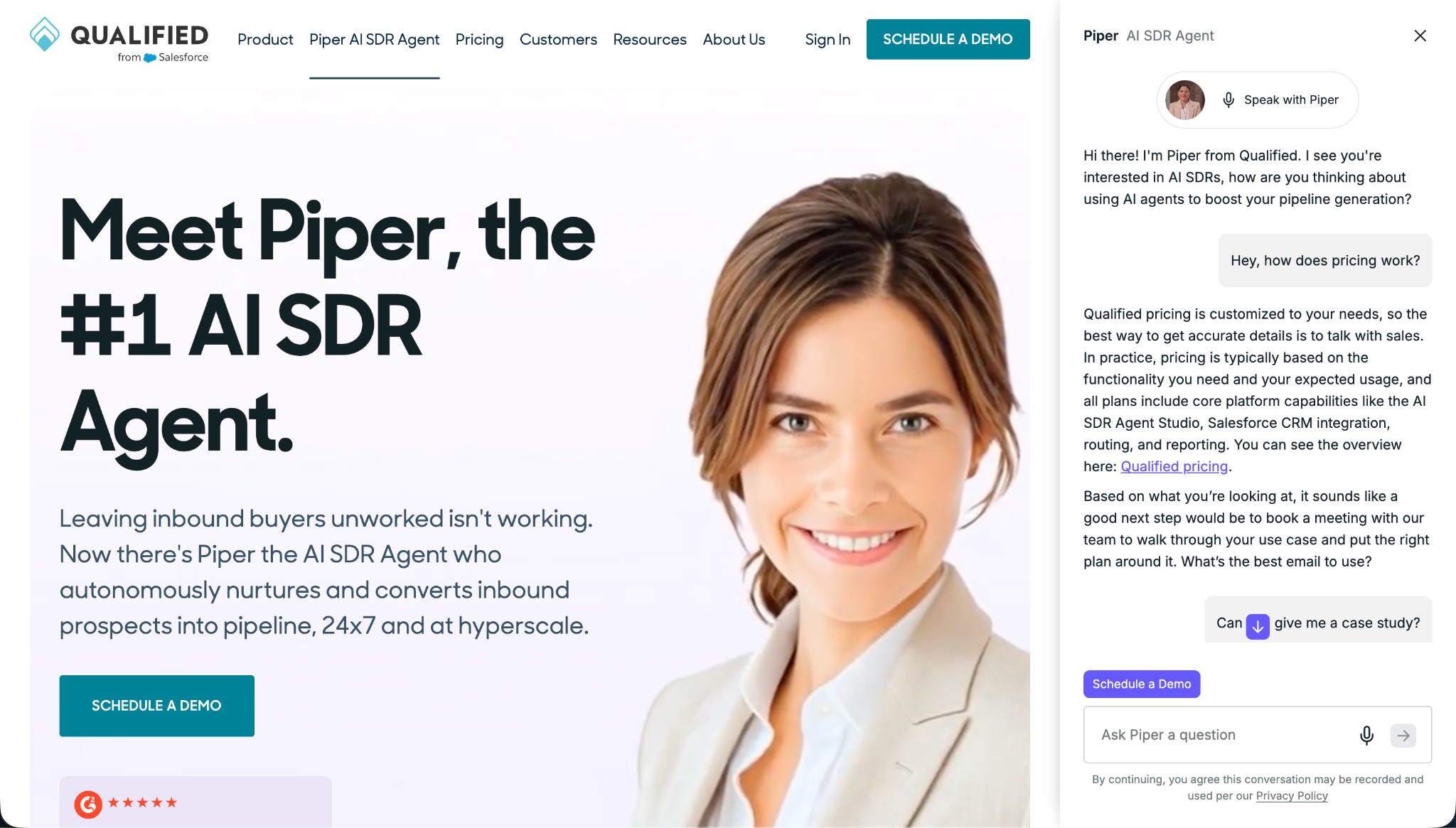
Pricing: quote-based. All three tiers (Premier, Enterprise, Ultimate) are "contact us".
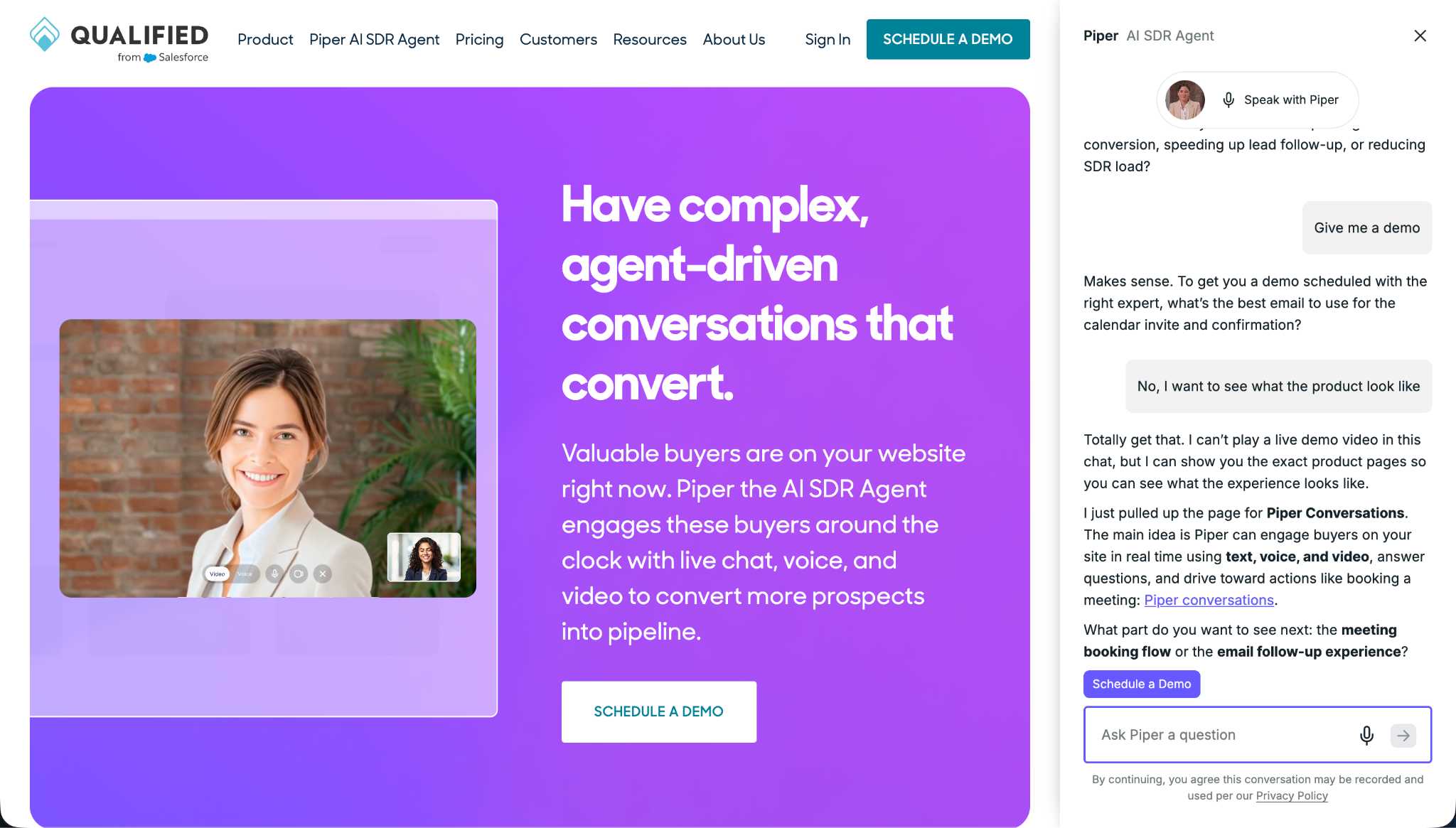
Where it falls short: it is an enterprise purchase with no public price, and it is strongest when Salesforce is the center of your revenue stack. Its focus is conversation, qualification and routing; if your buyers mostly want to see the product before they talk, check how much product proof it can show you in a trial.
Pick it if: you are a Salesforce-centric enterprise with meaningful inbound traffic and the budget for an annual platform contract. If you are weighing it against other options, see our Qualified alternatives roundup.
RepX by Storylane
RepX is Storylane's website agent. It talks with visitors in text, voice or video, answers product questions, asks your qualification questions, handles objections and books the meeting (or pushes a signup or trial, if that is the goal). You train it on your website, help docs, sales decks, call recordings and Storylane interactive demos (see how Storylane compares in our interactive demo software guide).
The difference is that it shows the product. When a visitor asks how something works, RepX pulls up the relevant interactive demo and walks through the real product inside the chat. Playbooks let each page run its own game plan, for example your pricing page books an AE while your docs page books support. You can set rules on what it will and will not say about pricing, competitors and compliance. Qualified leads and conversation summaries flow to HubSpot, Salesforce and Slack. Storylane's case study with Hospitable reports 36 meetings booked in RepX's first month.
Here is how a RepX agent is set up and trained:
Pricing: free for up to 2,000 visitors a month; paid plans start at $24K a year with Demo Suite and scheduling included. Price scales with traffic and the number of AI reps you run.
Pick it if: you have real traffic and your buyers want to see the product before they agree to a call.
Spara
Spara sells "a dedicated sales agent for every buyer" across chat, email, voice and text. It is mainly an inbound tool but also offers context-aware outbound. Its Growth plan adds voice, AI demos, visitor deanonymization and A/B testing on top of the Starter plan's chat, email and workflows.
Pricing: Starter $2,100/mo and Growth $3,750/mo, both billed annually; Enterprise is custom.
Where it falls short: voice and demos sit on the higher plan, so price the plan that has the features you actually evaluated.
Pick it if: you want one inbound agent that also follows up by email and text, with a published price to plan against.
Docket
Docket's AI marketing agent engages website visitors in voice, text, slide and video conversations, qualifies them, routes meetings and syncs to the CRM. Its answers come from what Docket calls the Sales Knowledge Lake, built from your CRM, call recordings and documentation. Higher tiers add video avatars, ABM targeting and custom personas per product line.
Pricing: Core from $4K/mo, Pro from $6K/mo, Enterprise from $10K/mo, all billed annually and priced by features rather than traffic or seats.
Where it falls short: the entry price is high for a team still testing whether website conversations convert for them.
Pick it if: you run active demand gen programs and want a knowledge-grounded agent with predictable feature-based pricing.
1mind
1mind builds photorealistic AI agents it calls Superhumans. Its use cases cover website inbound, riding along on live sales calls, in-product guidance and customer success.
Pricing: quote-based; no price is published on its site.
Where it falls short: a custom AI agent program needs implementation time and people to train and govern it, which is hard to justify on low-ACV deals.
Pick it if: you sell a complex, high-ACV product and want a lifelike agent to handle the first discovery conversation. If you are replacing Drift, our Drift alternatives guide compares 1mind with other options.
Signal-led tools: for following up on visitors who never fill a form
These tools identify who is on your site (at the person or company level) and act on it, through chat on the page and outreach afterwards. They need traffic to work: no visitors, no signal.
Breakout
Breakout's Signals plan covers visitor and company deanonymization, waterfall enrichment and buying group identification. The Growth plan adds an inbound AI SDR, rep hand-off, multichannel plays, real-time routing and alerting, and scheduling.
Pricing: Signals from $500/mo; Growth from $2K/mo; Enterprise is custom.
Pick it if: you have steady traffic, low form-fill rates and no SDR team to chase the visitors who leave.
Warmly
Warmly pairs person-level visitor identification with an Inbound Agent for on-site chat and a TAM Agent for outreach. On June 30, 2026, Warmly announced an agreement to be acquired by HubSpot; it says existing contracts, pricing and product stay unchanged, and it still sells under its own name.
Pricing: Inbound Chat $20,000/yr; AI Inbound Autopilot $30,000/yr; AI Web-Deanonymization alone $10,000/yr (annual billing).
Pick it if: you want identification, AI chat and follow-up from one vendor, especially if you run on HubSpot.
Scheduling-first teams also look at Chili Piper. Its Experiences plan includes Chat AI alongside routing and booking, from $42,000/yr. It fits when the real leak is between form and calendar, not the conversation itself. For other options in that space, see our Chili Piper chat alternatives.
Outbound AI SDRs: for creating conversations that do not exist yet
Outbound tools differ mainly on three things: where the contact data comes from, which channels they run (email only, LinkedIn, phone), and how much they protect your sending domains. All of them do better with a tight ICP and clean targeting than with a broad list.
11x (Alice and Julian)
11x sells AI "digital workers". Alice handles email and outbound prospecting, research and multichannel sequencing; Julian handles voice and inbound, turning form fills and incoming leads into meetings. Channels include voice, email, chat, social, SMS and WhatsApp.

Pricing: quote-based. Pick it if: you run high-volume outbound where phone is part of the motion and want enterprise support.
Artisan (Ava)
Artisan describes Ava as an AI BDR that finds and enriches B2B leads, writes and sends personalized outreach, handles replies and books meetings, with B2B data, enrichment, deliverability, sequencing, a dialer and intent signals in one platform.

Pricing: quote-based. Plans are sized by volume (Team around 2,500 leads contacted a month, Scale around 6,000), with pricing "scoped on your plan".
Where it falls short: consolidation means you are betting on one vendor's data for your segments. Test it on accounts you know well before scaling.
AiSDR
AiSDR runs outbound across email, LinkedIn (connection requests, DMs, InMail) and voice notes, with phone through an Aircall integration on team plans. It includes a lead database, email infrastructure and HubSpot and Salesforce integrations.
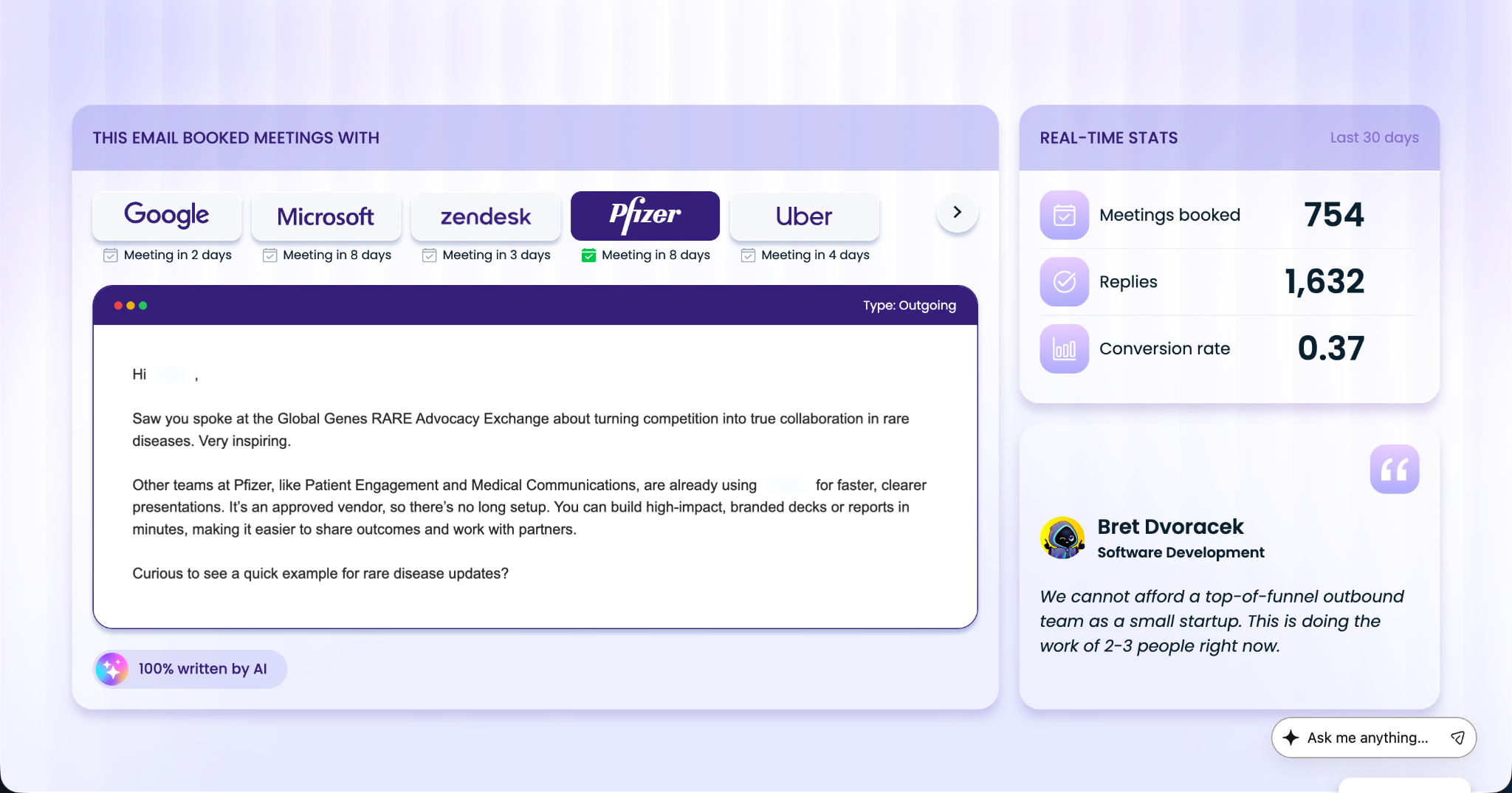
Pricing: pay as you go at $1.50 per person prospected, charged daily, plus $33/mo per warmed-up mailbox if you need one. Team plans for 1,000+ contacts a month are priced on a sales call.
Pick it if: you want to test outbound AI with a small budget and stop anytime.
Salesforge (Agent Frank)
Agent Frank is Salesforge's AI SDR: 24/7 automated prospecting in autopilot or co-pilot mode, a 500M+ contact database and 20+ languages, on a platform built around mailbox management.
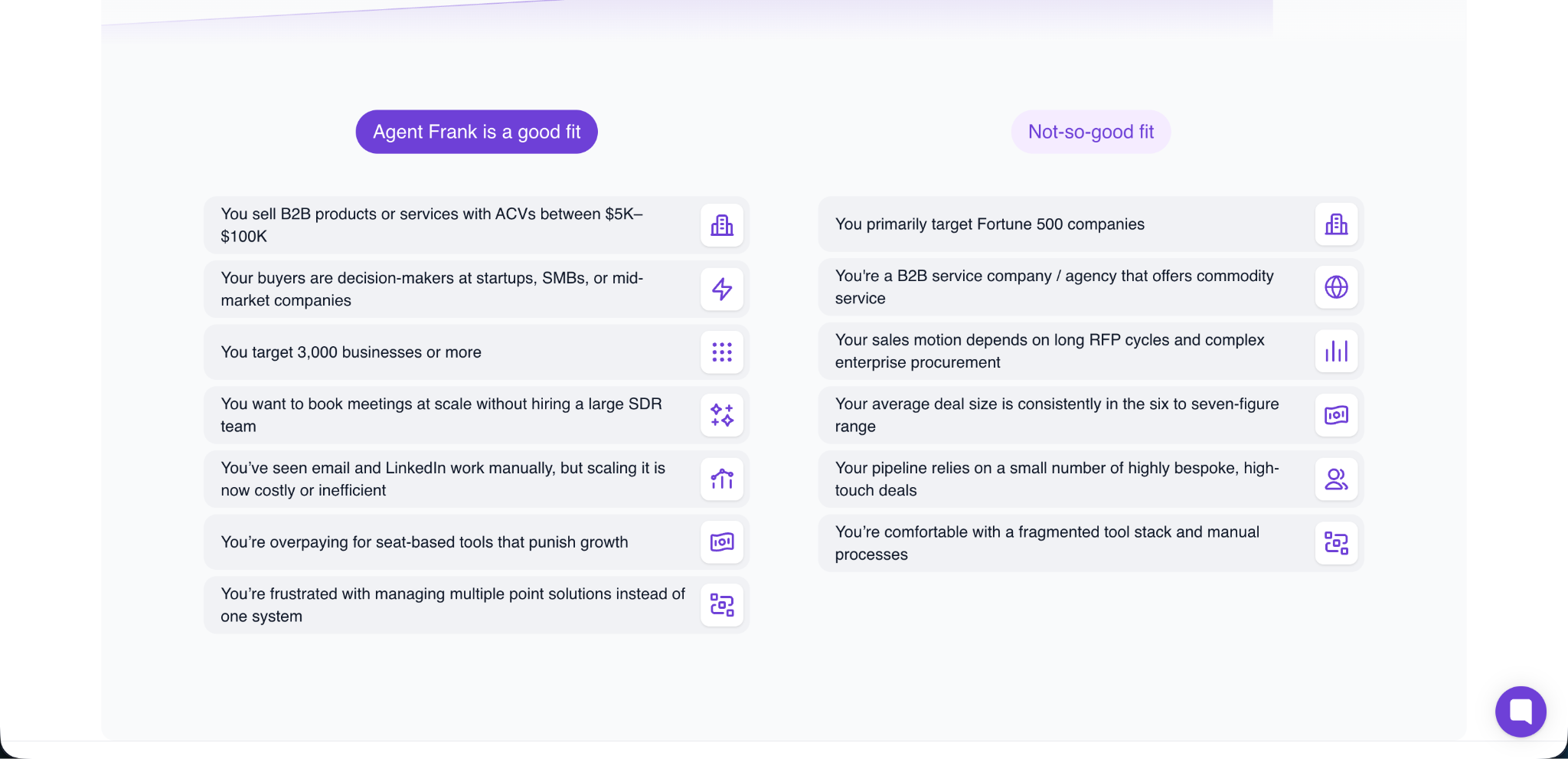
Pricing: $499/mo billed quarterly or annually. The human-run Pro and Growth plans start at $40/mo and $80/mo.
Pick it if: you run email-first outbound and inbox placement is your constraint.
Topo
Topo is an AI sales platform that runs outbound: finding in-market buyers, personalizing outreach and booking meetings, with email and LinkedIn sequences and a unified inbox. It is built for reps who want AI doing the research and drafting while they stay on the account.

Pricing: Solo $89 per seat/mo, Team $129 per seat/mo, Enterprise custom. A free trial is available.
How AI SDR pricing works, and what to model
The vendors above use four pricing models, and the cheapest sticker is often not the cheapest tool for your volume.
- Per contact prospected (AiSDR pay as you go): cost scales with how many people you reach. Model it on your real monthly list size.
- Per seat (Topo): cost scales with reps, not volume. Cheap for a small team running a lot of outbound.
- By traffic or AI reps (RepX): cost scales with monthly website visitors. Check what happens when a campaign spikes traffic.
- Annual platform fee by tier (Spara, Docket, Warmly, Chili Piper, and the quote-based tools): you pay for features. Ask which features the price you were quoted actually includes.
For a deeper look at seat-based vs outcome-based models, see AI sales agent pricing models.
How to run a fair AI SDR pilot
Demos of these tools all look good. A two-to-four-week pilot on your own traffic or list tells you more. Before you start:
- Agree the success metric up front. For inbound, qualified meetings booked from website conversations. For outbound, positive replies and meetings held, not emails sent.
- Train it on real material. Docs, objection handling, pricing rules and (for inbound) product demos. Then try to break it with the hardest questions your reps get.
- Test the handoff. Book a meeting yourself and check what lands in the CRM and how fast a rep is alerted.
- Read the transcripts. Wrong answers about pricing, security or integrations are the ones that cost you deals.
- Check guardrails. Can you control what it says about competitors and pricing, and review changes before they go live?
Our framework for measuring the ROI of AI SDRs covers the metrics in detail. If you are also deciding how much of the human SDR role to keep, see AI SDRs vs human SDRs, and for the non-AI side of the stack (dialers, data, sequencing), our general SDR tool stack guide.
Who RepX is best for
RepX is a website AI SDR. It belongs on your shortlist if you have meaningful traffic and your buyers want to see the product before they talk to sales, because it answers and qualifies with your real product on screen, built from the Storylane demos you may already have. The free tier up to 2,000 visitors a month lets a smaller team test it on live traffic.
Qualified leads and conversation summaries flow to HubSpot, Salesforce and Slack, so your reps pick up where RepX left off. Some teams run both an outbound AI SDR and a website agent, since outbound sends people to the site and the site has to convert them. To see RepX on your own site, book a demo.
FAQ
What is an AI SDR?
An AI SDR is software that does the first-touch work of a sales development rep: starting conversations, answering early questions, qualifying fit and booking meetings for account executives. Outbound AI SDRs prospect from contact lists; inbound AI SDRs work with visitors already on your website.
Which AI SDR is best for inbound leads?
Pick by stack and buyer. Qualified (Piper) suits Salesforce-centric enterprises, RepX by Storylane suits teams whose buyers want to see the product in the conversation, and Spara and Docket suit teams that want a knowledge-grounded agent with published annual pricing. For visitors who never fill a form, signal-led tools like Breakout and Warmly add identification and follow-up.
How much do AI SDR tools cost?
Published starting prices on vendor sites in October 2026 range from $1.50 per person prospected (AiSDR pay as you go) and $89 per seat a month (Topo) to $499 a month (Salesforge Agent Frank), $2,100 a month (Spara) and $20,000 a year (Warmly Inbound Chat). Qualified, 1mind, 11x and Artisan are quote-based. Model cost against your real list size or traffic, not the sticker price.
Do any AI SDR tools offer a free trial?
Some do. Topo offers a free trial, AiSDR's pay-as-you-go plan can be stopped anytime, and RepX is free for up to 2,000 website visitors a month. Enterprise tools such as Qualified and 1mind are sold through a sales process, so ask for a scoped pilot instead.
Are AI SDRs worth it?
They are worth it when they match the job. An outbound AI SDR pays off when you need more conversations with new accounts and have a tight ICP; an inbound one pays off when you have traffic that is not turning into meetings. Run a time-boxed pilot with a success metric agreed in advance before you sign an annual contract.
Sources
- Storylane RepX
- Qualified pricing and Salesforce newsroom: Qualified acquisition
- Spara pricing
- Docket pricing
- 1mind
- Breakout pricing
- Warmly pricing and Warmly: Warmly is joining HubSpot
- Chili Piper pricing
- 11x
- Artisan pricing
- AiSDR pricing page (aisdr.com/pricing)
- Salesforge pricing
- Topo pricing