
.svg)

Summary
Most teams hit HowdyGo's ceiling the same way: they share a demo, someone asks how it performed, and the answer is "we'd need the $399/mo plan to find out." Demo creation is table stakes. Knowing which demos convert (and which accounts are engaging) is the actual job. If you're paying for a demo platform without that visibility, here are 7 alternatives where that answer doesn't cost extra.
Why teams look for HowdyGo alternatives (+ evaluation criteria)
We compared these 7 platforms across demo formats, analytics depth, AI capabilities, integrations, security certifications, and pricing. Though demo automation is a rapidly evolving category, we keep updating our vendor articles every 90 days based on publicly available data as well as anonymized insights from customers we speak to.
Five patterns surface in G2 reviews and competitive evaluations when teams start looking beyond HowdyGo.
1. Analytics are gated behind a $399/mo paywall
HowdyGo's Starter plan ($159/mo annual, $199/mo monthly) covers demo creation but locks funnel visualization, engagement tracking, and drop-off analytics behind the Pro plan at $399/mo (annual) or $499/mo (monthly). For context, Storylane includes analytics and Account Reveal starting at $40/mo (annual).
A Storylane study of 110,257 web sessions found interactive demos convert at 24.35% vs. a 3.05% baseline: a 7.9x improvement. Teams that cannot measure this because analytics are paywalled are flying blind on their highest-converting channel.
2. No published SOC 2 Type 2 certification
Enterprise procurement teams require SOC 2 Type 2 before approving vendors that touch customer data. HowdyGo has not published this certification. For teams selling into regulated industries or enterprises with formal vendor security reviews, this is a disqualifier.
3. Missing features that scaling teams need
HowdyGo does not offer Account Reveal, A/B testing, AI video avatars, or MAP integrations (Marketo, Pardot). Role-based access control is Enterprise-only. Teams that need to tie demo engagement to pipeline or manage permissions across departments hit a ceiling.
4. No AI sales agent or deal room capability
As demo platforms evolve into revenue platforms, teams need capabilities beyond static demo links. HowdyGo does not offer an AI agent that qualifies website visitors or branded deal rooms where champions can share demos alongside ROI data and security documentation with buying committees.
5. Unlimited users loses its edge at scale
HowdyGo's unlimited-user pricing ($159/mo Starter, $399/mo Pro) is compelling for small teams. But once Pro-tier features become necessary, the gap with full-featured platforms narrows: Storylane Growth at $500/mo (annual) includes 5 seats, HTML demos, A/B testing, personalization tokens, and a dedicated CSM.
What HowdyGo is
HowdyGo is a bootstrapped, founder-owned interactive demo platform built in Australia. Its core proposition is simplicity: a Chrome extension captures web products and produces three outputs from a single recording (interactive demo, video, and GIF). All plans include unlimited users with no per-seat charges.
The platform targets small-to-mid-size B2B SaaS teams that need polished product walkthroughs without enterprise complexity. G2 reviewers consistently praise the hands-on support from the founding team, the speed of demo creation, and the cinematic video quality from auto-progression and zoom/pan features.
HowdyGo prices on features, not seats: Starter at $159/mo (annual), Pro at $399/mo (annual), and Enterprise at custom pricing. There is no free plan; a 14-day trial is available.
The 7 best HowdyGo alternatives
1. Storylane
Best for: B2B SaaS teams from seed stage through enterprise that need a complete demo platform across marketing, sales, and presales.
Storylane runs two product lines: Demo Suite (interactive demos, sandbox demos, and Hubs for multi-format buyer enablement) and RepX (an AI sales agent that qualifies website visitors and routes high-intent signals to sales). For teams leaving HowdyGo, the sharpest difference is access: analytics and Account Reveal start at $40/mo (annual) , HowdyGo gates them behind the $399/mo Pro tier. Prospects who engage with interactive demos convert at 3.2x the rate of those who don't (10.1% vs. 3.1%). Being able to measure that from day one changes what's possible.
Where Storylane wins:
- Analytics + Account Reveal from Starter ($40/mo annual) , not locked behind a $399/mo paywall
- RepX: AI sales agent qualifying visitors 24/7 and surfacing intent signals
- Hubs: deal rooms with multi-format content, ghost stakeholder detection, and Deal Intelligence
- A/B testing on Growth tier ($500/mo annual)
- AI voiceovers in 25+ languages with 50+ voices, AI video avatars, AI demo creation. Phenom built 35 demos in 3 weeks using these features for a flagship tradeshow
- SOC 2 Type 2 certified; GDPR compliant
- 5,000+ customers including HubSpot, Microsoft, Okta, Palo Alto Networks, Gong
This is what a Director of Product Marketing at a cybersecurity SaaS company had to say about Storylane's analytics.
"We can see exactly which screens are getting people stuck or where they're dropping off. That kind of insight doesn't exist when you're just sending a link,"
Honest tradeoff: Storylane doesn't spin up code-level environments (that's Reprise) or inject live data into your product during SE calls (that's Saleo). If screen recordings without interactivity are all you need, Loom is free.
G2 rating: 4.8/5 across 1,405 reviews. #1 in Demo Automation with a G2 Satisfaction Score of 99/100. Ease of Use: 9.3. Ease of Setup: 9.4. Quality of Support: 9.3.
Pricing: Free; Starter $40/mo annual ($50/mo monthly); Growth $500/mo annual ($625/mo monthly), 5 seats; Premium $1,200/mo annual ($1,500/mo monthly), 10 seats; Enterprise custom.
2. Supademo
Best for: Product-led startups and small marketing teams that need polished demos quickly with minimal budget.

Supademo was the fifth fastest-growing software product on G2 in 2025, built around speed and accessibility. The free plan includes 5 demos with unlimited views; paid plans start at $38/mo (annual) per creator.
The platform supports screenshot, HTML, video walkthrough, and Figma import formats. AI voiceovers cover 15 languages, and AI Demo Audit analyzes engagement drop-off points to recommend structural improvements. The editor is lightweight and fast: teams can go from Chrome extension capture to published demo in minutes.
Where Supademo differentiates from HowdyGo is the free plan (HowdyGo has none) and the lower paid entry ($38/mo vs. $159/mo). For teams that want to test interactive demos before committing budget, Supademo removes the financial barrier.
Where Supademo wins:
- Free plan with 5 demos (HowdyGo has no free plan)
- AI voiceovers in 50 languages from the Scale plan ($38/mo annual)
- AI Demo Audit for engagement optimization
- Figma import for design-led teams
- Per-creator pricing scales predictably
One CEO at a B2B SaaS startup noted Supademo's aggressive pricing:
"Supademo came in with better pricing for sure. Their list pricing was already lower, and then they knocked another 30% off."
Another CEO captured the tradeoff:
"Supademo, being a bit of a smaller company, that is a bit of a risk. On the other side, when we had feedback or challenges, they were really good at having quick access to the team and making adjustments."
Honest tradeoff: Honest tradeoff: Supademo does not offer Account Reveal (company identification), Deal Intelligence (pipeline connection), or RepX-level AI agent capabilities. Route Hub (launched April 2026) provides multi-format content but without deal-level intelligence. Analytics are present but less granular than Storylane or Navattic. The platform is optimized for product-led motions and marketing-led pipeline; sales-led teams that need deal intelligence, presenter tools, or CRM depth will outgrow it. SSO requires the Enterprise plan.
G2 rating: 4.7/5 across 617 reviews.
Pricing: Free (1 creator, 5 demos); Scale $38/mo annual ($50/mo monthly) per creator; Growth $350/mo annual ($450/mo monthly), 5 creators; Enterprise custom.
3. Navattic
Best for: Marketing teams running account-based campaigns that need HTML demos feeding ABM workflows with intent data.

Navattic’s strength is its ABM integration layer: demo intent data, account identification, engagement signals, and LaunchPad (a workspace for managing account-level demo experiences). Buyer circle discovery on the Growth plan reveals which stakeholders from a target account are engaging with demos.
For teams leaving HowdyGo because they need to connect demo engagement to ABM campaigns and account-level pipeline tracking, Navattic is the most focused solution.
Where Navattic wins:
- Deep ABM workflow integration with account-level intent signals
- LaunchPad workspace for managing demos by account
- Buyer circle discovery (Growth plan) for multi-stakeholder deals
- Free plan with 1 HTML or media demo
- AI Copilot for demo creation across all tiers
Honest tradeoff: Navattic supports video demos and sandbox demos but focuses primarily on HTML demos for marketing teams. LaunchPad adds sales functionality, though the platform remains marketing-first. No AI video avatars or Hubs equivalent. The minimum paid plan is $500/mo (annual, billed quarterly or annually; no monthly option), which is a significant jump from HowdyGo's $159/mo Starter. If your team needs video walkthroughs, sales-specific features, or a broader platform spanning marketing and sales, Navattic's narrow focus becomes a limitation.
As one GTM leader at an AI-powered hardware startup put it about competitors moving upmarket:
"Where they have their biggest gap is going upmarket; they haven't yet climbed that ladder to work with the Fortune 1000s."
Navattic's marketing focus means similar scaling questions apply for sales-heavy organizations.
G2 rating: 4.8/5 across 914+ reviews.
Pricing: Free (1 demo); Base $500/mo annual (or $600/mo quarterly), 5 seats; Growth $1,000/mo annual, 10 seats; Enterprise custom. No monthly billing option.
4. Saleo
Best for: SE teams whose primary pain is showing realistic, prospect-specific data in live product demos.
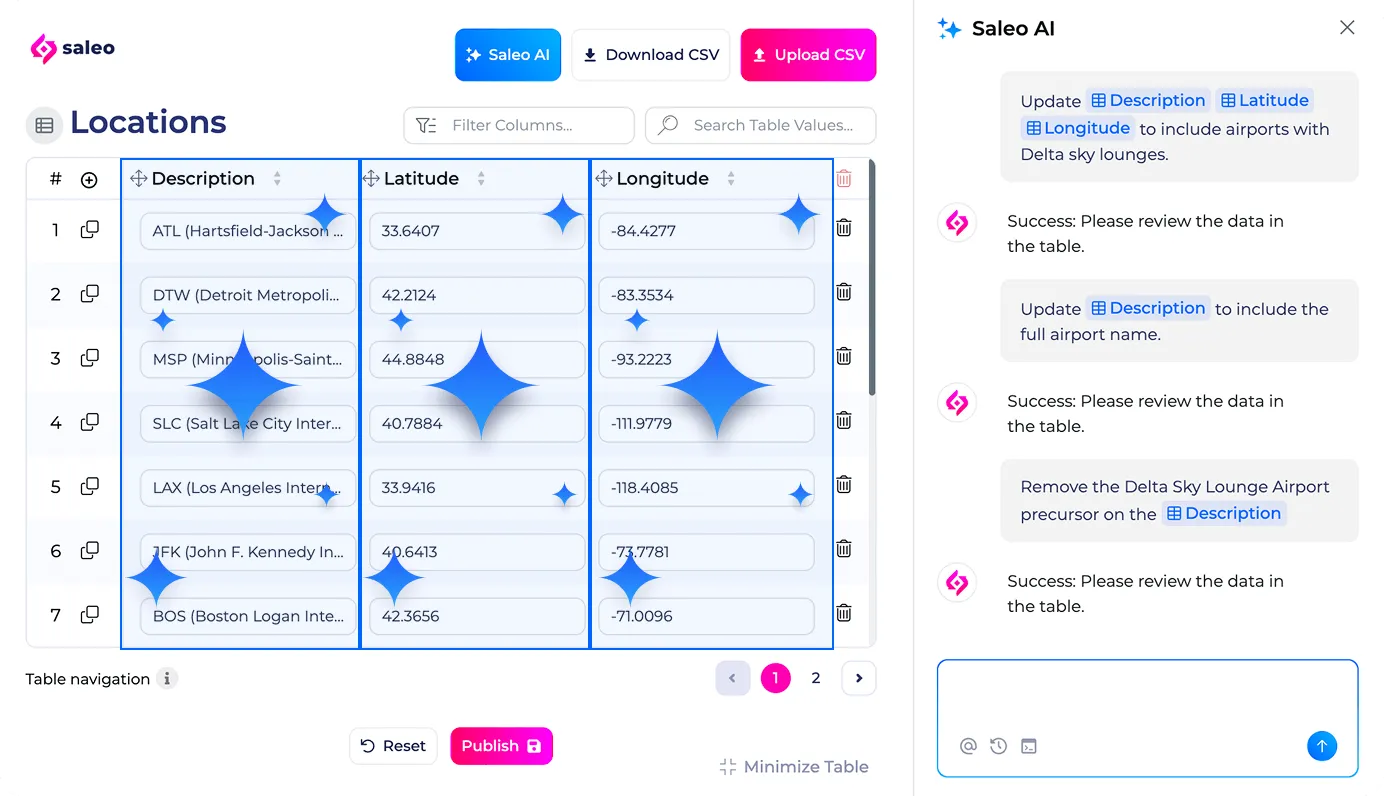
Saleo occupies a different product category than HowdyGo. Rather than creating standalone interactive demos, Saleo injects realistic demo data directly into your live product via a Chrome extension. SEs can show prospect-specific data (company names, deal sizes, industry metrics) without production database access or engineering support.
The platform's AI Data Creation Agent generates realistic datasets from text prompts, removing the manual data preparation that eats SE hours before every call. Saleo is the only platform in the demo automation category with ISO 27001 certification, making it the compliance leader for teams in regulated industries.
Where Saleo wins:
- Live data injection into real product (no cloned environment needed)
- ISO 27001 certified (unique in the category)
- AI Data Creation Agent for realistic demo datasets
- SE-controlled: no engineering dependencies for demo data
- SOC 2 Type 2 certified
Honest tradeoff: Saleo is enterprise-only with custom pricing typically ranging from $20,000 to $60,000+/year. There is no self-serve entry, no free trial, and no published pricing. If your team's problem is not specifically "our live demos show garbage data," the cost and complexity are not justified. Saleo only recently lauched their interactive demo line and isn't their main offering, It does not offer a free or low-cost plan, and requires more implementation effort than screenshot or HTML-based demo tools.
G2 rating: 4.9/5 across 222 reviews.
Pricing: Enterprise-only, custom. Typical range: $20,000 to $60,000+/year. No self-serve entry.
5. Reprise
Best for: Enterprise teams with complex products that require code-level demo environments supporting real data manipulation.

Reprise serves large enterprises like Databricks and ServiceNow. Its primary differentiator is Replicate: a full code-level product clone supporting complex interactions, dynamic data manipulation, and freeform user exploration, a functional copy of the product on dedicated CDN infrastructure, not a screenshot overlay.
The platform also includes Reveal (live demo overlay for SE calls) and Replay (guided HTML tours). For products involving complex backend workflows or multi-step data processes that screenshot and HTML demos cannot handle, Reprise is the only platform that goes deep enough.
Where Reprise wins:
- Replicate: code-level product clone with real data manipulation
- Freeform user interaction (not guided-only)
- Reveal: live overlay for SE calls with real-time annotations
- Dedicated CDN infrastructure for concurrent demo users
- Enterprise-grade: purpose-built for complex, technical products
Honest tradeoff: Reprise carries a 4.4/5 G2 rating across 174 reviews, the lowest among the platforms on this list. G2 reviewers cite slow performance, steep learning curves, buggy rendering, and difficulty handling off-script questions. The platform requires significant engineering resources for implementation; this is not a marketer-friendly self-serve tool. Pricing is enterprise-only, typically $30,000 to $80,000+/year with no free plan or self-serve option. For teams that do not genuinely need code-level environments, simpler platforms deliver better outcomes with less friction.
G2 rating: 4.4/5 across 174 reviews.
Pricing: Enterprise-only, custom. Typical range: $30,000 to $80,000+/year. No free plan.
6. Consensus
Best for: Large enterprise teams that need granular role-based access controls and video-first demo distribution.
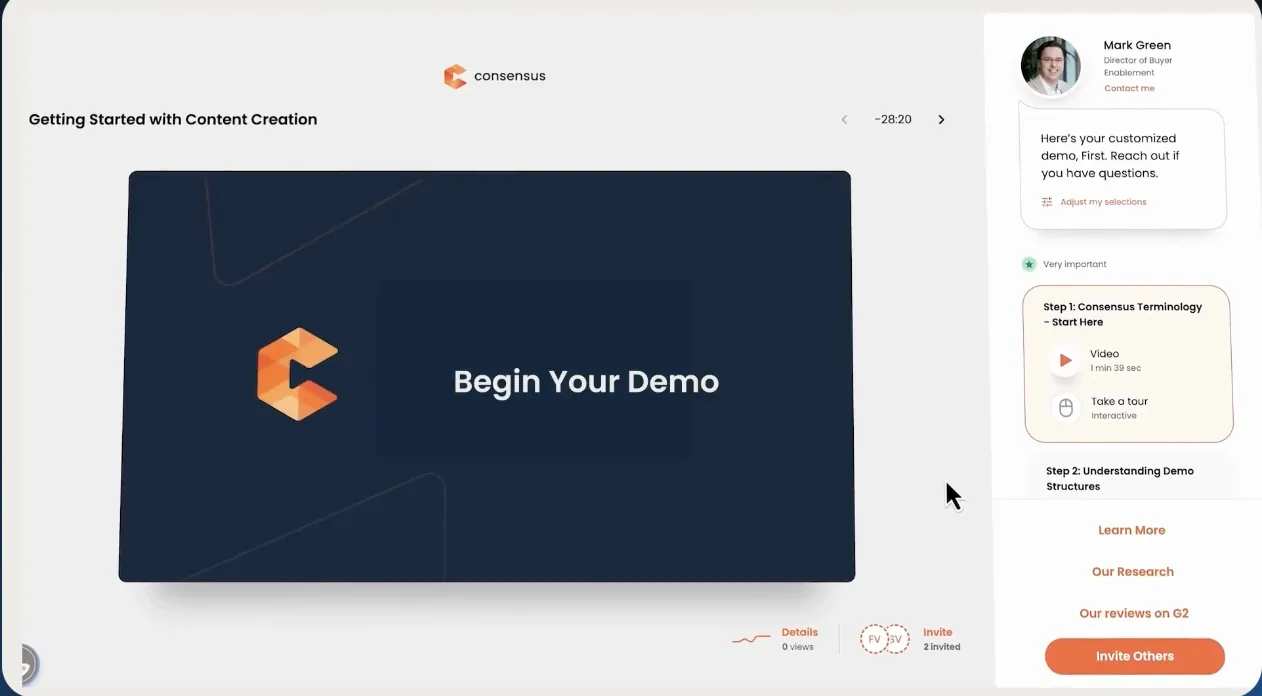
Consensus has a decade-long track record in demo automation, originally built around video-based demo distribution. The platform's standout capability is its enterprise access management: 8 pre-defined system roles plus customizable roles, and a Group Hierarchy system that controls demo access across teams, regions, and partner channels. For organizations where "who can see what demo" is a compliance or governance requirement, Consensus has the deepest controls.
The platform recently expanded beyond video with interactive demo capabilities and AI Content Studio (powered by Trupeer) for polished video production. Demolytics provides buying committee intelligence: tracking which stakeholders view demos, how long they watch, and which sections they revisit.
Where Consensus wins:
- Granular role-based access: 8 system roles + custom roles + Group Hierarchy
- Demolytics: buying committee intelligence with stakeholder-level engagement data
- Deep Salesforce integration with opportunity-level demo tracking
- AI Content Studio for polished video production
- G2 Top 5 Sales Software 2026 (only demo automation platform on the list)
Honest tradeoff: Consensus starts at $600/mo on an annual-only commitment with no monthly billing option. G2 reviewers report inconsistent user experience, authentication errors with external sharing, and SSO restricted to the Enterprise tier. The video-first architecture means interactive demo capabilities are a recent addition, not the platform's core strength. For teams primarily needing screenshot or HTML demos with fast creation workflows, Consensus adds cost and complexity without proportional value.
G2 rating: 4.7/5 across 1,700 reviews.
Pricing: Starter $600/mo annual only; Pro $1,250/mo annual only; Enterprise custom. No monthly billing option.
7. Loom
Best for: Teams using screen recordings to show their product today, before graduating to interactive demos.
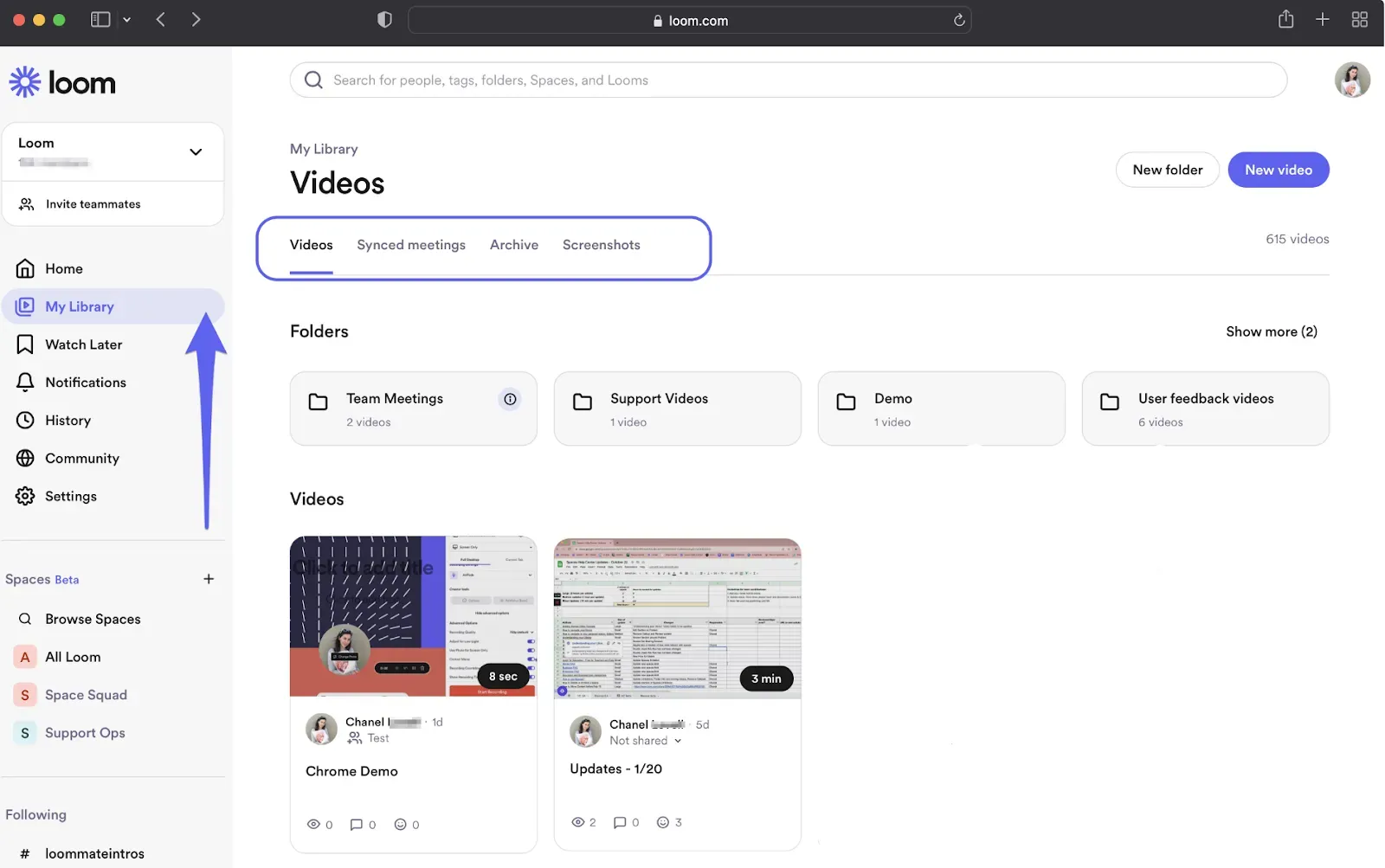
Loom is the best screen recording tool: free, zero learning curve, and effective for async product walkthroughs. Screen recordings are a legitimate starting point and plenty of teams close deals with a well-narrated video.
The ceiling arrives when you need to measure what happens. Screen recordings are passive. Once you need step-level analytics, lead capture, or account-level personalization, Loom won’t solve your requirement. Storylane's free plan (1 demo, no time limit) lets you run both in parallel and compare.
Where Loom wins:
- Free plan with generous recording limits (25 looms)
- Zero learning curve: record, share, done
- Strong async communication features (comments, reactions, tasks)
- Integrations with Slack, Notion, Jira, and most productivity tools
- AI-powered summaries and transcriptions
Honest tradeoff: Loom does not offer interactive demos, step-level analytics (completion rates, engagement by step, drop-off points), lead capture forms, CRM integrations for demo data, Account Reveal, A/B testing, or any of the capabilities that define the interactive demo category. It is not designed to be an interactive demo platform and should not be evaluated as one. But, Loom IS the best screen recording tool.
G2 rating: 4.7/5
Pricing: Free plan available. Business plan at $15/user/mo. Enterprise at custom pricing.
Comparison matrix
How to Choose the best HowdyGo Alternative
Start with the problem, not the feature list.
"We need analytics on our demos and cannot afford $399/mo for HowdyGo Pro."
Storylane's Starter plan ($40/mo annual) includes analytics and Account Reveal. Supademo's Scale plan ($38/mo annual) includes tracking and analytics. Both solve the analytics gap at a fraction of HowdyGo's Pro pricing.
"We need to connect demo engagement to ABM campaigns."
Storylane's Account Reveal and Deal Intelligence (Premium tier) also serve this need with broader platform capabilities. Navattic is also great for this as you get account-level intent data, buyer circle discovery, and ABM workflow integrations
"Our SEs need to show realistic prospect-specific data in live demos."
This is Saleo's exact use case. No other platform on this list injects live data into your actual product. But if this is not your specific problem, Saleo's $20,000+ annual cost is not justified.
"Our product is too complex for screenshot or HTML demos."
Reprise's Replicate is the only platform that creates code-level product clones. But it requires engineering resources and $30,000+/year. Storylane's Sandbox Demos (Enterprise tier) cover many complex product scenarios without the same implementation overhead.
"We need to control who sees which demos across global teams."
Consensus has the deepest role-based access controls in the category: 8 system roles, custom roles, and Group Hierarchy.
"We are still using screen recordings to show our product."
Loom is free and effective for that. But when you need to get into serious demoing business, you need to invest in demo automation tools. When you are ready to measure what prospects actually engage with, start with Storylane free plan and compare conversion rates on the same audience.
The bottom line
HowdyGo does what it does well: simple HTML demo creation with unlimited users and a tight feedback loop from a founder-led team. For small teams with straightforward needs, it delivers.
But teams outgrow it for predictable reasons. Analytics behind a $399/mo paywall means you cannot measure the ROI of your highest-converting channel. No SOC 2 certification means enterprise procurement teams flag it. No AI sales agent, no deal rooms, no Account Reveal means the platform stops at "create and share" when modern buyers expect "engage, qualify, and close."
For most teams leaving HowdyGo, Storylane is the natural next step: analytics from day one at $40/mo (annual), SOC 2 Type 2 certified, and a platform that spans marketing, sales, and presales without requiring three different tools. Start with the free plan and compare side-by-side.
Frequently asked questions - HowdyGo Alternatives
Q: Does HowdyGo have a free plan?
A: No. HowdyGo offers a 14-day free trial but no permanent free plan. Storylane and Supademo both offer free plans (1 demo and 5 demos, respectively) with no time limit.
Q: Can HowdyGo create HTML demos?
A: Yes. HowdyGo includes HTML demo capture from its Starter plan ($159/mo annual), which is cheaper than Storylane's HTML tier (Growth at $500/mo annual). If HTML demos are your only requirement, HowdyGo offers a lower entry price.
Q: Is HowdyGo SOC 2 certified?
A: HowdyGo hasn't published a SOC 2 Type 2 certification as of May 2026. Storylane, Supademo, Navattic, Reprise, Consensus, and Saleo all hold SOC 2 Type 2 certification.
Q: What is the biggest difference between HowdyGo and Storylane?
A: Platform depth. HowdyGo excels at demo creation with unlimited users. Storylane adds analytics from its $40/mo plan, Account Reveal, A/B testing, Hubs (branded deal rooms), RepX (AI sales agent), Deal Intelligence, Presenter Mode, SOC 2 Type 2 certification, and scales from a free plan through enterprise.
Q: Which HowdyGo alternative is cheapest?
A: For paid plans, Supademo Scale starts at $38/mo (annual) and Storylane Starter at $40/mo (annual). Both include analytics. For free usage, Storylane's free plan (1 demo) and Supademo's free plan (5 demos) have no time limit.
Q: Which alternative is best for enterprise teams?
A: Depends on the need. For broad demo capabilities with security certifications: Storylane (SOC 2 Type 2, GDPR). For code-level product environments: Reprise. For granular role-based access: Consensus. For ISO 27001 compliance: Saleo (only platform in the category with this certification).
Q: Does any alternative match HowdyGo's unlimited users pricing?
A: No. But a team of 5 on Storylane Growth ($500/mo annual) gets analytics, HTML demos, A/B testing, and a dedicated CSM , capabilities that require HowdyGo's $399/mo Pro plan, without the analytics depth.
Ready to see the difference?
Try Storylane free: create your first interactive demo in minutes. No credit card required.
Or book a demo: see Hubs, RepX, and Deal Intelligence in action with your team.