
.svg)

Summary
Supademo is a credible interactive demo platform: 4.7 on G2 across 607 reviews, ranked #4 in Demo Automation, and G2's fifth fastest-growing software product in 2025. They've shipped fast over the last 18 months: HTML/CSS demos went GA in late 2024, sandbox capabilities, conditional branching, In-App Demo Hub, and AI features have all rolled out. Buyers don't usually leave Supademo because they regret choosing it. They leave because they outgrow it. The seven strongest alternatives in 2026 are Storylane, Navattic, Arcade, Guideflow, Consensus, Walnut, and HowdyGo. Storylane is the broadest fit for B2B SaaS GTM teams that have outgrown SMB-tier tooling: ranked #1 in Demo Automation on G2 with 1,405 reviews, two product lines (Demo Suite and RepX), enterprise customers including HubSpot, Microsoft, Okta, and Palo Alto Networks, and a live AI sales agent (RepX) that no current Supademo product matches.
| # | Platform | Best for | G2 rating | Starting price |
|---|---|---|---|---|
| 1 | Storylane | Teams that have outgrown Supademo and need enterprise depth, RepX live AI sales agent, and broader AI suite | 4.8 (1,405 reviews) | Free + $40/mo Starter |
| 2 | Navattic | HTML-first marketing teams with mature commenting workflows | 4.8 (893 reviews) | Free + $500/mo Base |
| 3 | Arcade | Design-led marketing teams running screenshot demos for brand and PLG | 4.6 (varies) | Free + $32/user/mo Pro |
| 4 | Guideflow | Product and onboarding teams primarily building guided product tours | 4.6 (varies) | Free + $35/mo Solo |
| 5 | Consensus | Enterprise sales teams running video-first demo programs | 4.7 (1,689 reviews) | Custom (~$7,200/yr Starter) |
| 6 | Walnut | Sales-led teams with HTML demo programs and existing Walnut investment | 4.5 (151 reviews) | $9,000/yr Starter |
| 7 | HowdyGo | Small teams that want HTML demos at flat-rate unlimited-user pricing | 4.9 (83 reviews) | $159/mo Starter |
A note on perspective: I've spent serious time evaluating Supademo, both as a competitor in deals and as a product to study. What follows is the honest breakdown of where Supademo fits in 2026, where teams typically outgrow it, and which alternatives I'd point you toward depending on what you're trying to solve.
Already decided Storylane is the switch? Read the full Supademo to Storylane migration guide.
Why look for a Supademo alternative
Supademo has a deserved reputation as the SMB-friendly entry point for interactive demos. They have a real free tier, a self-serve trial without a sales call, and pricing that starts at $38/creator/mo. They were G2's fifth fastest-growing software product in 2025 for a reason: the team has shipped fast over the last 18 months, including HTML/CSS demos (GA late 2024), conditional branching, sandbox capabilities, an In-App Demo Hub, and an expanding AI suite.
So why are buyers actively comparing alternatives in 2026? In conversations I've had with prospects evaluating both, four themes have come up consistently.
1. The product depth gap is real but qualitative, not categorical. Supademo has shipped most of the headline features that Storylane has, including HTML demos, sandboxes, hubs, and AI voiceovers. Where buyers feel the difference is in polish and execution depth. As a senior solutions engineer at a mid-market tech company put it during a recent evaluation:
"I looked at Supademo too, and they were okay. But I really liked your interface. I can see the differentiator with yours versus the others. It's just like they're kind of missing teeth, right?"
The "missing teeth" framing came from the prospect, not from us. It captures the qualitative difference better than any feature checklist.
"It's super easy to get started. It really takes you less than 10 minutes to create the first demo. We noticed that prospects prefer this way of interaction." - Ebba Nordlung, HR Manager, Aurium Consulting (51-200 employees) - Switched from Supademo | G2
2. Supademo's customer base concentrates at SMB and startups. Their named customers include Turo, beehiiv, and Bullhorn: strong in product-led, high-velocity SaaS. Less common: Fortune 1000 enterprises with heavy procurement processes, dedicated SE teams, and complex governance requirements. Per a Storylane Demo Strategist explaining the gap to an enterprise prospect on a recent call:
"Supademo is the newest entrant in the group, and they are the smallest. They come from a background of screenshot and video demos. They're a much smaller team focused on startups. When you look at Supademo, they do a really good job on the lower end of the market, but they struggle with enterprise logos and offering more advanced features."
3. There's no live AI sales agent in the Supademo product. Storylane shipped RepX (a conversational AI sales agent that runs on your website, qualifies inbound visitors via voice, video, and text, and books meetings) as the first live AI sales agent in the demo automation category. Supademo has not shipped a comparable product as of this writing.
4. Buyers anchor Supademo as the budget tier in their evaluation. The price perception is real. This isn't a complaint about Supademo's pricing being too high. It's the opposite: Supademo is consistently the price anchor, and buyers comparing alternatives are asking whether a more substantial platform justifies the difference. For some buyers it does. For others it doesn't.
What Supademo is
Supademo is an interactive demo platform built for accessibility and rapid iteration. They're rated 4.7 on G2 across 607 reviews, ranked #4 in Demo Automation, and were named G2's fifth fastest-growing software product in 2025. The product surface includes HTML/CSS demos (GA since late 2024), screenshot demos, video walkthroughs, Figma plugin imports, multi-demo Showcases, an In-App Demo Hub for triggering demos as in-app modals, conditional branching, dynamic variables, AI voiceovers, AI Demo Audit (a feature that scores demos and flags drop-off risk), and translations into 15 languages.
Pricing is per-creator: Free tier, Pro at $38/creator/mo, and Scale/Enterprise requiring sales conversation (typically $50+/creator/mo for teams of 25+). Supademo offers a 14-day free trial with no credit card required.
Supademo is a strong choice for solo creators, SMB teams, and product-led startups looking for accessible interactive demos with a fast iteration cycle. The places where buyers look for alternatives: enterprise readiness perception, polish in the demo viewing experience, broader AI capabilities, and the absence of a live AI sales agent.
How we evaluated alternatives
We evaluated each platform on seven dimensions: demo format support, pricing accessibility, AI capability completeness, GTM versatility (SMB-focused vs cross-functional vs enterprise), customer reviews and G2 reputation, native integrations, and where each platform falls short. Every alternative below gets an honest tradeoff section, not a sales pitch.
Pricing is verified against vendors' current public pricing pages where available. G2 ratings reflect data verified May 6, 2026. Where pricing is enterprise-only and not publicly listed, we say so explicitly.
The 7 best Supademo alternatives in 2026
1. Storylane: best overall Supademo alternative
Best for: B2B SaaS marketing, sales, and pre-sales teams that have outgrown SMB-tier tooling and need enterprise depth, broader AI capabilities, and a live AI sales agent.
Storylane is our product. I work on it. The honest tradeoff at the end of this section is where I cover what Supademo does better than we do. Storylane is the #1 ranked demo automation platform on G2 with a Satisfaction Score of 99 across 1,405 reviews. The product spans two product lines.
Demo Suite is the demo creation and distribution platform: HTML, screenshot, and video demos built in a unified editor; Sandbox Demos for code-free interactive product environments; and Hubs for multi-format buyer experiences combining demos, PDFs, videos, and embeds in one shareable surface. The Demo Suite ships with a full AI capability set: AI voiceovers (with in-app voice recording, not just TTS), AI video avatars in production, AI content generation, video-to-demo capture, and translations into 25+ languages.
RepX is the live, multimodal AI sales agent. RepX runs on your website, qualifies inbound visitors via real conversation across voice, video, and text, surfaces case studies and pricing alongside demos, and books meetings with sales-ready prospects. It's trained on your product documentation, sales call recordings, and GTM collateral.
5,000+ customers use Storylane, including HubSpot, Microsoft, Okta, Palo Alto Networks, SentinelOne, Silicon Valley Bank, and Gong. SOC 2 Type 2 and GDPR compliant. A quarter of Storylane's workforce is in support and customer success; onboarding and 24x7 support are included on every paid plan.
Where Storylane wins (vs Supademo):
- Live AI sales agent (RepX): no Supademo equivalent as of this writing
- 1,405 G2 reviews and #1 ranking vs Supademo's 607 reviews and #4 ranking (2.3x review base)
- Enterprise customer footprint: HubSpot, Microsoft, Okta, Palo Alto Networks vs Supademo's SMB/startup concentration
- AI suite breadth: in-app voice recording for voiceovers + AI video avatars in production
- Native Salesforce App and full Salesforce CRM integration depth
- Built-for-Sales features at Premium ($1,200/mo): Presenter Demos, Deal Intelligence, Offline Demos
- Polish and enterprise readiness in the demo viewing experience (per recurring prospect feedback)
Honest tradeoff: Supademo's pricing is more flexible than Storylane's at small team sizes. Their per-creator pricing model (vs Storylane's per-additional-seat structure) can be cheaper if you have one or two heavy creators and many viewers. Supademo also includes sandbox demo capabilities at lower paid tiers, while Storylane positions sandbox at the Enterprise tier. Storylane's sandboxes are reportedly smoother and easier to build, but the tier-gating is real and matters at mid-market price points. Supademo also ships AI Demo Audit, a feature that scores demos and flags drop-off risk, that Storylane doesn't currently have.
"Storylane's by far the easiest and most reliable out of other competitors." - Martin Kurowski, Product Marketing Manager, Rockwell Automation
G2 rating: 4.8/5 (1,405 reviews), ranked #1 in Demo Automation, Satisfaction Score 99/100.
Pricing: Free, Starter $40/mo, Growth $500/mo, Premium $1,200/mo, Enterprise custom. 20% discount on annual billing.
2. Navattic: best for HTML-first marketing teams with mature commenting workflows
Best for: Marketing teams that build website-embedded HTML demos and prioritize native commenting and HTML capture polish.
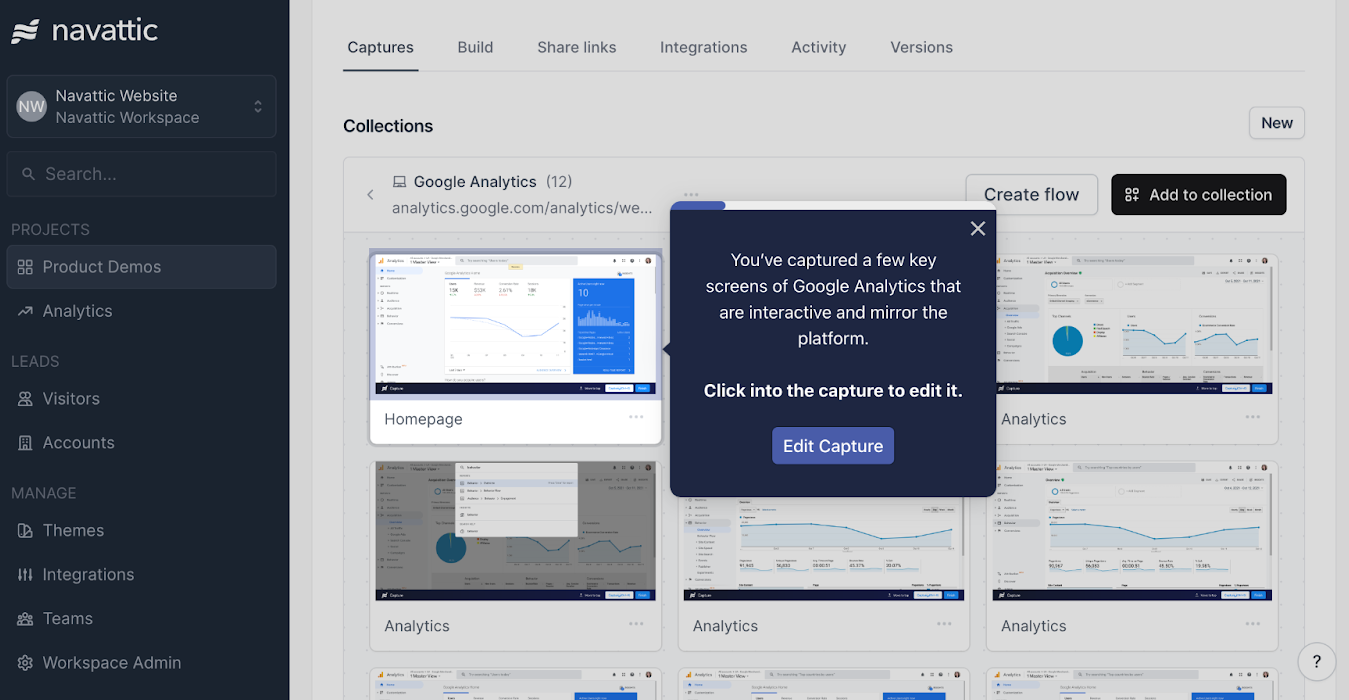
Navattic is an interactive demo platform built around HTML/CSS demo capture. They're rated 4.8 on G2 across 893 reviews and ranked #3 in Demo Automation. The product centers on HTML demos, with adjacent products Launchpad (sales demo collection, released September 2025) and Agent Demos (autonomous AI demo walkthroughs, beta 2026). Their February 2026 release added unified building view, A/B testing, voiceovers (text-to-speech and uploaded audio), animating text, and Recapture (auto-recapture when product UI changes).
Where Navattic wins:
- Mature HTML demo capture (their original product, refined over 5+ years)
- Native in-product commenting and threaded collaboration on demos
- Recapture feature (unique to Navattic)
- Native Amplitude and Chameleon integrations
- Sandbox demos at $1,000 Growth tier
Honest tradeoff: HTML-first means video and standalone screenshot demos are secondary formats. Navattic's pricing jumps from Free directly to $500/mo Base (no entry paid tier under $500). Marketing-led customer concentration means cross-functional GTM adoption is narrower than Storylane.
G2 rating: 4.8/5 (893 reviews), ranked #3 in Demo Automation, Satisfaction Score 95/100.
Pricing: Free, Base $500/mo, Growth $1,000/mo, Enterprise custom.
3. Arcade: best for design-led marketing teams
Best for: Marketing teams that prioritize design polish and visual aesthetic for screenshot-based demos, brand content, and PLG campaigns.
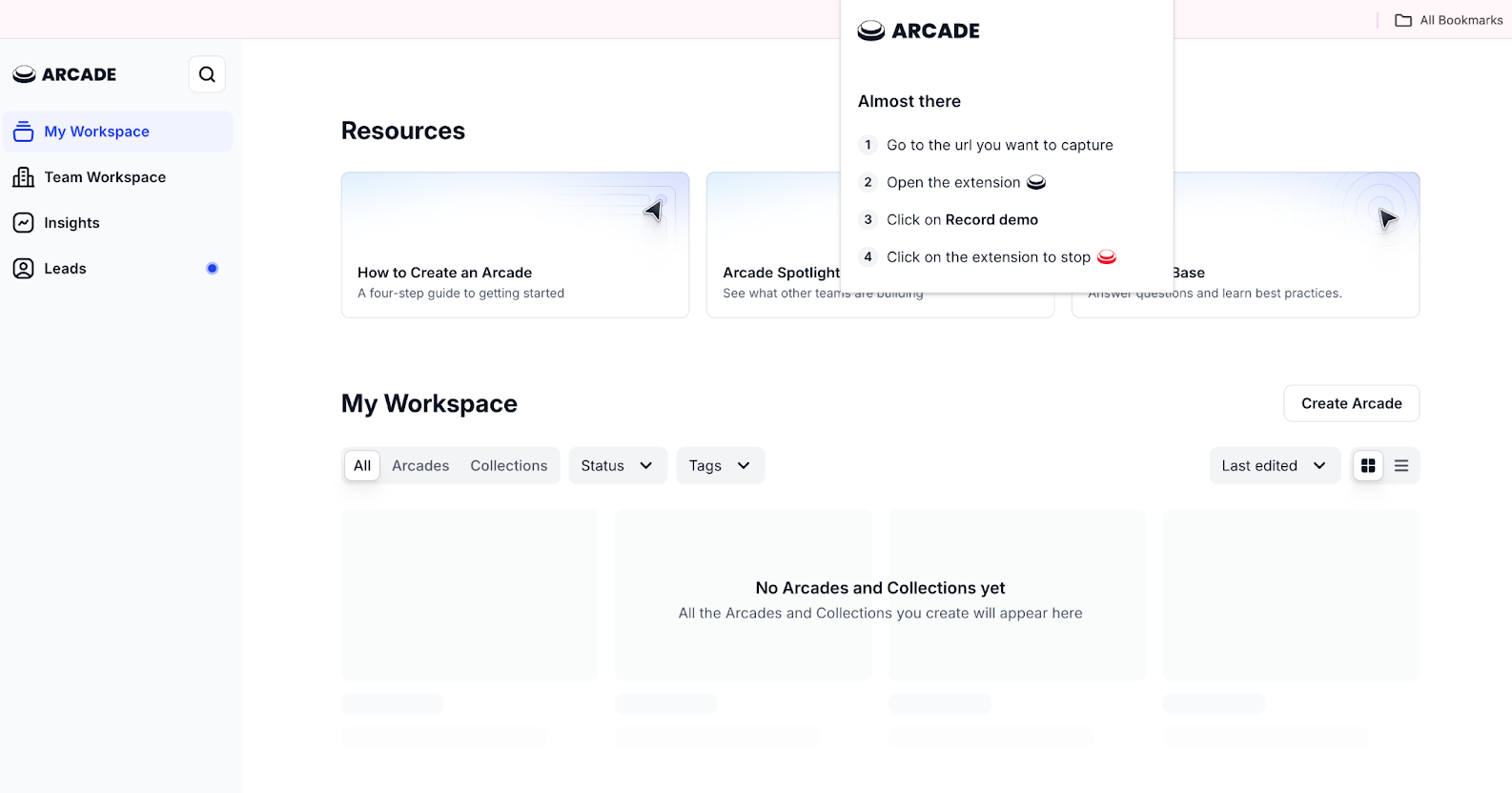
Arcade is a screenshot-and-video-first demo platform popular with design-led marketing teams. They added HTML capture in 2025 (Growth tier and above), but their primary content type remains screenshot demos and screen recordings with branching, custom branding, and synthetic voiceovers (their AI is branded "Avery"). Pricing changed in 2026: Growth moved from $42.50/user/mo to $297.50/mo flat (with 5 included seats, $150 per additional seat).
Where Arcade wins:
- Strong visual aesthetic and design polish for screenshot demos
- Popular in marketing and PLG communities
- Quick onboarding for screenshot demos (10-15 min from recording to publish)
- Free tier with real capabilities (3 demos, 200 AI credits, AI voiceover, Chrome extension, desktop app, Figma plugin)
Honest tradeoff: HTML capabilities arrived later and are gated to Growth tier and above. Analytics and CRM integrations are narrower than category leaders. The product has limited scope outside marketing use cases. The 2026 pricing shift was significant for some buyers: existing customers on per-user Growth saw their effective pricing change meaningfully.
G2 rating: 4.6/5.
Pricing: Free, Pro $32/user/mo, Growth $297.50/mo flat (5 seats), Enterprise custom. 15% annual billing discount.
4. Guideflow: best for guided product tours
Best for: Product, marketing, or onboarding teams that need guided product tour functionality more than full interactive demos.

Guideflow focuses on guided product tours: step-by-step walkthroughs that highlight key product features. They support sandbox demos at a basic level. Five-tier pricing structure (most granular in the category): Free, Solo $35/mo, Growth $499/mo (HTML capture unlocks), Advanced $1,499/mo, Enterprise $2,999/mo.
Where Guideflow wins:
- Strong guided demo specialization
- Sandbox demo support at lower tiers
- Five-tier pricing offers flexibility at multiple budget points
- Free tier with 5 guideflows and unlimited views
Honest tradeoff: Reported lagginess and crashes per G2 reviewer feedback. Missing relative to category leaders: AI Avatars, multi-format Hubs, Presenter Mode, Offline demos, intent signals, native A/B testing.
G2 rating: 4.6/5.
Pricing: Free, Solo $35/mo, Growth $499/mo, Advanced $1,499/mo, Enterprise $2,999/mo.
5. Consensus: best for enterprise sales teams running video-based demo programs
Best for: Enterprise sales and SE teams that prioritize video-based demo automation and have established demo or SE departments.
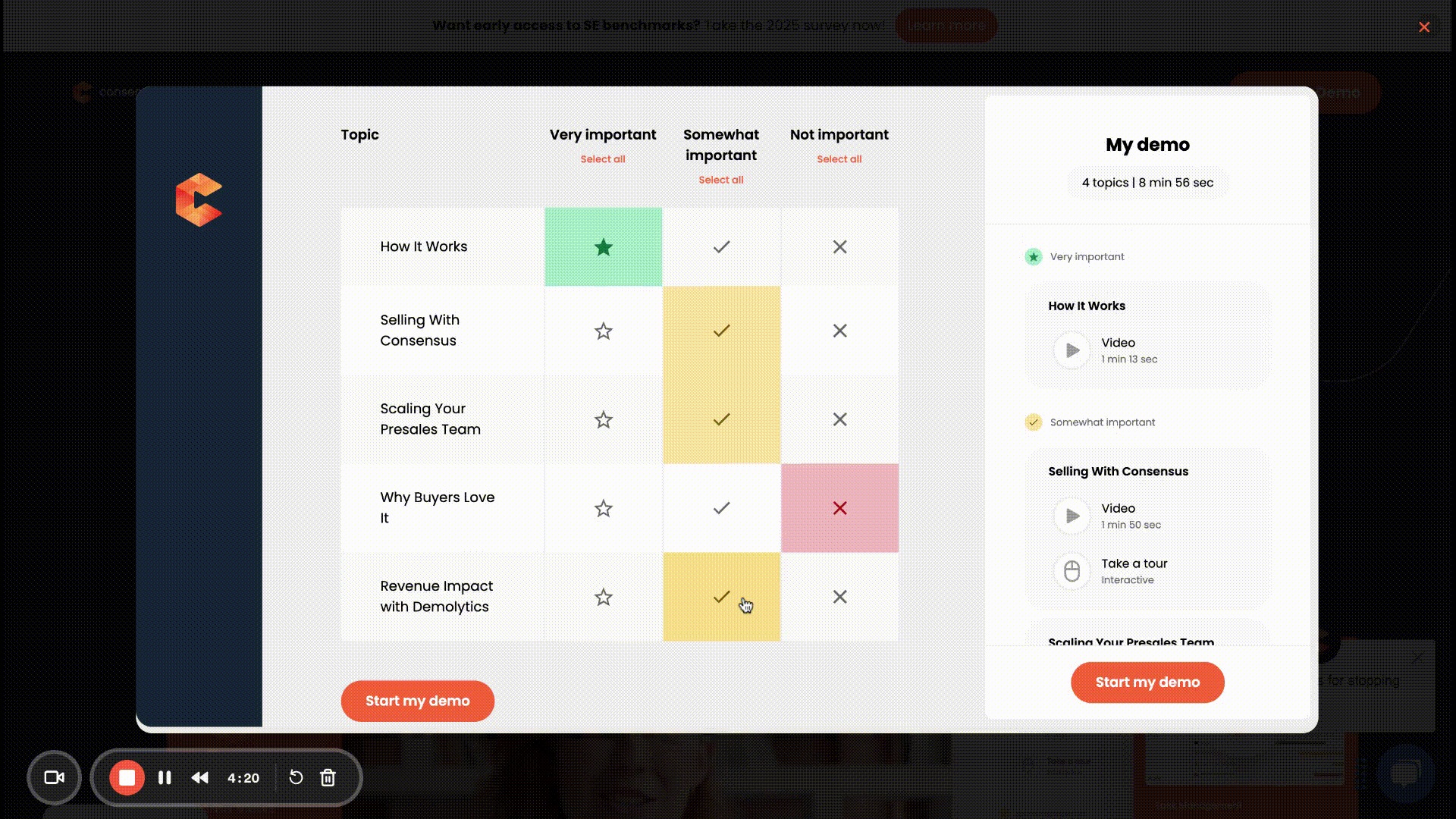
Consensus has been in the demo automation category longer than most platforms have existed. They built their reputation on video-based demo distribution, and that history shows in how the product is structured today: still primarily video-first, with HTML/Simulations (acquired from Reachsuite in 2025) gated to the Enterprise tier and AI Demo Agents (acquired from Peel in 2026) becoming the new AI agent product surface. They're rated 4.7 on G2 with 1,689 reviews (the most in the category) and ranked #2 in Demo Automation.
Where Consensus wins:
- Largest G2 review base in Demo Automation (1,689 reviews)
- Most mature video demo capability in the market
- Enterprise role governance and access control depth (eight pre-defined system roles plus customizable roles)
- Established sales-led customer base
Honest tradeoff: Video-first means rigid maintenance: when product UI updates, you re-record video segments rather than swap screens. Pricing starts at $7,200/year (Starter) with no free plan, no monthly billing, and no self-serve trial. HTML and Simulations are Enterprise-only and acquired rather than native. The product surface feels disjointed across video, simulations, and AI agents per recurring market feedback.
G2 rating: 4.7/5 (1,689 reviews), ranked #2 in Demo Automation.
Pricing: Custom enterprise pricing. Starter $600/mo billed annually ($7,200/yr), Pro $1,250/mo ($15,000/yr), Enterprise custom.
6. Walnut: best for sales-led teams already invested in Walnut
Best for: Sales-led organizations with existing Walnut investment running HTML demo programs.

Walnut was an early entrant in demo automation with substantial venture funding through 2023. Following layoffs and a strategic pivot, Walnut launched a competitive AI suite in 2026: AI Mode (build/edit demos with single prompt), StoryCaptureAI (auto-creates demos as you click and narrate), InsightsAI (engagement analysis), and EditsAI (bulk personalization, translation, multi-demo updates). Customers include Adobe, Cisco, OpenText, and Medallia.
Where Walnut wins:
- Currently-shipping AI capabilities (AI Mode, StoryCaptureAI, InsightsAI, EditsAI)
- Strong native integrations with major CRMs
- Established enterprise sales-team customer base
Honest tradeoff: Walnut is late to the AI category. Storylane shipped AI voiceovers in December 2023 and full AI content generation by February 2025; Walnut's AI suite became fully marketed in 2026, putting them 12 to 18 months behind in AI maturity. They've caught up with capable products, but they're playing catch-up. Walnut is also still HTML-only (no native screenshot or video as first-class formats), pricing is $9,000+ per year (vs Storylane's $40/mo Starter), and the G2 review base is 151 reviews (vs Storylane's 1,405).
G2 rating: 4.5/5 (151 reviews).
Pricing: Starter ~$9,000/yr, Professional $18,600 to $20,000/yr, Enterprise custom. No free plan, no trial.
7. HowdyGo: best for small teams wanting HTML demos at flat-rate unlimited-user pricing
Best for: Small teams (4-10 people) that want HTML demos and value flat-rate pricing with unlimited users over per-seat scaling.
HowdyGo is a bootstrapped, founder-led demo automation tool focused exclusively on HTML demos. The product is intentionally narrow: HTML demos done well, with everything else as a deliberate non-goal. Distinctive pricing model is flat rate with unlimited users on every plan. No per-seat charges, no demo limits.
Where HowdyGo wins:
- Flat-rate unlimited-user pricing ($159/mo Starter is cheaper than per-seat platforms for teams of 4+)
- Pixel-perfect HTML demos with no-code editor
- Three outputs from a single recording (interactive HTML demo, video, GIF)
- Hands-on founder support via shared Slack channels for paying customers
- 14-day free trial, no sales call required
- 4.9 G2 rating (small but strongly rated review base)
Honest tradeoff: No SOC 2 Type 2 published audit (they have documented security controls and annual penetration testing, but no formal certification on the website). Procurement-heavy enterprise buyers may flag this. No free plan. No screenshot or standalone video formats. No sandbox demos. No multi-format Hubs or DSR. Native demo analytics are gated to the $399/mo Pro tier. Smaller G2 community (83 reviews).
G2 rating: 4.9/5 (83 reviews).
Pricing: $159/mo Starter (unlimited users, all core features), $399/mo Pro (adds analytics + integrations), Enterprise custom (adds SSO and additional security).
Comparison matrix: all 7 platforms side by side
| Storylane | Navattic | Arcade | Guideflow | Consensus | Walnut | HowdyGo | |
|---|---|---|---|---|---|---|---|
| G2 Rating | 4.8 | 4.8 | 4.6 | 4.6 | 4.7 | 4.5 | 4.9 |
| G2 Reviews | 1,405 | 893 | varies | varies | 1,689 | 151 | 83 |
| Demo Automation Rank | #1 | #3 | varies | #5 | #2 | not in top 20 | varies |
| Free Tier | Yes | Yes | Yes | Yes | No | No | No (14-day trial) |
| Entry Paid Tier | $40/mo | $500/mo | $32/user/mo | $35/mo | $600/mo annual | $9,000/yr | $159/mo |
| Self-serve trial | Yes | Yes | Yes | Yes | No | No | Yes |
| HTML demos | Yes (Growth+) | Yes (native) | Yes (Growth+) | Yes (Growth+) | Enterprise only | Yes (native) | Yes (native) |
| Screenshot demos | Native | Secondary | Native | Yes | Yes (Reachsuite) | Limited | No |
| Video demos (standalone) | Native | Limited | Yes | Limited | Native | Limited | No (export only) |
| Sandbox demos | Enterprise | Growth ($1K) | No | Basic | Enterprise (Simulations) | Limited | No |
| Multi-format Hub / DSR | Yes (Hubs) | LaunchPad (demos only) | Basic | No | Yes | Basic | No |
| AI voiceovers (in-app recording) | Yes | No (TTS + upload) | No (TTS) | No | Yes (TTS) | Yes (StoryCaptureAI) | Limited |
| AI video avatars (production) | Yes | Beta | No | No | Limited | No | No |
| Live AI sales agent | Yes (RepX) | Agent Demos (beta) | No | No | AI Demo Agents (Peel) | No | No |
| Cross-functional GTM | Yes | Marketing-led | Marketing-led | Product / Marketing | Sales-only | Sales-led | Marketing-led |
| SOC 2 Type 2 | Yes | Yes | Yes | Yes | Yes | Yes | Documented controls only |
| GDPR | Yes | Yes | Yes | Yes | Yes | Yes | Yes |
| ISO 27001 | No | No | No | No | No | No | No |
"Storylane helps me create visually appealing demos quickly and easily. It also makes it simple to manage demos and organize them into folders based on use cases." - Petteri Piimala, Customer Retention Manager, Trustmary (11-50 employees) | G2
How to choose the right Supademo alternative
The right alternative depends on what specifically led you to start looking. Here's how I'd think about it, framed by the problem you're trying to solve.
You've outgrown Supademo and need enterprise depth. Storylane. Format breadth, RepX live AI sales agent, enterprise customer footprint (HubSpot, Microsoft, Okta), Built-for-Sales features at Premium tier.
You want HTML demos as your primary format and your demo program lives in marketing. Navattic for HTML specialization, mature commenting workflows, and Amplitude/Chameleon integrations. Storylane if you want HTML plus the option of screenshot and video formats in the same editor (full Storylane vs Navattic breakdown here).
You want design-polished screenshot demos for marketing campaigns. Arcade if visual aesthetic is the priority. Storylane if you want screenshot demos plus broader AI features and cross-functional GTM positioning.
You primarily build guided product tours and onboarding flows. Storylane for broader interactive demo capabilities. Guideflow if guided-only with sandbox at lower tiers is genuinely all you need.
Your sales-led team has existing Walnut investment. Walnut for the AI suite (AI Mode, StoryCaptureAI, InsightsAI, EditsAI) and CRM integrations. Storylane if you want format versatility, cross-functional adoption, and the AI maturity that comes from shipping AI features 12 to 18 months earlier.
You're enterprise sales-led with video-first demo programs. Consensus for established video demo depth and enterprise role governance. Storylane if you want HTML and screenshot formats as first-class options alongside video.
You want HTML demos at flat-rate unlimited-user pricing. HowdyGo if you have a 4-10 person team and don't need analytics until $399/mo. Storylane if you need the broader product surface.
You need a live AI sales agent that surfaces case studies, pricing, and books meetings. Storylane RepX is the only production option in this list.
The bottom line
If you're evaluating Supademo alternatives in 2026, here's how I'd boil it down. Storylane is the strongest overall fit for B2B SaaS GTM teams that have outgrown Supademo's SMB-friendly positioning and need enterprise depth, broader AI capabilities (in-app voice recording, AI video avatars in production), a multi-format Hub product, and a live AI sales agent (RepX).
The common thread among teams leaving Supademo: their demo program scaled past Supademo's natural ICP. They didn't reject Supademo. They outgrew it. The right alternative depends on where the program is heading. If your demo program is HTML-only and lives in marketing, Navattic is purpose-built for it. If you want design-polished screenshot demos for brand content, Arcade is credible. If you have a 4-10 person team and want flat-rate unlimited-user pricing with HTML, HowdyGo is the honest fit.
Each tool has its place. Pick the one that matches your team's specific goals and constraints.
See how Storylane compares, live
Get a personalized walkthrough and see how fast your team can ship interactive demos that book more meetings.
Book a demoFrequently asked questions
What's the best free Supademo alternative?
The strongest free Supademo alternatives are Storylane, Navattic, Arcade, and Guideflow. Storylane's free plan includes 1 published demo, AI Suite (Free), Lead Capture, Video Recordings, Slack integration, and basic analytics. Storylane is the right choice if you want interactive demos with broader AI capabilities and a path to enterprise depth. Arcade and Guideflow are also free-tier options if your needs are more narrowly screenshot or guided-tour focused.
Which Supademo alternative is best for sales teams?
Storylane has the broadest sales-team product surface: Built-for-Sales features (Presenter Demos, Deal Intelligence, Offline Demos), native Salesforce App integration, and RepX (a live AI sales agent that qualifies inbound and books meetings). Walnut is also strong for sales-led teams with existing Walnut investment. Consensus is purpose-built for enterprise sales teams running video-first demo programs.
How does pricing compare across Supademo alternatives?
Pricing varies significantly. Storylane has the most accessible structure (Free, $40/mo Starter, $500/mo Growth, $1,200/mo Premium). Navattic starts at $500/mo Base after the Free tier, and our Navattic alternatives roundup lists lower-cost options. Guideflow has a granular five-tier structure starting at $35/mo Solo. Arcade is $32/user/mo Pro or $297.50/mo flat Growth. HowdyGo is flat-rate at $159/mo with unlimited users. Walnut, Consensus, and Reprise are enterprise-only with custom pricing.
Can I migrate from Supademo to another platform easily?
Yes. Multiple Storylane customers have migrated demo programs from Supademo. The process typically takes a few days for small libraries (under 20 demos) and a few weeks for larger ones, depending on demo complexity and customizations. Most platforms offer a migration walkthrough; talk to their team for specifics.
Why is Storylane ranked #1 on G2 in Demo Automation?
Storylane has a G2 Satisfaction Score of 99/100 across 1,405 verified reviews, the highest in the Demo Automation category. The score factors in real-user ratings on satisfaction, ease of use, ease of setup, product direction, and other dimensions. Storylane has more than twice the review base of Supademo (1,405 vs 607).
Which platform has the best AI features?
Storylane has the broadest AI capability set in production: AI voiceovers with in-app voice recording, AI video avatars (production, not beta), AI content generation, video-to-demo capture, AI Hub Creation, and RepX (a live AI sales agent). Supademo has AI voiceovers, AI Demo Audit (a unique feature for scoring demos and flagging drop-off), and 15-language translation, but a narrower overall AI suite. Other platforms have varying coverage.
Does Supademo have HTML demos?
Yes. Supademo's HTML demo capability went GA in late 2024 after exiting beta. They support HTML/CSS demos alongside screenshot and video formats. The earlier framing of "Supademo is missing HTML demos" is no longer accurate as of 2026.
Does Supademo support sandbox demos and demo hubs?
Yes to both. Supademo supports sandbox demos and offers two related products in the hub category: Showcases (multi-demo collections) and In-App Demo Hub (demos triggered as in-app modals for onboarding, feature announcements, and training). The earlier framing of "Supademo has no hubs" is no longer accurate as of 2026.
About this guide: Demo automation is one of the fastest-evolving categories in B2B SaaS. AI capabilities ship monthly, pricing changes quarterly, and vendor acquisitions reshape the competitive landscape regularly. We refresh this article every 90 days against verified primary sources: vendor pricing and product pages, G2 reviews, recent prospect conversations, and our own competitive testing. The "Last updated" date at the top reflects our most recent verification cycle, so you're working with the most current information available.