
.svg)

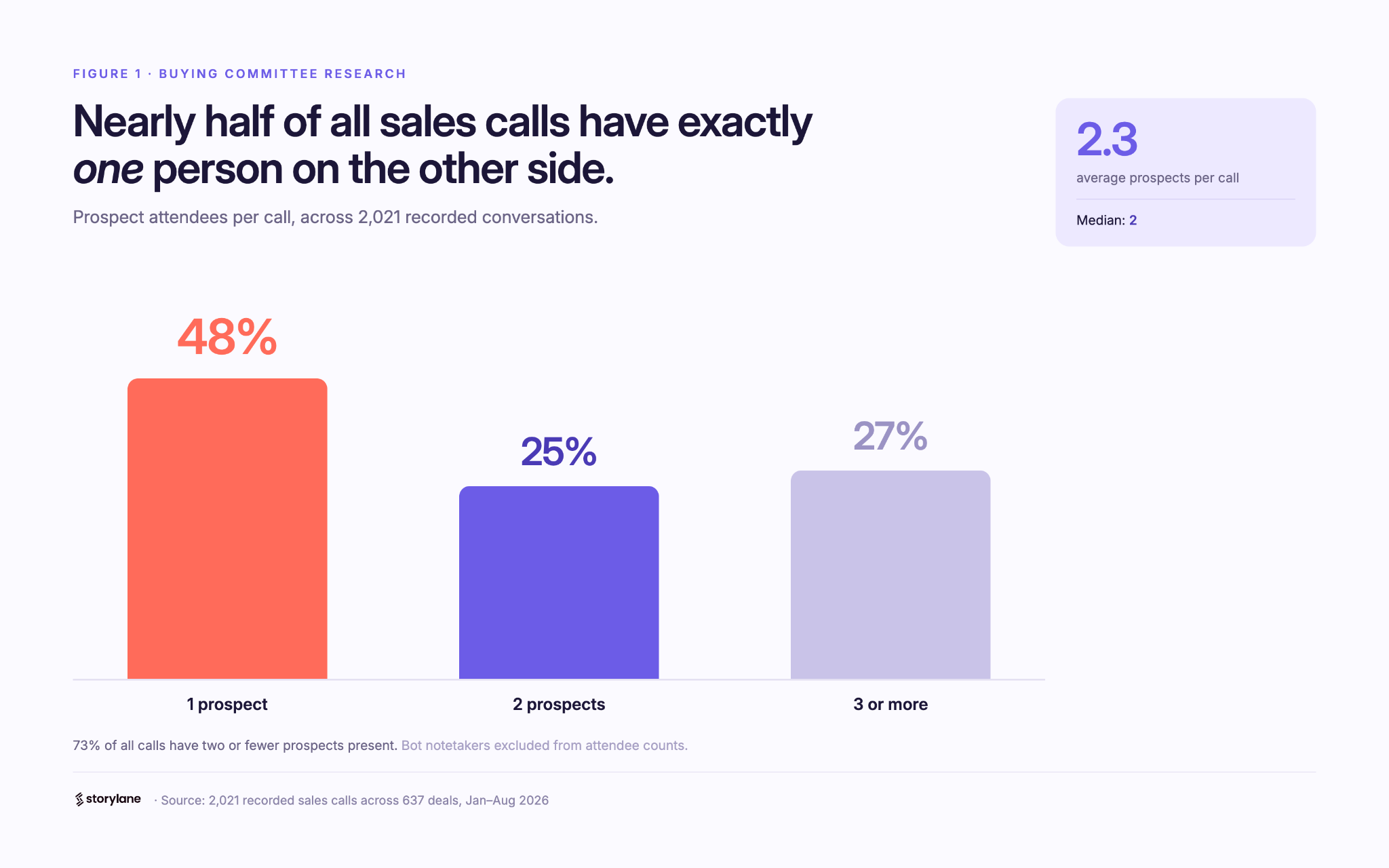
Ask Sales about a deal's buying committee and they'll point to a CRM record with 20+ contacts. Ask them who actually showed up on calls? Two people. Maybe three. And the person with budget authority almost certainly wasn't one of them.
Based on an analysis of 2,021 recorded sales conversations and 637 active and closed mid-market and enterprise deals, here are some interesting learnings about how B2B buying decisions are made today (and why furnishing your champions with the right assets matters more than ever).
The sales call is the smallest part of the deal
I went into this analysis expecting to learn about who sits on a buying committee. Instead, what I found is that the call is one of the least representative surfaces of a B2B deal. The average buying account has about 23 known contacts in the CRM (median: 10). The average number of people who actually appear on a call is 2.3. Roughly one in five known contacts ever joins a call. In some cuts, this figure is as few as one in eight.
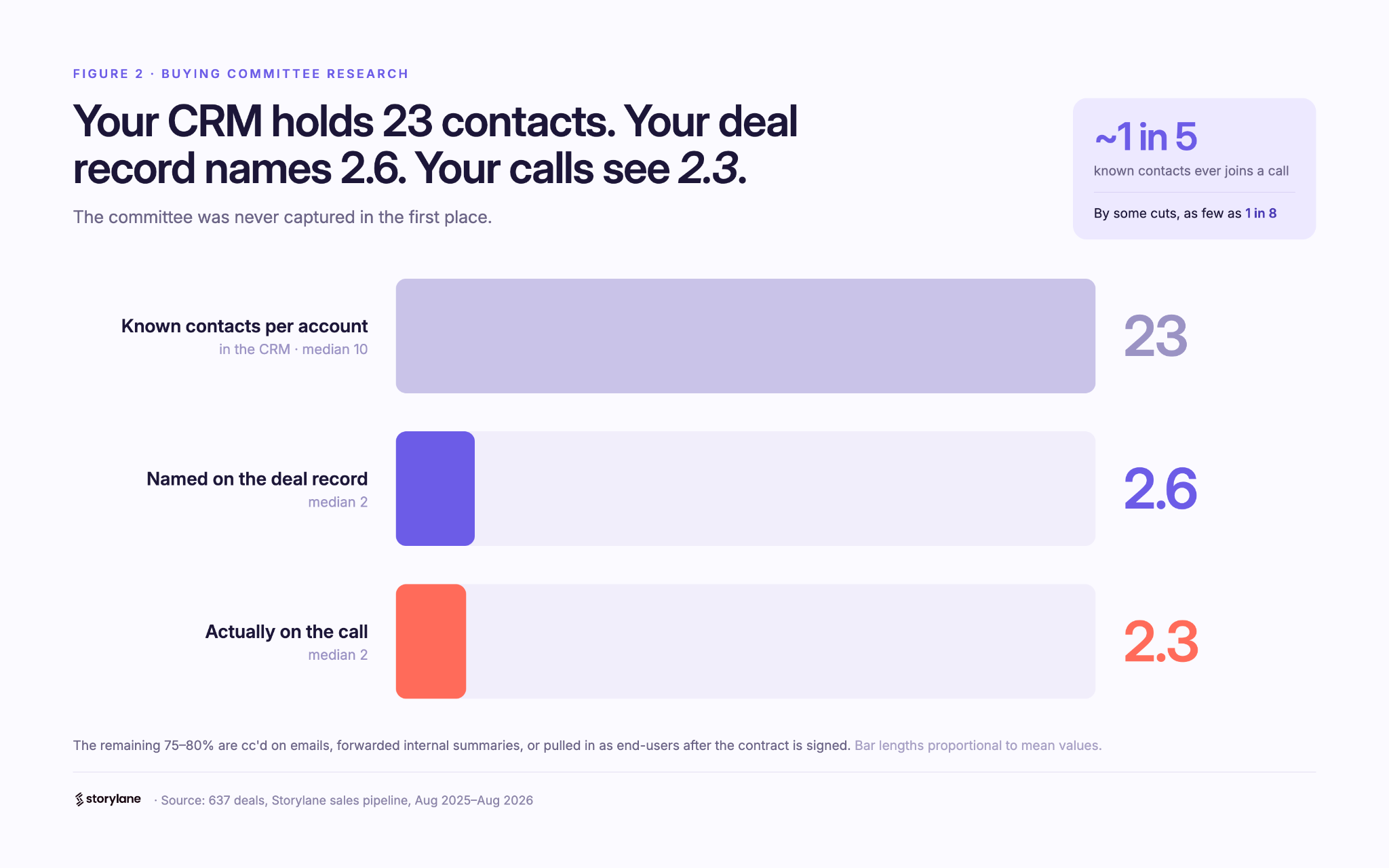
The remaining 75–80%? They're cc'd on emails, forwarded internal summaries, or pulled in as end-users after the contract is signed. Some of them have veto power. None have ever heard your pitch. They're reading forwarded summaries, weighing in on Slack threads, sending requirements back through your champion, running the security review, approving the budget (or quietly refusing to).
And it isn't only that most of the committee never gets invited. Plenty are invited and don't come. Across the 2,021 calls, buyers' own teams put 6,187 people on invitations. Only 4,547 turned up (73%). This means that roughly one in four invitations went unused. These weren't people who'd left the deal. They'd just stopped using calls to participate in it.
All this to say: none of this makes the sales call unimportant. It makes it partial. The call is where you meet the deal but it isn't where the deal gets decided. If you're still refining what happens in that room, here's a guide on how to prepare a software presentation.
Trend #1: Self-service buyers are the new normal (and they arrive semi-decided)
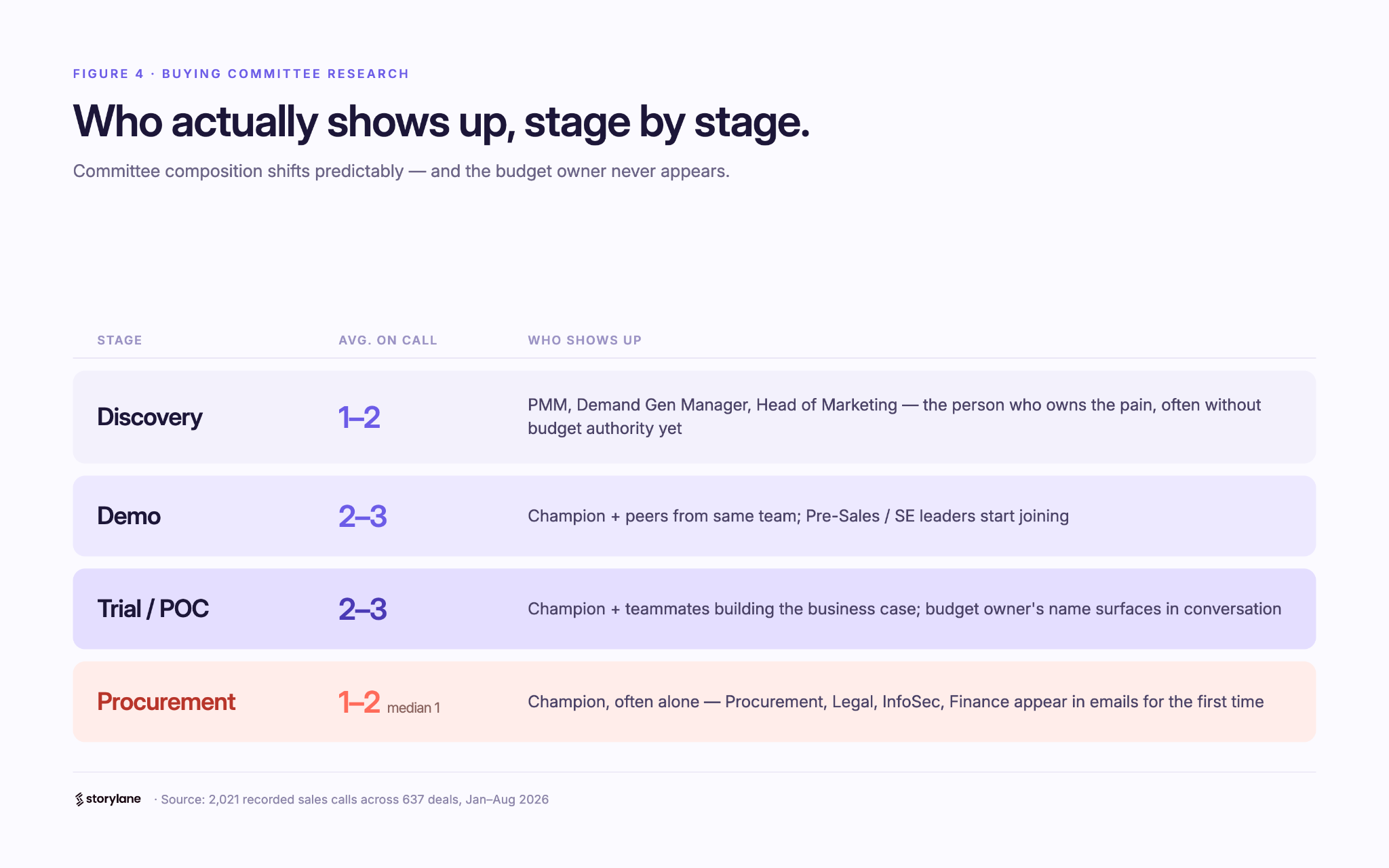
Across the dataset, Discovery calls consistently involve just 1–2 people (almost always a single end user who has self-identified the pain and initiated contact independently), often without explicit budget authority.
Another recurring pattern: multiple champions had already evaluated a direct competitor before their first call. Rather than exploring, they were validating a thesis they'd already formed. This showed up unprompted, at the very opening of first calls, across multiple deals:
"Just to be fully transparent, I've looked at Competitor A, Competitor B, there's a few others that I'm going to be looking at over the next couple of weeks." - Marketing lead at an enterprise SaaS company, unprompted at the start of their first demo call
This isn't a one-off; it appears consistently enough across the 637-deal set to represent a structural shift: the research phase now happens before the vendor knows the deal exists.
Which means the most consequential part of your funnel is the part you have no presence in.
What this means for you
Discovery is no longer an exploratory conversation; it's a validation meeting. Your champion arrived with a point of view. The job in that first call isn't just to educate but to confirm their thesis and arm them with the language to sell it internally. The question to answer isn't "what problem are you solving?" It's "what do you need to walk away with so you can get your team on board?"
But the deeper implication is about the window before that call. If buyers are forming their shortlist while browsing anonymously, the only assets that can influence that stage are the ones that work without a rep in the room.
This is the gap interactive demos were built for, and the reason we’re building RepX (conversational sales agents that qualify and convert visitors before a meeting exists). RepX asks the discovery questions a rep would ask, handles competitor and pricing objections, presents a live interactive demo inside the conversation, and books the meeting at the right moment. An early RepX customer told us that their agent handles about 80% of the very specific product questions they get.
The point isn't automation for its own sake. It's that the champion in the quotes above was comparing three vendors before speaking to any of them. Whoever answered their questions in that window shaped the shortlist.
Trend #2: Economic buyers shape deals without ever joining a call
At every stage, CMOs, VPs and SVPs are largely absent from calls. But the trial-stage analysis surfaces a more actionable pattern: champions are actively building internal resources (demos, decks, etc) specifically to pitch leadership. Not just for evaluation, but as their internal business case. Here’s an anonymous extract from one of our own buyers from a recent sales conversation:
"I can spend a bit of time trying to polish an example demo and then I can probably get at least one person from each of our teams — sales, engineering and customer success — to maybe get on a call with the two of us…and then if no one is objecting to it, I can use that as data to pitch it to my SVP." - Head of Marketing at a mid-market SaaS company, solo on a working session call
The budget owner's name surfaces in these conversations. Their requirements shape what the champion asks for. Their timeline drives urgency. In other words, what they have to work with when you’re not in the room is just as (if not more) important than on-call conversations.
What this means for you
You're not selling to one person. You're selling through one person into a room you'll never enter. Which reframes the job: your champion isn't a contact to be worked. They're a colleague running an internal campaign on your behalf, usually with no training, no materials and no budget.
So the question stops being "how do I get the economic buyer on a call?". Our data says you mostly won't. Instead, it becomes "what am I putting in my champion's hands, and can I see what happens to it?" (In other words, exactly what buyer enablement is meant to solve.)
Both halves of that matter, and the second is the one most teams miss. A slide deck emailed to a champion disappears. You don't know if it was opened, forwarded, or ignored, or who else saw it. That blindness is precisely why the deal record names 2.6 people: calls are the only telemetry most sales teams have, so calls become the only stakeholders they can name.
This is what Hubs was built for. A Hub is a single personalized link that holds everything the committee needs (interactive demos, videos, pricing PDFs, ROI material, forms ) laid out either as a gallery to explore or a playlist that walks a buyer through a sequence.
Content can be segmented by role, pain point or persona, so the SVP who opens it lands on business impact while an end user lands on workflow.
Two things follow from that, and they map directly onto the findings above:
- It travels where you can't. A hub link is the thing a champion forwards into the internal review you're not invited to. Instead of your argument being reconstructed from memory in a Slack thread, the committee sees the product itself.
- It gives you telemetry that calls can't. Hubs track who engaged, with what, and how deeply, and push those insights into HubSpot and Slack. That's how a stakeholder who will never join a call becomes a name you can see as well as how "we're multi-threaded" turns from a claim into something your CRM can actually evidence.
If you're not actively helping your champion build the internal pitch and watching what happens when they run it, you're leaving the most important conversation in the deal entirely to chance.
Trend #3: The people who can kill your deal have never heard your pitch
Attendance remains largely consistent through evaluation: Demo → POC → POC complete averages 2.52 → 2.56 → 3.00 prospects per call. Interestingly, however, attendance during procurement collapses to 1.89, with a median of 1. The champion really does walk into the last mile alone.
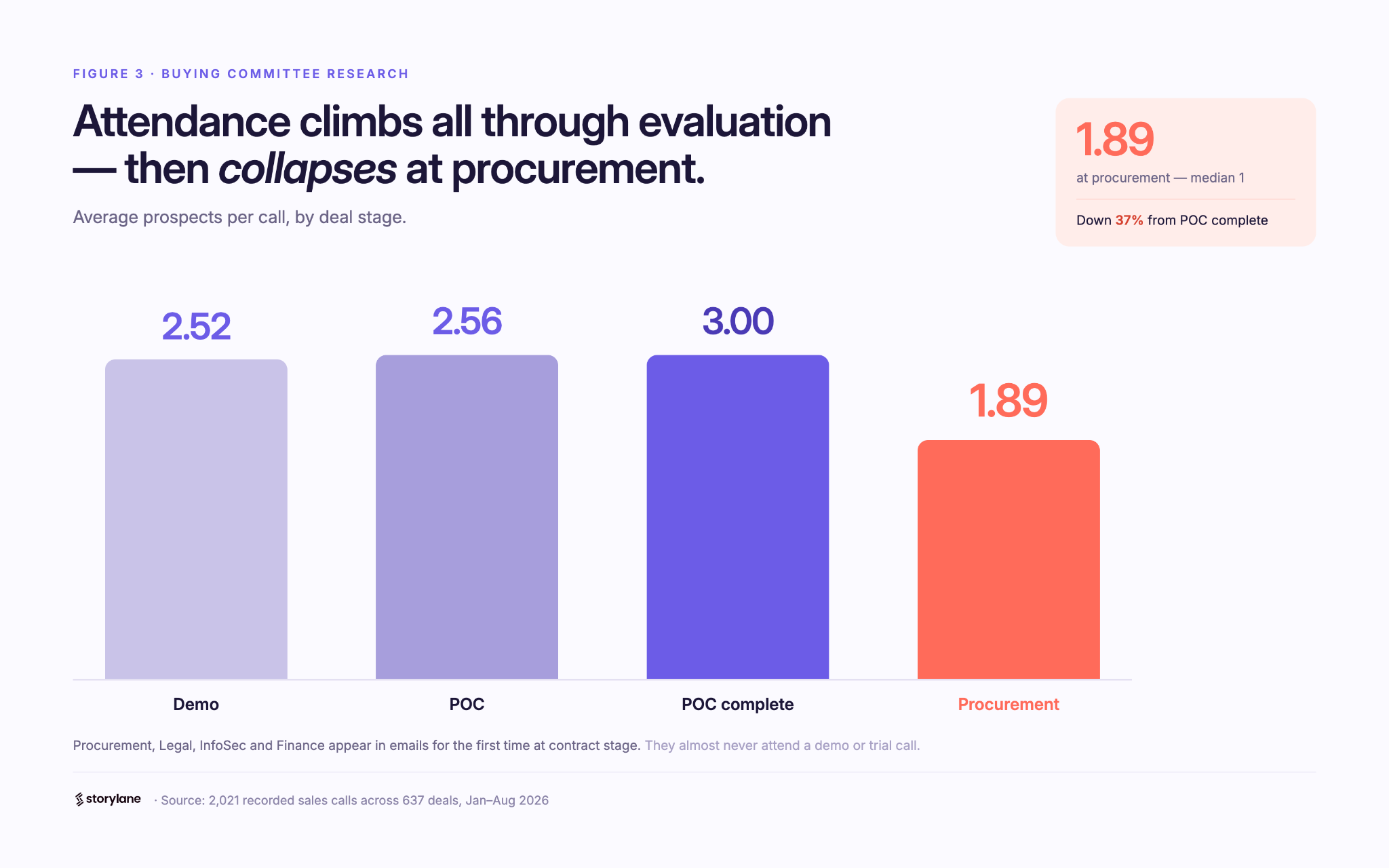
Procurement, Legal, InfoSec and Finance appear in emails for the first time at contract stage. Not during evaluation. Not during trial. At contract. These roles almost never attend a demo or trial call. By the time they enter the picture, they have no context, no relationship and no stake in the outcome. Only the authority to slow things down (or worse).
What this means for you
The people who can kill your deal are being introduced to your product through a second-hand summary written by a champion who may not know what Legal or InfoSec actually needs to hear.
Pre-empt it. In trial, ask your champion directly: "Who else will need to sign off, and what do they need from us?" The earlier you surface these stakeholders, the less power they have to stall. This is where the best presales tools earn their keep, arming SEs to get ahead of procurement before it stalls the deal.
Then make the answer easy to act on. Security documentation, your SOC 2 report, a standard MSA and a short data-flow overview should already be sitting in the Hub you gave your champion in week one in a section addressed to reviewers, framed as partnership transparency rather than a compliance chore.
Every question procurement would have asked, answered before they ask it, is a week back in your cycle. And crucially, it isn't your champion who has to go and get it.
The same role-segmentation that serves an SVP a business case serves an InfoSec reviewer a security posture. It's the same link. They just land in different places.
What this all adds up to
If there's one thing to take from 2,021 calls, it's this: we have been measuring the part of the deal that is easiest to see, and mistaking it for the part that matters.
The call is a sliver of the decision making process. Half the time it's one person. A quarter of the invitations buyers send their own colleagues go unused. The committee never appears in the CRM. And the decisive conversations (the internal pitch, the security review, the budget approval) all happen somewhere you have no presence and no visibility.
The instinct is to fight this: get more people on calls, push for the exec meeting, insist on multi-threading. Our data suggests that's mostly swimming upstream. Buyers aren't withholding attendance out of bad faith. They're doing what every one of us does: evaluating software asynchronously, on their own time, in their own tools, and looping in colleagues by forwarding something rather than booking something.
The teams that will win aren't the ones who drag more stakeholders onto Zoom. They're the ones who accept that most of the buying happens without them, and who equip the one person who is there to carry the deal through rooms they'll never enter with product and resources they can show rather than claims they must repeat, and with enough visibility on the other side that the invisible committee stops being invisible.
Frameworks like the Miller Heiman sales process have mapped buying-committee roles for years — our data shows how differently that plays out when 75-80% of the committee never joins a call.