
.svg)

Ask a B2B founder who builds the best demos at their company and you'll get one of two answers. "Me, because nobody else knows the product well enough." That's a problem. Or "our engineering team, because they built the product." That's also a problem.
The best demos get built by the people who know the buyer best, not the people who know the product best. That's a real shift in how to staff the demo function, and it's worth walking through carefully because most teams default the wrong direction.
Why engineers default to building demos (and why it backfires)
The reflex is understandable. Interactive demos are product surfaces. Who knows the product better than the team that built it? If we're going to show someone the workflow, shouldn't the person who shipped the workflow narrate it?
The logic breaks down the moment you remember what a demo is actually for.
A demo is an argument that this product is the right fit for this buyer's specific problem, shown through a sequence of moments where the buyer goes from skeptical, to curious, to convinced. The argument is the point. Features are the evidence.
Engineers, at their best, think about correctness, edge cases, and what happens when the data is malformed, the network drops, or the user clicks the wrong button. That's exactly the thinking you want when building a product. It's almost the opposite of what you want when demoing one.
When an engineer is asked to build a demo, the instinct is to cover ground: show every feature, explain every option, hedge every claim. The result is a demo that's technically complete and narratively dead.
The people who actually think like the buyer
Marketers and SEs do.
A good product marketer spends their week thinking about the buyer's internal monologue. What is this persona worried about on a Monday morning? Who's asking them hard questions in their staff meeting? What do they need to walk out of this demo believing, so they can defend the purchase to their boss?
A good solutions engineer sits through hundreds of disco calls. They can quote back the exact phrasing of the five objections that come up on every deal. They know which part of the demo lands with a CFO versus a VP of Security versus a head of ops. They've watched prospects' eyes glaze over at minute four and light up at minute nine, and they've built pattern recognition about why.
Those are the people who should be building your demos. Not because they know the product best (they usually don't, at least not compared to engineering) but because they know the audience best. Audience is what a demo is built for.
The Storylane operating model
This is built into how the platform works, not just a recommendation we make.
The Creator and Presenter role split exists to put demo building in the hands of the people who should be doing it, and demo sharing in the hands of the people who should be doing that.
The Creator role (build, edit, publish demos) is designed for marketers and SEs. They have full access to the dashboard and editor. They set the narrative, pick the proof points, sequence the chapters, choose what to highlight and what to skip. They write the demo.
The Presenter role (view, personalize, share, track) is designed for sellers. They don't need to rebuild; they need to send. They take the marketer's or SE's work, layer on the prospect's name, logo, currency, and industry data, and ship it. They distribute the demo.
Neither role requires engineering's calendar. That's the design.
What engineering should actually do
The goal is to put engineering where they create the most value, which usually isn't inside the demo tool.
Engineering's biggest contribution to the demo flow happens upstream of the demo. Making the product easy to demo means clean UI states, reset-able sandboxes, realistic seed data, feature flags that let marketing surface the right capabilities at the right timing.
When the product is easy to demo well, marketers and SEs can move fast without ever filing a ticket. When the product needs a custom build for every demo, the demo bottleneck becomes the engineering team, and demos ship late, scoped narrow, and narratively thin.
So involve engineering. Just involve them upstream, in product decisions, not downstream in demo construction.
The AI-assisted layer that changed who can build
There's one more shift that reshapes who can reasonably build a demo in the first place: AI-assisted demo creation.
A few years ago, the argument that "marketers should build demos" hit a practical wall. Most marketers didn't have the technical chops to capture screens, edit flows, and sequence chapters fast enough to matter. The tool was too manual. So even when the role split was right in theory, the work defaulted back to whoever was technical enough to do it. Often an engineer. Often slowly.
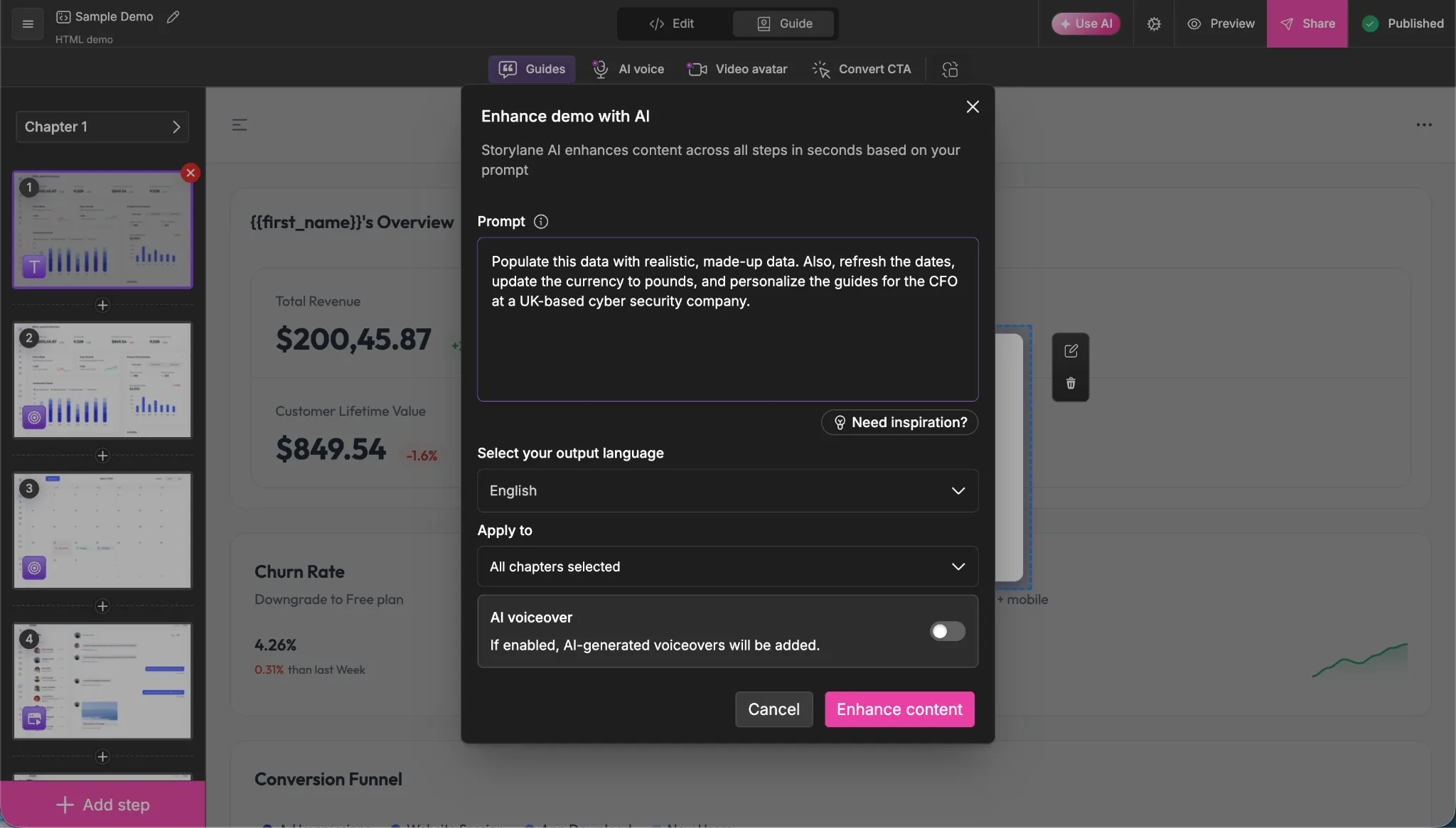
That ceiling has moved. With AI demo creation, a marketer can describe what they want ("a three-chapter demo showing how a finance ops lead approves expense reports, with tokens for the buyer's company name and logo") and get a first draft in minutes instead of days. The marketer then edits, narrates, and ships. The SE reviews for technical accuracy and gives notes.
The whole pipeline that used to take a week now takes an afternoon. The work sits with the people who understand the buyer, because the technical bottleneck has moved off their desks.
The role split, in practice
If you're redesigning how your team builds demos, the simple version:
- Product marketing owns the narrative. They decide what the demo is trying to argue, and for whom.
- SEs own the technical accuracy and the storytelling flow. They build the golden demo inside the platform, reviewed by product marketing.
- Sellers own personalization and delivery. They take the golden demo, tokenize it for the prospect, send it, and track the signal back.
- Engineering owns the product's demo-ability. They ship features that are easy to show without custom builds.
None of these roles has to touch the others' work. The Creator and Presenter split in the platform enforces the boundary. The workflow stays clean.
The payoff
When the role split is working, a few things change.
Sellers get more demos shipped faster, without opening a ticket. Marketers get their narrative to show up intact in every buyer conversation, because it's baked into the demo instead of riding on slide notes. SEs spend their time on golden demos that get used hundreds of times instead of one-off custom builds. Engineers get their calendar back.
That last one matters more than it sounds. Engineering time is the scarcest resource in most B2B companies. Every hour an engineer spends inside a demo tool is an hour not spent on the product that makes the demos worth building in the first place.
Your best demo builder is the person who spends all day thinking about your buyer. Put the tools in their hands and the rest of the org speeds up.