
.svg)

Arcade costs $32/month per seat, setup is relatively fast, and the Chrome extension captures a product walkthrough in minutes. That's why it ends up on a lot of shortlists. Then the program expands. Marketing asks which demo version converts better. Sales needs a deal room for the champion. Someone wants to know which companies are watching before they fill out a form. Arcade doesn't do any of those things.
That gap, not at the first demo, but at the third, fifth, tenth use case, is what this comparison covers.
Quick comparison: Storylane vs Arcade
What Arcade does well
Arcade's Chrome extension captures a product walkthrough without any setup. Paste a URL into the AI demo builder, and it generates a draft without manually clicking through every step. Conditional branching lets viewers self-select their path through the product. At $32/month per seat on annual billing, a solo PMM can launch a demo program without a procurement conversation.
For teams whose entire output is screenshot or HTML-guided demos on a website or in email, Arcade covers the job cleanly. The editor is uncluttered, publishing is fast, and the free plan is real; you can ship a demo without a credit card.
The features Arcade doesn't have, A/B testing, Presenter Mode, Hubs, Deal Intelligence, and RepX, are not edge cases. They're the features teams reach for as soon as a demo program moves beyond the website.
"What got me to bit was their Demo Hub feature - a place that I could curate a set of demos and unite them in one place for events, campaigns, and our website." - Adam O'Brien, VP of Marketing, iDonate (11-50 employees) | G2
Demo creation and formats
Arcade and Storylane both support screenshots, HTML demos, and video. The capability difference is in what each platform layers on top of those formats.
Arcade's approach: The guided screenshot demos are Arcade's core. The extension captures clicks, packages them into a walkthrough, and lets you add annotations and branching. HTML demo support is available, and video capture covers basic recording alongside screenshots. For standard guided walkthroughs for website and email, this covers the job.
Storylane's approach: Beyond screenshots, Storylane specializes in video and HTML demos. Videos export as GIFs or video files for email and social. HTML demos create functional product replicas with real interactions—critical for complex products where static screenshots miss the experience.
Storylane is a multi-format demo automation platform. Leading with its HTML demos (which Storylane has offered for four years, Arcade only recently added them, having always been screenshot-first) and Video to Demo conversion, where a screen recording becomes an interactive step-by-step walkthrough.
Storylane also lets you build Hubs, complete deal rooms assembled from existing demos, videos, PDF, embeds etc, without starting from scratch.
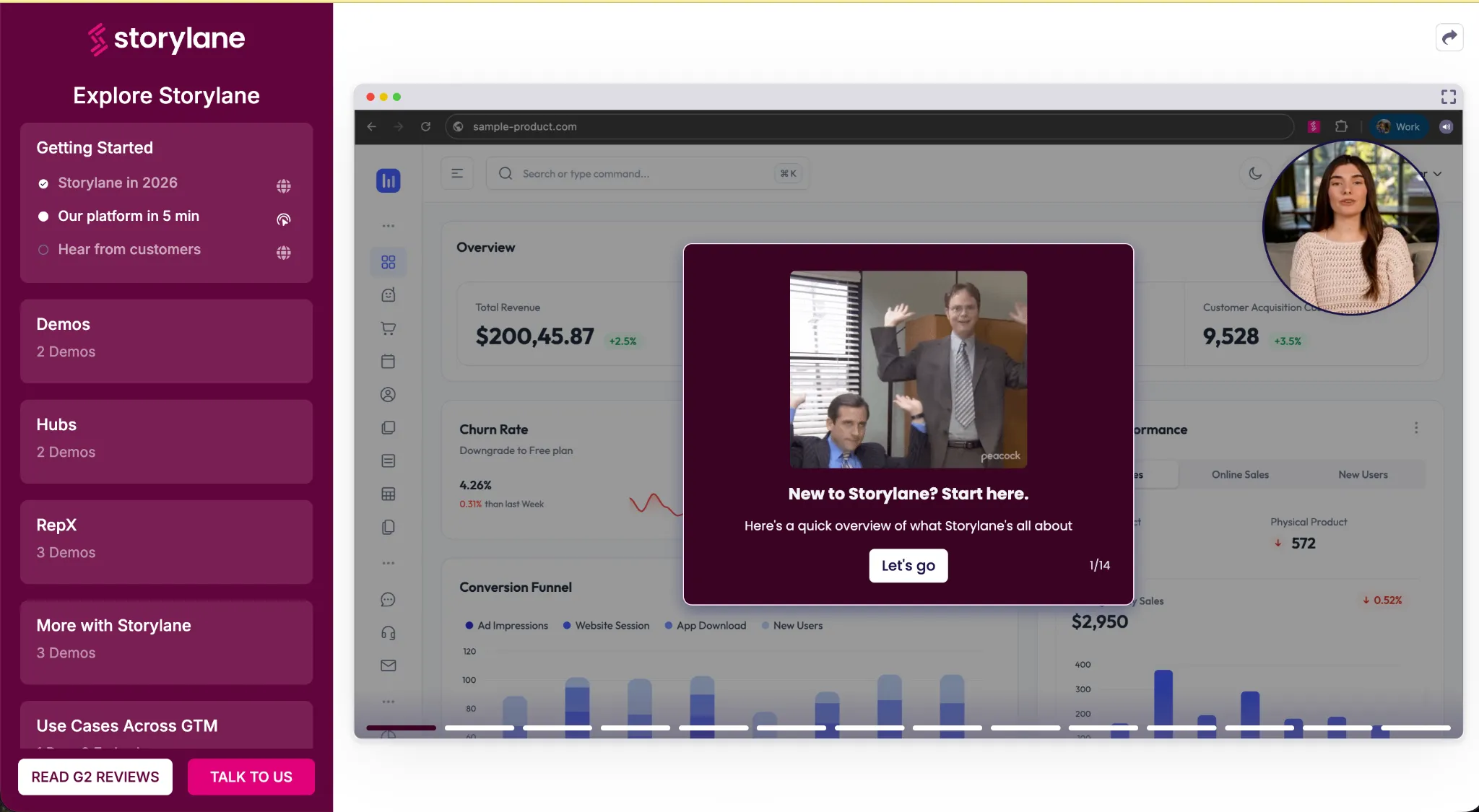
Verdict: Both platforms produce screenshots and HTML demos, but Storylane has been HTML-native for years while Arcade is a late entrant to that format. Storylane also adds GIF/video export, video-to-demo conversion, and Hubs for deal room creation. If your program needs any of those, Arcade doesn't have them.
AI capabilities
Arcade's AI covers creation and voiceovers: build a demo from a URL or recording, add narration without a recording setup. That handles the baseline.

Storylane's AI goes further across 4 additional capabilities:
- AI Video Avatars: Generate a presenter avatar to narrate the demo, no recording required, no face needed from the team
- AI Translations: Localize voiceovers into 30+ languages without re-recording. One demo asset, every market
- AI Editor: Edit HTML demos using natural language prompts, without touching code, useful for any team updating demos after product changes
- Video-to-Demo conversion: Convert existing screen recordings into interactive demos with AI-added hotspots and annotations—useful when you've already invested in video libraries and don't want to rebuild from scratch.
Read more: For teams embedding demos into blog content, one 90-day experiment grew organic traffic 8x (25k to 200k/month) with signups up 106% MoM.
Arcade doesn't have AI video avatars. For a single-market team that records demos in one language and doesn't update HTML demos frequently, that's manageable. For teams selling across geographies or iterating on HTML demos regularly, those are the gaps that force re-work.
Verdict: Storylane wins on AI depth. Arcade covers creation speed. Storylane covers creation speed plus translation, avatar narration, HTML editing, and hub generation.
Analytics and optimization
Arcade's analytics cover views, completion rates, time spent, and basic engagement. For a new demo program that tells you whether anyone is watching.
The questions that come next aren't answered by view counts: which companies are watching without filling out a form? Which of the two demo versions converts better? Which stakeholder went dark in an active deal? Which distribution channel is actually driving engagement?
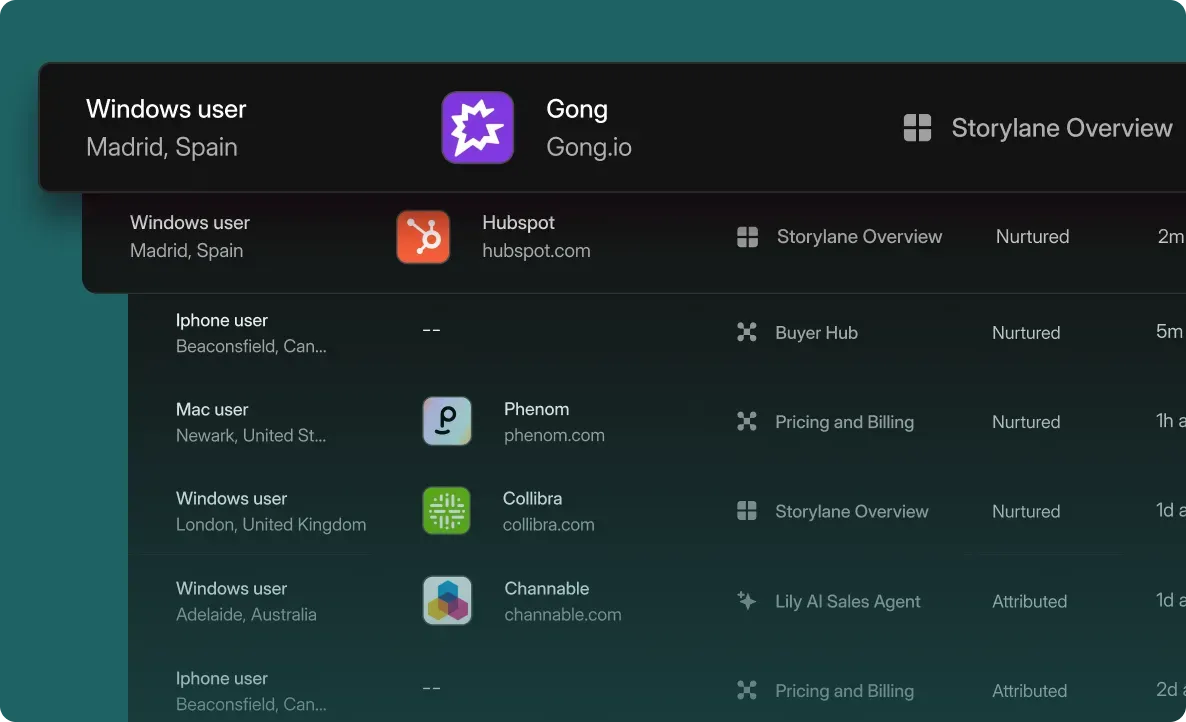
Storylane's analytics layer covers those questions:
- Account Reveal: Identify companies viewing demos by name, from the Starter tier, before they raise their hand
- A/B Testing: Run two demo variants head-to-head to find which drives more completions or downstream action, Growth+
- Engagement Scoring and alerts: Score prospects by demo behavior; get notified when a target account re-engages
- Deal Intelligence: Track per-stakeholder engagement inside active deals, who viewed, how long, which steps they replayed
- Tracking Links: Create channel-specific links to attribute demo views to campaigns, email sequences, or paid channels
- Personalized Demo Links: Generate individual prospect links so engagement data maps to specific contacts in your CRM
Read more: On A/B testing: Storylane's own data across 8,800 sessions shows single-flow demos under 12 steps complete at 34.66%. Over 12 steps, completion drops to 14.62%, a 2x+ difference. Without A/B testing, you can't measure that tradeoff in your own demos. You're using industry averages as a proxy for your specific audience.
Arcade has no A/B Testing, engagement scoring, alerts, or Deal Intelligence.
Verdict: Storylane wins here. Account Reveal tells you which companies are watching before they fill out a form. A/B Testing tells you which demo version converts. Arcade tells you how many people watched. Those answer different questions.
Sharing, distribution, and buyer enablement
Arcade publishes to a shareable link or embed code, standard website, and email placements.
Storylane covers the same embed and link sharing, plus:
- Hubs: Branded deal rooms where champions share demos, PDFs, videos, and other assets with their buying committee through a single link. Deal Intelligence tracks which stakeholders opened what. Ghost stakeholder detection surfaces, the contacts the champion didn't mention
- Presenter Mode: Run a demo live on a call without screen sharing; the presenter controls navigation, and the viewer sees only the demo
- Popup demos: Trigger demos as overlays rather than inline embeds, for conversion-focused placements
- Offline demos: Run at conferences and field events without internet
- RepX: Storylane's AI sales agent trains on product docs and call transcripts, handles async discovery, and qualifies prospects before routing to sales
Read more: On demo placement: inline demos drive 26% average CTR versus 23% for CTA buttons, across 130,000+ sessions.
Verdict: Storylane wins on distribution and buyer enablement. Arcade covers website embeds and email links. If that's your entire use case, Arcade is sufficient. If your demo program touches live sales calls, active deals, or field events, Arcade has none of the tools for those moments, no Presenter Mode, no Hubs.
A L&D and Sales Enablement Lead at a 5,000-person enterprise fleet technology company said of why their sales enablement team had outgrown it:
"Right now, Arcade is just a demo simulation software. We want something that's a little bit more multifaceted than just Arcade. Arcade is only used in our courses. Sales enablement wants to be able to use it in other ways."
Pricing: what you actually pay for
Arcade has three plans: Free, Growth at $42.50/seat/mo (billed annually), and custom Enterprise. Interactive HTML demos are Enterprise-only.
Arcade pricing at a glance:
- Free — $0: 1 published demo (plus 1 video), AI content assist, lead capture.
- Growth — $42.50/seat/mo (billed annually, up to 10 seats): unlimited demos, custom branding, advanced analytics, integrations.
- Enterprise — custom: adds interactive HTML demos, offline demos, SSO, and advanced controls.
How Arcade pricing compares to Storylane:
- Arcade's paid entry plan (~$42.50/seat) lines up with Storylane Starter ($40/seat) — not Storylane Growth ($500).
- HTML demos: Arcade gates them to Enterprise; Storylane includes them from Growth ($500/mo).
- A/B testing and offline demos: Enterprise-only on Arcade; available mid-tier on Storylane.
- AI usage: Arcade meters AI video by credits; Storylane's AI copy, voiceover, and translation are uncapped.
- Both offer a genuine free plan.
Arcade Pricing FAQ:
- How much does Arcade cost? Arcade's paid Growth plan is $42.50 per seat per month, billed annually, for up to 10 seats. Enterprise is custom-priced. There is also a free plan.
- Does Arcade have a free plan? Yes — one published demo plus one video, AI content assist, and lead capture. Storylane also has a free plan.
- Does Arcade offer HTML demos? Only on Enterprise. Storylane includes HTML demos from its $500/mo Growth plan.
- Is Arcade's Growth plan like Storylane's Growth plan? No. Arcade Growth (~$42.50/seat) maps to Storylane Starter ($40). Storylane Growth is $500/mo and adds HTML demos and A/B testing.
A co-founder and COO at an early-stage AI sales tech startup said directly:
"If you look at Arcade's pricing, it's significantly cheaper. Just because again they don't have a lot of what (Storylane) has."
Custom Domains and SSO on Arcade are Enterprise-gated. On Storylane, Custom Domains are available from Growth and SSO from Premium, both accessible without going to Enterprise.
Full comparison matrix
"Super easy to use, finished product feels polished with minimal effort, the support team is highly responsive and we have had inbound demo bookings driven by the Storylane videos on our website." - Holly Groom, product Marketing Lead (51-200 employees) | G2
How to choose
Choose Storylane if:
- Your demo program has moved past website embeds into sales enablement, live call delivery, or deal rooms
- Your product is complex enough that screenshot demos flatten the experience, HTML demos close that gap
- Marketing needs A/B testing to know which demo version converts, not just which one got more views
- Your team sells into multiple languages and needs localized demo content without re-recording
- You want to know which companies are viewing demos before they fill out a form
- You need Custom Domains or SSO without going to the Enterprise tier
Choose Arcade if:
- You're launching your first demo program and need something live within a day
- Your primary output is screenshots or HTML-guided demos for the website and email
- Your team is 1 to 3 people, and Arcade's per-seat Pro pricing fits your scale
- Budget is the primary constraint, and the features Arcade lacks aren't part of your current program
The bottom line
Arcade is a focused demo tool. Screenshot demos, HTML demos, basic analytics, shareable links, it does those things well. The features it doesn't have aren't obscure: A/B testing, Presenter Mode, Hubs, Deal Intelligence, Account Reveal beyond the basics, and RepX. Those are the features that come up once a demo program starts covering more than the website.
A revenue and GTM leader at a mid-market e-commerce analytics company said after evaluating both:
"We've been working with Arcade as well, but I think (Storylane) is more efficient."
The consistent pattern from teams that have made the switch: Arcade worked until the program needed to do more than create and share a link.
Storylane covers the full range: website embeds, HTML demos for complex products, live call delivery with Presenter Mode, buyer enablement via Hubs, and pipeline intelligence with Deal Intelligence and Account Reveal. If your demo program is just getting started and those features feel far away, Arcade is a reasonable starting point. If you can already see the next use case on the list, start with the platform that covers it.
Frequently asked questions - Arcade vs Storylane
Q. Is Storylane harder to use than Arcade?
For screenshot demos, the setup experience is comparable; both platforms use Chrome extensions for capture, and both have guided tour builders that non-technical users can operate without training. Storylane's HTML demo editor has a steeper learning curve. For teams whose primary output is screenshots or video demos, day-to-day, the experience is similar. The complexity shows up in advanced formats, not in basic demo creation.
Q. Does Arcade have A/B testing?
No. Arcade's analytics cover views, completion rates, and basic engagement. A/B testing is not available on any Arcade plan. Storylane offers A/B Testing from the Growth tier.
Q. Can Arcade demos be delivered live on a sales call?
Arcade demos can be screenshared like any browser tab. Storylane's Presenter Mode is different: the presenter controls the demo navigation from their side while the viewer sees only the product experience, no screenshare, no accidental window reveals, no lag from screen recording. Arcade has no Presenter Mode equivalent.
Q. What is Storylane Hubs, and does Arcade have something similar?
Hubs is Storylane's buyer enablement product: a branded deal room where champions share demos, PDFs, videos, and supporting content with their buying committee through a single link. Deal Intelligence tracks which stakeholders opened what and when. Arcade shares demos as individual links, no buyer enablement layer, no combined asset view, no multi-stakeholder tracking.
Q. How does Arcade's pricing compare to Storylane at team scale?
At a single seat, Arcade Pro ($32/mo annual) is slightly cheaper than Storylane Starter ($40/mo). At 5 seats, Arcade Pro runs $160/mo. Storylane Growth at $500/mo includes 5 seats and adds HTML demos, A/B Testing, Custom Domains, and a deeper analytics layer. The price gap reflects a capability gap, not just seat count.
Q. Does Storylane have a free plan?
Yes. Storylane's Free plan supports 1 seat with basic demo creation and 250 Account Reveal views per month. Arcade also has a free plan with core screenshot and HTML demo features. Both free tiers work for individual exploration; neither is built for a team demo program.