.svg)
How Storylane influenced 40.9% of Dreamdata's closed-won deals



.svg)
When Andrea Coloma joined Dreamdata as Senior Product Marketing Manager, her first instinct wasn't to build demos. It was to get everyone in the building to agree on what Dreamdata actually does.
Dreamdata is a B2B revenue attribution and data activation platform. Their buyers are companies with complex go-to-market stacks — long sales cycles, multiple stakeholders, and data flowing from CRMs, ad platforms, intent sources, and more. The primary users are demand generation, growth, and performance marketers. The people they report to — CMOs, CROs, and finance — want to see what that data translates to in pipeline and revenue.
A product like that doesn't sell itself in a single demo. It has to be understood first. That was Andrea's starting point.
.svg)
Where it started: documenting use cases
"When I got here, I wanted to hit the ground running and start by documenting our use cases — not only externally, but internally, for our sales teams, customer success, product, everyone," Andrea says. "The goal was, if someone started at Dreamdata on their first day and had to demo a use case, where would they go?"
The process was extensive. Andrea talked to customers. She ran alignment sessions across every team — from founders to CS reps — until there was consensus on which use cases were real, validated, and worth building around. She describes it like writing a thesis. "Everyone was involved. It was a lot of meetings."
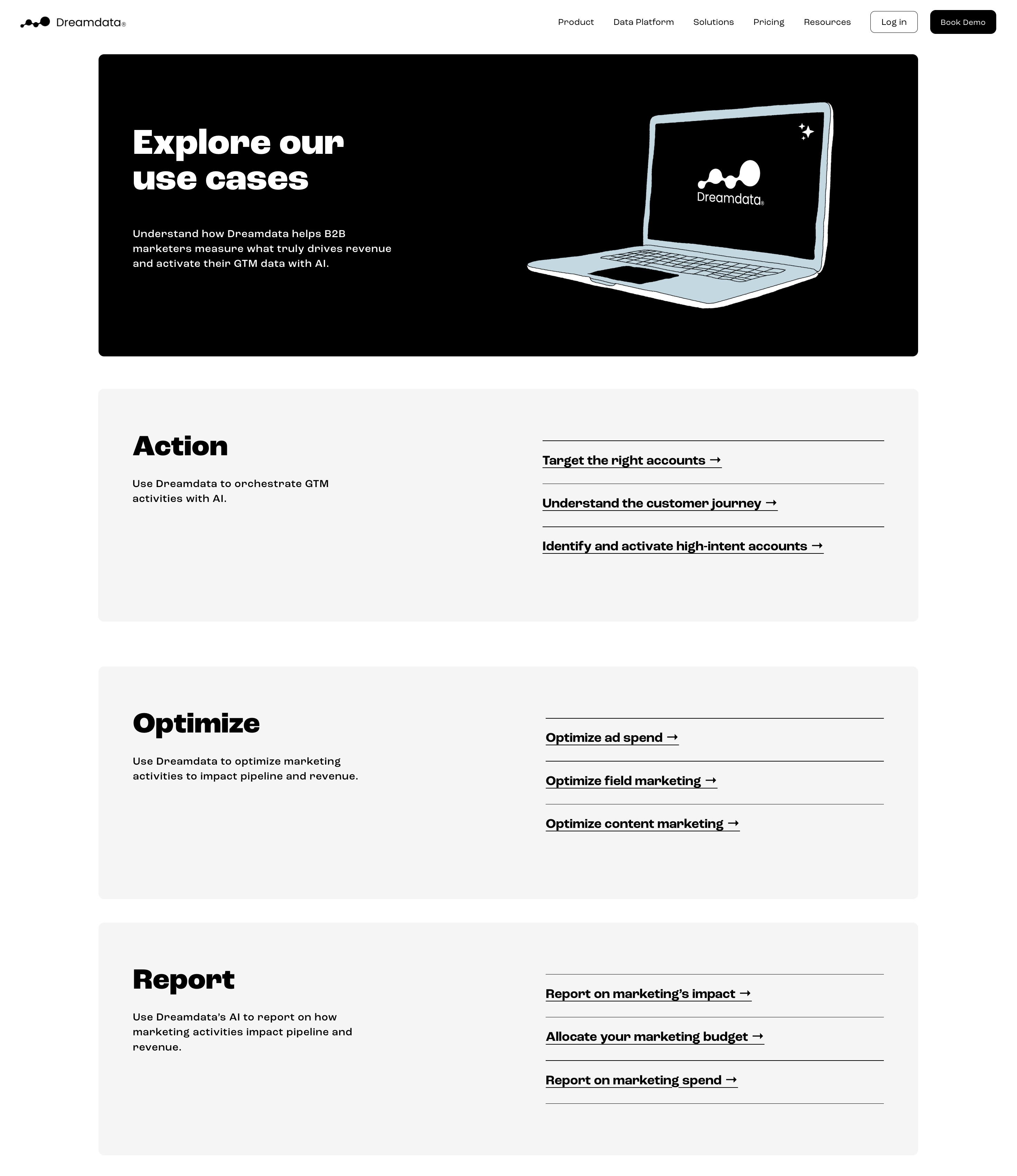
Only after that documentation was solid did interactive demos enter the picture. "The landing pages and the interactive demos were literally the end result," she says. "When everybody had agreed these are our use cases — when we had validated them, when everybody looked at each other in the eye and said yes — then they came out into the real world."
Building demos: intentional from the start
Andrea worked with a product marketing assistant, Camilla, who handled the Storylane builds. Because the scripting, use case logic, and positioning had already been worked out, execution moved quickly. The first demo took a couple of weeks to get right; after that, Camilla could turn one around in a day.
But the bigger decisions were about design, not speed.
Who is this demo for? Every demo was built from the perspective of the primary user — not the buyer, not the executive sponsor, but the practitioner who would actually use Dreamdata day to day. "For us, that's the paid marketer, the demand gen marketer, the growth marketer," Andrea says. "They want to see: where do I spend more money? Where do I save costs? How do I automatically optimize my LinkedIn and Google ads with offline conversion data? Every demo takes that perspective."
Don't let it run long. The first demo — optimizing ad spend, one of Dreamdata's strongest use cases — started as a one-to-one translation of the internal demo script. It was too long. "I asked Camilla to sit with a salesperson and go through it with them. If they get bored, if you lose their attention — that's when it needs to stop." The working rule became: if you think it's too long, your prospects will too.
Sales has final say. "Nothing was published without an okay from the sales team." This wasn't a courtesy review. Sales was the primary stakeholder throughout the demo-building process — specifically because the demos were meant to do what a good salesperson does before they even get on a call.
Weave in proof. One of Andrea's signature moves: mid-demo social proof. Customer stats and success moments are embedded directly into the flow — not saved for the end, not dropped in randomly, but placed at points where a real sales conversation would naturally reference them. "What if we just put in like, boom — this customer improved their ROAS by 68%? We said, why don't we do that? That sounds genius."

Giving buyers room to explore
Dreamdata's demos also make use of Storylane's branching and table-of-contents features in a specific way. Every demo has a visible chapter structure so prospects can navigate freely. And for features like Dreamdata's B2B customer journey reports — a fan-favorite that's technically relevant to every use case but would make each demo too long to include in full — there's an optional branch. "Do you want to see the customer journey? If yes, go. If you want to continue, you can do that too."
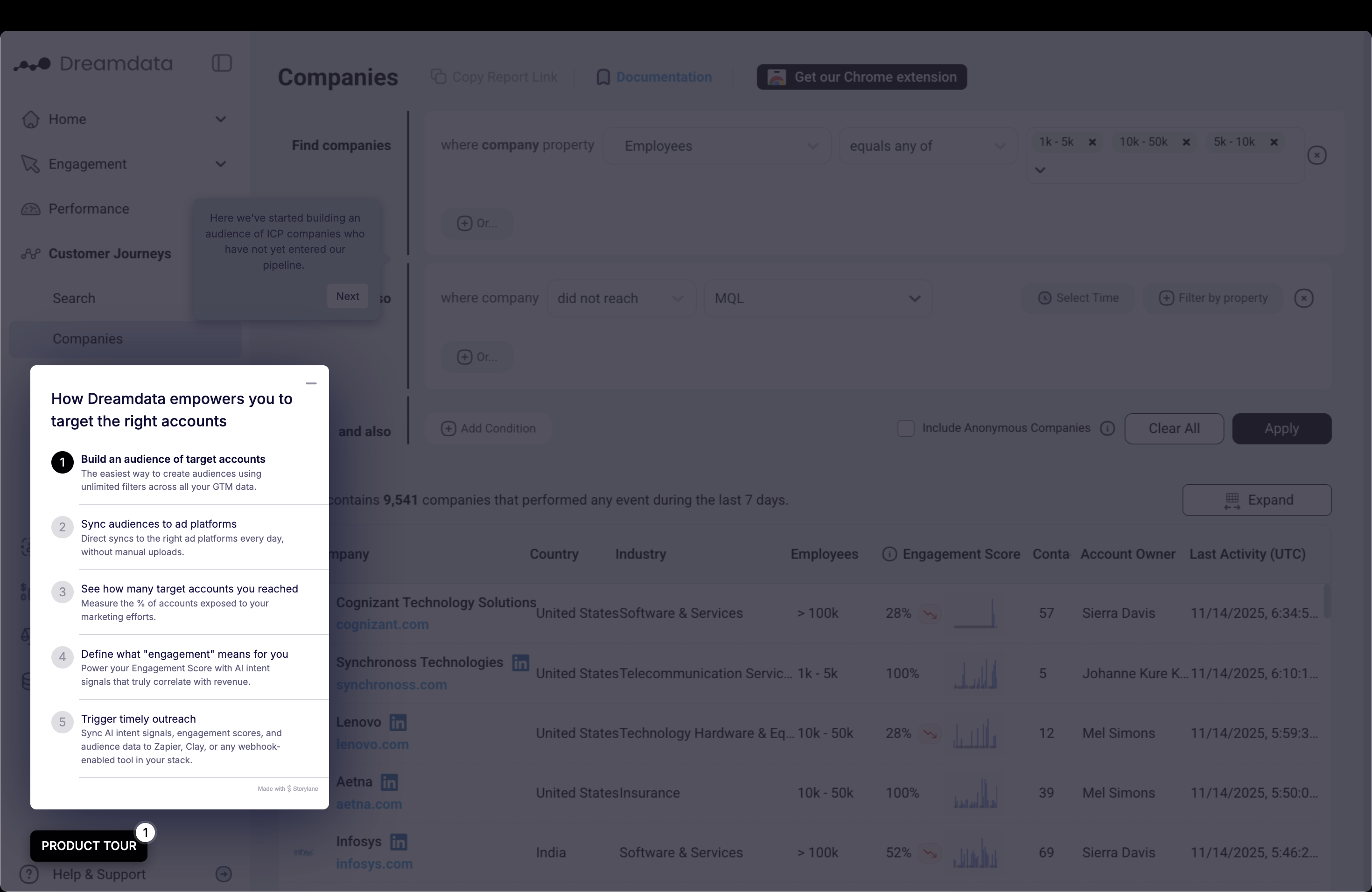
"We don't want people to feel trapped. These demos are scripted, yes. But if someone wants to skip to the ROI report or the offline conversion sync section, we want them to have that freedom."
Measuring the impact — with Dreamdata's own platform
Here's where the story gets a bit recursive: Dreamdata, a revenue attribution platform, used its own product to measure the impact of its Storylane demos.
Their RevOps team worked with Camilla to pipe Storylane engagement events — demo viewed 20%, 25%, 40%, 50%, 75%, and 100% — into Dreamdata via Zapier and a JavaScript integration. Once those events were in their data model, they could connect demo engagement to pipeline and revenue using the same attribution methodology they offer their own customers.
The results, reported as of this year:
- 40.9% of all closed-won new business was influenced by a use case demos
- 8.9% of SQLs touched a use case page before converting
- 4.3% of MQLs were influenced — and as Andrea notes, the early-stage numbers look modest until you realize that almost every buyer who eventually closed had touched at least one use case page
- 17% of renewals were influenced — a meaningful signal that the demos serve retention and expansion, not just acquisition
- The biggest deal in Dreamdata's history had a use case page in its journey
"The demos influenced our biggest deal yet"
.png)