
.svg)

Summary
Arcade is a credible interactive demo platform: 4.6 on G2, popular with design-led marketing teams running brand and PLG-focused screenshot demos. Two things changed in 2026 that triggered buyer evaluations of alternatives. First, Arcade's Growth plan pricing moved from $42.50/user/mo to $297.50/mo flat (with 5 included seats), which was a meaningful price hike per user for small teams. Second, Arcade quietly added HTML capture at the Growth tier and above, putting them in direct competition with HTML-first platforms they were previously adjacent to. The seven strongest alternatives in 2026 are Storylane, Supademo, Navattic, Guideflow, HowdyGo, Loom, and Tella. Storylane is the broadest fit for B2B SaaS GTM teams that need format versatility (HTML, screenshot, and video as first-class formats), accessible pricing across team sizes, full-stack AI in production, multi-format Hubs, and a live AI sales agent (RepX) that no Arcade product matches.
| # | Platform | Best for | G2 rating | Starting price |
|---|---|---|---|---|
| 1 | Storylane | B2B SaaS teams that need format versatility, enterprise readiness, and a live AI sales agent | 4.8 (1,405 reviews) | Free + $40/mo Starter |
| 2 | Supademo | Solo creators and SMB teams with multi-format demo needs | 4.7 (607 reviews) | Free + $38/creator/mo Pro |
| 3 | Navattic | Marketing teams that want HTML demos as the primary format | 4.8 (893 reviews) | Free + $500/mo Base |
| 4 | Guideflow | Product and onboarding teams primarily building guided product tours | 4.6 (varies) | Free + $35/mo Solo |
| 5 | HowdyGo | Small teams that want HTML demos at flat-rate unlimited-user pricing | 4.9 (83 reviews) | $159/mo Starter |
| 6 | Loom | Teams that need async video communication, not interactive demos | 4.7 (Atlassian) | Free + $15/user/mo Business |
| 7 | Tella | Solo creators and educators wanting polished async video with multi-track editing | 4.0 (smaller base) | Free + $12/mo Pro (annual) |
A note on perspective: Arcade has been one of the most dynamic competitors I've watched at Storylane. The 2026 pricing change shifted the conversation in a lot of buyer evaluations, and the addition of HTML capture at the Growth tier put them in direct competition with platforms they were previously adjacent to. What follows is the honest breakdown of where Arcade fits today, what's actually changed, and which alternatives I'd point you toward depending on what you're trying to solve.
Why look for an Arcade alternative
Arcade was purpose-built for design-led marketing teams that want polished screenshot demos for brand and PLG content. That's still what they're best at. Two things shifted in 2026 that made buyers start evaluating alternatives in earnest: a major Growth-tier pricing change (from $42.50/user/mo to $297.50/mo flat with 5 included seats) and the quiet addition of HTML capture as a tier-gated capability.
In conversations I've had with prospects evaluating both, four themes show up consistently.
1. The pricing shift was meaningful for small teams on the Growth plan. Under the old per-user pricing, a 3-person Growth team paid $127.50/mo. Under the new flat-rate Growth pricing, the same team pays $297.50/mo (the floor) for 5 seats they may not be using. For larger teams (8+ people), the flat-rate model is friendlier than per-seat would have been. But for the sub-5-person teams that were Arcade's natural customer base, the change effectively raised their bill by $170/mo.
2. HTML capture is now tier-gated, not a free upgrade. Arcade added HTML capture in 2025, but it sits behind the Growth tier ($297.50/mo) and above. For teams primarily on the $32/user/mo Pro plan looking to expand into HTML demos, that's a meaningful step up. Buyers comparing alternatives often discover that platforms like Storylane (HTML at the $500 Growth tier with broader format support) or Supademo (HTML at the $350/mo Growth tier as part of multi-format support) are price-competitive once HTML enters the equation.
3. Adoption is concentrated in marketing teams. As a learning and development manager at a mid-market B2B software company put it during a recent evaluation:
"Arcade is just a demo simulation software. We're looking for something a little more multifaceted than just Arcade. Arcade doesn't have unguided demos, they don't have testing capabilities, it kind of limits us. Sales enablement wants to be able to use it in other ways, but Arcade is only for learning and courses and curriculum building at our company."
That cross-functional gap is consistent across buyer profiles. Sales, pre-sales, and customer success teams that want to use the same platform marketing uses often find Arcade's product surface narrower than they need.
4. Support model and dedicated CSM access depend on tier. Per a co-founder at an early-stage AI sales performance startup on a recent evaluation call:
"We were looking at Arcade, but Arcade really doesn't support a dedicated CSM. If you look at Arcade's pricing, it's significantly cheaper than Storylane, but there's a reason why. They don't have as much. Do you want a platform that can help you, or do you just want to self-serve it yourself?"
For teams that value hands-on customer success investment, the Arcade model works at the entry tier but requires moving up to Enterprise to unlock dedicated support.
What Arcade is
Arcade is a screenshot-and-video-first interactive demo platform popular with design-led marketing teams. They added HTML capture in 2025 (Growth tier and above), but their primary content type remains screenshot demos and screen recordings with branching, custom branding, and synthetic voiceovers (their AI tools are collectively branded "Avery"). The product strength is visual aesthetic and design polish for top-of-funnel marketing demos, brand campaigns, and PLG content.
Pricing as of mid-2026: Free tier (3 demos, 200 AI credits, AI voiceover, Chrome extension, desktop app, Figma plugin, no time limit), Pro at $32/user/mo (or $27.20/user/mo annual), Growth at $297.50/mo flat (or $252.88/mo annual, includes 5 seats, $150 per additional seat), Enterprise custom (SSO, API, RBAC, dedicated support).
Arcade is a strong choice for marketing-led teams with a screenshot-demo-heavy content motion. The places where buyers look for alternatives: response to the 2026 pricing shift, expansion into HTML demos that requires Growth-tier upgrade, cross-functional GTM use beyond marketing, and dedicated CSM support before reaching Enterprise tier.
How we evaluated alternatives
We evaluated each platform on seven dimensions: demo format support (screenshot, HTML, video, sandbox), pricing accessibility, AI capability completeness, GTM versatility (marketing-only vs cross-functional), customer reviews and G2 reputation, native integrations, and where each platform falls short. Every alternative below gets an honest tradeoff section, not a sales pitch.
Pricing is verified against vendors' current public pricing pages where available. G2 ratings reflect data verified May 5, 2026. Where pricing is enterprise-only and not publicly listed, we say so explicitly.
The 7 best Arcade alternatives in 2026
1. Storylane: best overall Arcade alternative
Best for: B2B SaaS marketing, sales, and pre-sales teams that want format versatility (screenshot, HTML, video as first-class formats), enterprise readiness, full-stack AI in production, and a live AI sales agent.
Storylane is our product. I work on it. The honest tradeoff at the end of this section is where I cover what Arcade does better than we do. Storylane is the #1 ranked demo automation platform on G2 with a Satisfaction Score of 99 across 1,405 reviews. The product spans two product lines.
Demo Suite is the demo creation and distribution platform: HTML, screenshot, and video demos built in a unified editor; Sandbox Demos for code-free interactive product environments; and Hubs for multi-format buyer experiences combining demos, PDFs, videos, and embeds in one shareable surface. The Demo Suite ships with a full AI capability set: AI voiceovers (with in-app voice recording), AI video avatars in production, AI content generation, video-to-demo capture, and translations into 25+ languages.
RepX is the live, multimodal AI sales agent. RepX runs on your website, qualifies inbound visitors via real conversation across voice, video, and text, surfaces case studies and pricing alongside demos, and books meetings with sales-ready prospects.
5,000+ customers use Storylane, including HubSpot, Microsoft, Okta, Palo Alto Networks, SentinelOne, Silicon Valley Bank, and Gong. SOC 2 Type 2 and GDPR compliant. A quarter of Storylane's workforce is in support and customer success; onboarding and 24x7 support are included on every paid plan.
Where Storylane wins (vs Arcade):
- Format versatility: HTML, screenshot, and video as three first-class formats in a unified editor, not gated to higher tiers
- Live AI sales agent (RepX): no Arcade equivalent
- Enterprise customer footprint and 1,405 G2 reviews vs Arcade's smaller and more SMB-skewed base
- AI suite breadth: in-app voice recording for voiceovers + AI video avatars in production
- Multi-format Hubs (demos, PDFs, videos, embeds in one shareable surface)
- Cross-functional GTM positioning (marketing + sales + pre-sales + CS) vs Arcade's marketing-only adoption pattern
- Built-for-Sales features at Premium tier (Presenter Demos, Deal Intelligence, Offline Demos)
- Dedicated CSM included at Growth tier ($500/mo); Arcade reserves dedicated support for Enterprise
Honest tradeoff: Arcade is the design-led screenshot demo specialist. Their visual conventions, polish, and branding tools for screenshot-based demos are genuinely strong, particularly for marketing teams creating brand-aligned content. If your demo program is exclusively screenshot demos for top-of-funnel marketing campaigns, Arcade's visual aesthetic may suit your brand better than Storylane's. Arcade also offers a more accessible Pro tier at $32/user/mo for individual designers and small marketing teams compared to Storylane's $40/mo Starter.
"Storylane's by far the easiest and most reliable out of other competitors." Martin Kurowski, Product Marketing Manager, Rockwell Automation
G2 rating: 4.8/5 (1,405 reviews), ranked #1 in Demo Automation, Satisfaction Score 99/100.
Pricing: Free, Starter $40/mo, Growth $500/mo, Premium $1,200/mo, Enterprise custom. 20% discount on annual billing.
2. Supademo: best for solo creators and SMB teams
Best for: Solo creators, individual marketers, and small businesses wanting multi-format demos (HTML, screenshot, video, Figma) with accessible per-creator pricing.

Supademo is positioned as accessible interactive demo software for SMB and individual builders. They're rated 4.7 on G2 across 607 reviews and were named G2's fifth fastest-growing software product in 2025. The product surface includes HTML/CSS demos (GA since late 2024), screenshot demos, video walkthroughs, Figma plugin imports, multi-demo Showcases, an In-App Demo Hub, conditional branching, sandbox demos, dynamic variables, AI voiceovers, AI Demo Audit (a unique feature that scores demos and flags drop-off risk), and translations into 15 languages.
Where Supademo wins:
- Multi-format support: HTML, screenshot, video, and Figma all in one product
- Per-creator pricing model ($38/creator/mo Pro) can be cheaper than per-seat for small teams with one or two heavy creators
- AI Demo Audit is a unique feature for scoring demos and identifying drop-off risk
- 14-day free trial with no credit card required
- Sandbox demos at lower paid tiers (vs Arcade's no sandbox)
- Strong adoption in the product-led SMB segment
Honest tradeoff: Smaller G2 community than category leaders (607 reviews vs Storylane's 1,405). Customer base concentrates at SMB and startups, not enterprise. Polish in the demo viewing experience is consistently noted as less mature than Storylane's. No live AI sales agent. Narrower CRM integration depth.
G2 rating: 4.7/5 (607 reviews).
Pricing: Free, Pro $38/creator/mo, Scale/Enterprise custom (~$50+/creator/mo for teams 25+).
3. Navattic: best for HTML-first marketing teams
Best for: Marketing teams that build website-embedded HTML demos and want HTML demos as the primary format with mature commenting workflows.
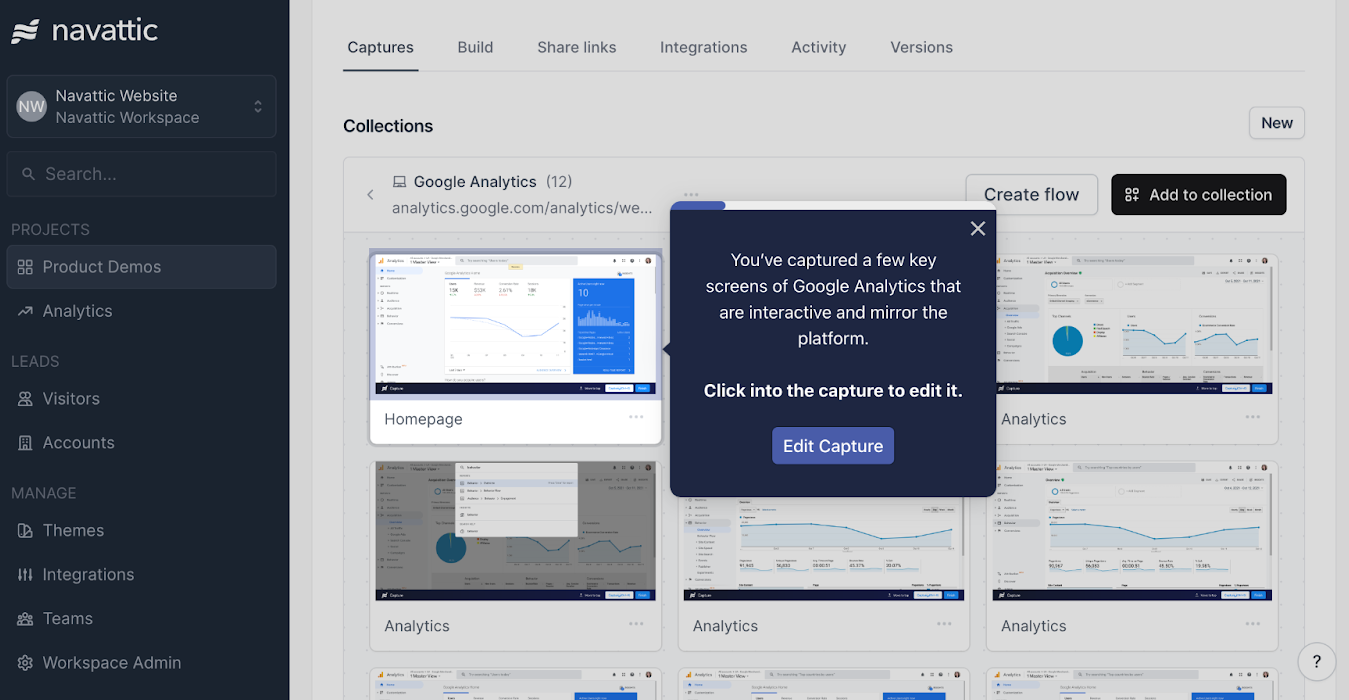
Navattic is an interactive demo platform built around HTML/CSS demo capture. They're rated 4.8 on G2 across 893 reviews and ranked #3 in Demo Automation. The product centers on HTML demos, with adjacent products Launchpad (sales demo collection, released September 2025) and Agent Demos (autonomous AI demo walkthroughs, beta 2026). Their February 2026 release added unified building view, A/B testing, voiceovers (text-to-speech and uploaded audio), animating text, and Recapture (auto-recapture when product UI changes).
Where Navattic wins:
- Mature HTML demo capture (their original product, refined over 5+ years)
- Native in-product commenting and threaded collaboration on demos
- Recapture feature (unique to Navattic)
- Native Amplitude and Chameleon integrations
- Sandbox demos at $1,000 Growth tier
Honest tradeoff: HTML-first means video and standalone screenshot demos are secondary formats. Pricing jumps from Free directly to $500/mo Base (no entry paid tier under $500). For teams currently on Arcade's $32/user/mo Pro plan, the jump to Navattic's $500/mo Base is significant. Marketing-led customer concentration; cross-functional adoption is narrower than Storylane.
G2 rating: 4.8/5 (893 reviews), ranked #3 in Demo Automation, Satisfaction Score 95/100.
Pricing: Free, Base $500/mo, Growth $1,000/mo, Enterprise custom.
4. Guideflow: best for guided product tours
Best for: Product, marketing, or onboarding teams that need guided product tour functionality more than full interactive demos.

Guideflow focuses on guided product tours: step-by-step walkthroughs that highlight key product features. They support sandbox demos at a basic level. Five-tier pricing structure (most granular in the category): Free (5 guideflows, screenshot capture, 7-day analytics, 3 team members), Solo $35/mo, Growth $499/mo (HTML capture unlocks), Advanced $1,499/mo, Enterprise $2,999/mo.
Where Guideflow wins:
- Strong guided demo specialization
- Sandbox demo support at lower tiers
- Five-tier pricing offers flexibility at multiple budget points
- Free tier with real capabilities (5 guideflows, unlimited views)
Honest tradeoff: Reported lagginess and crashes per G2 reviewer feedback. Missing relative to category leaders: AI Avatars, multi-format Hubs, Presenter Mode, Offline demos, intent signals, native A/B testing.
G2 rating: 4.6/5.
Pricing: Free, Solo $35/mo, Growth $499/mo, Advanced $1,499/mo, Enterprise $2,999/mo.
5. HowdyGo: best for small teams wanting HTML demos at flat-rate unlimited-user pricing
Best for: Small teams (4-10 people) that want HTML demos and value flat-rate pricing with unlimited users over per-seat scaling.
HowdyGo is a bootstrapped, founder-led demo automation tool focused exclusively on HTML demos. The product is intentionally narrow: HTML demos done well, with everything else as a deliberate non-goal. Distinctive pricing model is flat rate with unlimited users on every plan. No per-seat charges, no demo limits.
Where HowdyGo wins:
- Flat-rate unlimited-user pricing ($159/mo Starter is cheaper than per-seat platforms for teams of 4+)
- Pixel-perfect HTML demos with no-code editor
- Three outputs from a single recording (interactive HTML demo, video, GIF)
- Hands-on founder support via shared Slack channels for paying customers
- 14-day free trial, no sales call required
- 4.9 G2 rating (small but strongly rated review base)
Honest tradeoff: No SOC 2 Type 2 published audit (documented security controls and annual penetration testing, but no formal certification on the website). Procurement-heavy enterprise buyers may flag this. No free plan. No screenshot or standalone video formats. No sandbox demos. No multi-format Hubs or DSR. Native demo analytics are gated to the $399/mo Pro tier. Smaller G2 community (83 reviews).
G2 rating: 4.9/5 (83 reviews).
Pricing: $159/mo Starter (unlimited users, all core features), $399/mo Pro (adds analytics + integrations), Enterprise custom.
6. Loom: best for async video communication
Best for: Teams whose product walkthroughs work as one-way async video and don't need clickable interactivity, lead capture, or demo personalization.
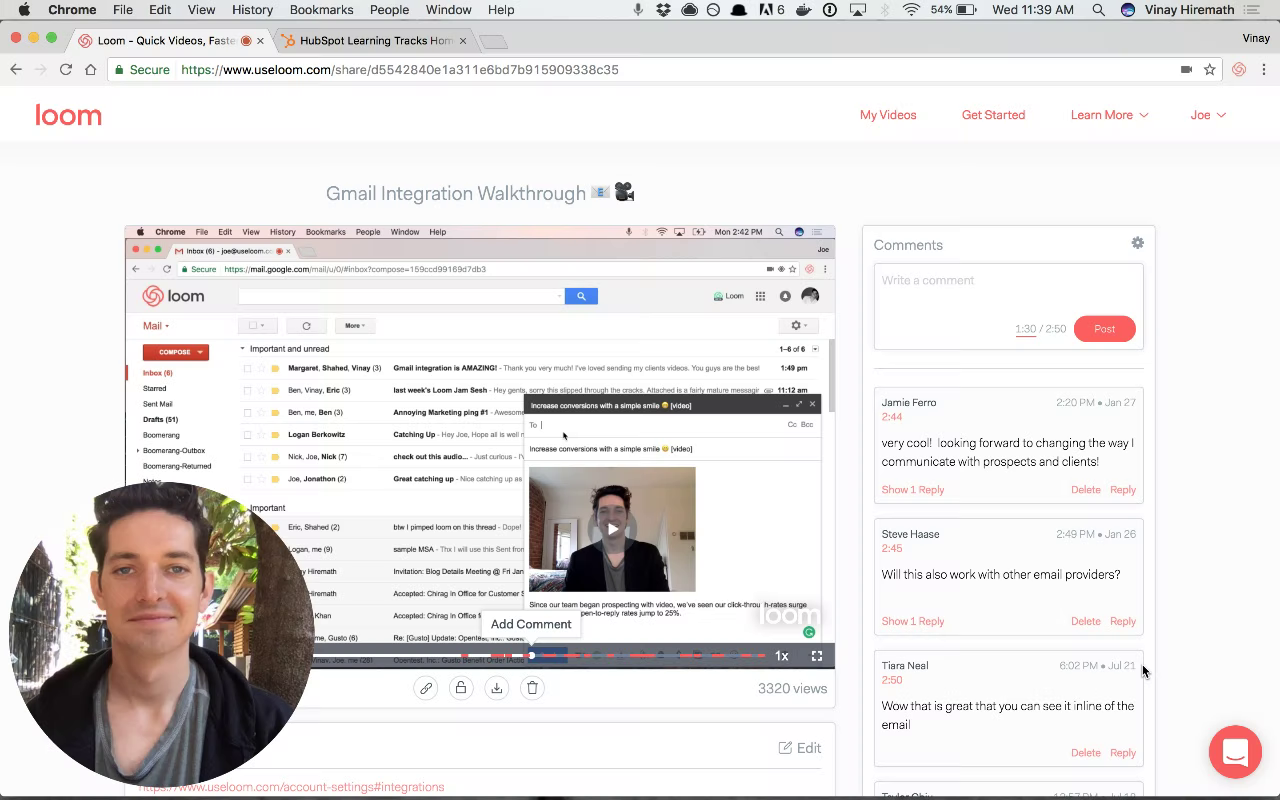
Loom is async video communication, not interactive demo automation. Now part of Atlassian. The product surface: screen and camera recording, instant link sharing, basic engagement analytics, plus the Loom AI suite (auto titles, summaries, chapters, filler/silence removal, video-to-text). It belongs on this list because many teams searching for Arcade alternatives are coming from a Loom-first motion or considering whether to upgrade from async video to interactive demos.
Where Loom wins:
- Free Starter tier with real capabilities for getting started (25 videos, 5-min limit)
- Business plan at $15/user/mo (annual): the most accessible entry point on this list
- Atlassian-backed reliability, integrations, and security posture
- HIPAA compliance available at Enterprise tier
- Loom AI suite for video summarization and transcription
Honest tradeoff: Loom is a different product category. No interactive demos (no clickable hotspots, no guided tours, no HTML capture, no sandbox). Prospects watch, they don't click. Engagement signal is limited to view counts and watch duration. The moment you need click-through analytics, lead capture, or scaled demo personalization, you've outgrown Loom for demo purposes.
G2 rating: 4.7/5 (very large review base, Atlassian-owned).
Pricing: Free Starter (25 videos, 5-min limit), Business $15/user/mo, Business + AI $20/user/mo, Enterprise custom.
7. Tella: best for solo creators wanting polished async video with multi-track editing
Best for: Solo creators, educators, and content creators who want a higher-production async video tool than Loom with more sophisticated editing capabilities.
Tella is a browser-based screen recording and editing platform. Like Loom, it's async video, not interactive demo automation. The differentiator vs Loom is editing depth: Tella records screen and camera as separate tracks, lets you pick from 30+ layouts in post-production, and includes AI-powered features like filler word removal, automatic transitions, and auto-applied layouts.
Where Tella wins:
- Screen + webcam recording with separate tracks (key differentiator vs Loom's single composite)
- 30+ layout options for combining screen and camera in the final video
- AI-powered filler word removal, transitions, layout suggestions
- 4K export
- Custom backgrounds, presets, zoom effects
- Automatic editable subtitles
- Free tier available
Honest tradeoff: Same fundamental limitation as Loom: this is an async video tool, not an interactive demo platform. No clickable hotspots, no guided tours, no HTML capture, no sandbox demos, no demo personalization, no lead capture, no engagement analytics beyond basic view counts. Smaller community than Loom or Arcade. Best fit for solo creators and educators rather than B2B GTM teams running scaled demo programs.
G2 rating: 4.0/5 (smaller review base).
Pricing: Free, Pro $19/mo or $12/mo annual, Premium $49/mo or $39/mo annual, Team custom.
Comparison matrix: all 7 platforms side by side
| Storylane | Supademo | Navattic | Guideflow | HowdyGo | Loom | Tella | |
|---|---|---|---|---|---|---|---|
| G2 Rating | 4.8 | 4.7 | 4.8 | 4.6 | 4.9 | 4.7 | 4.0 |
| G2 Reviews | 1,405 | 607 | 893 | varies | 83 | very large | smaller |
| Demo Automation Rank | #1 | #4 | #3 | #5 | varies | n/a (not category) | n/a (not category) |
| Free Tier | Yes | Yes | Yes | Yes | No (14-day trial) | Yes | Yes |
| Entry Paid Tier | $40/mo | $38/creator/mo | $500/mo | $35/mo | $159/mo | $15/user/mo | $12/mo (annual) |
| Self-serve trial | Yes | Yes | Yes | Yes | Yes | Yes | Yes |
| HTML demos | Yes (Growth+) | Yes (Growth+) | Yes (native) | Yes (Growth+) | Yes (native) | No | No |
| Screenshot demos | Native | Yes | Secondary | Yes | No | No | Limited |
| Video demos (standalone) | Native | Limited | Limited | Limited | No (export only) | Native (async only) | Native (async only) |
| Sandbox demos | Enterprise | Yes (lower tiers) | Growth ($1K) | Basic | No | No | No |
| Multi-format Hub / DSR | Yes (Hubs) | Showcases + In-App Hub | LaunchPad (demos only) | No | No | No | No |
| AI voiceovers (in-app recording) | Yes | No (TTS) | No (TTS + upload) | No | Limited | Yes (Loom AI) | Yes (filler removal) |
| AI video avatars (production) | Yes | No | Beta | No | No | No | No |
| Live AI sales agent | Yes (RepX) | No | Agent Demos (beta) | No | No | No | No |
| Cross-functional GTM | Yes | Marketing / SMB | Marketing-led | Product / Marketing | Marketing-led | Async video (any team) | Solo creators / educators |
| SOC 2 Type 2 | Yes | Yes | Yes | Yes | Documented controls only | Yes | Verify |
| GDPR | Yes | Yes | Yes | Yes | Yes | Yes | Yes |
| ISO 27001 | No | No | No | No | No | No | No |
How to choose the right Arcade alternative
The right alternative depends on what specifically led you to start looking. Here's how I'd think about it, framed by the problem you're trying to solve.
You're responding to the 2026 pricing change and want a similar visual-aesthetic screenshot demo tool at lower cost. Storylane Starter at $40/mo (vs Arcade Pro at $32/user/mo) is competitive at small team sizes and includes broader format support. Supademo Pro at $38/creator/mo is also competitive and adds HTML, sandbox, and Showcases as part of the standard Pro tier.
You're expanding into HTML demos and want them as a first-class format, not gated to a higher tier. Storylane (HTML at Growth $500), Navattic (HTML native at $500 Base), or HowdyGo (HTML at the entry $159/mo Starter for unlimited users). Supademo includes HTML in their Growth tier ($350/mo).
You want cross-functional GTM adoption beyond marketing. Storylane is the strongest fit. Built-for-Sales features at Premium tier, native Salesforce App, and RepX (a live AI sales agent that surfaces case studies, pricing, and books meetings) all support multi-team adoption.
You want async video instead of interactive demos. Loom for the most accessible async video at $15/user/mo. Tella for higher-production solo creator content with multi-track editing. Note that switching from interactive demos back to async video is usually a step backward in demo program maturity for B2B GTM teams.
"Storylane has allowed us to create a suite of micro demos that we can use to promote our product, as well as building out lots of demos for customer onboarding and education." - Russell Mitchell (11-50 employees, switched from Arcade) | G2
You're a solo creator or small SMB team. Storylane Starter or Supademo Pro for interactive demos with full AI capabilities. Loom or Tella for async video walkthroughs.
You want HTML demos at flat-rate unlimited-user pricing. HowdyGo at $159/mo for teams of 4-10 people that don't need analytics until $399/mo Pro tier.
You need a live AI sales agent that surfaces case studies, pricing, and books meetings. Storylane RepX is the only production option in this list.
The bottom line
If you're evaluating Arcade alternatives in 2026, here's how I'd boil it down. Storylane is the strongest overall fit for B2B SaaS GTM teams that need format versatility (HTML, screenshot, video as first-class formats), accessible pricing across team sizes, full-stack AI in production, multi-format Hubs, and a live AI sales agent (RepX).
The common thread among teams comparing Arcade alternatives in 2026 is one of two triggers: response to the Growth-tier pricing change, or expansion into HTML demos that surfaces price-competitive multi-format alternatives. The right alternative depends on which trigger you're responding to. If you want HTML demos at flat-rate unlimited-user pricing, HowdyGo is the cleanest fit. If you want async video instead of interactive demos, Loom or Tella are honest answers. If you want a multi-format demo platform with broader AI capabilities than Arcade, Storylane or Supademo are the strongest options.
Each tool has its place. Pick the one that matches your team's specific goals and constraints.
See how Storylane compares, live
Outgrowing Arcade's free plan? Get a personalized walkthrough and see how fast your team can ship demos that qualify buyers and book more meetings.
Book a demoFrequently asked questions
What's the best free Arcade alternative?
The strongest free Arcade alternatives are Storylane, Supademo, Navattic, Guideflow, and Loom. Storylane's free plan includes 1 published demo, AI Suite (Free), Lead Capture, Video Recordings, and Slack integration. Supademo's free tier includes 5 demos and unlimited screenshots. Loom's free Starter plan includes 25 videos with a 5-min limit. Choice depends on whether you want interactive demos (Storylane, Supademo, Navattic, Guideflow) or async video (Loom).
Which Arcade alternative is best for sales teams?
Storylane has the broadest sales-team product surface: Built-for-Sales features (Presenter Demos, Deal Intelligence, Offline Demos), native Salesforce App, and RepX (a live AI sales agent that qualifies inbound and books meetings). Arcade's sales-team adoption pattern is narrower than Storylane's because Arcade is primarily marketing-led.
How does Arcade's 2026 pricing change affect my evaluation?
Arcade's Growth plan moved from $42.50/user/mo to $297.50/mo flat (with 5 included seats, $150 per additional seat) in 2026. For teams of 1-4 people on the Growth plan, this raised effective cost per user. For teams of 6+ people, the flat-rate model is friendlier than per-seat would have been. The shift triggered evaluation conversations because the floor price became less accessible for small marketing teams that were Arcade's natural ICP.
Does Arcade support HTML demos?
Yes, but at the Growth tier ($297.50/mo flat) and above. Arcade added HTML capture in 2025 as a tier-gated capability. Their primary content type remains screenshot demos and screen recordings.
Can I migrate from Arcade to another platform easily?
Yes. Multiple Storylane customers have migrated demo programs from Arcade. The process typically takes a few days for small libraries (under 20 demos) and a few weeks for larger ones, depending on demo complexity and customizations. Most platforms offer a migration walkthrough; talk to their team for specifics.
Why is Storylane ranked #1 on G2 in Demo Automation?
Storylane has a G2 Satisfaction Score of 99/100 across 1,405 verified reviews, the highest in the Demo Automation category. The score factors in real-user ratings on satisfaction, ease of use, ease of setup, product direction, and other dimensions. Storylane has more than 17x the review base of Arcade.
Which platform has the best AI features?
Storylane has the broadest AI capability set in production: AI voiceovers with in-app voice recording, AI video avatars (production, not beta), AI content generation, video-to-demo capture, AI Hub Creation, and RepX (a live AI sales agent). Arcade has Avery AI for voiceovers, copy generation, and translations. Supademo has AI voiceovers, AI Demo Audit, and 15-language translation. The depth differs significantly.
Is Loom or Tella a real Arcade alternative?
Loom and Tella are different product categories. Both are async video tools, not interactive demo platforms. They belong on this list because some Arcade evaluators are also considering whether to upgrade or downgrade between async video and interactive demos. If your demo program needs prospect interactivity, click-through analytics, lead capture, or scaled demo personalization, Loom and Tella are downgrades from Arcade. If your needs are simpler (one-way product walkthroughs and async sharing), they're cheaper and more focused tools.
About this guide: Demo automation is one of the fastest-evolving categories in B2B SaaS. AI capabilities ship monthly, pricing changes quarterly, and vendor acquisitions reshape the competitive landscape regularly. We refresh this article every 90 days against verified primary sources: vendor pricing and product pages, G2 reviews, recent prospect conversations, and our own competitive testing. The "Last updated" date at the top reflects our most recent verification cycle, so you're working with the most current information available.