
.svg)

Summary
Most teams searching this comparison arrive from the same place: they published a demo on HowdyGo, someone asked how it performed, and the answer was "analytics are on the Pro plan." That's a reasonable trigger. Below is what actually matters when choosing between the two.
What HowdyGo gets right
HowdyGo is a bootstrapped tool built by a small distributed team across Australia and Europe. Its commercial model is genuinely different from every other platform in this category, and that difference is worth naming clearly before making any comparative argument.
- Unlimited users across all plans. Every HowdyGo plan, Starter, Pro, and Enterprise, includes unlimited seats at no extra charge. For a 10-person GTM team where marketing, sales, and CS all need access, the pricing math is straightforward: one flat monthly fee regardless of headcount. Competitors, including Storylane, charge per seat on most plans. G2 reviewers consistently name this as the deciding factor over per-seat alternatives.
- HTML capture from $159/mo. HowdyGo includes HTML capture at its Starter plan. Storylane's HTML Demo Editor requires Growth at $500/mo (annual). For teams building technically interactive demos who don't yet need analytics or integrations, HowdyGo's HTML entry point is roughly 3x cheaper.
- Single capture, three output formats. One recording in HowdyGo exports as an interactive demo, a video, and a GIF simultaneously. For small teams distributing demos across a website, an email, and a social channel, that's a real efficiency gain. Storylane handles each format separately.
- Founding team support. G2 reviewers consistently flag responsive, hands-on support from the people who actually built the product. For early-stage teams where implementation friction is a blocker, that kind of direct access matters
HowdyGo is a legitimate choice for teams under ten people who need clean HTML demos, want to avoid per-seat pricing, and don't yet need analytics, intent scoring, or deal room functionality. The case for looking further is about what the platform doesn't do, not about what it does poorly within its intended scope.
Demo capture
Both platforms support screenshot capture and HTML capture. That's where the feature parity ends.
HowdyGo's approach: HTML capture is available from the Starter plan ($159/mo annual). A single recording session exports three formats simultaneously: interactive demo, video with auto-progression and zoom/pan effects, and an animated GIF. The zoom/pan video output is a differentiated capability for teams that want a cinematic feel for social or campaign assets without a separate video production step.
Meanwhile, Storylane is a multi-format demo automation platform with Guided Demos (screenshot + video), HTML Demos, Sandbox Demos, and Video-to-Demo (AI-converted). Screenshot capture is available from Starter ($40/mo annual). HTML Demos are available at Growth plans ($500/mo annual). Sandbox Demos, live product clones in an isolated environment, are Enterprise only.
Verdict: For teams whose primary need is HTML capture at a low entry price, HowdyGo's $159/mo Starter undercuts Storylane's $500/mo Growth plan. For teams that need Sandbox Demos for live product environments, or Video-to-Demo conversion for existing recordings, Storylane is the only option in this comparison.
AI capabilities and production speed
HowdyGo's approach: AI demo creation and AI voiceovers are confirmed features. The platform does not offer AI video avatars, AI Translations, or AI Hub Creation.
Storylane's approach: Demo Suite includes AI Demo Creation, AI Video Avatars, AI Voiceovers (25+ languages with 50+ voices), Video-to-Demo conversion, and AI Translations. AI Hub Creation (launched April 2026) automates Hubs setup from existing demo assets. These capabilities live in the same editor where you capture screens: no export, no third-party tool handoff.
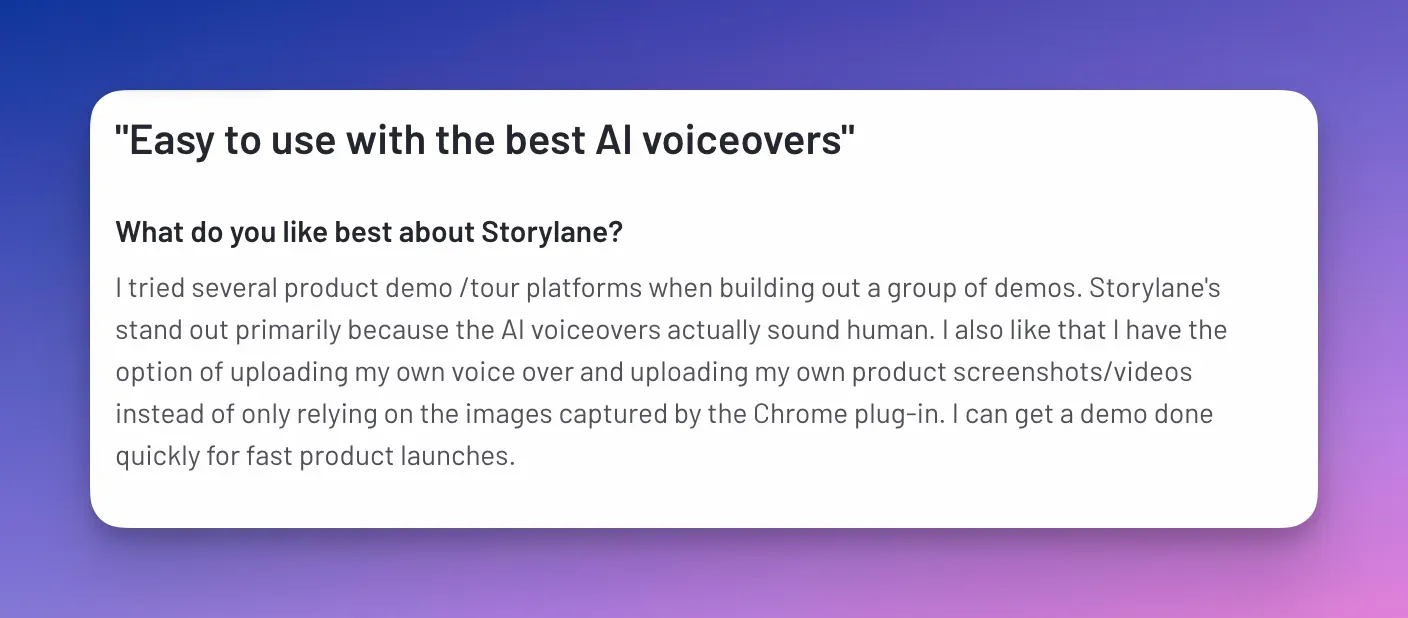
The production speed gap becomes concrete at volume. Michael DeMarco at Phenom built 35 demos in 3 weeks using Storylane's AI-assisted workflow for a flagship tradeshow, a rate that would have required dedicated design resources without the AI layer. A separate 5-person marketing team created 1,500+ screenshot demos in a single quarter using Storylane's bulk workflows.
Also read: Five ways B2B teams are using interactive demos that nobody talks about
For multilingual GTM teams, Storylane's 30+ language voiceover support enables localized demo assets without re-recording. HowdyGo offers AI voiceovers; the number of supported languages is not confirmed in public documentation.
Verdict: Storylane wins on AI depth. For a team building a single demo in English for a landing page, the gap is irrelevant. For teams producing demos at volume, in multiple languages, or with video avatar content, Storylane's AI layer removes the dependency on design and engineering resources that HowdyGo's current capability set reintroduces.
Analytics and pipeline visibility
This is the most common inflection point in this comparison. It's also where the platforms diverge most sharply by pricing tier.
HowdyGo's approach: Demo analytics (views, engagement, completion) are available on Pro and above. Pro is $399/mo (annual billing). Starter at $159/mo has no analytics access. Account Reveal (visitor deanonymization), engagement scoring, intent signals, and A/B testing are not confirmed on any HowdyGo plan.
Storylane's approach: Analytics are available from Starter ($40/mo annual). Account Reveal (identifying anonymous visitors by company) is included from Starter with 250 reveals/month, scaling to unlimited at Enterprise. A/B Testing is available from the Growth plan onwards. Deal Intelligence, which surfaces engagement signals at the account level back into the CRM, is available on Premium+.
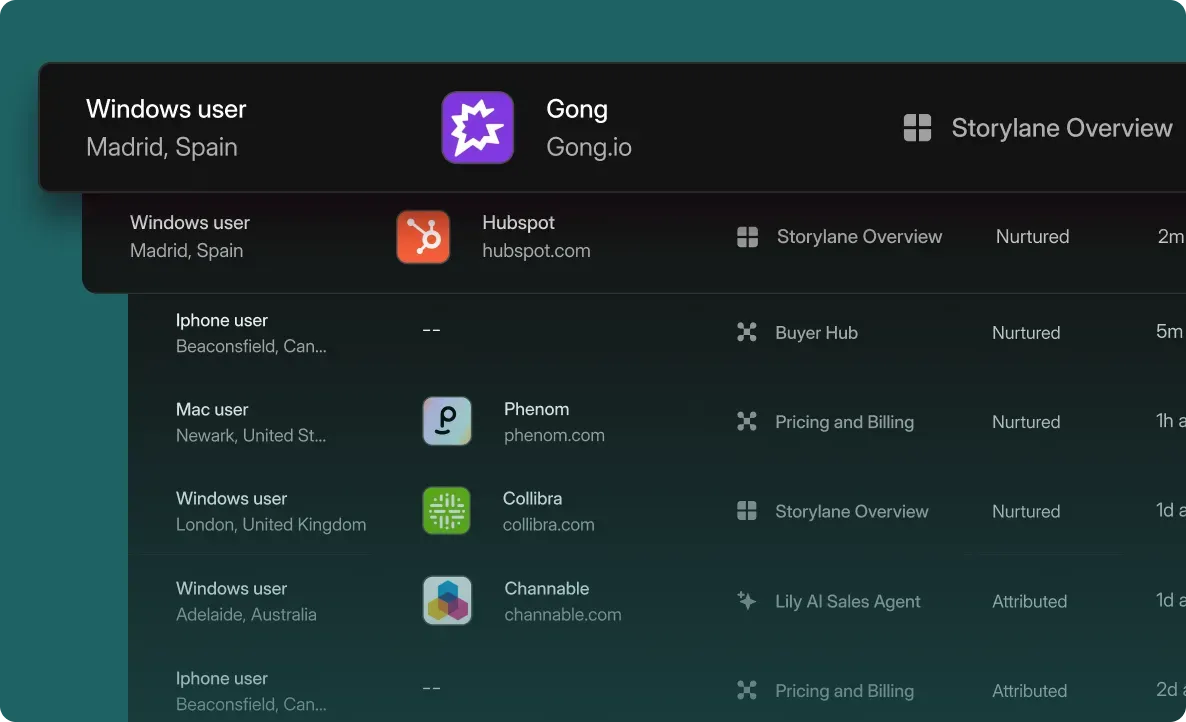
The pipeline impact of demo analytics is measurable. Across 110,257 web sessions in Storylane's research, prospects who engaged with an interactive demo converted at 24.35% vs. a 3.05% baseline: a 7.9x improvement. Knowing which accounts are engaging, and surfacing that signal to sales before the follow-up call, is what separates a demo as content from a demo as a pipeline instrument.
"We can see exactly which screens are getting people stuck or where they're dropping off. That kind of insight doesn't exist when you're just sending a link." — Storylane customer, Director of Product Marketing, cybersecurity SaaS.
Verdict: For teams on HowdyGo Starter, analytics don't exist. For teams on HowdyGo Pro ($399/mo), basic analytics are available but without account-level intent data or CRM sync. Storylane includes analytics at $40/mo Starter, with account identification, A/B testing, and intent scoring at growth tiers. If pipeline visibility matters, the comparison ends here.
Integrations and GTM infrastructure
HowdyGo's approach: CRM integrations, Salesforce, and HubSpot, are confirmed on the Pro plan ($399/mo annual). The HowdyGo JS SDK is also available on Pro, enabling custom embed logic. MAP integrations (Marketo, Pardot) are not confirmed. API access is not confirmed.
Storylane's approach: Salesforce App (with opportunity stage updates and field mapping), HubSpot, Marketo, Zapier, Gong, Gmail, and Slack are all native integrations. The Salesforce App and HubSpot integrations support field mapping and workflow triggers: when a prospect completes a Hubs session, that event can update a Salesforce opportunity stage, enroll a contact in a HubSpot nurture sequence, or fire a Slack alert to the assigned AE. The Salesforce App and Gong integrations are from Growth onwards with full Deal Intelligence at Premium+.
This is the difference between a CRM integration that logs data passively and one that drives next steps in your revenue workflow. For RevOps teams building pipeline influence reporting, Storylane's integration depth is material. For a small team using a shared Notion doc, it isn't.
Verdict: HowdyGo offers Salesforce and HubSpot on Pro ($399/mo). Storylane offers a broader integration set with trigger-based automation available at Growth ($500/mo). Teams running multi-step revenue workflows or MAP-based nurture sequences will find HowdyGo's confirmed integration surface too narrow.
Buyer enablement and deal acceleration
HowdyGo's approach: Demo sharing via links, password protection, and custom domains (Pro+) are confirmed. HowdyGo does not have a deal room or Hubs equivalent.
Storylane's approach: Hubs is a standalone product that creates branded deal rooms combining demos, PDFs, videos, and embeds in a single shareable link. It's built for late-stage deals: sales shares one link, champions distribute it internally, and every stakeholder interaction surfaces as intent data back in the CRM via Deal Intelligence. Interest Screens (Premium+) add personalized landing pages inside Hubs for individual stakeholders.
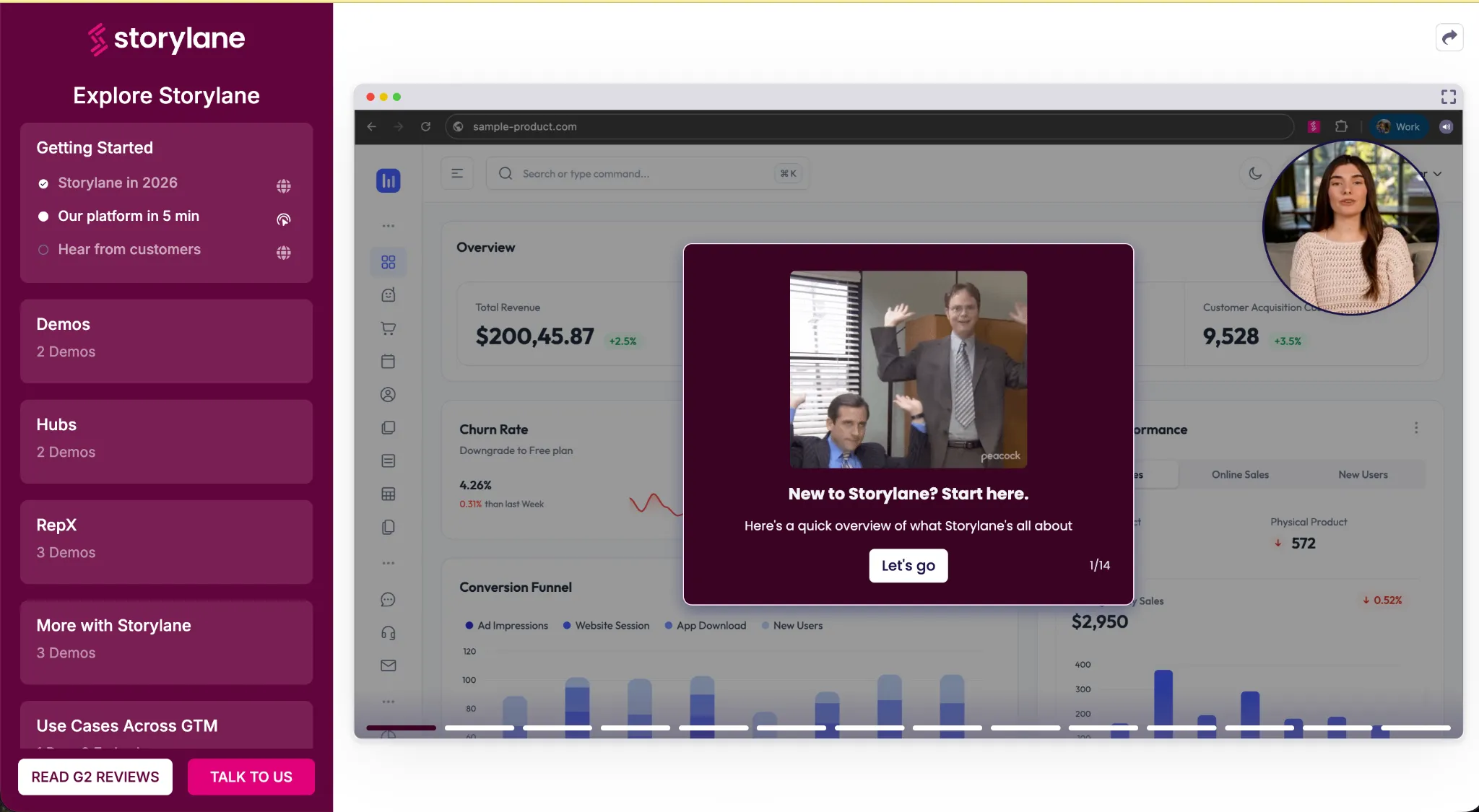
Hubs addresses a specific friction point in multi-stakeholder deals: the "where's the demo link?" back-and-forth between calls. When a champion can send one link that contains the right demo, the relevant case study, and a clear next step, the deal room becomes a live asset rather than a one-time viewing event. Storylane's research on 150 deals shows that interactive demos showed 18% reduction in time to close when embedded in the sales motion.
Hubs accelerate that further by keeping the deal context persistent between calls.
RepX, Storylane's AI sales agent, operates at the top of the funnel: it trains on product docs and call transcripts, guides prospects through a tailored demo flow, fields questions, and qualifies intent before a human rep engages. For inbound teams and PLG motions, RepX acts as an always-on qualification layer. HowdyGo has no AI agent feature.

Verdict: For teams sharing individual demo links, both platforms handle the job. For teams running multi-stakeholder deals where the demo is an ongoing conversion surface, or teams wanting AI-assisted prospect qualification, Storylane's Hubs and RepX fill gaps that HowdyGo doesn't have a roadmap answer for.
Pricing: what you actually get
HowdyGo (annual billing):
- Starter: $159/mo, Unlimited users, unlimited HTML demos, 1 collection, AI demo creation, AI voiceovers, lead capture, embed, GIF/video export. No analytics.
- Pro: $399/mo, All Starter features + demo analytics, CRM integrations (Salesforce, HubSpot), offline demos, password protection, custom domain, HowdyGo JS SDK. Sandbox environments as a $99/mo add-on.
- Enterprise: custom, All Pro features + SSO (SAML/SCIM), custom interactive components, feature request priority, hands-on onboarding.
No free plan. 14-day trial available.
Storylane (annual billing):
- Free: $0, 1 seat, 1 demo. Suitable for initial evaluation.
- Starter: $40/mo, 1 seat (+$40/seat), screenshot and HTML capture (HTML on Growth only), basic analytics, Account Reveal (250/mo), embed options.
- Growth: $500/mo, 5 seats (+$100/seat), HTML Demo Editor, A/B Testing, AI capabilities, Salesforce + HubSpot integrations, Hubs as paid add-on.
- Premium: $1,200/mo, 10 seats, Hubs included, Deal Intelligence, Presenter Mode, Interest Screens, Salesforce App, SSO.
- Enterprise: custom, Sandbox Demos, RepX, Audit Logs, API access, custom data retention, dedicated CSM.
The pricing asymmetry is real and worth naming directly: a 3-person team that only needs HTML demos and unlimited seats pays $159/mo on HowdyGo vs. $500/mo on Storylane for Growth (where HTML lives). At that specific configuration, HowdyGo is cheaper. The math changes at the point where analytics, integrations, or Hubs enter the requirements: HowdyGo Pro at $399/mo delivers analytics and CRM, but without A/B testing, intent scoring, Deal Intelligence, or Hubs, capabilities that appear at Storylane's Growth/Premium tiers.
Head-to-head comparison
How to choose
Choose HowdyGo if:
- Your team is under 10 people and per-seat pricing creates real budget friction at the scale you need
- Your primary use case is HTML capture at a low entry price, $159/mo vs. Storylane's $500/mo for Growth
- You want the multi-format output (interactive + video + GIF) from a single recording session
- You don't need analytics until you're ready to spend $399/mo on Pro, and won't need intent scoring, Hubs, or deal room features in the next 12 months
- Hands-on founding team support is the kind of vendor relationship you want
Choose Storylane if:
- You need analytics from day one, Starter at $40/mo includes views, completion, and Account Reveal
- Your sales motion involves multi-stakeholder deals where Hubs can consolidate demos, collateral, and next steps in a single persistent link
- You need CRM integrations with workflow automation, not just passive activity logging
- AI capabilities (video avatars, multilingual voiceovers, AI Hub Creation) are part of how your team produces demos at volume
- You're building a PLG motion or inbound qualification workflow where RepX's autonomous demo conversations replace early SDR touches
- SOC 2 or enterprise procurement requirements are non-negotiable
The bottom line
HowdyGo wins on the pricing structure for small teams and on the HTML capture entry price. If unlimited seats and low-cost HTML demos are your primary criteria, the math favors it at the Starter tier. Storylane wins on analytics, integrations, buyer enablement, AI depth, and enterprise readiness. If your demo program needs to generate pipeline signals, not just publish content, Storylane's platform is the infrastructure that makes that possible.
Frequently asked questions - Storylane vs HowdyGo
Q. Is HowdyGo cheaper than Storylane?
At equivalent feature sets, it depends on the tier. HowdyGo Starter ($159/mo) includes HTML capture and unlimited users with no analytics. Storylane Starter ($40/mo) includes analytics and Account Reveal but HTML capture requires Growth ($500/mo). For a team that needs HTML demos, no analytics, and unlimited seats: HowdyGo Starter is cheaper. For a team that needs HTML plus analytics: Storylane Growth ($500/mo) vs. HowdyGo Pro ($399/mo), comparable price, meaningfully different feature sets.
Q. Does HowdyGo integrate with Salesforce and HubSpot?
Yes. CRM integrations with Salesforce and HubSpot are confirmed on HowdyGo's Pro plan ($399/mo annual). The depth of field mapping and workflow triggers is not confirmed in public documentation; verify at howdygo.com/product/pricing.
Q. Does HowdyGo support HTML demos?
Yes, from the Starter plan at $159/mo (annual billing). This is earlier in the pricing tier than Storylane, where HTML demos require Growth at $500/mo.
Q. What is Storylane Hubs?
Hubs is a standalone Storylane product that creates branded deal rooms combining demos, PDFs, videos, and embeds in a single shareable link. It includes Deal Intelligence for tracking stakeholder engagement and ghost stakeholder detection. Available at Premium+ ($1,200/mo annual) or as a paid add-on on Growth. HowdyGo has no equivalent.
Q. What is RepX?
RepX is Storylane's AI sales agent. It trains on product documentation and call transcripts, guides prospects through demo flows, answers questions, and qualifies intent before a human sales rep is involved. It is available on Enterprise plans and is designed for inbound qualification and PLG motions. HowdyGo has no AI agent feature.
Q. Which platform has better analytics?
Storylane includes analytics from Starter ($40/mo annual) with Account Reveal (visitor identification) from 250 identifications per month. A/B Testing is available on from Growth onwards. Intent scoring and Deal Intelligence are available on Premium+. HowdyGo analytics are only available from Pro ($399/mo) and do not include confirmed account identification or intent scoring.
Try Storylane
Storylane's free plan includes one demo with unlimited views and no credit card required to sign up. Teams evaluating against HowdyGo typically use the free plan to test the editor, then upgrade to Starter for analytics access.