
.svg)

Your SE just spent two days rebuilding demo environments after Tuesday's product release. Meanwhile, three reps are waiting for personalized demos for deals closing this month. If you're weighing Demostack against Storylane, you're really choosing between two different answers to the same question: how do you show your product without slowing down your team?
Demostack clones your live product into working replicas with real backend data flows. Storylane lets any team create demos in minutes across four formats without touching the live product. The right choice depends on whether your bottleneck is simulation fidelity or demo velocity and scale.
What Demostack does well
Demostack's core strength is genuinely impressive: it clones your live product with functional backend connections. This isn't screenshot stitching or screen recording. When a prospect clicks through a Demostack demo, they're interacting with a working replica that connects to actual APIs and databases. For products where the backend is the demo (ETL tools showing real data transformations, DevOps platforms displaying actual latency metrics, ERP systems with complex data flows), this simulation fidelity matters.
The customer proof points back this up. Gainsight reported a 25 percent increase in win rate. Hunters closed three deals without running a single POC, cut their sales cycle in half, and achieved 95 percent customer satisfaction scores. BlueVoyant achieved ROI from a single call on a multi-million dollar RFP. These aren't vanity metrics. They reflect what happens when enterprise buyers can interact with a product that behaves like the real thing.
Demostack's G2 Quality of Support score of 9.6 tells another story: when you're betting $55,000 per year on a demo platform, you expect white-glove service, and Demostack delivers it. Their AI capabilities (natural language edits to cloned environments, bulk database editing, context-specific content generation) make simulation editing faster once the clone exists.
Demo creation philosophy: simulation vs. velocity
Demostack clones your live product in a single click-through, creating a functional replica with every screen, workflow, and data point. This approach delivers maximum fidelity for complex products where showing real backend behavior is key to the sale. But cloning creates dependencies: any product update requires rebuilding all existing clones from scratch. Declan Tariq, an account executive at a fleet management company, wrote in his G2 review that
"any updates or changes made to the actual product necessitate recreating all existing clones from scratch."
Demo links break when clones are edited, requiring updates across website embeds, sales decks, and email templates.
Storylane creates demos from scratch across four formats (Screenshot + Video, HTML/CSS, Sandbox, Guided) without touching the live product. This decoupling means stable URLs, granular step-level edits, and no rebuild cycles when your product ships. The tradeoff is explicit: you're building representations of your product rather than cloning the live system. For teams where demo velocity matters more than perfect backend simulation, this is the unlock. Phenom's marketing team built 35 demos in three weeks for a flagship tradeshow, according to Michael DeMarco, their product marketing manager. That pace is only possible when demo creation doesn't depend on engineering resources or product release schedules.
The decision comes down to what you're showing. If your product's value lives in how data flows through the backend (data pipelines, infrastructure tools, security platforms processing real network traffic), Demostack's cloning delivers better fidelity. If your bottleneck is getting personalized demos into reps' hands quickly, Storylane's format flexibility and independence from the live product removes the constraint.
Who can actually create demos?
Demostack targets solutions engineers and large GTM teams. The tool requires technical understanding of the product being cloned. You're working with a functional replica of your live system, which means the person creating demos needs to understand how that system works. This makes sense for enterprise organizations with dedicated SE teams, but it creates a bottleneck: demo creation scales with headcount, not permissions.
Storylane's G2 ease of use score of 9.3 means marketing teams, customer success managers, partner enablement teams, and RevOps can self-serve without SE involvement. The HTML Demo Editor (available from the Growth plan onwards) lets non-technical users edit demo flows with a visual interface. This is the scalability gap: when your head of partnerships needs a co-branded demo for a channel partner, or your CS team wants to build onboarding demos for different user roles, or your product marketing manager needs to test five different messaging angles before a launch, Storylane's accessibility removes the queue.
AI capabilities: editing vs. automation
Both platforms invested in AI, but they're solving different problems. Demostack's AI makes simulation editing easy AI Database Bulk Category Editing automates dataset changes across cloned instances. The AI Text and Image Generator creates realistic, context-specific content. AI for Data Rules lets you modify application logic via natural language. These capabilities reduce the time from "I cloned the product" to "the demo is ready to show."
Storylane's AI automates the entire demo lifecycle.
- AI Demo creation generates complete demos as you click through your product interface in just 2 minutes
- AI Voiceovers add narration in 25+ languages with 50-plus voices.
- AI Video Avatars create presenter-led demos without filming.
Storylane also has more AI features like:
- AI Video-to-Demo converts recorded product walkthroughs into interactive demos.
- AI Translations localize demos across languages.
But the best part would be RepX, Storylane's conversational AI sales agent (a separate product line from the Demo Suite), trains on product documentation and call transcripts to handle discovery, qualify prospects, and hand off to sales.

The philosophical split: Demostack's AI makes you faster at simulation editing. Storylane's AI reduces human involvement end-to-end. Choose based on where your bottleneck lives. If you have clones but editing them takes too long, Demostack's AI helps. If you need to go from "here's a product video" to "here's a narrated, translated, personalized demo in six languages" without hiring a production team, Storylane's AI does that.
Analytics and buyer intelligence
Storylane's analytics start at earlier tiers and go deeper at Premium. Account Reveal (available from the Starter plan onwards, 250 identified accounts per month on Starter, unlimited on Enterprise) identifies anonymous viewers by company. Deal Intelligence (Premium and above) tracks buying committee engagement across multi-stakeholder deals. A/B Testing (available from the Growth plan onwards) lets you test demo variants and measure conversion impact. The platform reports that prospects who engage with interactive demos convert at 24.35 percent versus a 3.05 percent baseline, and sales cycles shorten from 33 to 27 days, a 7.9x improvement across 110,257 sessions and a six-day reduction measured across 150 deals.
.avif)
Demostack offers Demo Intelligence for engagement tracking and analytics. The public documentation provides less granular detail about specific capabilities or tier availability. What's clear from customer reviews is that the analytics exist and support enterprise sales processes. BlueVoyant's ROI from a single call on a multi-million dollar RFP suggests the platform delivers visibility into high-stakes buying processes.
The difference matters most when your sales motion requires tracking multiple stakeholders across long enterprise cycles. Storylane's Deal Intelligence (available from the Premium plan at $1,200 per month annually) surfaces which executives are reviewing demos, how often, and which sections they focus on. For transactional sales or shorter cycles, Account Reveal at the Starter tier ($40 per month annually, plus $40 per additional seat) covers the basics: knowing which companies are engaging.
Pricing: what you actually get
Demostack's entry point is approximately $55,000 per year for the Starter tier (10 users, one application). The Pro tier runs around $100,000 per year and includes mobile support. No free plan exists. No free trial is offered. When you factor in operational costs, first-year total cost of ownership is estimated between $73,000 and $83,000. Every team that uses Demostack goes through an enterprise sales process.
Storylane offers five tiers. The Free plan ($0) includes one seat and basic demo creation. Starter ($40 per month annually, one seat, plus $40 per additional seat) adds Account Reveal with 250 identifications per month. Growth ($500 per month annually, five seats, plus $100 per additional seat) unlocks the HTML Demo Editor, A/B Testing, and personalization tokens. Premium ($1,200 per month annually, 10 seats) adds Hubs (multi-format deal rooms combining demos, PDFs, videos, and embeds in one shareable link), Deal Intelligence, Presenter Mode, the Salesforce App, and SSO via SAML. Enterprise (custom pricing, custom seats) includes Sandbox Demos (the closest format equivalent to Demostack's product cloning), unlimited Account Reveal, and dedicated support.
A team can run Storylane Growth for $6,000 per year (less than 11 percent of Demostack's entry price) and get HTML demos, A/B testing, and personalization. Even Storylane Premium at $14,400 per year includes deal rooms, buyer intelligence, and Salesforce integration for roughly one-quarter of Demostack's Starter cost. The question isn't which is cheaper (that's obvious), it's whether Demostack's simulation fidelity justifies a 9x to 10x price premium for your specific use case.
Flexibility and persona targeting
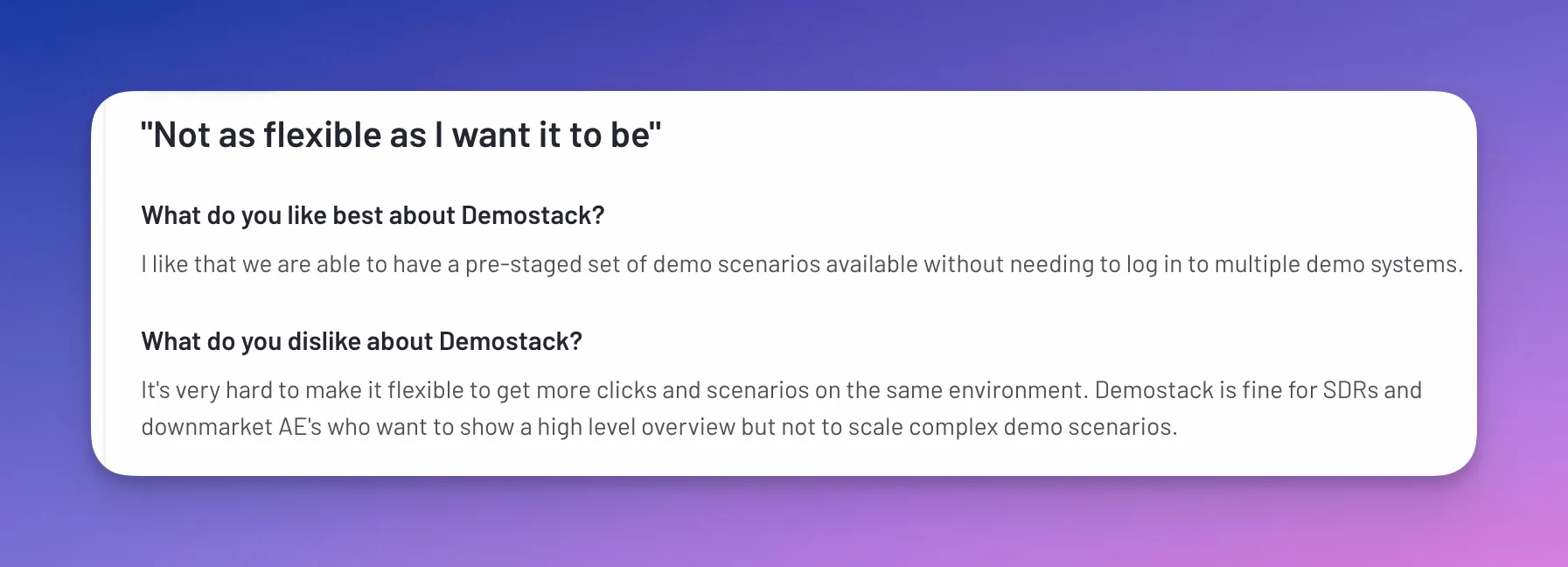
Daniel Del Valle, an Enterprise Solutions Engineer at Motive, gave Demostack a 1.5-star review i, writing that the platform is
"not flexible enough for complex demo scenarios"
and
"struggles with edge cases or highly customized workflows."
This is the tension in any cloning approach: you get the live product's behavior, but customizing that behavior for different buyer personas or use cases requires working within the constraints of what the clone can do.
Storylane's format flexibility (four demo types, each editable at the step level) means you can adapt the narrative without fighting the underlying system. When a rep needs to show a simplified five-step workflow to a director but a 20-step technical deep dive to a solutions architect, they're creating different demos, not trying to make one clone serve both audiences.
This matters most for products with deep feature sets or multiple user roles. If your product does 100 things but each buyer cares about seven different things, Storylane's format flexibility lets you create 10 targeted demos. Demostack's clone shows all 100 things, and you navigate through it differently based on who's watching. The tradeoff is explicit: Storylane's demos are representations optimized for each conversation, not the live system itself.
Compliance and security
Demostack holds SOC 2 Type II certification from PwC. This Big Four auditor branding matters to enterprise security teams evaluating vendors. The platform includes role-based access control and SSO. The cloning approach means customer data stays within controlled environments during demos.
Storylane is SOC 2 Type 2 certified and GDPR compliant. SSO via SAML is available from the Premium plan onwards. The platform does not hold HIPAA certification or ISO 27001, which eliminates it for healthcare and certain financial services use cases. The auditor for Storylane's SOC 2 is not a Big Four firm, which some procurement teams flag during vendor reviews.

For most B2B SaaS sales teams, Storylane's compliance posture clears the bar. For regulated industries or enterprises with strict auditor requirements, Demostack's PwC-certified SOC 2 creates less friction during security reviews.
How to choose
Choose Storylane if:
- You need to scale demo creation across multiple teams (marketing, sales, CS, partners)
- Your bottleneck is getting personalized demos into reps' hands quickly
- You have a self-serve or PLG motion where prospects need instant access to interactive demos
- Your budget is under $50,000 per year for demo infrastructure
- You want to test multiple demo variants and measure conversion impact
- You need demos in multiple languages with AI-generated voiceovers
Storylane works best for teams where demo velocity matters more than perfect backend simulation.
Choose Demostack if:
- Your product's value lives in backend behavior that's hard to represent any other way (data transformations, infrastructure performance, real-time processing)
- You have a dedicated SE team that will own demo creation and maintenance
- Your sales motion is enterprise-only with long cycles and technical buyers who need to see the actual product in action
- Your budget supports $55,000-plus annual spend
- PwC-certified SOC 2 compliance is a hard procurement requirement
Demostack works best for complex enterprise products where simulation fidelity justifies the price premium and maintenance overhead.
The bottom line
Demostack clones your live product with functional backend connections. This delivers unmatched fidelity for products where the backend is the demo. The tradeoffs are price ($55,000-plus per year), maintenance burden (clones rebuilt after product updates, links breaking during edits), and limited accessibility (requires technical understanding to create demos).
Storylane creates demos across four formats without touching the live product. This delivers speed (35 demos in three weeks), stability (no broken links, no rebuild cycles), and accessibility (marketing and CS can self-serve). The tradeoffs are explicit: you're building representations rather than cloning the live system, Sandbox Demos (the closest equivalent to Demostack's cloning) are Enterprise-tier only, and compliance certifications don't include HIPAA or ISO 27001.
Most teams will find Storylane's format flexibility and pricing accessibility solve their demo bottleneck. Teams selling complex enterprise infrastructure where simulation fidelity is non-negotiable will find Demostack's cloning approach worth the premium.
Frequently asked questions - Storylane vs Demostack
Q. Can Storylane's Sandbox Demos replicate what Demostack does?
Sandbox Demos (Enterprise tier only on Storylane) connect to your live product like Demostack's clones, but the implementation differs. Demostack clones your entire product with backend data flows. Storylane's Sandbox Demos provide isolated environments for hands-on exploration. If your requirement is "show the actual product with real backend behavior," both approaches work. Demostack's cloning is more comprehensive; Storylane's sandbox is more controlled. The decision comes down to whether you need full product cloning or guided sandbox environments, and whether your budget supports Enterprise-tier pricing.
Q. What happens to Demostack demos when our product updates?
All existing clones must be rebuilt from scratch. Demo links break when clones are edited, requiring updates across your website, sales decks, email templates, and any other location where those links exist. For products shipping frequent updates, this creates recurring maintenance work. Some teams schedule clone rebuilds weekly; others rebuild per major release. Factor this operational cost into your total cost of ownership calculation.
Q. How does Storylane's AI compare to Demostack's AI capabilities?
Different focus areas. Demostack's AI speeds up simulation editing: natural language environment modifications, bulk database updates, auto-generated realistic data. Storylane's AI automates the full lifecycle: creating demos from URLs or videos, adding voiceovers in 25-plus languages, generating video avatars, translating demos, and (via RepX) handling autonomous sales conversations. If your bottleneck is editing cloned environments faster, Demostack's AI helps. If your bottleneck is going from raw product footage to polished, multilingual, narrated demos without a production team, Storylane's AI solves that.
Q. Which platform has better analytics?
Storylane's analytics start at lower tiers (Account Reveal from Starter at $40 per month) and go deeper at Premium (Deal Intelligence tracking buying committee engagement). The platform publishes conversion data: 24.35 percent conversion for prospects who engage with interactive demos versus 3.05 percent baseline, and sales cycles shortened from 33 to 27 days across measured deals. Demostack offers Demo Intelligence but publishes less granular detail about capabilities. Both platforms support enterprise sales analytics. Storylane's advantage is accessibility (analytics from $40 per month versus $55,000 per year entry point) and published conversion proof points.
Q. Can non-technical teams create demos on Demostack?
Demostack targets solutions engineers and technical GTM teams. The cloning approach requires understanding how your product works because you're creating functional replicas with backend connections. Marketing or CS teams without technical product knowledge will struggle. Storylane's G2 ease of use score of 9.3 reflects accessibility for non-technical users. The HTML Demo Editor (Growth plan and above) uses a visual interface. If democratizing demo creation across marketing, partners, and CS is a requirement, Storylane removes the technical barrier.
Q. Does Storylane work offline for conferences and events?
Storylane demos have been used at conferences: SentinelOne built a kiosk at RSA Conference running Storylane demos on multiple iPads. Demostack uses a desktop app delivery model. For teams running demos at events with unreliable connectivity, confirm with each vendor's sales team what offline or low-connectivity options are currently supported.
Also read: Interactive demo checklist for in-person events and conferences
See Storylane in action. Create your first interactive demo in minutes. Start free at storylane.io or book a demo to explore Sandbox Demos and Enterprise features.