
.svg)

2 in 3 buyer questions arrive when your sales team isn't around and a couple of other findings from analyzing 8,611 RepX sales agent and human rep conversations.
In summary
1. Agents get asked about price and competitors. Reps get asked deeper product questions. Pricing and competitor comparison questions are asked more frequently (and earlier in the conversation) with sales agents as compared to human reps. This trend is reversed in the case of integration, onboarding, and security questions. Buyers use sales agents to work out whether you are worth considering, then engage with human reps for the questions that matter once they've decided you are.
2. Buyers open with questions to RepX they would never lead with on a call. Price is the first thing asked in 9.4% of agent conversations and 2.5% of calls. On a call it surfaces around two thirds of the way through. Buyers don't really wants to sit through a 30-min demo only to find out they cannot afford the product.
3. The longer a chat runs, the more likely that buyer wants to talk to you. Conversations past eleven turns reach pricing 51% of the time and end in a request for a human 25% of the time, against 8.8% and 1.6% for one-message conversations. Length tells you who is serious, earlier than a form does.
What we looked at
8,211 conversations with AI sales agents between June 2025 and August 2026, holding 26,382 buyer questions, across 19 separate deployments. Against that, 402 first and discovery calls holding 5,687 prospect-side questions, median 12 per call.
Two things worth knowing. We compared against discovery calls rather than all calls, because measuring anonymous website visitors against buyers deep in procurement would tell you about deal stage instead of channel. And we discarded roughly half the raw agent volume: visitors who never typed anything, single clicks on a suggested prompt, and internal testing. That last point is worth carrying if you ever benchmark your own agent against a vendor's published numbers.
Finding #1: buyers use agents to evaluate and human reps to commit
The table below runs top of funnel at the top to bottom of funnel at the bottom.
The progression is clean. The two earliest topics, what it costs and how it compares, both go to the RepX sales agent. The three later ones all go to the human rep, and the gap widens the further down the funnel you look.
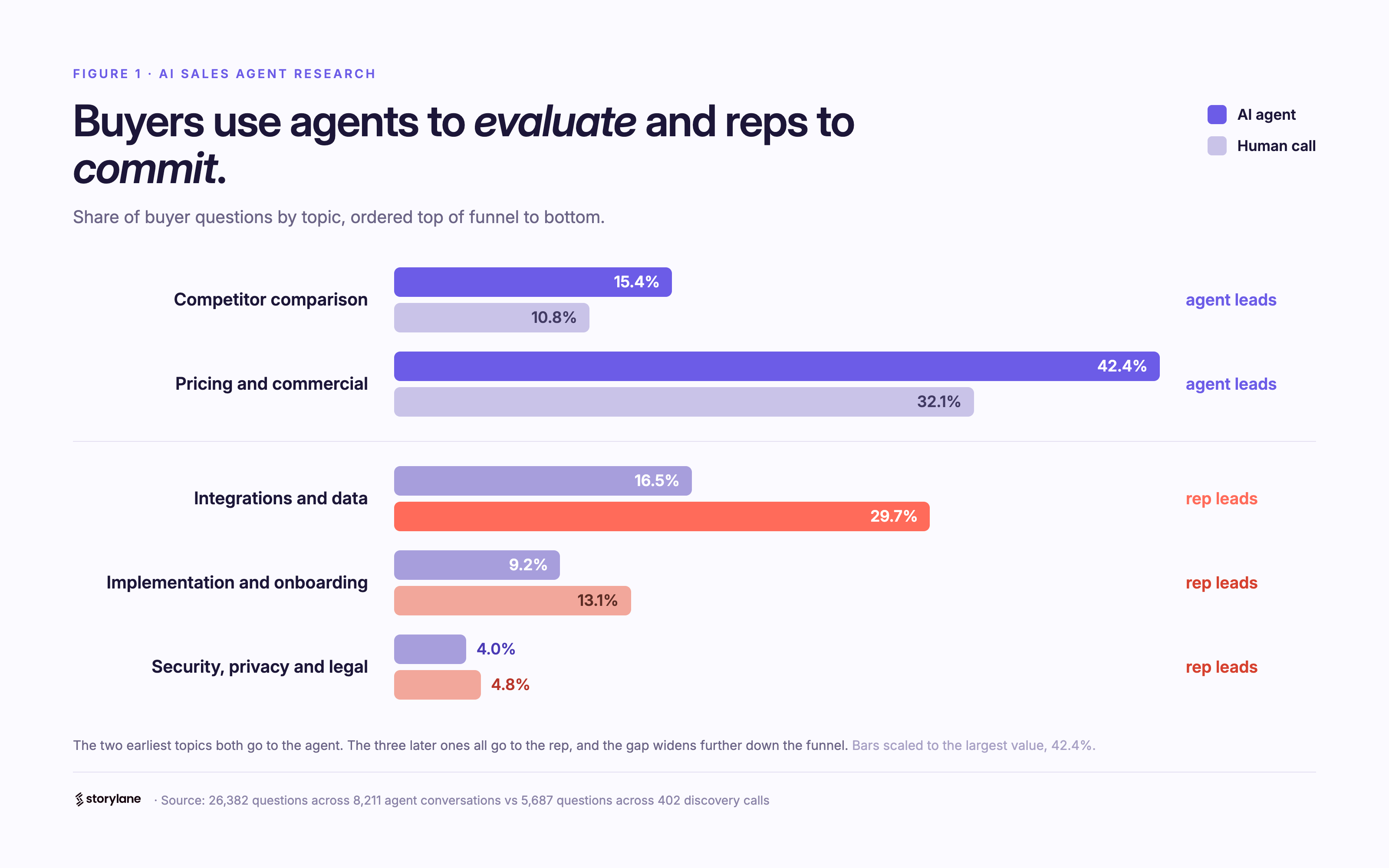
The human rep-leading topics are a different kind of question. Integrations are the clearest case, at nearly double the rate on calls. Nobody asks whether your product syncs with their specific CRM out of curiosity. They ask because they have started picturing it running inside their own stack, which means they have already decided you are a serious contender. Onboarding questions work the same way, and security to a lesser degree. Those questions are premature rather than uncomfortable. You cannot ask them until you know enough to know what to ask.
Why the awkward questions go to the agent
The topic split tells you what gets asked. The timing tells you why.
On a call, price waits. Raising it in the first two minutes signals that you might not be able to afford the product, or that you are not serious about the problem, or that you are wasting the rep's time. So buyers sit through the demo and bring it up near the end, around two thirds of the way in.
A chat window charges nothing for that question, so it comes out first. One buyer in the dataset said it plainly: "Is there a free trial, or do we need to go through a sales call first?"
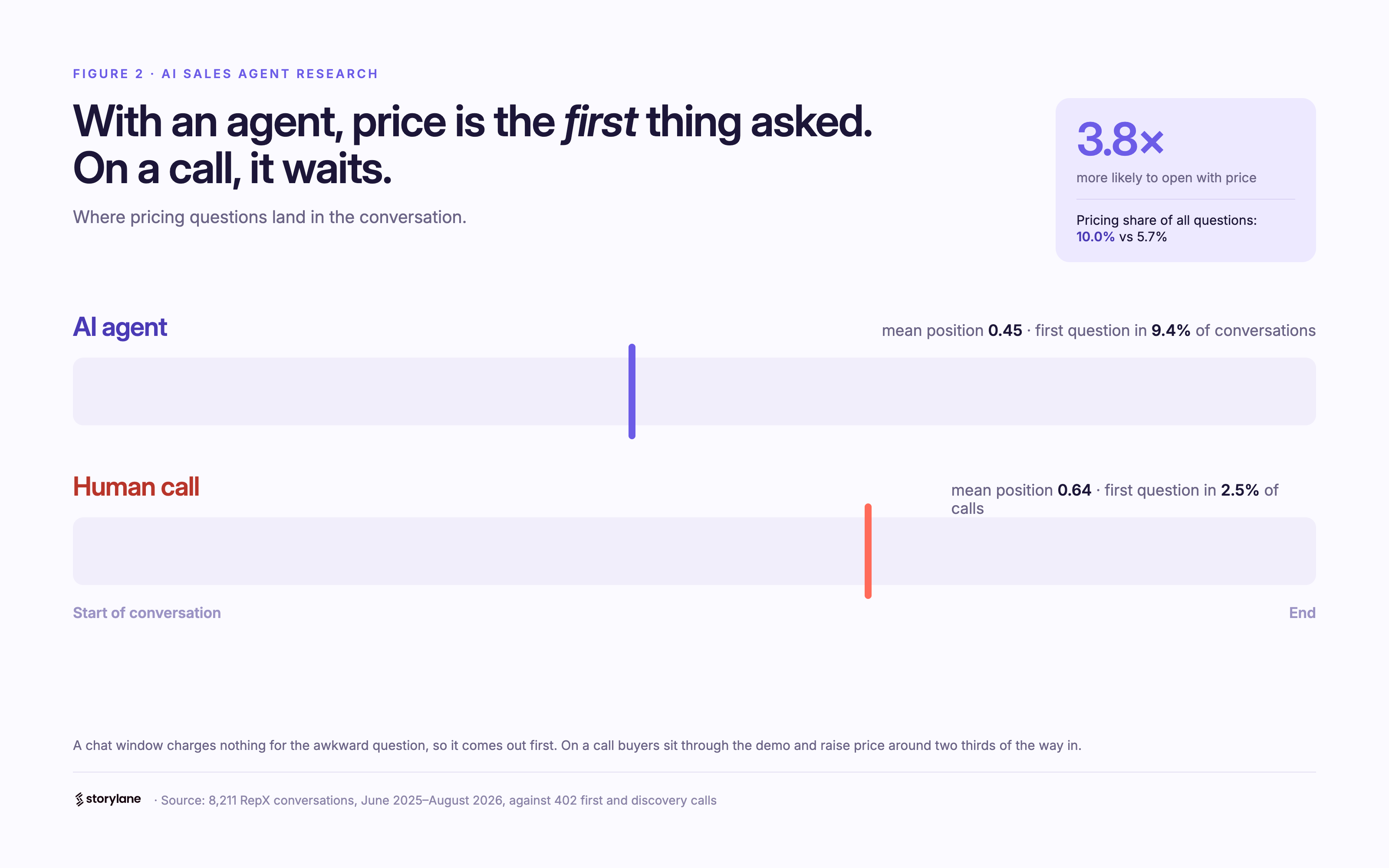
Comparison questions follow the same logic. Some version of "how are you better than X" appears roughly ten times more often with an agent than on a call. Buyers will ask an AI sales agent to argue against its rivals in terms they would never use with a salesperson.
Finding #2: conversation length is a better qualification signal than a form
If agent conversations were deflected FAQs, length would tell you nothing about intent. It tells you a lot.
Every buying signal climbs with length, and it climbs smoothly. Past eleven messages, half of conversations reach pricing, integration questions have multiplied sevenfold, and a quarter end with the buyer asking to speak to somebody.
One caution on reading this. Length almost certainly follows intent rather than causing it. Serious buyers stay longer because they were already serious. So the agent is where serious buyers show themselves; a chat window does not manufacture intent.
That still makes length immediately useful, because you can see it in real time and it costs the buyer nothing to produce. A visitor eight messages into a conversation has told you more about their intent than a completed form ever will.
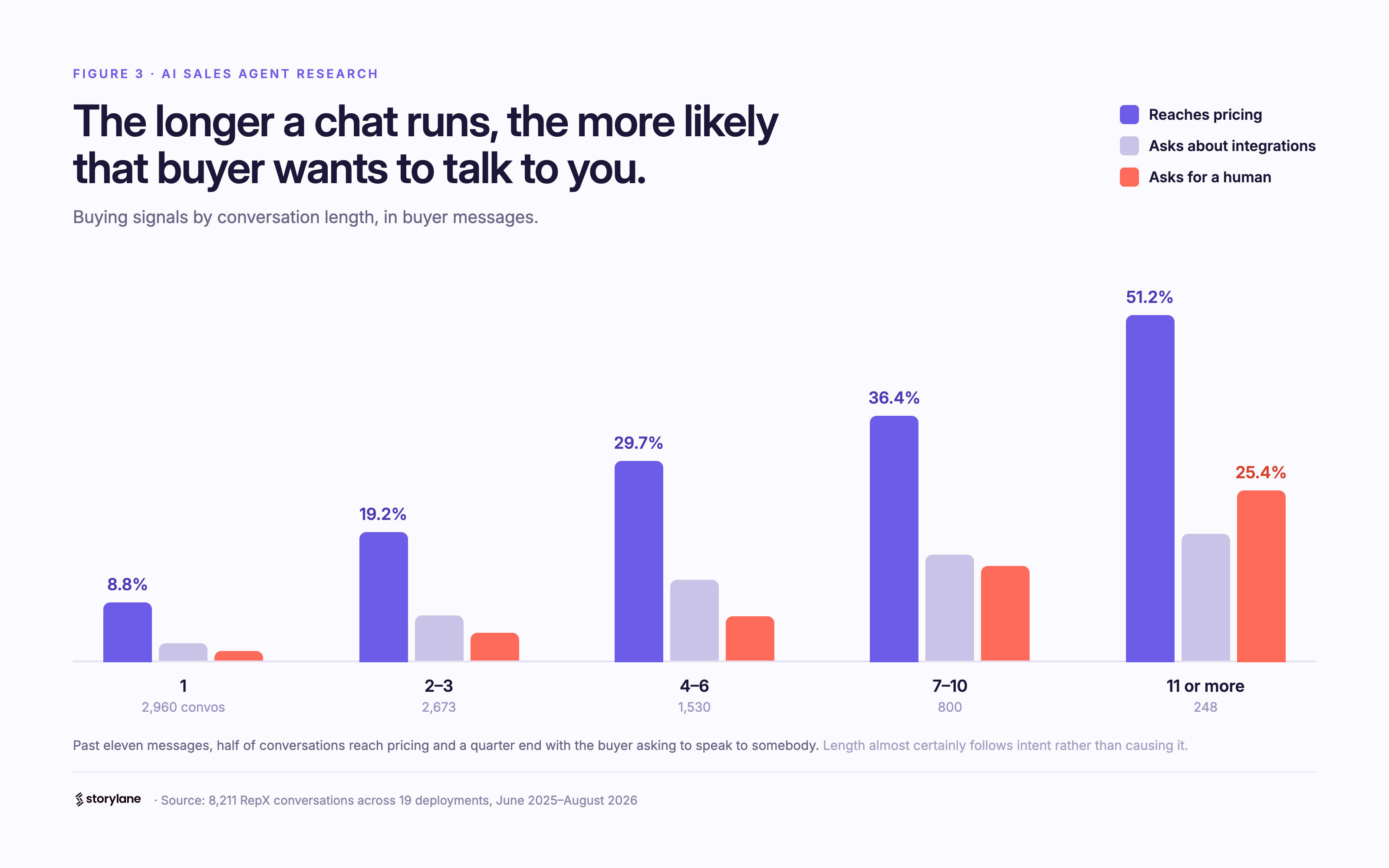
What to do with it. Treat a conversation past six or seven messages as a qualified inbound signal and get a human involved while the buyer is still there, rather than waiting for a form fill or a booked meeting.
Finding #3: two thirds of conversations happen when nobody is at work
64.5% of buyer questions, and 63.2% of whole conversations, arrive outside Monday to Friday, 09:00 to 18:00 in the seller's own timezone. 9.7% land at weekends. The buyer was plainly awake. The question is whether anyone was available to answer them, and nearly two thirds of the time the answer was no.
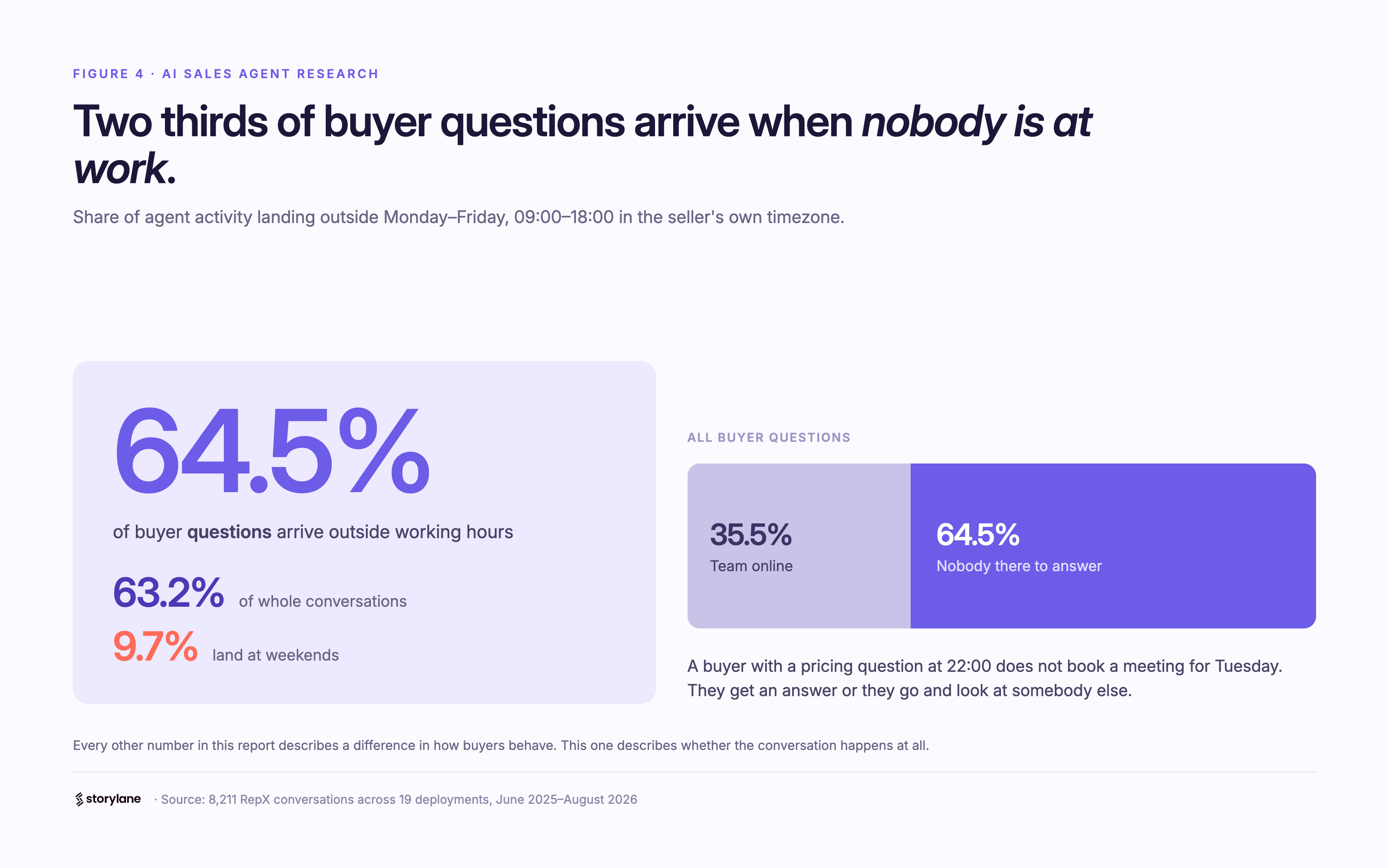
This is the least arguable finding here and probably the most consequential. Every other number in this report describes a difference in how buyers behave. This one describes whether the conversation happens at all. A buyer with a pricing question at 22:00 does not book a meeting for Tuesday. They get an answer or they go and look at somebody else.
What to do with it. Before deciding whether an agent is worth it, look at when your own inbound actually arrives. If a significant number lands while your team is offline, an agent is not competing with your reps for those conversations. They're supporting them while they're away.
The part buyers want to skip, and the part they don't
Across 32,000 questions, buyers were not treating an AI agent as a cheaper substitute for a salesperson. They were using it as a complement to human reps: answering the questions that are awkward to ask a person, at hours when no person is there, before they have decided you deserve a meeting.
Once that was done, a quarter of the most engaged of them asked for a human anyway. The reps who take those calls start further along. Price has been discussed. Competitors have been raised and handled. What is left is the buyer's own stack, their own edge cases, their own rollout, which is the conversation that genuinely needs a person in it.
Buyers are getting the awkward part over with first, then showing up better prepared for the part that matters.