How to Create an Interactive Product Demo: A Step-by-Step Guide
written by
Akash Bansal
Co-Founder at Storylane
reviewed by
|
Table of contents
In this new product-led era, buyers are deciding quickly and want to feel the product to make those decisions. However as a growth marketer, one of the challenges is to get your prospects to engage with the product quickly enough. Each day you lose prospects because they didn’t get to see your product.
An interactive product demo or tour is a great way to build trust with your prospects. In this article, I will go over the series of steps you want to take to build an interactive product demo.
Let's get started.
How to create Interactive Product Demo?
Here are the 8 steps you need to take:
1. Questions to ask
Some questions to ask before creating your interactive product demo or tour.
(a) Guided product tour or Custom demo
Often, when buyers land on a new product, they don’t know what to do and get frustrated.
Guided tours like Storylane solve exactly this. It enables you to let your prospects go through a guard-railed experience of your product.
A custom demo is more useful at the later stages of the buyer's journey where they will invest even more time to explore the product. At that time, you can have them engage with a custom demo as an alternative to a pre-POC demo.
(b) Video or interactive demo
A well produced video of your product is a great way to showcase your product. But a good video will need to stitch together the product imagery and is hard to build. Moreover, it's not self guided and doesn’t gives that aha moment to the prospect which comes only out of self exploration. This is where a more interactive experience of the product demo helps.
Interactive demos generate 3-4x more engagement on landing pages. Prospects spend 4-5 minutes exploring demos versus 1-2 minutes watching videos.
Videos are okay for one-way communication. Interactive demos excel when prospects need to explore features themselves. Storylane enables you to create demos that support both formats.
2. Choose the right tool
Pick a platform that doesn't have an engineering dependency. The best demo tools are no-code and use simple browser extensions to capture your product. Marketing teams should be able to build and publish demos independently.
Look for these capabilities:
No-code capture and editing: Browser extension captures your product interface. Inline editor lets you change text, images, and data without touching code.
Multiple demo formats: HTML demos for interactive experiences. Screenshot demos for quick tours. Video demos for email campaigns. Don't limit yourself to one format.
Self-serve setup: You can ship your first demo in minutes, not weeks waiting for dev resources.
Storylane supports HTML, screenshots, and video formats in one platform. It works for both sales teams (personalized demos) and marketing teams (website-embedded demos and lead capture).
3. Create a story that you want to tell
Story is what will draw your prospects to engage deeply and eventually make a buying decision. Your prospects want to evaluate quickly how your product is going to make their life simpler and be valuable over time. A good story is when you can articulate the “aha” moments when your customers use your product.

4. Capture your screens
Capture your product through the native screen capture tools available in your browser or your computer. Storylane offers you a Chrome extension through which you can capture your product. You have the option of capturing the entire HTML or only images of the product. Image captures result in a faster time to value since it’s extremely easy to build.
5. Add guided widgets
Guided widgets (or explainer bubbles) enable you to tell your story through a guided walkthrough for your prospects. It’s a very powerful tool to communicate the value of your product as they step through the screens. Intercom, Walkme and Pendo use it beautifully as an onboarding journey for users. You can use it for the product demos that you have built and improve the user experience with these explainer bubbles through guided widgets.
Sample of guided widgets
6. Gather information about your Leads
(a) Lead Form
A well scripted interactive product tour when embedded on the website will generate more qualified leads. Your prospects on the website will want to experience it. So have your lead capture form at the start, end or middle of the product tour. You want to get the information from them at their highest point of excitement. Ask for quick info like - Name and Email
Sample lead form
(b) Intelligent Lead Insights
Use services like Clearbit and Zoominfo to get lot of insight about your leads. Storylane integrates with these services to provide the info and you might not even need to collect through lead form
(c) Integrate chat
Another option in addition to the above ones, would be to add chat widget to interactive product tour like intercom or drift. Through Storylane you can simply add these widgets and have them connect with sales rep at appropriate time during their journey in product tour
7. Share and embed your demos
Another use case of your demos is to send it to buyers who are looking at your product and evaluating it. A way to stand out from competitors is to have them experience your product quickly enough. That way the champion in the buyers organization can create enough pull towards your product and you can close the sale quickly.
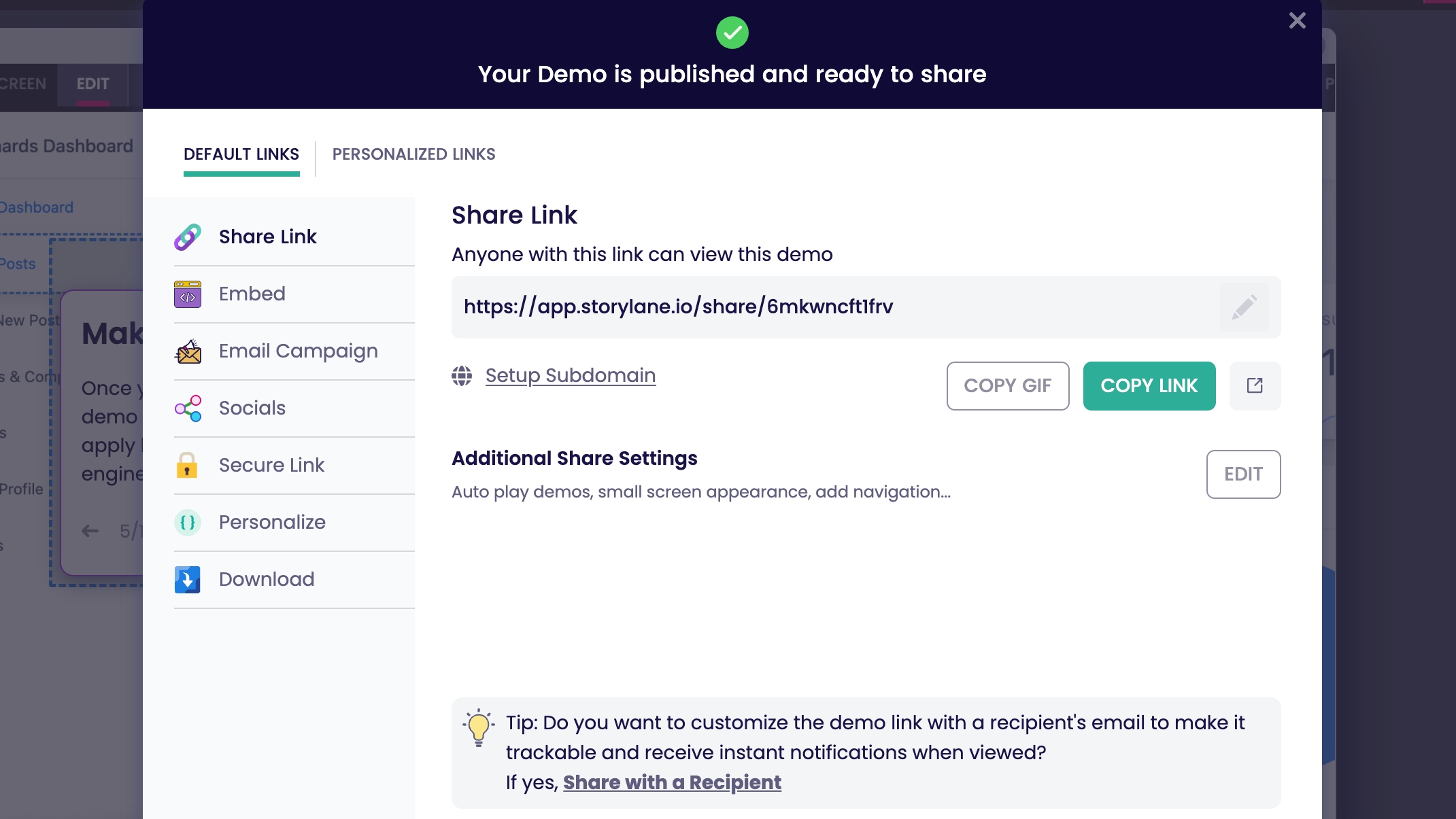
After you have the interactive demo, share it not just as an embedded product demo on the website, but personalize it and send it to the buyers.
The demo software you chose should be such that it’s easy to customize your demo and share it.
How to embed interactive demos on your website
Copy the embed code from your demo platform and paste it into your website's HTML in minutes.
Common placements: homepage, product pages, pricing pages, dedicated "/demo" page.
For Webflow, WordPress, or HubSpot: paste the code into a custom HTML block.
Storylane embeds load in under 2 seconds and work on mobile. The platform generates the code automatically with optional lead forms.
Bonus: Download offline versions for trade shows and conferences. Storylane's offline mode runs demos on laptops without internet—critical during situations with unreliable connections.
8. Get analytics that works
Analytics is the cornerstone for evaluating the success of these interactive product demos and pushing your leads deeper into the funnel. You want to track a few metrics:
Who has viewed your demo
How many steps have they progressed in your entire self-guided product tour
How much time have they spent on the product tour
How many members of the same company have viewed it
And this analytics has to be available in your system of records like Marketo, Hubspot and Salesforce.
Now that you know how to make a killer interactive product demo, it's time to start using some awesome tools available in the market and winning the love of your buyers and driving your Product-led growth.
Q. Do I need engineering resources to create interactive demos with Storylane?
No. Storylane's browser extension captures your product interface in minutes. Marketing teams can build and ship their first demo in 2-3 hours without touching code.
Q. How does Storylane compare to Navattic and Supademo for creating product demos?
Storylane supports HTML, screenshot, and video demos—Navattic only does HTML, Supademo focus is on screenshots. Storylane also includes AI-powered editing and works across marketing, sales, and customer success teams.
Q. What's the ROI of implementing interactive demos on my website?
Companies typically see 1.7x more sign-ups and 1.5x better activation rates. PQLs from interactive demos convert at 30% versus 6% for traditional MQLs, cutting sales cycles by roughly 30%.
Q. Is Storylane worth the cost compared to cheaper alternatives like Supademo?
Storylane starts at $40/month with full HTML editing, AI features, and analytics. Supademo is $27/month but limited to screenshots. If you need personalization and AI, Storylane delivers more features per dollar.
Q. Can marketing teams create demos without relying on sales engineers or product teams?
Yes. Storylane is built for marketing self-service. Teams can create, update, and organize demos independently—no handoffs to engineering when products change.
Q. What's the difference between HTML demos and screenshot demos, and which should I use?
HTML demos let you edit data and personalize at scale—ideal for sales. Screenshot demos are faster to build and better for simple top-of-funnel flows. Storylane supports both formats.
Q. Can I use interactive demos at trade shows without internet?
Yes. Platforms like Storylane offer offline demo modes that run without WiFi. Download an offline copy of your demo to a device before the event. The attendees can engage with the demo at your booth while you handle other conversations or scan badges. Add a simple email capture form to collect leads. After the event, send personalized demo links as a follow-up.
“In a world older and more complete than ours they move finished and complete, gifted with extensions of the senses we have lost or never attained, living by voices we shall never hear.”
The best AI SDR tools in 2026 fall into two distinct categories: outbound (prospecting and cold outreach at scale) and inbound (qualifying website visitors in real time). Before evaluating any specific tool, figure out which problem you are actually trying to solve.
Best for inbound qualification: RepX by Storylane, the only AI SDR in the category that qualifies visitors and demonstrates the product simultaneously.
Best for outbound prospecting: AiSDR, Salesforge, Artisan, and 11x.ai each have genuine strengths for different outbound motions.
Best for data and enrichment: Clay and Apollo.io are the tools that power the AI SDR workflow before outbound sequences run.
Most "best AI SDR tools" lists treat these platforms as roughly interchangeable, differing only in price and feature count. That framing is not useful. Tools built to find new prospects through cold outreach and tools built to qualify visitors already at your website are solving genuinely different problems, and require genuinely different architectures to solve them. The eight tools in this roundup are organized by which problem they were built for.
This list is updated for Q2 2026. Some platforms that were early in their AI integrations a year ago have matured meaningfully. A few others have stagnated. The distinctions matter more now than they did when the category was newer.
Why the Right AI SDR Tool Depends on Where Your Pipeline Is Breaking
There is a diagnostic question worth asking before any AI SDR software evaluation: is your problem that you need more conversations with new prospects, or is it that you are not converting the demand that is already arriving at your website?
If your pipeline is thin because you are not generating enough top-of-funnel activity, outbound AI SDR tools are the right category. These automate the research, personalization, and sequencing that SDRs do to build cold pipeline from target account lists. Salesforce's research on AI agents describes this class of tool as operating "around the clock to qualify leads, answer questions, and create quotes" — which captures the outbound automation promise accurately.
If you have meaningful website traffic and it is not converting into qualified pipeline, the inbound AI SDR category is more relevant. These tools engage visitors in real time, answer product questions, surface product demos, and qualify intent without requiring a form fill or a calendar invitation.
Both types exist in the market. The eight tools below are organized by type so the comparison is actually useful. For a broader view of how AI agents are reshaping the SDR role, see our guide to AI agents for sales.
The 8 Best AI SDR Tools in 2026
Tool
Type
G2 Rating
Starting Price
Best For
RepX (Storylane)
Inbound
4.8 stars (1,405 reviews)
$1,500/mo
Inbound qualification and demo for website visitors
Qualified (Piper)
Inbound
4.9 stars (1,400+ reviews)
~$42K/yr
Enterprise Salesforce-native inbound conversion
AiSDR
Outbound
4.7 stars (76 reviews)
$900/mo
Multichannel outbound with transparent pricing
Salesforge (Frank)
Outbound
4.6 stars (85 reviews)
$599/mo
Outbound email deliverability
Artisan (Ava)
Outbound
3.9 stars (22 reviews)
~$2K+/mo
All-in-one outbound with built-in prospect database
11x.ai (Alice)
Outbound
4.4 stars (27 reviews)
~$5K+/mo
Enterprise multichannel outbound with voice
Clay
Data + enrichment
Free / $149+/mo
Free / $149+/mo
Building enriched, AI-researched prospect lists
Apollo.io
Data + outreach
4.8 stars (7,000+ reviews)
Free / $49+/mo
Combined data, sequencing, and outreach in one platform
Inbound AI SDR Tools
RepX by Storylane
RepX is Storylane's inbound AI SDR: a voice and video agent that lives on your website and engages visitors in real time. It was built for the opposite use case from most tools on this list. Where outbound AI SDRs go out to find new prospects, RepX operates on the traffic that is already arriving.
The structural differentiator from every other inbound platform is the demo integration. When a visitor asks a product question, RepX does not respond with a generic chat message or a link to a help article. It surfaces the relevant Storylane interactive demo and walks the visitor through it mid-conversation. Qualification and product demonstration happen at the same time, in the same session.
RepX is trained on your product documentation, website content, and sales call transcripts. When the conversation signals genuine fit, it routes the visitor to a calendar booking or self-serve signup and pushes the full conversation context to your CRM. The rep who follows up has a complete picture of what the visitor asked, which demo they watched, and where interest peaked.
Deployment typically takes under a week. Pricing starts at $1,500/mo.
Honest tradeoff: RepX is purpose-built for inbound. If your bottleneck is generating new cold pipeline from prospect lists, this is not the tool for that job.
Best for: B2B SaaS teams whose buyers want deep product understanding before committing to a full sales conversation.
Qualified (Piper)
Qualified's Piper is the dominant inbound AI SDR for enterprise teams running Salesforce as their CRM. Its core strength is the depth of the Salesforce integration: real-time account signals, deal history, and CRM data feed into how Piper qualifies and engages each visitor. If a prospect is already in an active Salesforce opportunity, Piper knows it and adjusts the conversation accordingly.
The tradeoff is the pricing and implementation commitment. At roughly $42K per year with enterprise-scale onboarding, Qualified is a serious investment. For teams outside the Salesforce ecosystem, or teams that need to get an inbound AI SDR live quickly at lower cost, RepX is the more accessible starting point.
Best for: Enterprise B2B teams where Salesforce is the center of their revenue operations and real-time CRM signal integration is a requirement.
Outbound AI SDR Tools
AiSDR
AiSDR is an outbound AI SDR platform that has differentiated itself on transparent pricing and multichannel reach. At $900/mo with no seat-based pricing surprises, it gives access to outbound sequences across email and LinkedIn. Its G2 score of 4.7 stars is strong relative to its review count, which suggests real customer satisfaction rather than a review volume campaign.
The limitation that surfaces in reviews: the personalization logic works well on tightly defined ICPs with clean lists, but produces less sharp output on complex enterprise accounts with nuanced messaging needs. It performs best when the targeting work has been done upstream, ideally with a data tool like Clay.
Best for: Outbound teams that want multichannel AI SDR software capabilities with straightforward, predictable monthly pricing.
Salesforge (Frank)
Salesforge's AI agent Frank specializes in outbound email deliverability. Most outbound AI SDR tools optimize for sequence length and personalization depth. Salesforge optimizes for inbox placement, which has become an increasingly consequential variable as spam filters have tightened and buyer email fatigue has compounded across the market.
At $599/mo, it is the most accessible full-featured outbound option on this list. The email focus means it is not the right choice for teams that need LinkedIn outreach or voice capabilities included in the same platform.
Best for: Outbound teams where email deliverability is the primary constraint, not outreach volume.
Artisan (Ava)
Artisan's AI agent Ava attempts to consolidate prospect data, personalization, and multichannel sequencing into a single platform. The core pitch is that you do not need a separate data provider if Ava covers both database access and outreach automation.
The G2 score of 3.9 stars from 22 reviews is the lowest on this list, and it is worth taking seriously. The reviews reflect visible rough edges, particularly around data quality for specific verticals and consistency of AI-generated personalization. The product has an ambitious vision that the execution is still working to catch up with. Worth revisiting in 12 months.
Best for: Outbound teams comfortable being early adopters who want a single consolidated platform and are willing to trade some reliability for the convenience of an integrated database.
11x.ai (Alice)
11x.ai's Alice is the enterprise option at the high end of the outbound AI SDR tools category. Where AiSDR and Salesforge are optimized for accessible pricing and fast deployment, Alice is designed for high-volume enterprise outbound that includes voice as a channel alongside email and LinkedIn.
Starting at roughly $5K+/mo, it is priced for enterprise budgets and implements at enterprise timelines. For teams running outbound at serious scale who need a voice component in the motion, Alice is worth the evaluation. For smaller teams or those without a mature outbound motion to augment, the cost is hard to justify.
Best for: Enterprise teams running high-volume multichannel outbound where voice calls are part of the outreach strategy.
AI SDR Software for Data and Enrichment
Clay
Clay is not a pure AI SDR tool in the way the platforms above are. It is a data enrichment and workflow automation platform that operates upstream of the outbound sequence. What it does: pulls from 50-plus data sources to build enriched prospect lists, then uses AI models to generate research summaries and personalized messaging drafts that feed into outbound tools.
The teams getting the most value from Clay are running it as the data infrastructure layer that makes their outbound AI SDR sequences sharper, not as a direct replacement for those sequences. It makes AiSDR or Salesforge more effective by improving the quality of the inputs those tools work from.
Best for: RevOps and sales ops teams building the enrichment infrastructure that powers higher-quality outbound AI SDR outreach.
Apollo.io
Apollo is the established player in the combined data-plus-outreach category. Its database is one of the largest in the market, and its sequencing and engagement capabilities are mature enough that many B2B teams run their entire outbound motion through Apollo without a separate outreach tool. The AI-native features have expanded substantially in 2025 and 2026, including intent signals, AI-written email suggestions, and buying committee identification.
The honest tradeoff: Apollo tries to do everything, and specialists in narrow categories still outperform it in those categories. The data is strong. The sequencing is solid. The AI SDR autonomous engagement features are improving but are not yet at the level of platforms built specifically for AI-driven outreach. HubSpot's roundup of sales prospecting tools consistently ranks Apollo among the top combined data-and-outreach options for this reason.
Best for: B2B teams that want a single platform covering prospecting data, email sequencing, and AI-assisted outreach without managing multiple vendors.
How to Choose the Right AI SDR Tool in 2026
The decision tree is more straightforward than most evaluation guides suggest. The first cut is diagnosing whether your constraint is inbound conversion or outbound pipeline generation.
If it is inbound, RepX and Qualified are the two serious options. The choice between them comes down to Salesforce dependency, budget, and how quickly you need to be live. If it is outbound, the choice depends on channel mix (email only vs. multichannel vs. voice), pricing model, and whether data enrichment is handled upstream or needs to be bundled in. For teams building out a full outbound sales strategy, the data layer question is often the one that gets underestimated.
A few things worth verifying before signing any contract in this category. Ask how the AI was trained on your specific product and ICP. Generic tools that have not been trained on your documentation, positioning, and customer language will consistently underperform tools that have. Check CRM integration depth carefully: a tool that does not push clean, structured conversation data to your CRM creates a downstream data problem that compounds over time. And wherever possible, talk to an existing customer in your segment who has been using the tool for at least six months.
According to Salesforce's State of Sales research, high-performing sales teams are significantly more likely to use AI for tasks like lead qualification and outreach personalization than their average-performing counterparts. The tools that deliver on that promise are the ones solving a specific, well-defined problem rather than trying to cover the entire SDR workflow. That pattern holds in most software markets. This one is not an exception.
For a broader comparison of traditional and AI-powered SDR tooling, see our best SDR tools roundup.
Frequently Asked Questions
What is the best AI SDR tool for inbound leads?
RepX by Storylane and Qualified (Piper) are the two purpose-built inbound AI SDR tools worth evaluating in 2026. RepX differentiates by combining real-time visitor qualification with interactive product demos in the same session, making it well-suited for B2B SaaS teams where product understanding drives conversion. Qualified is the stronger option for enterprise teams with Salesforce at the center of their revenue operations, though it requires a significantly larger budget and longer implementation timeline.
What is the difference between inbound and outbound AI SDR tools?
Outbound AI SDR tools automate the process of identifying target prospects, enriching their contact data, and sending personalized outreach sequences via email, LinkedIn, or voice. Inbound AI SDR tools engage visitors who are already on your website, qualifying their intent in real time and routing high-fit prospects to demos, calendar bookings, or self-serve signups. The two categories solve fundamentally different pipeline problems and should not be evaluated interchangeably.
How much do AI SDR tools cost in 2026?
Pricing varies significantly by category and scale. Outbound AI SDR software starts as low as $599/mo for Salesforge and $900/mo for AiSDR. Enterprise outbound platforms like 11x.ai start at roughly $5K+/mo. Inbound AI SDR tools range from $1,500/mo for RepX to approximately $42K/year for Qualified. Data enrichment platforms like Clay offer free tiers with paid plans starting at $149/mo, while Apollo.io has a free tier and paid plans from $49/mo.
Can AI SDR tools replace human SDRs?
AI SDR tools automate specific, repeatable parts of the SDR workflow: prospect research, list building, initial outreach, and first-touch qualification. They do not replace the judgment required for complex discovery conversations, multi-stakeholder deal navigation, or situations where a prospect's objections require nuanced, context-specific responses. The most effective deployments use AI SDR software to handle volume and first-touch engagement while routing qualified, high-intent conversations to human reps.
What should I look for when evaluating AI SDR software?
Four things matter most. First, whether the tool was trained on your specific product, ICP, and customer language — generic models underperform. Second, CRM integration depth: the tool needs to push clean, structured conversation data to your CRM, not just log that a conversation happened. Third, channel coverage relative to your actual outreach motion (email-only tools are a poor fit if LinkedIn or voice are part of your strategy). Fourth, customer references from companies in your segment who have been using the platform for at least six months.
What is the best AI SDR tool for small B2B sales teams?
For small teams focused on outbound, AiSDR at $900/mo and Salesforge at $599/mo offer the most accessible entry points without seat-based pricing complexity. For inbound qualification, RepX at $1,500/mo is purpose-built for B2B SaaS teams and deploys in under a week. Apollo.io is worth considering for small teams that need a combined data and outreach platform without managing multiple vendors.
An AI agent for sales is software that autonomously executes pipeline tasks (prospecting, qualifying, demoing) without waiting for a human to click
There are three categories of AI sales agents: prospecting agents, qualification agents, and demo agents. Each replaces a different manual bottleneck.
The real value of AI agents in sales is not doing things faster. It is running revenue workflows that would otherwise never happen: engaging every visitor, qualifying at 2 AM, delivering a personalized demo immediately, without waiting for a rep to be available.
RepX by Storylane is an always-on AI sales agent that lives on your website and engages every prospect with a personalized demo experience, without requiring a human rep.
Why your pipeline math is broken (and what AI sales agents fix)
Most sales leaders are running the same calculation right now: they need significantly more pipeline with the same headcount and no budget for additional reps. The instinct is to squeeze more out of existing reps through more sequences, calls, and follow-ups. That approach hits a ceiling quickly. A rep can only run so many conversations per day, and most of the pipeline gap is not in execution. It is in coverage. Your website gets traffic at midnight. Inbound leads sit for hours. Prospects who are not ready for a call get ignored. AI sales agents close that coverage gap, not by replacing reps, but by running the workflows that never had a human assigned to them in the first place.
What is an AI agent for sales?
An AI agent for sales is software that perceives its environment (your CRM, website traffic, email threads), decides what to do next, and takes action, all without a human in the loop. Unlike a chatbot that follows a script or an automation tool that runs a fixed sequence, an AI sales agent operates on a continuous loop of observing data, reasoning about the next best action, executing that action, and learning from the outcome.
Here is a concrete example of how AI agents work in sales:
A visitor lands on your pricing page at 11 PM.
The AI sales agent detects the visit, checks enrichment data, and identifies the visitor as a mid-market SaaS company.
It decides to surface a personalized product demo rather than a generic chat prompt.
The visitor engages. The agent qualifies them using your ICP criteria.
If qualified, the agent books a meeting with the right AE. If not, it routes them to a self-serve resource.
No human touched that workflow. The agent observed, decided, acted, and logged the result.
How this differs from traditional sales automation: Automation tools execute pre-built 'if/then' rules. AI sales agents evaluate context in real time and choose their next step. A drip campaign sends email #3 on day 7 regardless of what happened. An AI agent reads the reply to email #2 and adjusts.
The three types of AI agents in a B2B sales workflow
Not all AI sales agents do the same thing. They break into three categories based on where they operate in the pipeline. Here is how each one works, when to use it, and what to watch for.
Comparison: AI sales agent types at a glance
Type
What it does
Example tools
Use when
Prospecting agent
Identifies, enriches, and reaches out to potential buyers autonomously
11x, AiSDR, Artisan
Teams with a large TAM that need volume outreach without adding SDR headcount
Qualification agent
Scores, routes, and pre-qualifies inbound leads in real time
Conversica, Drift (Salesloft), Qualified
High-inbound teams where leads sit too long before first response
Demo agent
Delivers personalized, interactive product demos to prospects 24/7
Product-led or hybrid-motion teams that want every visitor to experience the product before a call
1. AI prospecting agents (AI SDR agents)
Prospecting agents handle the top of the funnel: finding accounts that match your ICP, enriching contact data, and initiating outbound sequences. Think of them as an AI SDR that runs 24/7 without quota fatigue.
A host of things that are all packaged that your SDR would be doing in that ten minutes before a call, and this agent is able to do it for you. Essentially it is automating the front-end piece of the SDR role that you would otherwise have to train someone on, and that someone has a significant chance of churning before they get good at it.
When to use a prospecting agent:
Your outbound team spends a significant share of their time on list building and initial outreach (a common pattern in teams without dedicated data ops)
You have a large total addressable market but limited SDR capacity
Your sequences are high-volume and pattern-based
What to watch for: Prospecting agents are only as good as the data they operate on. If your ICP criteria are vague, the agent will scale bad targeting, not good targeting.
2. AI qualification agents
Qualification agents sit between inbound and your AE team. They engage new leads through chat, email, or voice, ask qualifying questions based on your sales qualification process, and route hot leads to the right rep.
You will see a lift in qualified leads. There will be fewer leads overall, but they will be more qualified, and the end stage of the pipeline is going to look considerably healthier.
When to use a qualification agent:
Your inbound volume outpaces your SDR team’s capacity
You have clear ICP and disqualification criteria that can be codified
What to watch for: Over-qualifying can be as costly as under-qualifying. If the agent's criteria are too strict, it will reject good-fit prospects. Calibrate with your sales team before going live.
3. AI demo agents
Demo agents represent a newer category. Instead of qualifying leads with questions alone, they qualify through product experience. A demo agent delivers a personalized, interactive demo to the prospect based on their profile, use case, or behavior, then captures engagement data and routes the lead accordingly.
Once I learned about it, I was like, that is really interesting how it interacts with your users. It responds to that user's specific questions, which a video is not going to do. It can just get to that user's needs.
A particularly candid observation from a sales training leader who watched buyer behavior during demo agent sessions: People just cut off the AI agent and say, 'I don't care about that, tell me about this. It's like the conversations people want to have with sales reps, but they're maybe too polite to cut off a real one. One possible implication: buyers may self-direct more freely with an agent than with a human rep, which can surface cleaner intent signals before the first conversation.
When to use a demo agent:
Your product has a strong 'show, don't tell' value prop
Prospects want to evaluate the product before talking to sales
What to watch for: A demo agent that shows a generic product tour is no better than a recorded video. The value comes from personalization: showing the prospect the features and workflows relevant to their role, industry, or use case.
AI agent vs. SDR: what each does better
For most GTM teams, the question is not whether to choose between an AI agent and an SDR. It is which tasks belong to each. The table below maps capabilities to the right resource.
High-stakes conversations, enterprise negotiation, relationship building
The practical framework: Use AI agents for the bulk of pipeline tasks that are repeatable and high-volume. Reserve human reps for the portion that requires judgment, nuance, and relationship depth. The goal is not AI vs. SDR. It is giving your reps more at-bats with qualified buyers by offloading everything upstream.
Where AI agents fit across the sales funnel
Choosing the right AI sales agent starts with one question: where is your pipeline leaking?
Use this checklist to identify your biggest coverage gap:
Top of funnel (TOFU): Are you reaching enough of your TAM? Is outbound stuck at the same volume? Consider a prospecting agent.
Middle of funnel (MOFU): Are inbound leads waiting too long for a response? Are qualified leads slipping through because no one followed up? Consider a qualification agent.
Product experience gap: Do prospects drop off before they see the product? Is your demo-to-close rate lower than it should be? Consider a demo agent.
Most B2B teams start with one agent and expand. The common starting point depends on your motion:
Outbound-heavy teams start with prospecting agents.
Inbound-heavy teams start with qualification agents.
Product-led or hybrid teams start with demo agents.
You do not need to rip out your existing stack. AI agents layer on top of your CRM, enrichment tools, and intent-based marketing workflows.
Where Storylane fits: RepX Chat, an always-on AI sales agent
RepX is Storylane's conversational sales agent. It lives on your website and engages every visitor with a personalized, interactive demo experience, without requiring a human rep to be online.
Here is what RepX does:
Identifies visitor context using firmographic and behavioral data
Delivers a personalized demo tailored to the visitor's likely use case, role, or industry
Qualifies in real time by tracking engagement depth, feature interest, and intent signals
Routes qualified leads to the right AE with full context on what the prospect explored
Operates 24/7, capturing pipeline from traffic that would otherwise bounce
RepX combines the qualification and demo agent categories into a single experience. Instead of asking a prospect 5 qualifying questions in a chat window, it qualifies by showing them the product and observing how they engage.
Storylane is the #1-rated demo automation platform on G2 (4.8 stars, 1,400+ reviews), used by 5,000+ GTM teams with 200,000+ demos created. RepX extends that foundation into autonomous sales engagement.
What to look for when evaluating an AI sales agent
Not every AI sales agent delivers real pipeline value. Before you buy, run each vendor through this checklist.
Evaluation checklist for AI sales agents
Autonomy level: Does it actually take action, or does it just surface recommendations for a human to execute? A true agent acts on its own within guardrails you define.
Integration depth: Does it plug into your CRM, enrichment tools, and routing logic natively? Or does it require a middleware layer that adds complexity?
Personalization capability: Can it tailor its outreach, qualification, or demo to each prospect? Or does every visitor get the same experience?
Feedback loop: Does it learn from outcomes? An agent that books meetings but never improves its qualification criteria will plateau quickly.
Transparency: Can you see why the agent made each decision? If you cannot audit its logic, you cannot improve it.
Time to value: How long does it take to go live? Some agents require months of training data. Others (like RepX) can deploy on your existing interactive demo content and start engaging visitors within days.
Data privacy and security: Does the agent comply with your data handling requirements? Where is prospect data stored and processed?
According to BCG's research on AI agents in B2B sales, companies that deploy AI agents with clear guardrails and integration into existing workflows see measurably higher ROI than those that bolt on standalone tools. IBM's framework for AI agents in sales similarly emphasizes that the most effective AI agents operate within defined boundaries, not as black boxes.
Frequently asked questions about AI agents for sales
What is an AI agent for sales?
An AI agent for sales is autonomous software that handles pipeline tasks like prospecting, qualification, and product demos without human intervention. It observes data from your CRM and website, reasons about the next best action, executes that action, and learns from the outcome.
How do AI agents work in sales?
AI sales agents operate on a continuous loop: observe (ingest data from your CRM, website traffic, or email threads), reason (evaluate context against your ICP criteria and engagement signals), act (send an email, deliver a demo, book a meeting), and learn (adjust based on outcomes like reply rates, meeting show rates, and deal progression).
How much does an AI sales agent cost?
Pricing varies by category. Based on a review of publicly listed pricing from vendors like 11x, Artisan, Conversica, and Qualified, AI SDR and prospecting agents typically range from $1,000 to $5,000 per month depending on volume. Qualification agents are often bundled into conversational sales platforms at $2,000 to $10,000 per month. Demo agents like RepX are typically priced based on website traffic or engagement volume. The right comparison is not cost of tool vs. zero; but cost of tool vs. the pipeline value you are leaving on the table.
Can an AI sales agent replace my SDR team?
Not entirely. AI agents excel at high-volume, repeatable tasks: initial outreach, lead scoring, first-response qualification, and product demos. Human SDRs are still stronger at complex objection handling, relationship building, and nuanced enterprise conversations. The highest-performing teams use AI agents to handle the bulk of repeatable interactions and free up human reps for the conversations that require judgment and empathy.
The bottom line
AI agents for sales have moved from experimental to operational for B2B GTM teams that need more pipeline without more headcount. The common thread across teams using them well: they identify a specific coverage gap (midnight traffic, unqualified inbound, prospects who never see the product), deploy an agent to fill it, and keep human reps focused on the conversations that require judgment and relationship depth.
Start by identifying your biggest pipeline gap. Pick the agent category that addresses it. Run vendors through the evaluation checklist above. And if your gap is; prospects never see the product before a call RepX was built for exactly that problem.
A digital sales room (DSR) is a single shared link where a buying committee finds everything they need to evaluate a purchase: demos, pricing, case studies, and video, organized in one place.
The buying committee problem is the real driver. Deals now involve six to ten stakeholders, most of whom will never get on a live call with the seller. A DSR is the async bridge.
Most DSRs are document repositories. Building the room around interactive product demos keeps stakeholders engaged, generates intent signals, and shows who in the committee is actually paying attention.
Hubs is Storylane's take on the digital sales room software category: one link, multiple content formats, and interest screens that let each stakeholder self-route by role or use case.
Here is how deals die without anyone noticing. A champion walks out of a discovery call genuinely excited. They promise to share the product with three colleagues before the next meeting. Two weeks pass. The champion sends a PDF. Nobody reads it. One VP asks a question that was already answered in the call. Another stakeholder the champion did not mention materializes with a completely different set of objections. The sales cycle stretches from four weeks to four months, and the rep never had visibility into any of it.
This is not an edge case. B2B purchases now involve an average of six to ten stakeholders. Most of them will never get on a live call with the seller. The champion is the only bridge between the product and the committee, and most champions are sent into that room with a PDF and a prayer.
The digital sales room exists to solve this problem. Not by replacing the champion, but by giving them something they can actually use.
What is a digital sales room?
When your champion shares a digital sales room, your entire buying committee can evaluate the product on their own schedule, without a single additional meeting. A digital sales room (DSR) is a purpose-built, shared environment where a seller consolidates everything a buyer needs to evaluate a product: demos, pricing, case studies, video walkthroughs, and mutual action plans. Everything lives at a single link. The buyer accesses it on their own schedule, shares it internally, and the seller gets real-time visibility into who is engaging and with what.
The category goes by several names depending on the vendor: deal room, buyer hub, digital deal room, mutual success plan. The label varies, but the core function is the same. The goal is to replace the fragmented, untraceable back-and-forth of email attachments and one-off demo links with a single contained environment that both sides can navigate. Gartner's digital sales room category and G2's digital sales room category both track this space, and the market is expanding as buying committees get larger and deal cycles get longer.
What a DSR is not: it is not a proposal tool, though proposals can live inside one. It is not a CRM, though it can integrate with one. Think of it as the last-mile delivery layer of the sales process, the thing the champion sends when the deal moves from evaluating to deciding.
How you can implement it: Audit the last deal you lost and count how many stakeholders the champion mentioned after the fact. If there were more than three, map which of those people received any product content directly. If the answer is none, that is the gap a DSR closes.
Why buying committees changed the sales motion
Knowing how the buying committee grew is how you diagnose why your deal stalled. Six to ten stakeholders now control most B2B purchase decisions, and most of them will never speak to your rep directly. The full story of the B2B buying process shift explains why. A lot of deals used to be closed by a single decision-maker who had budget authority and signed things themselves. That buyer is increasingly rare. Procurement, legal, IT security, and finance have all inserted themselves into the evaluation process. A sales rep at a mid-market SaaS company now routinely navigates five or six stakeholders on a deal they would have closed with two people a few years ago. A director of sales at a B2B SaaS company we spoke to recently described the dynamic recently:
"It typically needs three or four different stakeholders within an organization for them to be able to make a decision. Being able to give them something they can take and run through internally changes the whole equation."
The calendar problem compounds everything. Getting six stakeholders on a call simultaneously is nearly impossible. One is in a different time zone. Two are back-to-back all week. The CFO will only join if the champion can make the ROI case in a ten-minute slot. Scheduling a group demo adds two to four weeks to every deal by default.
The DSR is the async solution to that scheduling problem. Instead of a live call with all six people, the champion gets a single link they can share in Slack or email. Each stakeholder explores on their own time. The seller sees exactly who opened it, what they looked at, and whether any new stakeholders surfaced. The committee conversation that used to require a two-hour all-hands call now happens asynchronously over two days.
How you can implement it: If your enterprise sales strategy involves multi-stakeholder deals, audit your last five closed-lost opportunities. Count how many had more than three stakeholders. If most of them did, you are likely losing deals to the coordination gap that a DSR solves.
What belongs in a digital sales room
A well-stocked room reduces the champion's coordination burden to a single link. These are the five components that make that possible.
1. Interactive product demos
Not a recording and not a live walkthrough, but an on-demand interactive product demo that each stakeholder can click through themselves. Interactive demos generate richer intent data than static formats because each click produces a trackable signal, showing which features each stakeholder explored and where they dropped off. The stakeholder is not passively watching; they are exploring. That exploration generates real intent data that the seller can act on: which features each person spent time on, where they dropped off, and how many times they returned.
2. Short explainer videos
A 60- to 90-second overview narrated by the rep provides human context that a static document cannot. Champions use this to frame the room before sharing it, which matters because most committee members are coming in cold with no context from the original discovery call.
3. Relevant case studies
One or two customer stories that match the prospect's industry or use case. A generic "5x ROI" case study for a SaaS company has far less impact than a story from a company in the same vertical at a similar growth stage. The specificity is what makes it land.
4. Pricing or ROI framing
Not necessarily a formal proposal, but enough context for a financial stakeholder to understand the rough cost-benefit case without asking. This reduces the number of follow-up emails the champion has to field internally, which helps keep deal velocity up.
5. A mutual action plan
A simple list of next steps, who owns each one, and the target close date. This keeps the deal moving even when the seller is not in the room and gives the champion something concrete to reference when they are pushing internally for a decision.
How you can implement it: After your next discovery call, build a deal room with these five components. Organize demos by stakeholder role (one for the technical evaluator, one for the business buyer) and include a one-page ROI summary the champion can forward to their CFO without additional context.
Where most digital sales rooms Fall Short
Knowing why most digital sales rooms fail to engage buyers tells you exactly what to build instead. Most digital sales room software is built around static documents: PDFs, slide decks, and video recordings. These formats are familiar and easy to assemble, but they do not engage buyers the way sellers assume they do.
A Director of Marketing at an education technology company put it plainly when evaluating her options:
"If it's just video or PDFS, it will be inherently less interactive for the viewer than the clickable demo. It leads to lower engagement rates and faster drop-offs. And there won't be any analytics, so you can't track how many people have seen the video."
That last point is the real problem. Static content is invisible. A PDF sent by a champion gets forwarded to five people the seller has never heard of, and the seller has no idea it happened. A video linked in an email gets watched by one person for under a minute before they close the tab. None of this surfaces in the CRM. None of it informs the next sales conversation. The seller goes into their follow-up call with the same information they had after the first meeting, flying blind through a committee they cannot see.
There is also what you might call the brochure trap. A content manager at a B2B training platform described the moment her team recognized they needed something different: "Whenever our clients need something, we want to show them rather than just sharing a brochure or something. We just wanted to go ahead and share an interactive or customized demo." The brochure describes the product. The demo shows it. For a buying committee member who was not on the original discovery call, that distinction matters enormously. They are forming a first impression of the product in the seller's absence, and a PDF is not doing that job well.
The gap between "we sent them a PDF" and "we know exactly which stakeholders engaged, with which content, and for how long" is the gap most digital sales rooms leave open. Better buyer enablement tools close that gap by putting the product itself at the center, not a document about the product.
How you can implement it: Review your current deal room setup. If the primary content type is a PDF or a recorded video, identify one deal currently in mid-cycle and replace the static content with an interactive demo. Track whether the champion's stakeholders open and engage with it more than once.
Where Storylane fits: The demo-native dgigital sales room
If you build your deal room around the product itself rather than documents about it, every stakeholder who opens the link generates a trackable intent signal. That is the distinction Hubs makes in the digital sales room category. Hubs is Storylane's implementation built around interactive product demos, not document storage. Most DSR tools are essentially file-sharing platforms with a nicer URL. Hubs is designed to put the product itself at the center of the buying experience. A CMO at a cybersecurity SaaS company described what he was looking for the moment he saw a Hub for the first time:
"This is what I had in my mind. Something sort of like a data room, but also a place where we can send all of the members of the buying committee. All in one place to say 'This is what you're about to buy. Click through it.'"
That reaction captures what separates a demo-native DSR from a document repository. The buying experience is active, not passive. Stakeholders are not reading about the product. They are clicking through it, which means they are self-educating at their own pace, in their own time, and generating engagement signals as they go.
A Hubs link can contain multiple formats in a single environment: interactive demos organized by use case, video walkthroughs, PDFs, and case studies. Reps choose from Gallery view, which is a visual grid of demo cards suited for self-directed exploration, or Playlist view, which is a guided, sequential experience that walks stakeholders through a specific narrative. Each format serves a different audience and selling motion, and reps can mix both within the same hub.
The Interest Screen changes how committees navigate a hub. When a champion shares the link, each new visitor lands on a checklist where they select their role or area of interest: Operations, IT, Finance, Executive, or whatever sections the rep has configured. The rep builds the paths before the link goes out. An operations leader gets the workflow demos. A CFO gets the ROI framing. The security team gets compliance documentation. Each path is tailored, and every selection generates an intent signal the seller can act on.
All of this is tracked. The seller sees which stakeholders opened the hub, which sections they spent time on, and when someone new from the buying committee accesses the room. New stakeholders the champion never mentioned appear in the analytics. The rep follows up with context rather than cold outreach, which means the follow-up is relevant rather than generic.
Hubs also connects to the Deals dashboard, available on Growth+ accounts, which pulls open deal and opportunity data from HubSpot or Salesforce and surfaces it alongside demo engagement signals. Reps can see buying intent and buyer reach per deal, filterable by stage, owner, or pipeline. Outreach gets timed to engagement instead of guesswork. That is the kind of signal that sales enablement tools should surface but rarely do.
Hubs is included in Storylane's Premium plan, which also covers Interest Screens, custom domain, and offline demos for conference deployments. A standalone add-on is available for Growth-tier accounts. Storylane is the #1 rated demo automation platform on G2, with 4.8 stars across 1,400+ reviews, used by 5,000+ teams.
How you can implement it: Start with one active deal. Build a Hubs room with sections mapped to each stakeholder role in the deal. Configure an Interest Screen so each visitor self-routes on arrival. Connect Hubs to your CRM via the Deals dashboard and set Slack alerts for engagement events. Review hub analytics 24 hours after the champion shares the link to identify which stakeholders engaged and which new ones surfaced.
Building a digital sales room that champions can actually use
A deal room built around the discovery conversation gives the champion the right asset for each stakeholder, which removes the coordination gap that stalls deals between meetings. A generic room sent cold does not do that.
The practical sequence works like this: After the discovery call, the rep identifies which stakeholders the champion needs to enable. For a deal involving a VP of Sales, a CFO, and an IT security lead, those are three audiences with three different questions. The rep builds a hub with three sections, one per persona, and configures an interest screen so each stakeholder routes themselves on arrival. Storylane's AI Quick Build can scaffold the hub automatically from a description of the deal context, compressing setup from 30 minutes to a few minutes.
The champion's job then becomes dramatically simpler. Instead of scheduling a three-way call or drafting separate follow-up emails with different attachments for each stakeholder, they send one link: here is everything the team needs, organized by role. That is a much easier ask for a champion to make internally, and it removes the coordination overhead that usually causes deals to stall between meetings.
For reps managing a high volume of deals, the analytics layer is where the advantage compounds over time. Deals where multiple stakeholders have explored multiple hub sections are qualitatively different from deals where the champion is the only person who has seen the product. The digital sales room makes that invisible engagement visible, so you can invest your time where the intent is highest rather than following up on deals that have already gone cold on the committee's side.
How you can implement it:
After every discovery call, build a deal room within 24 hours while context is fresh.
Organize content by stakeholder role, not by content type. A CFO section is more useful than a "Documents" section.
Use interest screens to let each stakeholder self-route on arrival.
Set Slack notifications for hub engagement so you follow up within the window of interest, not days later.
Review hub analytics before every follow-up call. Know who has engaged and who has not before you dial.
Digital Sales Room FAQ
What is a digital sales room?
A digital sales room is a secure, shared online space where sellers organize all the content a buying committee needs to evaluate and approve a purchase: demos, pricing, case studies, videos, and mutual action plans. Everything lives at a single link the champion can share across their organization.
How does a digital sales room work?
The seller creates a personalized room after a discovery call, loads it with relevant content organized by stakeholder role, and shares a single link with the champion. Each buyer accesses the room on their own schedule. The seller gets analytics on who opened it, what they viewed, and how long they spent on each section, giving them real-time visibility into committee engagement.
Why use a digital sales room instead of email attachments or document sharing?
Email attachments are untraceable. You have no idea who forwarded your PDF, whether anyone read it, or which stakeholders are engaged. A digital sales room centralizes everything in one place, gives the champion a single link to share, and gives the seller engagement analytics that reveal the real shape of the buying committee. When you can see which stakeholders are engaged, you invest follow-up time where intent is highest.
What should a digital sales room include?
The five core components: interactive product demos, which generate per-stakeholder engagement signals that static formats cannot, a short explainer video, relevant case studies matched to the prospect's industry, pricing or ROI context for financial stakeholders, and a mutual action plan with clear next steps and owners. A demo center approach, where demos are organized by persona or use case, tends to outperform a flat document list.
How is a digital sales room different from a shared drive or proposal tool?
A shared drive is a storage layer with no engagement tracking, no personalization, and no structure. A proposal tool focuses on a single document. A digital sales room is a purpose-built buying environment that combines multiple content formats, routes stakeholders to relevant sections, and gives the seller analytics on who engaged with what. It is the last-mile delivery layer between "interested" and "approved."