
.svg)

Introduction
Picture this: a rep runs through eight deals in 20 minutes, updating close dates and commit numbers while a manager types notes. The meeting ends. Nothing changes. Two weeks later, three of those deals slip.
This is how most pipeline reviews actually run — and it's why only 7% of sales teams achieve 90%+ forecast accuracy, according to Gartner's 2025 sales research. The median sits at 70–79%. Not because the data is missing, but because the meetings aren't built to act on it.
Pipeline reviews sit at the intersection of two real problems: managers need accurate forecasts and coached reps, yet most reviews serve neither goal. They become reporting rituals instead of decision-making sessions.
That changes when reviews are built around decisions, not status updates. This guide covers what a pipeline review actually is, how to structure one, best practices that move deals forward, common mistakes to cut, and how buyer engagement signals can sharpen every call.
Key Takeaways
- Pipeline reviews drive deal progression — keep them focused on coaching, not status updates
- Effective reviews use defined stage criteria so time goes to coaching, not recapping
- Cover Create, Advance, and Close stages equally; skipping early-stage deals creates quota gaps down the line
- Document action items with clear owners before the meeting ends
- Buyer engagement signals (demo views, stakeholder activity) turn gut feel into deal evidence
What Is a Sales Pipeline Review (and Why Most Teams Get It Wrong)?
A pipeline review is a recurring, structured meeting — typically a 1:1 between a manager and rep — focused on the status, health, and next steps of active deals. It's distinct from a general one-on-one and separate from a forecast roll-up call.
That distinction matters more than most teams realize.
The Most Common Misconception
Many leaders run pipeline reviews as metrics collection exercises. The questions sound like: "What are you committing this week?" or "What's the close date on that one?" Reps answer. Numbers get logged. The meeting ends.
What's missing: the story behind the numbers. Why is this deal at this stage? What has the buyer actually done? What happens next?
When reviews skip those questions, several things break down:
- Pipeline health goes unmonitored — stalled deals sit unnoticed for weeks
- Reps feel interrogated rather than helped
- Forecast accuracy suffers because no one addresses the risk beneath the commits
- Deal progression slows because no one is actively removing blockers
What an Effective Pipeline Review Looks Like
A well-run review is a collaborative discussion, not a status report. The manager asks probing questions about deal context, then helps the rep think through their next two moves. The output isn't updated numbers — it's a clearer plan.
That means covering the right ground on every deal:
- Who is actually involved on the buyer's side, and who holds the decision?
- What signals has the buyer given — actions taken, questions asked, timelines mentioned?
- Why is this deal moving or stalling right now?
- What's the next concrete step, and who owns it?
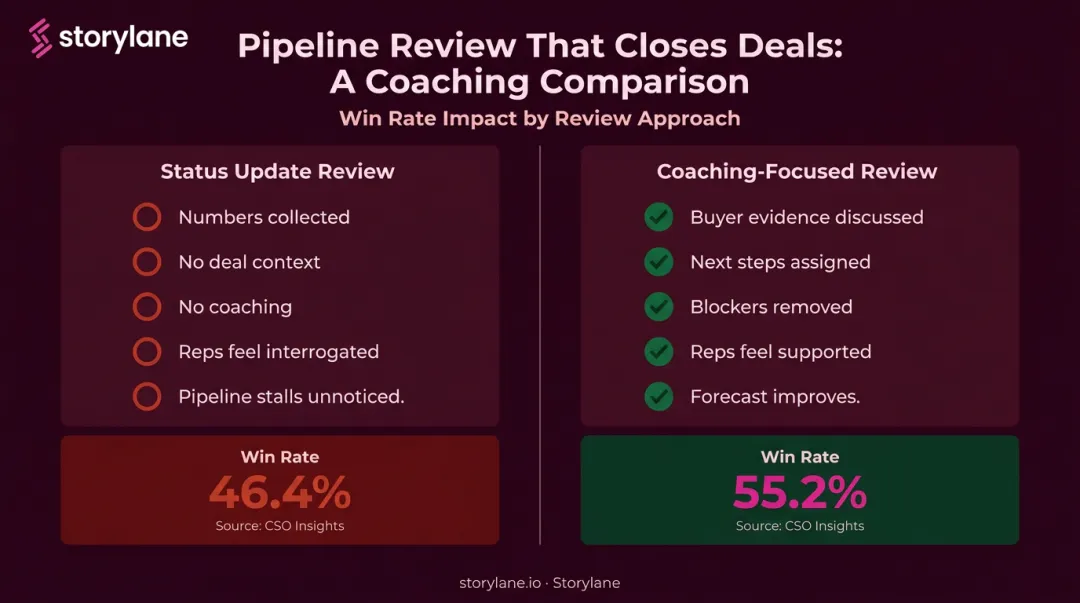
Research from CSO Insights found that organizations using dynamic coaching achieved a 55.2% win rate compared to a 46.4% average. That 9-point gap is won or lost in how managers run these conversations.
How to Structure Your Sales Pipeline Review Meeting
Structure determines whether a 30-minute review actually covers 10 deals or just three.
Frequency and Format
- Weekly or bi-weekly 1:1s work best for reps building pipeline or early-stage teams
- Monthly reviews suit more mature teams who supplement with async CRM updates
- Team-wide pipeline reviews serve a different purpose — pattern spotting across deals — and shouldn't replace individual 1:1s
Meeting Duration
A 30-minute 1:1 should cover 8–12 deals when reps arrive prepared. A 60-minute team session works for identifying cross-deal patterns. The length should reflect preparation quality, not deal volume. If a review regularly runs over time, the preparation process needs fixing — not the calendar invite.
Which Deals to Prioritize
Don't review every deal in the pipeline. Focus on:
- Largest deals by ARR or contract value, since these are the ones that actually move the number
- "Strike zone" deals: opportunities sitting in the stage where your specific sales motion wins or loses most often
Everything else gets a quick pass or an async CRM check.
Define Stage Exit Criteria Before Any Review Happens
This is the foundational requirement most teams skip. Without shared, documented definitions of what it means to clear each pipeline stage, every review devolves into storytelling.
A concrete example: a deal doesn't leave Discovery until both conditions are met — (1) the prospect has articulated a specific problem the solution solves, and (2) a next meeting with an agreed agenda is on the calendar.
Without that shared standard, "Discovery" means whatever the rep thinks it means.
Agenda Structure
Share the agenda with reps before the meeting. Reps who arrive prepared, not reactive, make the whole session faster and more useful. A workable time split for a 30-minute 1:1:
- Brief pipeline overview (5 minutes) — health check on the full pipeline
- Three priority deals (20 minutes) — focused discussion on each
- Action item wrap-up (5 minutes) — clear owners and deadlines logged before the meeting ends
Sales Pipeline Review Best Practices That Actually Move Deals
Prioritize Inputs Over Outcomes When Coaching Reps
A rep can run a near-perfect sales process and still lose the deal. Conversely, a poorly managed deal can close on luck. If managers only evaluate outcomes, they're rewarding luck and penalizing honest effort.
Evaluate how well reps controlled their side of the process: meeting prep, discovery quality, next-step ownership. Reframe review questions accordingly:
- Instead of: "Why didn't you close this?"
- Ask: "What did the buyer say that gave you confidence in that close date?"
- Or: "What's your plan if the champion goes dark this week?"
These questions surface whether the rep actually has evidence — or is operating on hope.
Use the Create–Advance–Close Model
Coaching on inputs alone won't fix coverage gaps. Most teams over-index on deals near the finish line, and after a strong close month, the pipeline runs dry.
A 2020 survey by ValueSelling and Selling Power found 69% of B2B salespeople didn't have enough pipeline to meet quota. The problem usually starts weeks or months earlier — when pipeline reviews never touched early-stage deals.
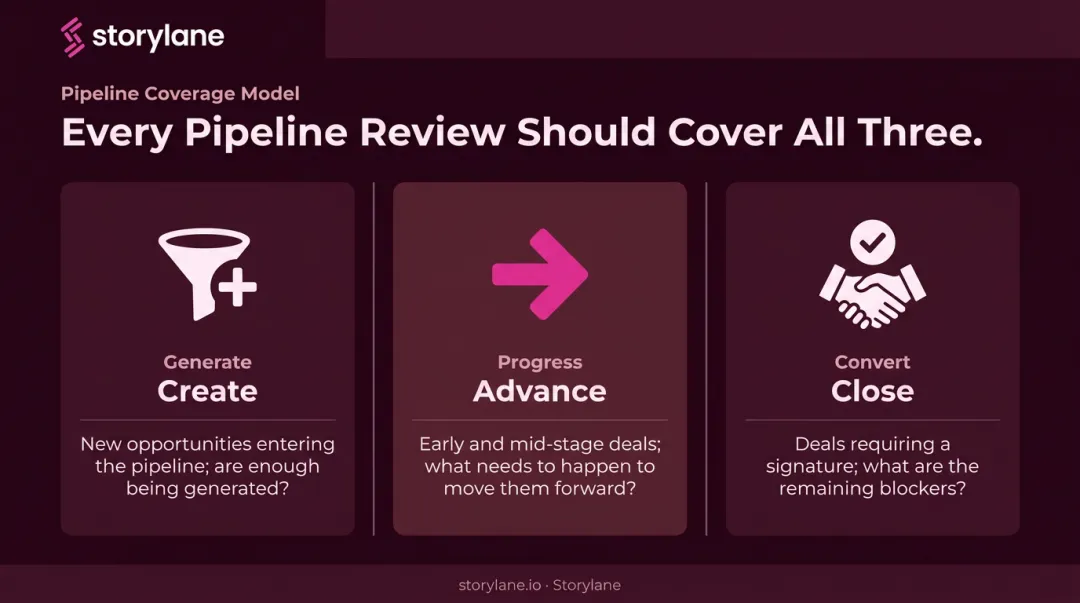
Every review should allocate attention across three buckets:
| Bucket | Focus |
|---|---|
| Create | New opportunities entering the pipeline — are enough being generated? |
| Advance | Early and mid-stage deals — what needs to happen to move them forward? |
| Close | Deals requiring a signature — what are the remaining blockers? |
Have Reps Summarize Each Deal in One Sentence Per Stage
This is a discipline, not just a technique. For each completed stage, reps state in one sentence how they achieved the exit criteria. For the next two upcoming stages, they state their plan to reach each one — a "next-next" structure that forces forward thinking.
It shifts the conversation from storytelling to strategic thinking. A rep who can't summarize a completed stage in one sentence doesn't have real evidence it was completed.
Ask Questions That Uncover Blind Spots
Once reps can articulate their deals clearly, managers can probe for what's missing. There are two categories of useful questions:
- Past stages — Is there hidden risk in how the rep achieved the exit criteria? Example: "Is there any way the prospect could replicate this outcome without us, or with a competitor?"
- Future stages — Is there risk in the plan to reach the next exit criteria? Example: "What could prevent the champion from getting exec approval?"
The first type catches overconfident stage assignments. The second catches plans that haven't accounted for real obstacles.
Document Action Items With Clear Ownership
Good questions only matter if the answers produce action. A pipeline review without documented follow-up has no accountability loop. Before ending every session, confirm:
- What needs to happen for each discussed deal
- Who owns each action — rep, manager, or executive sponsor
- By when
Log action items directly in the CRM so progress is visible before the next review.
Common Pipeline Review Mistakes to Avoid
Even well-intentioned teams repeat the same structural errors. Here are the ones that consistently hurt forecast accuracy and deal velocity:
How Reviews Are Run
- Running reviews without a set agenda — the conversation drifts to whatever the rep wants to talk about
- Letting reps assess deal health using gut instinct instead of CRM activity and buyer signals
- Creating a blame-oriented environment where reps sandbag or inflate numbers to avoid scrutiny — this directly corrupts the pipeline data leadership relies on
How Reviews Are Structured
- Running team-wide reviews instead of 1:1s — group settings rarely give individual deals the attention they need
- Letting reviews slip when things get busy — stalled deals go unnoticed for weeks
- Conflating pipeline reviews with general one-on-ones — this dilutes both
Stage Management and Definition Drift
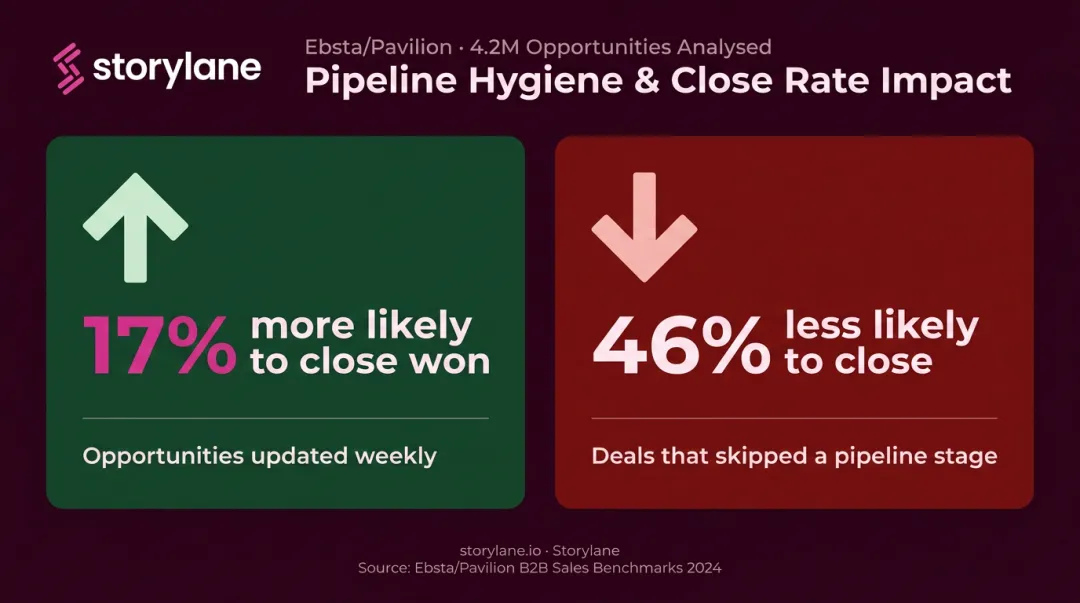
The Ebsta/Pavilion 2024 benchmark — drawn from 4.2 million opportunities — found that opportunities updated weekly were 17% more likely to close won, while deals that skipped a pipeline stage were 46% less likely to close. Stage integrity isn't administrative overhead. It's directly tied to outcomes.
When "qualified" means different things to different reps, the pipeline becomes meaningless as a forecasting tool. Audit stage definitions regularly, reinforce them during reviews, and treat consistency as a prerequisite for accurate forecasting.
Using Buyer Engagement Signals to Run Smarter Pipeline Reviews
There's a gap in most pipeline reviews that rarely gets discussed: they rely entirely on rep-reported activity. Calls made. Emails sent. Meetings held. What they miss is what the buyer was doing between those conversations.
This gap matters more than it used to. Gartner's 2025 buyer survey found 61% of B2B buyers preferred a rep-free buying experience — which means most of the evaluation happens without the rep in the room. A pipeline review that only captures rep-side activity is only seeing half the story.
What Demo Engagement Data Adds to the Conversation
When reps can point to which product flows a prospect explored, how long they spent, and whether they shared the demo with colleagues, the conversation shifts. Instead of "I think they're interested," the rep can say "they spent 12 minutes on the compliance workflow and came back twice — that's what they care about."
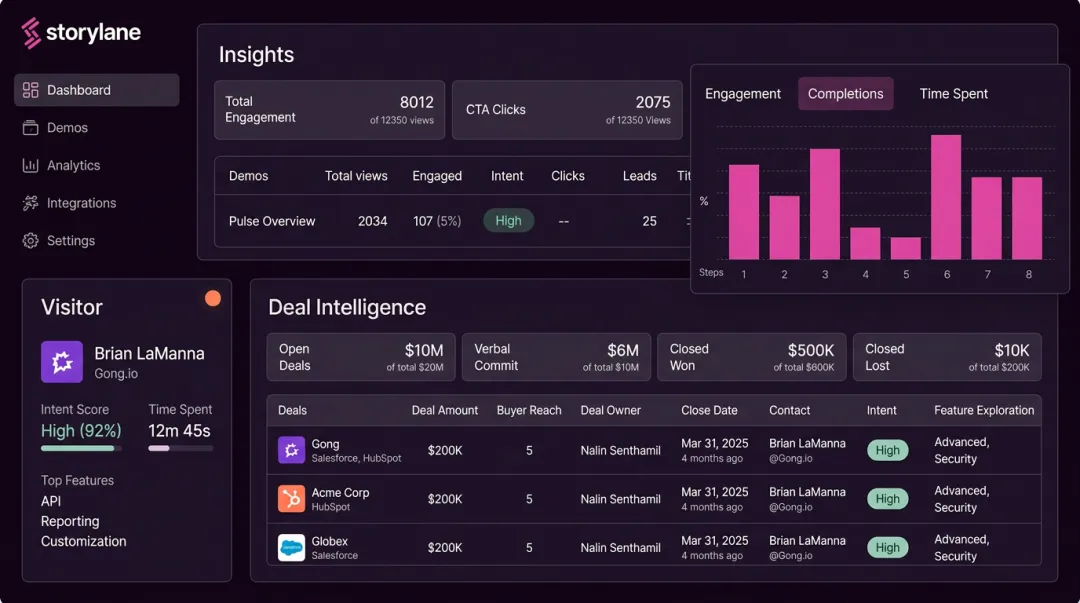
Storylane's demo analytics surface exactly this kind of buyer-side intelligence. The platform tracks:
- Time spent and completion rates per demo flow
- Feature exploration patterns and return visits
- Intent scores (Low, Medium, High) based on engagement depth
- Real-time Slack alerts with company identity, last view time, and CTA clicks when a high-intent prospect re-engages
The Account Reveal feature goes further: it de-anonymizes demo visitors at the company level, so when a new account shows up in the demo activity, that's a signal worth discussing in the pipeline review — even before the rep has spoken to anyone there.
Turning Passive Content Into Active Deal Intelligence
Here's how engagement signals translate directly into pipeline review talking points:
- No return visits, close date two weeks out — A stalled demo is a risk flag. Either something has changed or the deal isn't as far along as the commit date suggests.
- New stakeholder in the demo activity — Someone else is evaluating. Get introduced before they form their own conclusions.
- Disproportionate time on one product flow — That's the pain point. Address it directly in the next conversation.
Storylane's CRM integration pushes this engagement data directly into Salesforce and HubSpot deal records, meaning the intelligence is available in the same place managers review pipeline — no separate tool required.
Frequently Asked Questions
What is a pipeline review?
A pipeline review is a structured, recurring meeting between a sales manager and rep to assess deal status, identify obstacles, and agree on next steps. It's distinct from a general check-in — the focus stays entirely on active deals, their health, and what needs to happen next.
How often should you run a sales pipeline review?
Frequency depends on sales cycle length and team maturity. Weekly or bi-weekly works for most B2B SaaS teams. More mature teams may run monthly reviews and supplement with async CRM updates between sessions.
What questions should a manager ask during a pipeline review?
The best questions fall into two categories:
- Past stages (hidden risk): "What evidence do you have that the buyer is committed to this timeline?"
- Future stages (plan viability): "What could prevent the champion from getting exec approval?"
What's the difference between a pipeline review and a one-on-one?
Pipeline reviews focus exclusively on deal status, progression, and blockers. One-on-ones cover broader topics — rep development, morale, career goals. Schedule them separately so neither gets crowded out by the other.
How do you know if a deal should be removed from the pipeline?
Remove or flag a deal as at-risk if it has no next scheduled activity, hasn't advanced stages in a defined number of days, or lacks a confirmed decision-maker actively involved in the process.
How long should a sales pipeline review meeting be?
30 minutes for a well-prepared 1:1 covering 8–12 deals. Up to 60 minutes for team reviews. Shorter reviews signal better preparation — if a rep walks in knowing their deals cold, you'll rarely need the full hour.