Low Touch Sales: The Future of Product-led Growth?

Darshan
June 29, 2026
Table Of Contents

According to the 2022 Product Benchmark report, a larger number of respondents than ever before reported having tried a freemium or free trial product. This marks their first year, where most respondents have a product-led experience.

Instead of requesting a demo, companies are trying the product for free by themselves. Does it mean there is no need to rely on a salesperson to demonstrate the product? 

Yes!

Low-touch sales models are emerging to drive growth in B2B companies. 

In contrast, high-touch sales models involve a high level of interaction between the salesperson and the potential customer. This prioritizes relationship-building and personalized interactions. 

Let’s find out how low-touch sales are the future of Product-Led Growth (PLG).

What are Low Touch Sales Models?

The low-touch sales model is the one that requires minimal sales intervention to convert a prospect to a customer. It is best suited for low-priced solutions or basic product tiers, allowing customers to self-serve their way in.

Fortnite and similar companies have generated revenue surpassing one billion dollars through a freemium model. The product can sell itself by removing any obstacles for users to experience the product's value.

These models rely heavily on automation and self-service tools. Thus, buyers can research, evaluate, and purchase products or services without speaking to a sales representative.

Low-touch sales models typically involve a more streamlined, automated approach to sales that allows businesses to scale their operations and reach a larger audience while minimizing the need for direct, high-touch sales interactions. 

What is a Low Touch Sales Funnel in B2B SaaS?

Let's look at a low-touch sales funnel in B2B SaaS. 

The low-touch sales funnel typically involves several stages, including awareness, consideration, and decision-making:

  1. In the awareness stage, potential buyers become aware of the product or service through marketing channels such as email campaigns, social media ads, or blog posts. 
  2. In the consideration stage, buyers evaluate the product or service through free trials, demos, or self-service tools. 
  3. Finally, in the decision-making stage, the buyer decides whether to make a purchase or not.

Low Touch Sales - SaaS Examples

Jamdoughnut is an excellent example of a low-touch SaaS model that has been successful in the UK's cashback app market. 

Jamdoughnut is an excellent example of a low-touch SaaS model

The platform collects and analyzes user transactions through OpenBanking APIs, providing users with personalized recommendations on saving money by buying and spending rewards within the application.

One of the critical factors in the success of Jamdoughnut's low-touch SaaS model is its focus on quick wins for users. 

As a result, users can immediately see the app's benefits by minimizing the time to value, encouraging them to continue using it, and ultimately driving growth. This is achieved through a streamlined onboarding process and clear calls-to-action that guide users through the platform.

Another critical factor in Jamdoughnut's success is its built-in referral system, which encourages existing users to refer their friends and family to the app. This not only helps to lower customer acquisition costs but also increases customer loyalty and retention.

Jamdoughnut also uses notifications and email marketing to keep users engaged with the platform, providing personalized recommendations and alerts based on their spending habits. This helps to reduce churn and increase per-user spending on the platform.

Low-touch sales models are a fascinating and innovative way to sell products and services in B2B SaaS. Using automation and self-service tools, you can offer your buyers a more streamlined and efficient buying process while freeing up their sales teams to focus on higher-value tasks. 

What are High Touch Sales Models?

High Touch Sales Models are essentially sales strategies that involve a high level of interaction and engagement between a salesperson and a potential buyer. 

This approach requires much-personalized attention and communication with the customer instead of a more automated or self-service process.

High Touch Sales Models include features such as:

  • Personalized interactions
  • Customized solutions
  • Relationship-building
  • Consultative approach
  • High level of customer service
  • Longer sales cycle
  • Higher value products

A high-touch sales model places a greater value on understanding the needs and goals of each customer and providing tailored solutions to meet those needs. By leveraging technology and employing a team-based approach, businesses can implement a high-touch sales model and drive growth through customer satisfaction and loyalty.

High Touch Sales Models are essentially sales strategies that involve a high level of interaction and engagement between a salesperson and a potential buyer.

What is a High Touch Sales Funnel in B2B SaaS?

Now, when it comes to B2B SaaS (Business-to-Business Software as a Service) companies, a High Touch Sales Funnel refers to guiding potential customers through each sales cycle stage with a hands-on, personalized approach. 

This type of sales funnel typically involves multiple touchpoints, including initial outreach, product demos, follow-up meetings, and ongoing customer support.

High Touch Sales - SaaS Examples

Reachbird is a prime example of a high-touch SaaS model that leverages personalized interactions with potential customers to drive sales. 

The influencer marketing platform has designed its onboarding process to encourage visitors to schedule time with a live person to learn more about the platform and its benefits.

The website is designed to guide visitors toward scheduling a demo, with clear calls-to-action (CTAs) encouraging them to speak with a sales representative. Once a demo is scheduled, Reachbird's sales team takes a hands-on approach to engaging potential customers, using the opportunity to showcase the platform's features and functionality and demonstrate how it can help them achieve their marketing goals.

During the demo, Reachbird's team can answer any questions potential customers might have while highlighting the platform's unique selling points and the ROI it can deliver. 

Providing a personalized experience and demonstrating the platform's value in a one-on-one setting helped Reachbird build trust and establish a strong rapport with potential customers.

High Touch Sales Models can be incredibly effective in B2B SaaS, particularly for companies that offer complex products or services requiring a more hands-on approach. 

Wondering how it differs from low-touch sales? Here’s something for you:

Low Touch SaaS vs. High Touch SaaS: What's the Difference?

Here's a table outlining the main differences between Low Touch SaaS and High Touch SaaS:

 Low Touch SaaSHigh Touch SaaS
Customer SupportLimited or no direct human support, with a focus on FAQDirect and personalized support, often through a dedicated rep
OnboardingAutomated and streamlinedPersonalized and hands-on
Sales ApproachSelf-service model with limited human interactionPersonalized approach with direct human interaction
Sales Cycle LengthShorter, with lower acquisition costs and higher volumeLonger, with higher acquisition costs and lower volume
Target MarketPrice-sensitive, small- to mid-sized businessesEnterprise-level businesses and large accounts


Here's Jen Grant, the COO at Cube, talking about low touch and high touch customer onboarding:

What Makes Low-Touch Sales the Future of PLG?

"Three out of every four Business to Business (B2B) buyers would rather self-educate than learn about a product from a sales representative, according to Forrester."

― Wes Bush, Product-Led Growth: How to Build a Product That Sells Itself

Here’s why a low-touch sales model can be the future of product-led growth:

Inclination Toward Self-Service Options

Low-touch sales models have the ability to streamline sales operations and provide buyers with a seamless, self-service buying experience. 

According to TrustRadius, buyers are strongly inclined toward self-service options, with all indicating a clear preference for them.

Automated Lead Qualification

Product-led companies that offer a freemium product are more than twice as likely to experience rapid growth (100%+ year-over-year revenue growth) compared to sales-led companies.

Automated tools help identify high-quality leads and prioritize them for follow-up by your sales reps. So, B2B customers now expect PLG strategies like the ease of use, freemium or free trial, and self-service from companies. 

Atlassian grew a low-touch sales model into an automated growth machine. Watch Jay Simons (ex-president) getting candid about it: 

Buyer Enablement Tool

The typical company would successfully persuade three users to switch to paid accounts in this freemium model. In comparison, about two users would do so without directly interacting with a sales representative.

On average, a company following this free trial strategy could convert seven users to paid accounts, with one user making the transition without any salesperson involvement.

"Many SaaS businesses strive for $0 customer acquisition cost (CAC) and yet most still end up spending a small fortune acquiring each new customer. If you want to get to $0 CAC, Product-Led Growth is the only way you're going to make it happen."

— Olof Mathé, CEO, MixMax
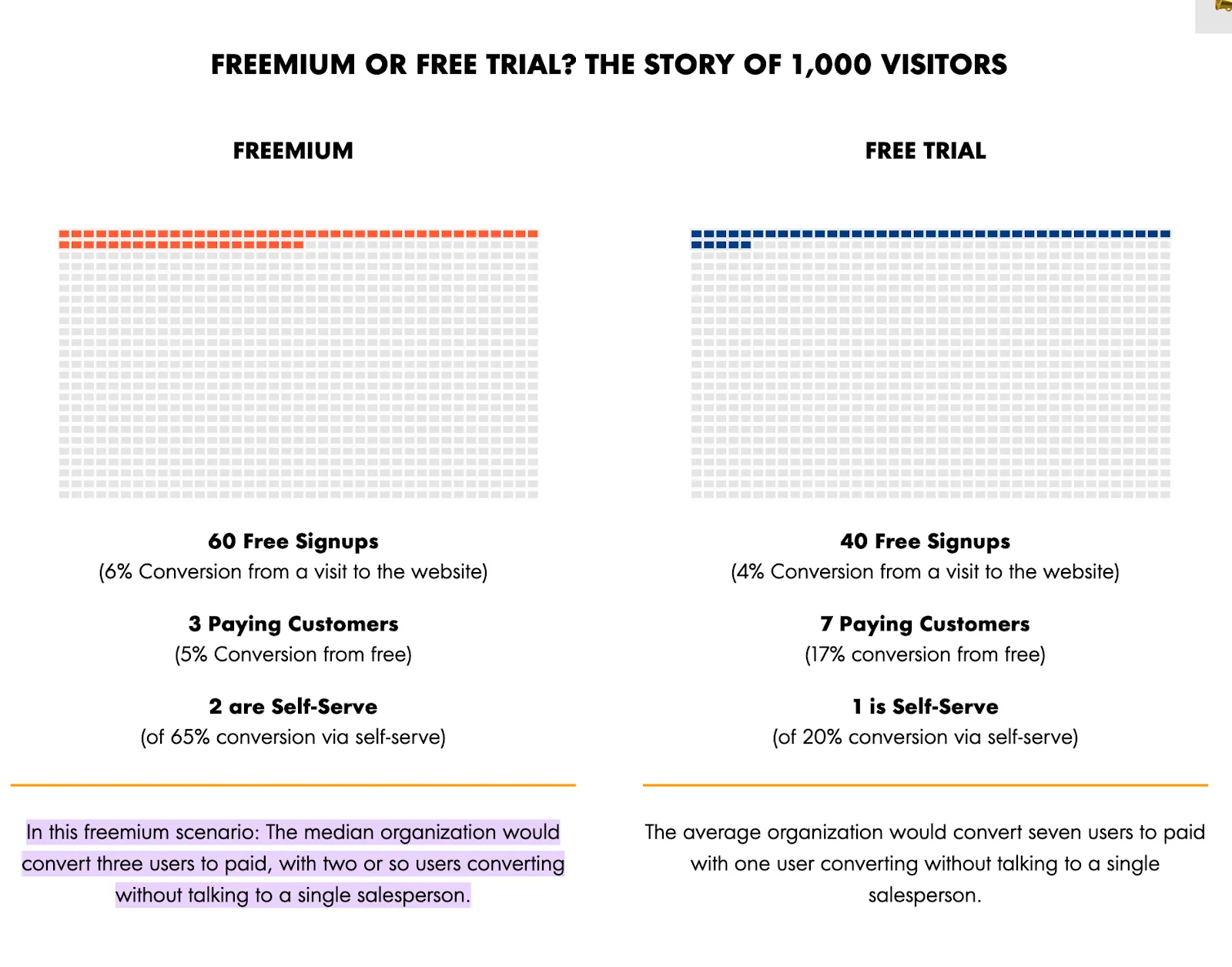
A study by OpenView Partners in 2022 revealed that on average, a company following a free trial strategy converted 7 users to paid accounts, with 1 user making the transition without any salesperson involvement.

Using buyer enablement tools such as chatbots and product demos helps educate buyers and make the purchasing process smoother, making low-touch sales models a more attractive option.

Digital-First Approach

With the retirement of baby boomers and the rise of millennials in decision-making positions, a digital-first approach to buying will become commonplace. 

According to Gartner's research, customers spend only 17% of their time meeting with potential suppliers during a purchase consideration, resulting in a decline in customer face time. Hence, virtual selling via digital channels will become more prevalent.

With the rise of digital-first buying and virtual selling becoming more prevalent, low-touch sales models that rely on self-service options will be the way of the future.

Instead of relying on traditional, high-touch sales approaches, companies are adopting a more customer-centric, product-led approach that focuses on delivering value to customers.

Lead Generation

Many organizations offer 'free trials,' which are opportunities for users to test a product. Still, they are used to gather personal information that can be utilized to pursue potential customers through sales efforts. 

Essentially, the 'free trial' serves as a disguised lead generation tactic.

The key to achieving real success with freemium product experiences and even certain trials is to provide value to users before requesting payment. 

This approach generates leads for your business and converts satisfied users into enthusiastic advocates who spread the word about your product through virality and word-of-mouth promotion. 

Ultimately, your satisfied users can become your most valuable marketing asset.

With the growing preference for self-service options and digital-first approaches, low-touch sales models are becoming the go-to strategy for businesses looking to scale their operations and reach a larger audience while minimizing the need for direct sales interactions.

Where Does Storylane Fit?

"A strong brand and social proof are no longer enough to build trust with the modern buyer. You need to let people try before they buy. The Product-Led Growth model is how you make this whole approach to doing business a reality."

— Karim Zuhri, Head of Product Marketing, SafetyCulture

Ready to try a low-touch sales approach for your company? 

Storylane offers free demos to help you unleash the power of PLG. 

Companies are turning toward low-touch sales models to reach a wider audience and minimize high-touch sales interactions. 

Our no-code tool means your customers can explore and purchase your product independently without engaging with sales reps. 

And the best part? 

In just a matter of minutes, you can create dynamic and engaging product demos that will capture your target audience's attention. 

Let your potential customers experience the value your product offers. Schedule a free demo with us, if you haven't already :)
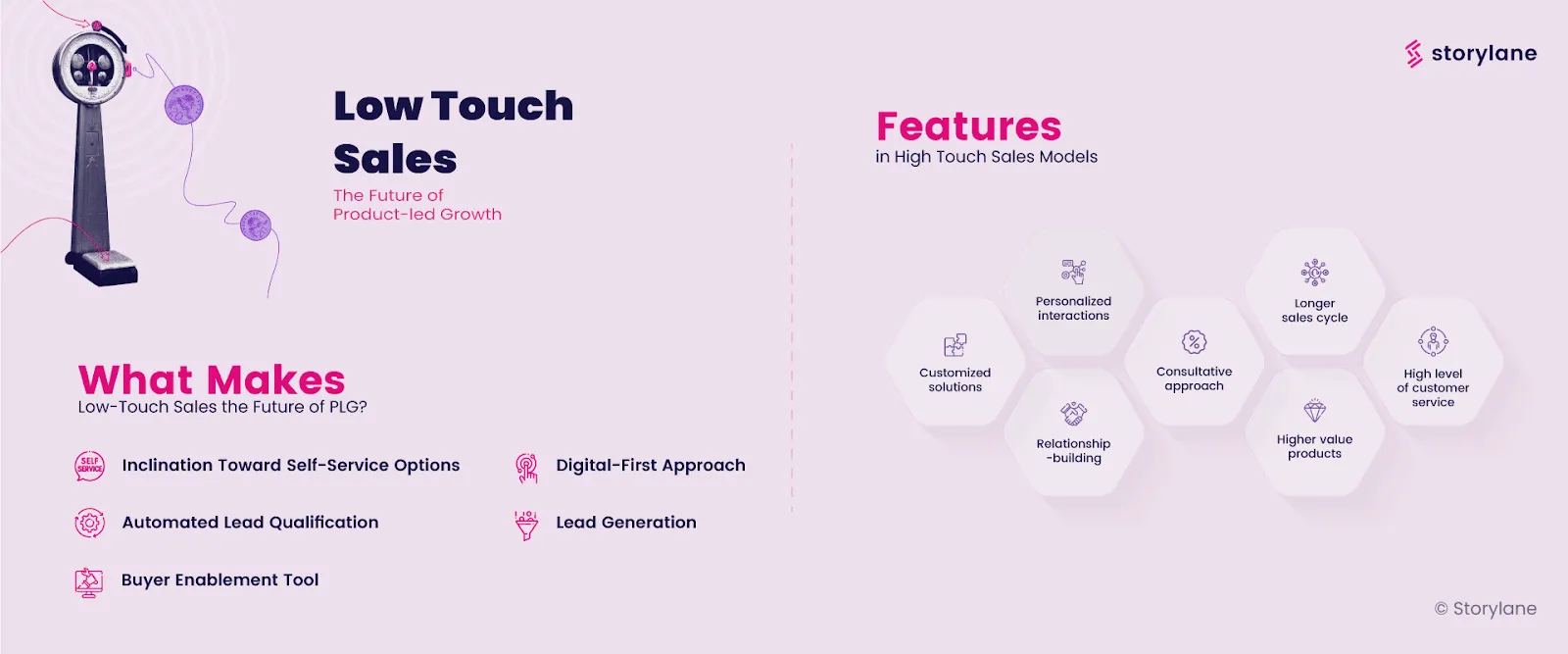
A takeaway sheet that tries to answer if low touch sales is the future of product led growth

Related Reading

Best PLG Examples: SaaS Companies Doing Product-led Growth Right

What is Product Led Marketing? Examples and Strategies

What is Product-Led Growth?

Killer demos for every stage

Build demos and agents that turn curious buyers to closed won
Book a demo

Related Articles

Read All Articles
Research
July 3, 2026
6 min read

68,000 deals, 3 findings: Measuring the ROI of interactive demos

This report analyzes ~68,000 deals (~50,000 of them closed) across 20+ anonymized B2B SaaS pipelines to measure what interactive demos actually do for pipeline metrics..
Ranga Kaliyur

This report analyzes ~68,000 deals (~50,000 of them closed) across 20+ anonymized B2B SaaS pipelines to measure what interactive demos actually do to pipeline metrics. Most demo benchmarks stop at engagement rates and time on page. I wanted the part that matters: do deals where buyers use a demo do better than deals where they don't?

My approach is simple. Using aggregated, anonymized Deal Intelligence data, I connected demo activity to real CRM outcomes, then compared deals with Storylane demos against deals without, inside each pipeline.

In summary

When buyers use an interactive demo, deals tend to...

  • Win 20% more often (38% vs 46% win rate), and it climbs the more they engage.
  • Reach 60% more of the buying committee (more stakeholders on the deal).
  • Land 2.75x bigger specifically in enterprise motions (flat in SMB and mid-market).

Methodology

  1. Using Storylane's Deal Intelligence, I connected demo engagement to CRM deal records (HubSpot and Salesforce) across 20+ anonymized pipelines: ~68,000 deals, nearly 50,000 closed.
  2. For each deal, I compared two groups: buyers who engaged with a demo (at least one demo session tied to the deal) and buyers who didn't. I measured win rate, deal size, and number of stakeholders.
  3. I report the median within each pipeline, then across pipelines, so a handful of large accounts don't skew the average (Simpson’s Paradox). The findings come from the 20 pipelines where the demo-to-deal link was clean enough to compare.

One caveat worth stating up front: this is a pattern, not proof of causation. Reps demo the deals worth demoing, so demo use partly reflects deal quality. Read these as strong, repeatable signals.

1. Conversion Lift: Buyers that engage with interactive demos close 20% more often

This is the big one: deals where the buyer engaged with an interactive demo won 46% of the time, versus 38% for deals with no demo  (about 20% more often), and it held in 14 of 20 pipelines analyzed.

The most interesting part is that the impact compounds with every session. The more a buyer returned to the demo, the higher the win rate. In our own pipeline the climb was steady: 87% (no demo) → 90% (1 session) → 91% (2–3) → 96% (4+ sessions). 

Across the dataset, deals with 4+ sessions won more often than zero-session deals in 71% of pipelines analyzed. A single view nudges the odds; repeat engagement moves them.

The logic is intuitive: a buyer who keeps coming back to a demo is a buyer building conviction. A static page can tell someone your product is good; a demo lets them prove it to themselves, and repeat visits usually mean they're selling it internally too.

🥡 Takeaway: Treat repeat demo use as a buying signal. When an account keeps coming back, get Sales in early.

2. Stakeholder Reach: Demos bring 60% more people into the deal

Deals with an interactive demo carried about 60% more stakeholders: a median of 1.6 contacts per deal vs 1.0 without, and more stakeholders in 15 of 17 pipelines. The gap was widest in enterprise pipelines, where one averaged 4.6 stakeholders per interactive demo-influenced deal vs 2.7 without, and another 5.2 vs 3.8.

Here's why it matters: B2B software isn't bought by one person anymore, it's bought by a committee. A demo is the rare sales asset that's easy to forward and relevant across functions, so it travels. One champion shares it, and suddenly the economic buyer, a security reviewer, and two end users have all seen the product for themselves. Deals that reach more of the committee are the deals that close.

🥡 Takeaway: Multi-thread on purpose. Send shareable, role-specific demos so the whole committee sees the product firsthand, not just your champion's secondhand pitch.

3. ACV Lift: In enterprise, deals with a demo are 2.75x bigger

Demos don't inflate every deal, and that's the honest part. The deal-size effect depends entirely on who you sell to.

  • Enterprise motions (large, complex, multi-team deals like GRC/compliance and enterprise healthcare): deals with a demo were 2.75x bigger at the median, and larger in 4 of 5 such pipelines. In one, median deal size went from roughly $16k without a demo to $127k with one; in another, from about $170k to $468k.
  • SMB and mid-market: no size difference. Demos there still won more deals and reached more people, they just didn't make deals bigger.

This tracks with how big deals actually get done. The larger and more complex the purchase, the more people and the more scrutiny involved, and the more room a demo has to do the explaining across stakeholders, functions, and weeks of evaluation. In a quick self-serve motion there's simply less for it to move.

🥡 Takeaway: if you sell enterprise, use demos as a late-stage lever, not just a top-of-funnel asset. That's where they move deal size.

How to read this report

The honest question is cause versus correlation. Demos land on the deals worth demoing, so some of this reflects deal quality alongside demo impact. To me that's what makes it worth taking seriously: across dozens of independent pipelines, the same three patterns keep showing up next to the deals that win, spread, and grow.

A few caveats. This is a first look at a subset of pipelines, deal values span multiple currencies, and a handful of accounts run against each trend. I've held an industry-by-industry breakdown for the next version, once there's enough data per vertical to say something solid.

What's next

A larger, cleaner dataset and a proper apples-to-apples comparison of similar deals with and without a demo, to turn these patterns into measurable lift, with industry and company-size cuts.

Guides
June 29, 2026
6 min read

Five ways B2B teams are using interactive demos that nobody talks about

What a conference booth in London, an EHR rollout for a differently-abled community, and a fintech triage system have in common — and what it tells us about where demo automation is actually going.
Ranga Kaliyur

What a conference booth in London, an EHR rollout for a differently-abled community, and a fintech triage system have in common — and what it tells us about where demo automation is actually going.

The standard demo automation playbook is predictable: marketing website tour, sales leave-behind, email nurture embed. That is what most companies start with.

But spend time in actual customer conversations and you see something different: teams using demos to solve problems the standard playbook never imagined.

This week, we reviewed a working session with an engineer at a large cloud computing company preparing for a technology summit in London. Her problem: she needed a product demo to play on a loop at her conference booth (no clicks, no one to navigate it, just a screen running in the background while conversations happened around it.)

Nobody markets demo automation as a conference booth tool. But that's exactly what she needed it for. And it wasn't the only unexpected use case this week.

1. Trade show and conference booth displays

The conference loop use case has specific requirements: autoplay enabled, 4-6 second transitions on title cards and pause slides, video clips set to 1.5-2x playback speed for longer recordings, and the entire thing downloaded onto the device. Conference WiFi is unreliable. You need the offline version ready before you walk in the door.

The structural formula that worked: technology stack slide (static) -> 4-second pause slide (blank) -> demo 1 with title card framing the problem ("Can I detect performance issues before they cause outages?") -> demo 2 -> repeat on loop. The problem-framing title cards are what make this work at a booth — a passerby reads a question they recognize and stops.

2. Staff onboarding for organizations with diverse accessibility requirements

A director of organizational performance at a nonprofit came to us mid-EHR transition. Her organization (200-plus staff, statewide) was moving to a new electronic health records platform and needed tutorials for everyone from clinicians to program administrators. Complicating factor: their staff includes a deaf and hard-of-hearing community.

Her requirements were specific: self-paced clicking rather than auto-advancing video, AI voiceover as an optional layer, and demos organized by function and embedded in SharePoint so staff could browse by department and role.

The training-center use case of interactive demos replacing annotated PDFs  is not new. The accessibility angle is. When a demo is self-paced, the viewer controls the speed versus video. That's a meaningful accommodation for populations that need more time, and it requires zero additional effort from the team building the content.

3. Multi-system integration demos

"We get asked all the time: what do these integrations actually look like?" said a co-founder at an early-stage health tech company. They had been answering that question in live demos, switching between systems in real-time and hoping nothing broke.

What they discovered: you can capture from multiple platforms in a single demo session. Finish recording in system one, click "add to existing demo," then capture from system two. The viewer moves between platforms seamlessly — without any live switching, without any risk of a broken environment. 

Live integration demos are high-risk, tedious (from a data management pov) and unrepeatable. Captured integration demos are neither. For a company whose primary sales objection is "show me exactly how the integration works," this is not a minor workflow change; it's a competitive differentiator.

4.Inside sales automation for long-tail accounts

An inside sales leader at a fintech company described a problem his team lives with daily: they manage accounts "where we're seeing very less revenue and more effort going from an account manager's point of view." His team's solution was a self-serve portal paired with interactive demos that replace human demos entirely for lower-priority accounts. Reps focus on the accounts with revenue potential; the demo handles the education and qualification for everyone else.

He had used this approach at a previous company and was replicating it here. The key insight: he was not evaluating demo automation as a way to improve existing demos; He was using it as a triage mechanism for a coverage problem. Interactive demos let you maintain a presence in accounts that don't justify a rep's time. That's a fundamentally different value proposition than "make your demos better," and it's one that VP of Sales audiences will understand immediately.

5. Localized demos for non-English-speaking markets

An inside sales team at a fintech company with a large India-based sales operation had one specific question: how many languages does the AI voiceover support? The answer, over 30, prompted an immediate workflow: build the demo once in English, then translate and duplicate into regional languages.

In markets where English-language demos create friction in the sales process, this is not a nice-to-have. It is a conversion rate issue. Prospects engage more deeply with content in their first language. The ability to generate a localized demo without re-recording or hiring a voice actor changes the economics of localization for inside sales teams that are already stretched thin.

Research
June 29, 2026
6 min read

Interactive demos vs. product videos: why revenue teams are switching over

Should you use interactive demos or product videos for sales? Compare creation time, maintenance, personalization, and analytics to decide.
Ranga Kaliyur

When sharing async product demos, sales teams have traditionally reached for a couple of options: quick and dirty screen recordings (think Loom, Vidyard, etc.) and high-end video productions (think Camtasia, Consensus, etc.). While there’s a time and place for both; AEs, SEs, and PMMs are increasingly adopting a third format — interactive demos — as a “better than both worlds” alternative. Here's why:

Interactive Demos vs Video: Feature Comparison
Compare Interactive demos
(Storylane)
Screen recordings
(Loom, Vidyard)
Video productions
(Camtasia, Consensus)
Time to create ✅ Fast, capture and creation often completed in minutes ✅ Fast but requires narration, timing, retakes, etc. ❌ Slow, can take weeks to script, shoot, and edit
Editing ✅ Self-serve, easy: replace screens, tweak text, reorder steps; no re-recording ❌ Limited scope: re-recording, trimming, stitching clips, fixing audio ❌ Technical dependency: needs expertise in pro editing software
Polish and branding ✅ Professional, consistent themes built-in; no editing software needed ❌ Low production value. Harder to maintain consistency; requires design/video tools ✅ Cinematic quality but requires video editing expertise
Publishing ✅ One-click publish; instantly updates everywhere ❌ Requires re-uploading and re-sharing new versions ❌ Requires re-uploading and re-sharing new versions
Maintenance & Updates ✅ Replace screens and content in minutes, auto-update instantly ❌ Requires re-recording entire sections/full-video ❌ Requires re-producing entire sections/full-video
Personalization ✅ Personalize at scale with dynamic tokens ❌ Hard to scale: Requires re-recording ❌ Impossible to scale: Requires re-production
Analytics ✅ Granular: Track views, interests, completion, and time-spent per step ❌ Limited to views, no actionable analytics or Opinions ❌ Limited to views, no actionable analytics or Opinions
Buyer experience ✅ Interactive, two-way experience ❌ Passive, one-way experience ❌ Passive, one-way experience
Ideal for… Across the board Ad-hoc touches, quick Q&A Top-of-funnel brand awareness campaigns

Why revenue teams are adopting interactive demos

Since our inception, we've noticed revenue teams of all sizes, from early-stage startups to Fortune 500 enterprises, switch over from videos to interactive demos. Here are the most common reasons we hear from customers.

Reason #1 - Speed without sacrificing quality

Screen recordings are quick and easy to produce but lack the polish and quality needed for high-value deals. On the other hand, producing polished video demos means days of planning, hours of environment prep, multiple recording attempts, and extensive editing. Interactive demos eliminate this friction entirely, especially now with AI, to instantly generate product-specific content (Guides, voiceovers, etc) from captured screens — no need for multiple takes. 

"Video is really strong at capturing people's attention and welcoming them into your story. But the thing that video can't do is provide a “click-through experience” allowing users to actually get their hands on the product — to feel it, to see it, to understand what the actual day in and day out of working with your tool is going to be like. Especially with its AI and automation, Storylane allowed us to build demos in such a quick amount of time."
- Michael DeMarco, PMM, Phenom

Reason #2 - Asset maintenance and scalability

Traditional videos are like baked cakes — once ingredients (product screens, click path, narrative) are combined into a video, it’s difficult to swap individual components. When your product UI changes six months from now, you face full reproduction from scratch.

Interactive demos keep these elements separate. Update a screen in minutes without touching the narrative. Adjust messaging without re-recording. Reorder workflows without starting over. This durability enables demos to stay current as your product evolves.

Further, creating persona-specific, industry-tailored, or localized video content means producing multiple versions of each asset — a multiplication problem that quickly becomes unmanageable. Storylane's AI editor recontextualizes entire demos for different personas or industries in seconds. Dynamic tokens automatically swap prospect information without creating separate versions. One base demo adapts to dozens of scenarios without manual overhead.

Reason #3 - Modern buying preferences 

Interactive demos respect buyer time by letting them jump to relevant sections, skip familiar concepts, and control their pace. Video forces a fixed timeline — even if viewers only care about one feature, they must scrub through the entire recording to find it. This level of control and self-serve flexibility reflects the preference of modern buyers, who'd rather click around a product tour for themselves than rely on a passive, one-way video.

"Nobody wants to watch a 5-minute video anymore. So my team sends a Storylane demo and the prospect sees the demo in 5 clicks."
- Jon Dolan, Sales Director, Cognism

The difference in analytics is equally striking. Video platforms show watch time and opens. Interactive demos reveal which features prospects explored, where they spent time, which stakeholders engaged, and where they dropped off. These step-level Opinions enable targeted follow-up conversations that video simply can't support.

Make buying easy with Storylane