This interactive demo was created free with Storylane in 2 minutes. Create your own demo
Start free
All Tutorials /Coda

How to Visualize the MongoDB Data in Coda

Updated on:
June 5, 2026
By:
Madhav Bhandari
Use this interactive demo to learn how to display MongoDB data as a structured table in Coda.

Quick summary

This tutorial shows how to visualize MongoDB data inside a Coda doc by creating and configuring a structured table with custom columns, column types, and display options. By following these steps, you can manually encode MongoDB records into Coda and format them to match your preferred data layout.


Steps

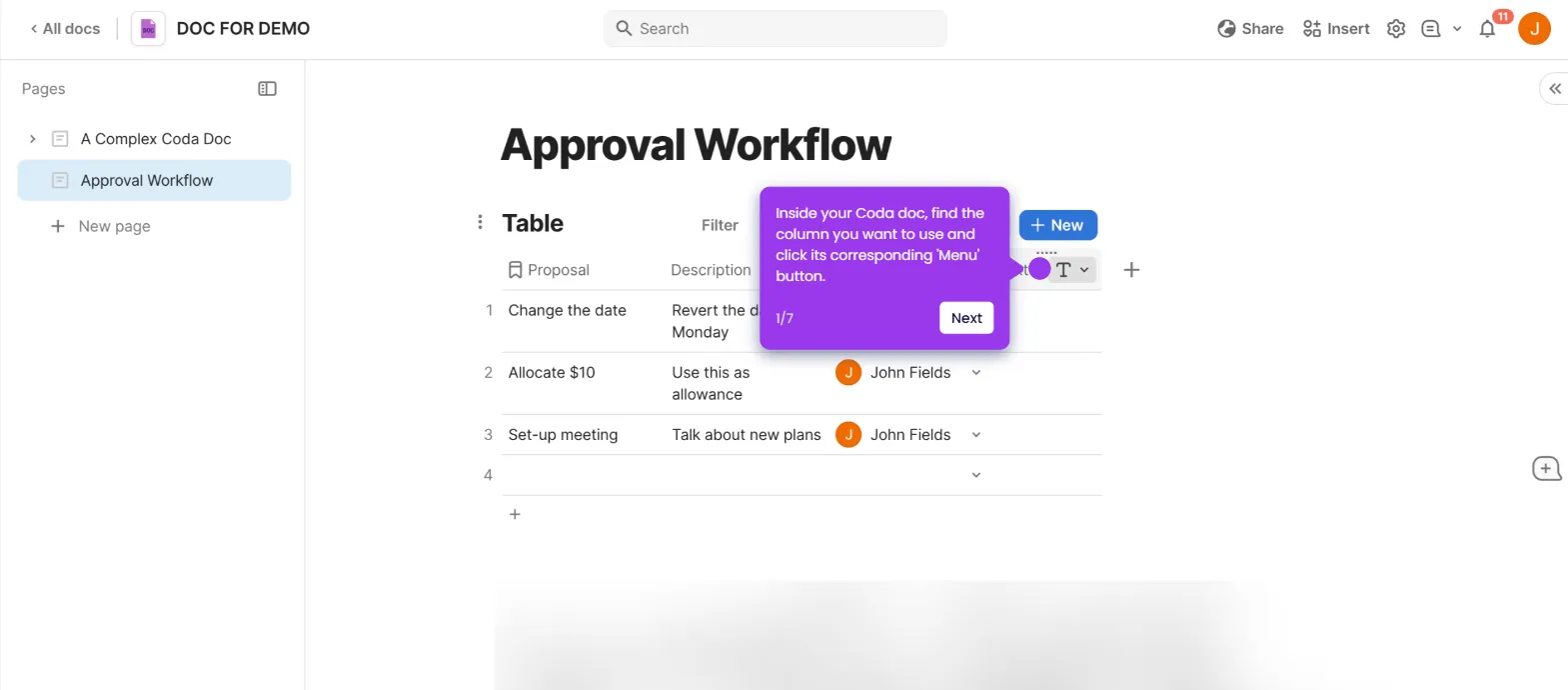
  1. Inside your Coda doc, find and click the Insert button.
  2. Choose Table from the list of options.
  3. Enter a unique table name in the input field, then use the floating bar to adjust the table style.
  4. Double-click each column header cell to edit the label and type your preferred column titles.
  5. To change a column type, tap the drop-down arrow next to the table.
  6. Hover over Column Type and select your preferred column type option.
  7. Click each cell and manually type the corresponding MongoDB data to populate the table.
  8. Click the Options button to proceed with further customization.
  9. Choose your preferred display format and configure its settings to match your preference.
  10. After completing all steps, your MongoDB data will be fully visualized as a Coda table.
📌 Why this matters

Visualizing MongoDB data in Coda bridges the gap between raw database records and collaborative, human-readable documentation. Teams that store operational data in MongoDB can use Coda's flexible table and column-type system to surface that data in structured views without needing a dedicated BI tool. This integration supports faster data review, cross-team sharing, and lightweight reporting directly inside the same workspace where teams plan and document. For data-driven organizations, connecting MongoDB output to Coda tables reduces context-switching and accelerates insight-to-action workflows.
Your product deserves an interactive demo
Start free
Similar Articles
Coda

How to Set Up Team Billing in Coda

Madhav Bhandari
Director of Marketing @ Storylane
Coda

How to Use Coda’s REST API

Madhav Bhandari
Director of Marketing @ Storylane
Coda

How to Create Approval Workflows in Coda

Madhav Bhandari
Director of Marketing @ Storylane
No items found.
Platform
Interactive Demos
Sandbox Demos
Hubs
RepX
Integrations
Solutions
Product Marketers
Growth & Demand Gen
Sales Reps & AEs
Presales & SEs
Customer Success
Product Managers
Customers
Demo Showcase
Customer Stories
Finer Demos Club
Features
Demo Signals
Personalization
Deal Intelligence
Resources
Blog
The Plot
Tutorials
Help Docs
What’s New
Demo Dundies
Company
Careers
Pricing
Partners
Contact
Trust Center
Backed by
Chrome Extension Icon
Chrome extension
Download
Desktop app
Download
Built in San Francisco Bay Area - ©2026 Storylane
Privacy PolicyTerms & Conditions
X Corp (formerly Twitter)LinkedIn
This website uses cookies to ensure you get the best experience on our website. Learn More
Got it
This website uses cookies to ensure you get the best experience on our website. Learn More
Got it