
.svg)

Part I - Logic: Why value clarity wins deals
One of the most persistent misconceptions about product storytelling is that it belongs to campaigns.
When people hear the word storytelling, they often imagine brand films, big launch moments, or creative marketing initiatives. Something expressive. Something seasonal. Something marketing owns.
But the real leverage of storytelling does not lie in campaigns at all. It sits inside sales enablement. This is where product stories are made or broken.
It lives in the demo someone watches before booking a call. It shapes how a sales deck is structured. It influences how onboarding flows introduce value. It determines whether a buyer understands what they are looking at or quietly disengages.
Interactive demos are among the most engaging environments in modern B2B. They sit somewhere between marketing and sales. They are structured, self-guided experiences. And because they are structured, they offer something powerful: control over how value is revealed.
To explore this further, I will be working with Storylane for the next three months to help their users better understand the science of storytelling so they can embed it directly into their interactive product demos. In this article, I will show how to turn sales demos from educational assets into persuasive tools that help customers clearly see the value you create, who it is for, and why you are the best at creating it.
In this first lesson, we will explore how to communicate your value clearly and effectively. Across dozens of industries and hundreds of product conversations, I have seen the same pattern. The companies that convert consistently are not simply the ones with the strongest feature sets. They are the ones that explain value most clearly at the moment a decision is being formed.
When designed intentionally, interactive demos are not just product tours. They are arguments.
Before diving into practical examples, it is worth grounding this in a simple framework.
The Triangle of Persuasion
In my work on product storytelling, I argue that every strong product narrative must answer three fundamental questions.
- What value does the product create?
- Who cares most about that value?
- How do we prove we are the best at creating it?

These correspond to Logic, Emotion, and Credibility, and in these lessons, we will explore how you can use the science behind each of them to create more effective story-driven interactive demos.
In this first lesson, I want to focus only on Logic. Because most demos break down before they ever reach emotion or proof.
If the value is not clear, nothing else can compensate for it.
The Feature Trap
Watch a typical product demo, and you will often see capability on display.
Tabs are opened. Dashboards are explored. Integrations are highlighted. Reporting views are showcased. The intention is understandable. If the product is powerful, the instinct is to demonstrate that power.
The difficulty is not commercial. It is cognitive.
Human working memory is limited. When information arrives without a clear organising principle, the brain has to work harder to interpret it. When it has to work harder, it fatigues faster. And when it fatigues, attention drops.
This is what people describe as “losing the thread.”
It can be tempting to use a product demo as an opportunity to bombard the user with as many informational arguments as possible to communicate why they should choose you. But how much information does a user really need to make a decision? The answer is a lot less than you think.
Humans prefer simplicity and clarity. When it comes to features, less is more. We are more interested in the value those features will provide than in understanding how each and every feature works.
The issue is rarely that the product lacks sophistication. The issue is that the value has not been defined clearly enough to anchor what is being shown. Without that anchor, each new feature increases cognitive load rather than persuasion.
Features, Benefits, and Value
To understand this more precisely, it helps to distinguish between three layers of communication.
- Features describe what a product does.
- Benefits describe what those features enable someone to do, achieve, or feel.
- Value describes the higher-level outcome or shift the product creates.
Most demos operate at the feature layer. Some move into benefits. Very few begin with value.
And the starting point matters more than we realise.
If a demo opens by clicking through functionality, the viewer has to construct the narrative themselves. They are silently asking, “Why does this matter?” If that question is not answered early, each additional feature becomes another piece of unconnected information.
By contrast, if a demo begins with a clear articulation of value, something shifts.
Imagine the demo opens with a simple framing: this product helps revenue teams close deals faster by eliminating manual administrative work. Now the viewer has a lens.
Automation is no longer just automation; it becomes a mechanism for speed. Reporting is no longer just reporting; it becomes measurement of progress. Integrations are no longer technical detail; they become acceleration.
The product has not changed. The experience of understanding it has.
Without a value lens, features remain isolated data points. With a value lens, they become evidence.
The Value Lens
Interactive demos are particularly interesting in this respect because they allow us to design sequencing intentionally.
Unlike live sales calls, they are architected environments. We choose what appears first. We choose what is emphasised. We choose what is omitted. We shape the order in which cognition unfolds.
That means storytelling is not an abstract layer placed on top of the experience. It becomes structural.
You can begin with value before exposing detail. You can guide users only through features that reinforce the core outcome. You can reduce cognitive overload instead of amplifying it.
But only if storytelling is applied deliberately.
Otherwise, even the most beautifully built interactive demo becomes a self-guided feature tour. Informative, perhaps. Persuasive, rarely.
The difference between those two approaches is subtle in design, but significant in commercial impact.
So in the next section, I want to move from principle to practice and look at how this plays out inside a real interactive demo. Examining a concrete example makes it easier to see how small structural shifts can dramatically change the clarity of value being communicated.
That is where we will turn next.
Storylane Case Study - Sprout Social.
In this walkthrough, I use a Storylane demo of Sprout Social as a practical example of structured product storytelling. Watch how features are anchored to value, turning what could be a feature tour into a persuasive narrative.
The Storytelling Sentence
If I reduce product storytelling to its simplest expression, it becomes this:
Here is how much better your life will be.
That sentence may sound straightforward, but it carries more weight than it first appears to. Because the responsibility of sales enablement is not merely to inform. It is to create clarity around improvement. It is to make the shift from current state to future state visible and believable.
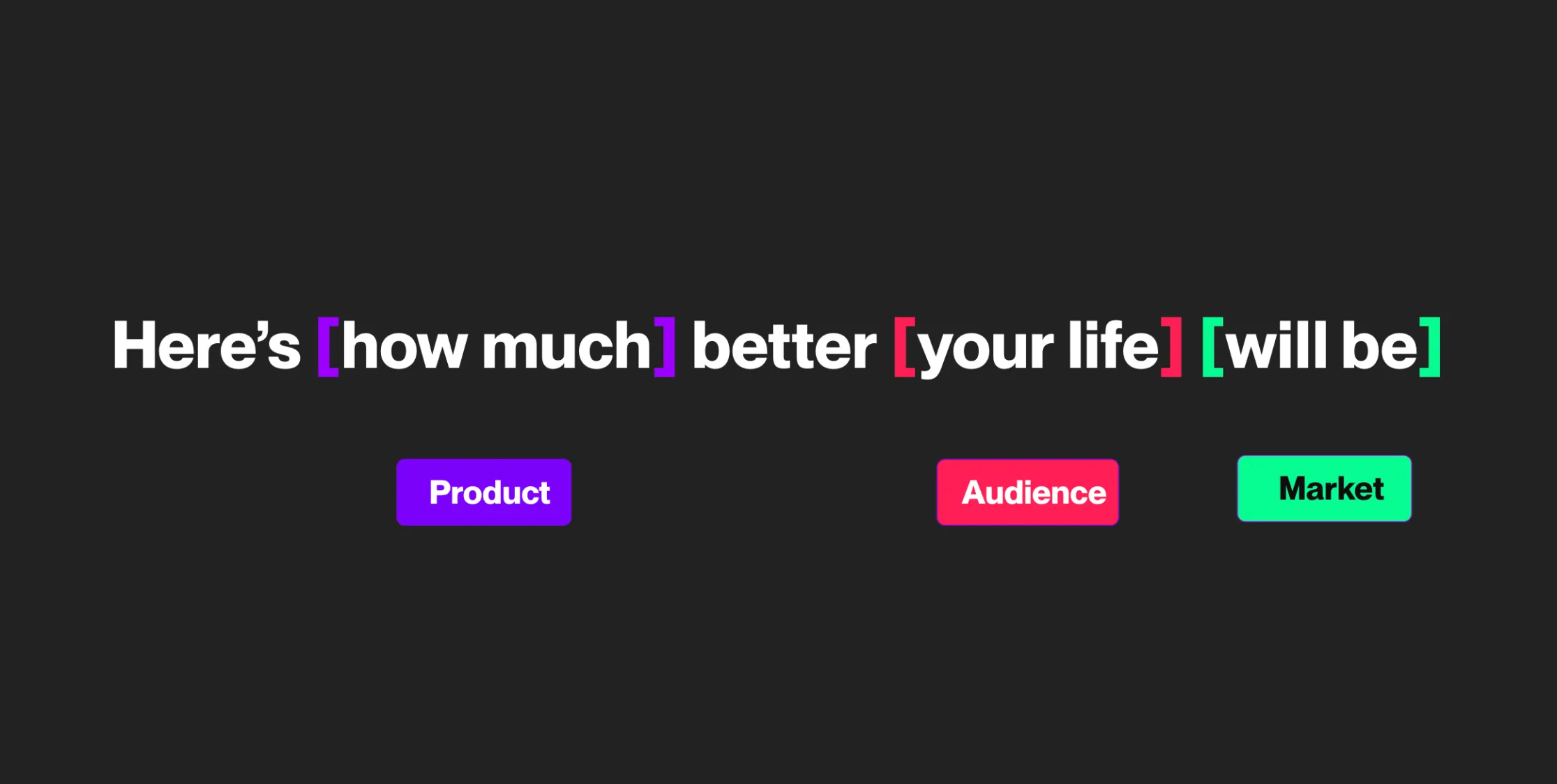
The “how much” matters. It forces us to define the scale of change. It pushes us beyond describing what the product does and into articulating what it changes. It introduces contrast. Before and after. Friction and flow. Manual effort and automated progress.
Without that contrast, features accumulate without direction. With it, every feature has a role to play in a larger narrative of improvement.
In the context of interactive demos, this becomes especially powerful. Because we control the flow of information, we have the opportunity to continually reconnect each piece of functionality to the long-term value it enables. Instead of presenting capability in isolation, we can anchor it repeatedly to the outcome it supports. Over time, this creates coherence. The experience feels intentional rather than exploratory. Structured rather than overwhelming.
When that happens, we are no longer asking the viewer to assemble meaning on their own. We are guiding them through a clear progression: this is where you are, this is where you could be, and this is how the product closes that gap.
That, ultimately, is what effective sales enablement should accomplish.
If you are interested in seeing further examples of how this principle can be embedded directly into interactive demo design, the Storylane case studies are a useful place to continue the exploration. They show how subtle structural decisions can turn a feature tour into a value-driven narrative experience.
Next Lesson - Customising Conflict.
In this lesson, we have focused on Logic.
On making value clear. On reducing cognitive overload. On structuring interactive demos so that features reinforce a single, coherent improvement. But clarity alone is not enough.
A demo can be logically sound and still fail to move someone. It can communicate value accurately and still feel generic. Because even when value is clear, it is not yet personal. This is where the second dimension of storytelling becomes essential: Emotion.
If Logic answers the question, “What value does this product create?” then Emotion answers a different, equally important question: “Who cares most about that value, and why?”
In the next lesson, we will shift our focus to audience.
We will explore how a deeper understanding of your ideal customer profile changes the way interactive demos should be structured. Not in terms of features, but in terms of emphasis. Language. Examples. Scenarios. The problems we foreground and the outcomes we prioritise.
An operations leader and a revenue leader may both use the same platform. But the tension they feel is different. The risk they worry about is different. The metric they care about most is different. If an interactive demo treats them as identical, it sacrifices persuasive power.
Emotion in product storytelling is not about theatrics. It is about relevance.
It is about demonstrating that you understand the specific pressures, ambitions, and constraints of the person on the other side of the screen. When that understanding is embedded into the structure of a demo, the experience shifts from informative to resonant.
So in Part Two, we will examine how to use sharper ICP definition and customer insight to customise interactive demos in a way that feels deliberate rather than generic. We will move from value clarity to value relevance.
Because once someone understands how much better their life could be, the next question is whether that better future feels designed specifically for them.
Part II - Emotion: Why one story isn't enough
Marketing is often described using the metaphor of casting a wide net. The wider the net, the larger the total addressable market. Greater reach implies greater opportunity. For organisations seeking growth, this logic is compelling.
Yet reach introduces a tension. As audiences broaden, specificity tends to diminish. Language becomes more general. Stories become more inclusive, but less precise. The message is designed to apply to many, but it may deeply resonate with few.
The alternative approach resembles spear fishing. Instead of reaching broadly, the focus narrows. One specific audience is identified and targeted with deliberate precision. This often creates stronger connection and sharper relevance, but it can also constrain scale and limit expansion into adjacent segments.
Modern B2B products complicate this tension further. Many platforms today are designed for multiple stakeholders within the same organisation. A CFO, a CMO, a Head of Operations, and Compliance may all participate in the same buying process. The product itself may serve each of them in meaningful ways. Yet the pressures, ambitions, and perceived risks shaping their decisions are rarely identical.
If communication narrows too aggressively, growth opportunities may be restricted. If it broadens excessively, resonance weakens.
The solution is not to choose between reach and precision. It is to design better lures.
Fishing lures are not generic objects cast blindly into the water. They are carefully shaped, weighted, coloured, and patterned to attract specific species within a larger ecosystem. Small adjustments in movement or reflection can determine whether the lure attracts attention or is ignored.
Modern storytelling requires similar intentionality. Marketers must operate within large markets while designing narratives that connect with distinct psychological triggers inside them. Doing so requires an understanding not only of product value, but of how emotion directs attention.
The Science of Emotion and Attention
In product marketing, it is possible to list every feature accurately and still be forgotten. Information alone does not guarantee memorability or persuasion. What tends to endure is not the technical detail, but the feeling associated with it.
Features inform. Stories persuade. Yet persuasion is most effective when emotion is engaged.
When a narrative triggers emotion, measurable processes unfold in the brain. Cortisol increases focus in moments of tension. Dopamine reinforces motivation and strengthens memory through anticipation. Oxytocin fosters trust and social connection. These responses shape attention and retention in ways that purely rational information does not.

Effective storytelling sequences these reactions deliberately. Tension maintains engagement. Anticipation sustains curiosity. Resolution reinforces belief. Without these emotional dynamics, information risks being processed passively.
Research into decision-making reinforces this understanding. Daniel Kahneman’s distinction between intuitive and analytical thinking illustrates how emotionally driven processing precedes and shapes rational justification. Even in enterprise environments structured by procurement frameworks and ROI models, decisions are made by human beings whose cognitive architecture remains unchanged.
The presence of analytical processes does not eliminate emotional influence. It often intensifies it. Career risk, reputational exposure, and organisational accountability heighten the emotional stakes of a decision.
Emotion is therefore not decorative. It determines what receives attention and what is filtered out.
From Value Clarity to Value Relevance
In Part One, we introduced the idea of the value lens. The purpose of the value lens is to ensure that features are interpreted as evidence rather than isolated data points. When value is articulated clearly at the outset, coherence increases and confusion decreases, allowing the audience to understand not just what the product does, but why it matters.
Clarity is essential, but on its own it rarely creates persuasion.
Most B2B purchasing decisions are made by buying committees composed of multiple stakeholders. A CFO, a CMO, a Head of Operations, Compliance, and IT may all evaluate the same platform. They attend the same demonstrations and review the same materials. From the vendor’s perspective, the value proposition may appear unified and consistent across these roles.
From the buyer’s perspective, however, the situation is more layered.
Each stakeholder enters the evaluation process with a different set of priorities and pressures. The CFO may focus on cost predictability, financial exposure, and capital efficiency. The CMO may concentrate on growth acceleration and competitive positioning. Operations may prioritise reliability and execution continuity. Compliance may emphasise regulatory assurance and risk mitigation.
Although the product remains the same, the tensions shaping the decision are not.
Yet most sales enablement materials assume that a single narrative framing will serve all stakeholders equally. The same sequencing is used, the same examples are foregrounded, and the same proof points are emphasised. The implicit assumption is that because the product creates value across functions, one story will resonate across them all.
If attention is influenced by emotion, and emotion is shaped by perceived tension, then different tensions naturally require different narrative entry points. What captures the attention of a CFO may not immediately resonate with a CMO. The underlying value proposition may be relevant to both, but the path into that value differs depending on the role and the context.
This is where the distinction between value clarity and value relevance becomes important.
Value clarity answers the question, “What does this product improve?” It ensures that the audience understands the improvement being offered and how the features contribute to it.
Value relevance answers a more specific question: “Why does that improvement matter to me, given my responsibilities and pressures?” It ensures that the improvement feels personally significant rather than theoretically useful.
Without clarity, the narrative fragments and becomes difficult to follow. Without relevance, it may remain coherent but feel distant or generic.
Interactive demos provide a structural advantage in addressing this challenge. Because they are designed environments, they allow for variation in framing while maintaining consistency in the underlying product. Different stakeholders can be introduced to the same platform through distinct tensions, examples, and metrics, before converging on shared capabilities. In this way, the core value remains stable, but the narrative pathway into that value can be adapted to reflect different priorities.
When stakeholders recognise their own concerns reflected early in an experience, attention tends to increase and resistance decreases. The interaction feels intentional rather than generic, and persuasion becomes a more natural outcome of alignment rather than the result of pressure.
Customising Conflict in Interactive Demos
Emotion in storytelling is closely tied to conflict. Conflict represents the tension between a current state and a desired future state. It gives direction to a narrative and provides meaning to the improvement being proposed. Without tension, change feels unnecessary. With it, movement becomes justified.
In the context of interactive demos, conflict can be shaped deliberately to reflect the concerns of different stakeholders. For an operations leader, the tension may centre on inefficiency or operational risk. For a revenue leader, it may relate to missed targets or competitive pressure. For a CFO, it may concern financial volatility or uncontrolled expenditure. Although these stakeholders are evaluating the same platform, the problem that captures their attention first is often different.
The feature set addressing these tensions may be identical. What varies is the sequencing, framing, and emphasis placed on particular outcomes.
Interactive demo platforms make this level of variation structurally possible. They allow teams to design branching pathways, adjust language, and foreground persona-specific metrics without reconstructing the entire narrative. In this way, storytelling becomes embedded within the architecture of the experience rather than applied as a superficial messaging layer.
When this approach is applied thoughtfully, the core value proposition remains consistent, but each stakeholder encounters it through a lens aligned with their own responsibilities and pressures. The underlying story does not fragment. Instead, it becomes more precise in how it enters the conversation.
Returning to the fishing metaphor introduced earlier, the environment in which the lure is cast does not change, but its design is adjusted to attract the intended audience within it. In the same way, the product remains constant, while the framing adapts to reflect the emotional context of the person engaging with it.
Channable Case Study
In the accompanying video, I will examine a practical example of this principle in action. We will look at how an interactive demo adapts its framing to address distinct stakeholder tensions while maintaining a consistent underlying narrative.
The Storytelling Sentence
In the previous lesson, we reduced product storytelling to a simple expression:
Here is how much better your life will be.
This sentence captures the responsibility of sales enablement. It is not merely to explain functionality. It is to articulate improvement in a way that feels tangible and believable.
In this lesson, that sentence becomes more specific.
The phrase “your life” cannot remain abstract. It must refer to a clearly understood context. A CFO’s professional life is shaped by different pressures than a CMO’s. Compliance experiences different tensions than Revenue. If we use the same emotional framing for each of them, the sentence loses precision.
To communicate how much better your life will be in a way that persuades, we must first understand whose life we are addressing and what improvement means within their role.
This is where the lure metaphor becomes practical rather than poetic.
Designing effective sales enablement requires two deliberate steps.
The first is to clearly separate audiences into meaningful groups based on the emotional triggers connected to the product. These groups should be defined not only by title or department, but by the tensions that shape their decisions. What risk are they trying to avoid? What ambition are they trying to fulfil? What outcome would create confidence rather than anxiety?
The second step is to reflect those distinctions structurally within interactive demos. Different pathways can foreground different tensions. Different examples and metrics can be emphasised. The core product value remains consistent, but the narrative entry point adapts.
In this way, each stakeholder encounters a version of the story designed for them, much like a carefully shaped lure designed for a specific species within a wider body of water.
When this is achieved, sales enablement ceases to feel generic. It begins to feel intentional. The buyer no longer has to translate the narrative into their own context. The narrative has already anticipated it.
That anticipation is what transforms clarity into conviction.
Part III - Credibility: A design problem
Why should your audience believe anything you say about your product?
Markets are crowded. Products are increasingly complex. Messaging has become repetitive. Buyers are exposed to thousands of claims each week, many of them polished, persuasive, and increasingly generated at scale.
Skepticism is not irrational. It is a rational response to saturation.
Markets today are not short of messaging. They are overloaded with it. Positioning language converges. Promises sound familiar. Confident copy is inexpensive.
Over time, saturation produces something predictable: scrutiny.
Buyers do not reject value because they fail to understand it. They reject it because they are no longer willing to assume it will materialise. In modern B2B environments, belief is not automatic. It must be earned deliberately.
Clarity and emotional resonance remain necessary. They are no longer sufficient. The question is no longer simply, “Does this make sense?” or “Does this matter to me?”
It is, “Can this be defended?”
Credibility Is a Design Problem
Most organisations treat proof as a collection of assets. They gather testimonials, case studies, ROI calculators, logos, certifications, and assume credibility is covered.
But credibility is not an asset library. It is a design problem.
It operates across two dimensions:
- Who is evaluating the claim
- Where they are in the buying process
Without aligning both, proof remains generic. And generic proof does not survive scrutiny.
The First Axis: Role
Different stakeholders require different forms of belief.
A product user looks for operational clarity. They want to see friction removed and workflows simplified. Their belief is grounded in practicality.

A CFO looks for economic defensibility. They assess predictability, cost control, measurable outcomes, and risk exposure. Their belief is grounded in justification.
A CMO evaluates growth impact and competitive positioning. A compliance leader looks for structural assurance and regulatory resilience.
The platform may be identical. The threshold for belief is not.
When sales enablement presents the same proof to every stakeholder, it risks satisfying none of them fully. Designing credibility means identifying what each role must see in order to defend the decision.
But role alone is only half the equation.
The Second Axis: Readiness
Credibility also changes depending on how close a buyer is to a decision.
This is where Antonia Webb’s buyer-stage framework becomes strategically powerful.
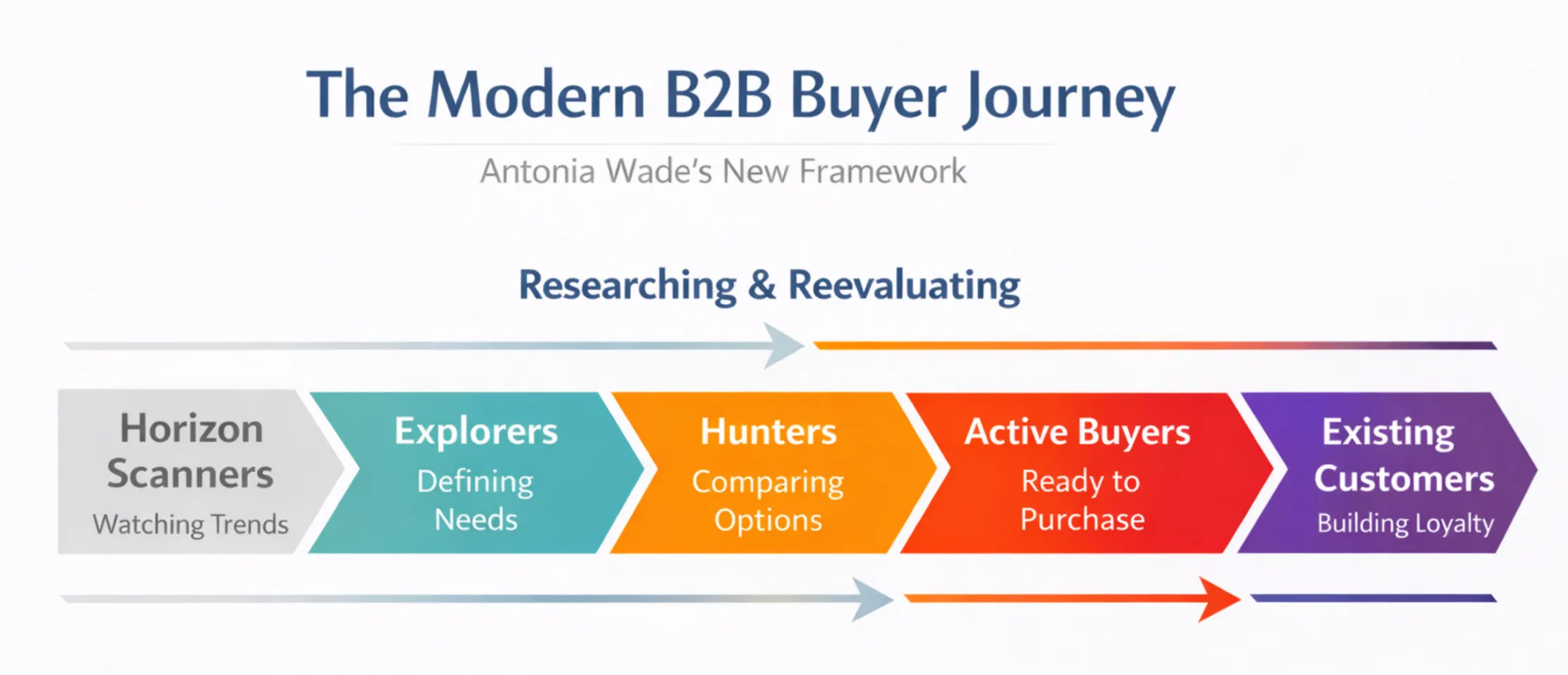
A Horizon Scanner is assessing opportunity and risk at a strategic level. They are asking whether a shift in direction is necessary. Presenting detailed integration diagrams or ROI spreadsheets at this stage is misaligned. The evidence may be accurate, but it answers questions they are not yet asking. Credibility here comes from informed perspective, industry context, and strategic framing.
An Explorer has acknowledged a challenge and is deciding whether action is required. They look for peer validation. Case examples from organisations facing similar pressures carry weight. They want to know whether others like them have navigated this transition successfully.
A Hunter understands the solution landscape. Scrutiny intensifies. Now quantified outcomes, structured comparisons, performance benchmarks, and tangible results become essential. General validation feels insufficient.
An Active Buyer is conducting due diligence. At this stage, credibility becomes granular. Security documentation, integration detail, financial modeling, procurement responses, and reference access determine whether the decision can withstand internal challenge.
An Existing Customer evaluates credibility through continuity. They look for evidence that performance persists and that expansion remains justified.
The common mistake is to flatten these stages into a single narrative of proof.
When early-stage buyers receive late-stage evidence, it overwhelms them. When late-stage buyers receive early-stage thought leadership, it frustrates them.
Credibility is not about the volume of validation. It is about alignment.
Belief develops progressively.
The Credibility Matrix
When we combine these two axes — role and readiness — credibility becomes a matrix.
A CFO acting as a horizon scanner requires a very different form of proof than a CFO conducting final-stage due diligence. A product user exploring options requires different evidence than a product user preparing to implement.
Most sales enablement materials collapse this matrix into a single sequence. The same demo. The same slides. The same proof points, regardless of who is watching and why.
This is not a storytelling failure. It is a design oversight. Credibility must be architected intentionally across both dimensions.
We see a great example of this in the Lovable website. The same narrative is packaged slightly differently depending on who they are trying to influence. Giving each role what they need to hear to take the next step in the buyer's journey.

Interactive Demos as Credibility Infrastructure
Interactive demos offer a structural solution to this design problem.
Because they are designed environments rather than linear presentations, they allow proof to be surfaced selectively. Persona-specific metrics can be foregrounded depending on entry point. Stage-appropriate evidence can be layered progressively.
A CFO entering at an exploratory stage may encounter strategic context and high-level economic impact. The same CFO in active procurement may be guided toward granular cost modeling and risk documentation.
A product user exploring the platform may experience workflow clarity and usability. The same user preparing for implementation may be shown integration depth and operational safeguards.
The product does not change. The evidence does.
When credibility is structured this way, belief accumulates rather than being asserted. Buyers encounter the proof required to justify their specific role and stage in the decision process.
Interactive demos, when designed intentionally, become more than explanatory tools. They become credibility infrastructure.
Case Study
In the accompanying video, I will examine a Stoylane interactive demo from DreamData that reflects this matrix in practice. Rather than presenting proof as a static appendix, it integrates persona-specific and stage-specific validation directly into the experience.
Storytelling in Sales Enablement
In modern B2B environments, persuasion does not collapse because value is unclear. Nor does it fail because relevance is absent. More often, it stalls because belief never fully forms.
Clarity explains what changes. Emotion explains why it matters. But explanation and relevance are not enough when decisions must survive scrutiny.
Complex buying processes are designed to test claims. Finance examines assumptions. Procurement evaluates risk. Leadership questions defensibility. What feels compelling in a demo must remain convincing in a boardroom. Improvement that cannot withstand examination does not progress.
This is why credibility cannot be treated as supporting material. It must be architected intentionally across both role and readiness. The proof shown to a product user is not the proof required by a CFO. The validation needed during exploration is not the same as the evidence demanded during due diligence.
When credibility is aligned with both dimensions, belief strengthens rather than erodes. The narrative does not rely on enthusiasm. It holds under pressure.
- Logic makes the change understandable.
- Emotion makes it meaningful.
- Credibility makes it believable.
But belief is not universal. It varies by role and by readiness.The proof that reassures a product user is not the proof that satisfies a CFO. The evidence that inspires exploration is not the evidence that closes a deal.
When credibility is designed across both dimensions, persuasion does not collapse under pressure. It strengthens as scrutiny increases.
That is the difference between telling a compelling story and building a defensible one.